 |
 630m And Recent Geomagnetic Activity
 28 September 2016 | by
High levels of geomagnetic activity have usually, but not always, been the kiss-off-death for LF/MF propagation.
These past few months have seen fairly regular field disturbances, often pushing the K index to a level '5' or higher. However, while usually attenuating the east-west and northerly polar paths, the Trans-Pacific path often seems to benefit from these events ... particularly last night.
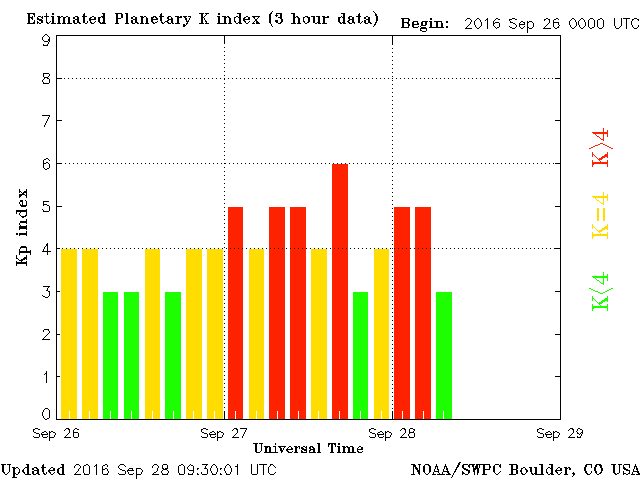
Perhaps it is related to the equinox's normal preference for this path or maybe the goop the sun is sending us at this point in the cycle is different or not as energetic as it is at mid-cycle. Nevertheless it's really encouraging to see that not all disturbances are detrimental to LF propagation.
For a daily summary of all overnight activity and much more, see KB5NJD's '630m Daily Reports'.
The WSPRnet map reproduced below shows the extent of reception during my own overnight WSPR 630m beaconing session. Missing are many of the normal spots from the eastern provinces and east coast states, indicating the attenuation on this path. Everything else seems enhanced.
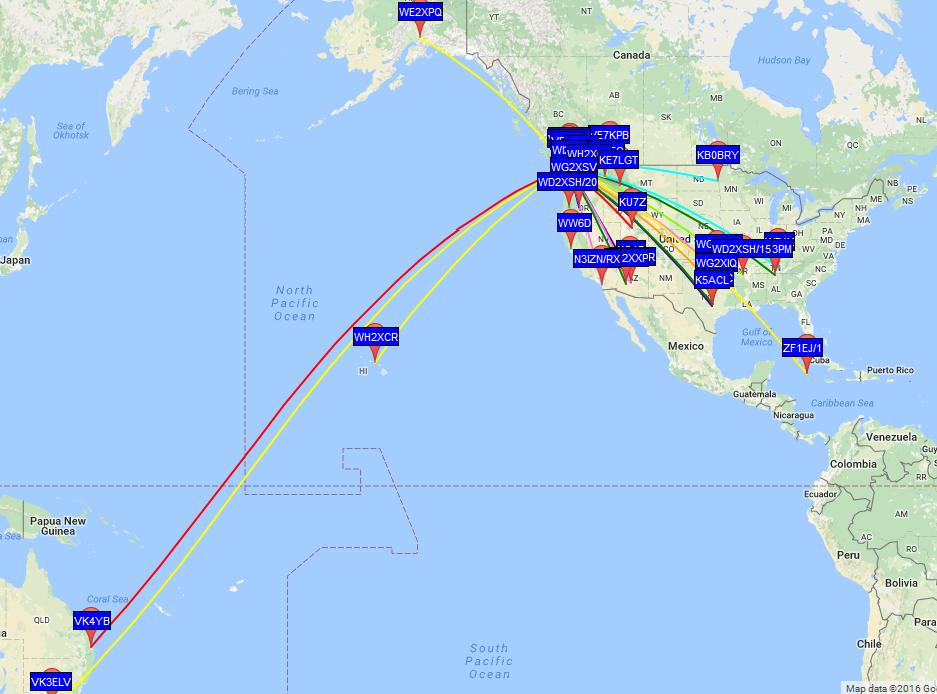 |
| courtesy: WSPRnet |
The path to down under, in-spite of my obstruction in that direction, perked-up as well, with VK4YB decoded here 19 times as well as VK3ELV's 150W and inverted-L near Wangaratta, Victoria.
13:56 VK4YB 0.4756 -28 QG62ku 11820
13:50 VK4YB 0.4756 -28 QG62ku 11820
13:44 VK4YB 0.4756 -24 QG62ku 11820
13:40 VK4YB 0.4756 -24 QG62ku 11820
13:30 VK4YB 0.4756 -27 QG62ku 11820
13:24 VK4YB 0.4756 -20 QG62ku 11820
13:18 VK4YB 0.4756 -24 QG62ku 11820
13:12 VK4YB 0.4756 -22 QG62ku 11820
12:42 VK4YB 0.4756 -26 QG62ku 11820
12:14 VK4YB 0.4756 -20 QG62ku 11820
12:02 VK4YB 0.4756 -23 QG62ku 11820
11:58 VK4YB 0.4756 -25 QG62ku 11820
11:52 VK4YB 0.4756 -25 QG62ku 11820
11:40 VK4YB 0.4756 -29 QG62ku 11820
11:32 VK4YB 0.4756 -26 QG62ku 11820
11:24 VK4YB 0.4756 -25 QG62ku 11820
11:12 VK4YB 0.4756 -22 QG62ku 11820
10:56 VK4YB 0.4756 -26 QG62ku 11820
10:54 VK4YB 0.4756 -25 QG62ku 11820
Merv, WH2XCR in Hawaii, was spotted here 56 times, with numerous transmissions at 'easy CW' levels. He even spotted me twice, with his 80m dipole, presently laying on the ground!
It was also encouraging to see 21 spots from Eden, ZF1EJ in the Cayman Islands, with several at CW levels.
The following stations all uploaded spots of my overnight WSPR signals, as nightly activity continues to grow with the DX season now at the doorstep. Given equal ERP, most of these stations would be workable on either CW or on JT9.
WH2XGP DN07dg 319 122
WG2XSV CN85sr 353 169
WI2XJQ CN87ts 138 150
NO1D DM34tn 1825 147
N3IZN/RX DM13ji 1796 161
WW6D CM88pl 1155 177
VE7CNF CN89ng 55 33
VA7MM CN89og 59 38
WE2XPQ BP51ip 2151 321
W5EMC EM10cl 2963 124
K5ACL EM10bd 2987 125
WG2XXM EM15lj 2610 115
ZF1EJ/1 EK99ig 4977 116
KE7LGT DN26xm 739 107
W3PM EM64or 3365 104
ZF1EJ EK99ig 4977 116
VE7KPB DN29cm 550 79
KU7Z DN41af 1227 129
WH2XCR BL11je 4295 236
KB0BRY EN17nc 1966 86
WD2XSH/20 CN83 598 178
WG2XIQ EM12 2841 120
WE4X EM65ut 3326 102
VE7BDQ CN89la 26 44
KB7W CN93jx 565 163
W6LEO DN17oq 498 103
WH2XAR DM33vp 1924 147
As interest in 630m continues to expand, many U.S. amateurs are already building their stations so they will be ready to go when the word finally comes. I suspect that 630m may soon sound like a small slice of 40m on a busy night ... will you be ready?
Steve McDonald, VE7SL, is a regular contributor to AmateurRadio.com and writes from British Columbia, Canada. Contact him at [email protected].
Tip: Use Snap Ring Pliers to Tighten a Loose HT Antenna Connection
 Got this great tip from Larry KG4ZAR:
Every ham seems to have a HT or two in their shack and sooner or later they find the rubber duck antenna loose.
Most times it’s the locking ring/nut on the chassis mount that’s worked loose. If you use one of the improved 1/4 wave aftermarket antennas, this becomes a more frequent problem.
Trying to tighten up this ring (especially on one of the Chinese radios) usually means grabbing a pair of needle nose pliers and making a mess of things, along with pinching your fingers when the pliers slip off the ring.
A much simpler way to tighten these rings is to purchase a cheap set of “snap ring pliers.” A set of these pliers (with various interchangeable tips) are under $10 at Harbor Freight and you’ll find many other uses once you own a set.
Matt Thomas, W1MST, is the managing editor of AmateurRadio.com. Contact him at [email protected].
The Spectrum Monitor — October, 2016
 Stories you’ll find in our October, 2016 issue:
LnR’s New LD-11: A Very Red, QRP, All-Mode, All-Band Transceiver
By Thomas Witherspoon K4SWL
LnR Precision, Inc., is a North Carolina-based company that specializes in antennas, straight-keys, and QRP transceivers. Earlier this year, when the company announced their latest QRP transceiver, the LD-11, Thomas Witherspoon was especially intrigued. The new LD-11 supports 160-10 meter operation with all modes (SSB, CW, CW-R, Digi, AM and FM). Find out why Thomas says its performance-for-price-point puts it in a market with some heavy-hitters like the venerable Yaesu FT-817ND, the Elecraft KX3, and the new Elecraft KX2.
The Slow Creep of Scanner Encryption
By Chris Parris
Those within the radio communications industry have been actively marketing the ability to encrypt the latest generations of business and personal radio communications fairly inexpensively. This trend follows one that has been on a steady march for years in the public safety communications industry, and it affects many more people than just scanner listeners. But why is this happening? Federal Wavelengths columnist, Chris Parris, takes a look at what encryption is, who is using it and how it affects all of us in the radio monitoring hobby.
Monitoring Russia’s Northern Fleet
By Tony Roper
In its current form, the Northern Fleet is still the largest in the Russian navy, consisting of approximately 80 warships, half of which are submarines, as well as this number again in service ships, tugs and icebreakers. Longtime military monitor, Tony Roper, shows us how he monitors the activities of this fleet through Morse code transmissions directly from the ships as well as using Web-based tools, such as Google Earth, and webcams to physically see the ships in action.
GMRS –The ‘Other’ Citizens Band – Part 2
By Cory GB Sickles WA3UVV
GMRS is a fun and useful aspect of Part 95 communications, seemingly as far removed from Class D CB as you can possibly get. And, while GMRS can be enjoyed without repeaters, having a well-placed and performing machine in your area makes it even more so. In this installment, Cory explains the hardware needed to set up such a repeater; how to start a local GMRS club, what the likely costs of will be, and he takes a looks a some successful GMRS clubs in different parts of the US.
The Hams Behind the Fender Guitar Legend
By Richard Fisher KI6SN
Gary Gray W6DOE’s Uncle Leo became a ham in about 1931 or ’32. “I’m not sure he ever renewed his license,” Gary told Richard Fisher in an interview. “He was most likely on the air using CW . . . There wasn’t much phone back then. He did a lot of electronic work as a ham.” One of the things Leo Fender, who held the first W6DOE call, recounted to Gary was how he started a career in audio by building amplifiers for public address systems. The rest, as they say, is musical history. With meticulous attention to musical and electronic detail, the Fender guitar and amplifier legend was born.
Scanning America
By Dan Veenaman
Howard County, Indiana and Monitoring Airborne TETRA
Federal Wavelengths
By Chris Parris
Scanning Smaller Federal Agencies
Utility Planet
By Hugh Stegman NV6H
US DGPS: Bad News and Good News
Digital HF: Intercept and Analyze
By Mike Chace-Ortiz AB1TZ/G6DHU
Getting Started with Digital GPS Decoding
HF Utility Logs
By Mike Chace-Ortiz and Hugh Stegman
Digitally Speaking
By Cory Sickles WA3UVV
Still in the Box? Put it on the Air!
VHF and Above
By Joe Lynch N6CL
Earth-Moon-Earth Communications
Amateur Radio Insights
By Kirk Kleinschmidt NT0Z
Radio Fun with an Uncooperative Ionosphere
Radio 101
By Ken Reitz KS4ZR
Obsessing about Awards and School Club Roundup
Radio Propagation
By Tomas Hood NW7US
Space Weather: Interfering with Global Positioning Satellites
The World of Shortwave Listening
By Andrew Yoder
Halloween Shortwave Pirates and Global Pirate Weekend
The Shortwave Listener
By Fred Waterer
Listening to Shortwave and Internet Radio
Maritime Monitoring
By Ron Walsh VE3GO
Stormy WX and an End to Some DGPS
The Longwave Zone
By Kevin O’Hern Carey WB2QMY
WSPRs on the Band
Adventures in Radio Restoration
By Rich Post KB8TAD
The Triple-Conversion Puzzle: Hammarlund HQ-180A
Antenna Connections
By Dan Farber AC0LW
Tools of the Trade: Antenna Work Essentials
Radio Horizons
New Digital Radio Mondiale Receiver
The Spectrum Monitor is available in PDF format which can be read on any desktop, laptop, iPad®, Kindle® Fire, or other device capable of opening a PDF file. Annual subscription is $24. Individual monthly issues are available for $3 each.
Ken Reitz, KS4ZR, is publisher and managing editor of The Spectrum Monitor. Contact him at [email protected].
Ham College 21
In this episode we conclude discussing Noise and Interference, and begin covering Schematics.
56:24
George Thomas, W5JDX, is co-host of AmateurLogic.TV, an original amateur radio video program hosted by George Thomas (W5JDX), Tommy Martin (N5ZNO), Peter Berrett (VK3PB), and Emile Diodene (KE5QKR). Contact him at [email protected].
Success!
Great moment this afternoon when the Automatic Loop Controller fired up as it should. Happy days.

When I first fired it up, after loading up the Arduino program, all I could see was a dull green glow on the screen. It wasn’t until I remembered a comment from another builder about adjusting the potentiometer on the PCB that controls the LCD contrast.
It was a great relief that my slow and deliberate build – double checking all component values and joints – paid off. Next step is to build the SWR bridge and connect to the stepper motor on the loop.
The Amazing BOG
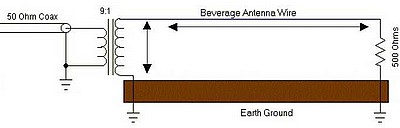 |
| courtesy: http://www.wd0m.com/antennas1.html |
A recent inquiry about 'BOG' antennas on the topband reflector reminded me of my own experiences with this simple yet very effective antenna. A 'BOG' or 'Beverage On Ground' seems to come in many varieties and is usually, out of necessity, shorter than a 'real' beverage.
In many instances, BOGs are as simple as running a wire out on the ground as long and as straight as practical. Not always, but usually, the BOG is fed by a small homemade balun to isolate and match the impedance to a 50 ohm feedline. Most real Beverages are terminated at the far end with a resistor to ground, while for BOG builders, some use it and some don't.
My own experience with a BOG, or as close as I could come to one, was an extension of my 160m half-sloper. The topband half-sloper was quite normal, being about 132' long and fed at the top of its supporting metal tower with 50 ohm coax ... the hot-side of the coax going to the wire and the shield going to the metal tower.
One afternoon I wondered how the antenna would work lower in frequency, in the NDB band below the broadcast band, if I were to extend the sloping 132' element further. I added another length of wire to the lower end and proceeded to run the wire along the ground on the bankside above the beach. I was able to run out another 500' approximately, in a straight line to the east, before running out of beach. I left the far end unterminated and waited for darkness to to have a listen.
The first thing I noticed when tuning the NDB band was how quiet it sounded. There seemed to be almost no noise, man-made or nature-made. Disconnecting the antenna showed a small drop in what little noise there was, indicating that sensitivity levels were still being determined by skynoise ... a good thing.
What amazed me however, was that signals just popped-up everywhere and although not as strong as on my normal NDB antenna (a loop at the time), they were much better copy since there was virtually no noise. The BOG produced a significant improvement in my SNR on all signals. It had been several months since I had logged any new beacons on the NDB band but over the next three weeks I was able to put 65 new catches in the log ... all previously unheard! Switching between the loop and the BOG almost always produced no copy at all on the new signals, compared to an easily copied one on the BOG.
My experience was very similar to that shown in these videos by VO1HP ... with solid signals well out of the low noise background and no sign of atmospheric noise to mask them.
It is clearly evident that the BOG delivers a much better SNR than the comparison loop and is the reason so many topbanders use a separate antenna for receiving. The next video compares the BOG with a 160m 'Inverted-L', a very popular antenna on topband.
BOGs need not be really long and good results can be had with just 200' of wire. Many BOG users employ a simple preamp to boost the low level of signal but often the switchable 'preamp' built into a receiver or transceiver will be enough to overcome the low gain of shorter wires.
I've often thought that if I had a lot of acreage, the ideal receiving system for MF and LF work would be a centrally located radio shack with long Beverage wires fed-out in various directions ... like the spokes of a wheel. Having the ability to directionally switch antennas would produce 'beam-like' capabilities on LF.
There is a ton of web information available on the BOG and the Beverage should you want to give this simple antenna a try and have a narrow strip of space where one might be laid out without causing a problem.
A very comprehensive source of BOG and Beverage information can be found on WØBTU's Beverage Receiving Antennas page here.
A nice compilation of Beverage / BOG exchanges from the Topband Reflector may be found on N1EU's Beverage Antenna Tips page here.
In addition, N1EU has a useful page of discussion about transformers used in these antennas.
PA5MW offers a colorful description of his own BOG experience here.
Bruce, K1FZ has a nice BOG 'hint's' page here and also passed this advise to the original BOG inquiry:
A BOG can do a good job unterminated. If too long they self terminate. Depends upon the soil as to length.
The biggest mistake is making the BOG antenna too long. Try not to go
over 200 feet for 160 meters. Longer will work in some locations
soil like desert, sand, other non/ partial conducting types.
Its been a few years since my last experience with a BOG but I may run one out again for the DX season, now that most of my neighbours have left the island for the winter.
Steve McDonald, VE7SL, is a regular contributor to AmateurRadio.com and writes from British Columbia, Canada. Contact him at [email protected].
Weekly Propagation Summary – 2016 Sep 26 16:10 UTC
Here is this week’s space weather and geophysical report, issued 2016 Sep 26 0103 UTC.
Highlights of Solar and Geomagnetic Activity 19 – 25 September 2016
Solar activity reached low levels this period due to isolated C-class flare activity. Region 2595 (N11, L=099, class/area=Dao/120 on 20 Sep) was the most productive region this period. In addition to multiple low-level C-class flares Region 2595 produced the largest event of the period, a C5 flare at 22/0547 UTC. Region 2597 (S13, L=349, class/area=Dsc/120 on 24 Sep) developed late in the week and produced an isolated C1 flare at 25/1914 UTC in addition to numerous B-class flares. No Earth-directed coronal mass ejections were observed this period.
No proton events were observed at geosynchronous orbit.
The greater than 2 MeV electron flux at geosynchronous orbit reached high levels on 21 Sep, moderate levels on 22-23 Sep, and was at normal levels throughout the remainder of the period.
Geomagnetic field activity reached G1 (Minor) geomagnetic storm levels on 20 Sep with active levels observed on 21 Sep in response to the influence of a negative polarity coronal hole high speed stream. G1 (Minor) storm levels were observed again on 25 Sep due to prolonged periods of southward interplanetary magnetic field orientation. Quiet conditions were observed on 22-24 Sep and quiet to unsettled levels were observed on 19 Sep under a background solar wind environment.
Forecast of Solar and Geomagnetic Activity 26 September – 22 October 2016
Solar activity is expected to be at very low levels throughout the period with a chance for C-class flare activity.
No proton events are expected at geosynchronous orbit.
The greater than 2 MeV electron flux at geosynchronous orbit is expected to be very high on 02 Oct with high levels expected on 29 Sep-01 Oct, 03-11 Oct, and 18 Oct following periods of an enhanced solar wind environment associated with coronal hole high speed stream influence. Normal and normal to moderate flux levels are expected throughout the remainder of the period.
Geomagnetic field activity is likely to reach G2 (Moderate) geomagnetic storm levels on 28-30 Sep and G1 (Minor) storm levels on 26 Sep, 01-02 Oct, and 17 Oct due to the anticipated influence of multiple, recurrent coronal hole high speed solar wind streams. Active conditions are expected on 27 Sep, 03 Oct, and 18 Oct with generally quiet and quiet to unsettled conditions likely throughout the remainder of the period.
Don’t forget to visit our live space weather and radio propagation web site, at: http://SunSpotWatch.com/
Live Aurora mapping is at http://aurora.sunspotwatch.com/
If you are on Twitter, please follow these two users: + https://Twitter.com/NW7US + https://Twitter.com/hfradiospacewx
Get the space weather and radio propagation self-study course, today. Visit http://nw7us.us/swc for the latest sale and for more information!
Check out the stunning view of our Sun in action, as seen during the last five years with the Solar Dynamics Observatory (SDO): https://www.youtube.com/watch?v=zXN-MdoGM9g
We’re on Facebook: http://NW7US.us/swhfr
Visit, subscribe: NW7US Radio Communications and Propagation YouTube Channel
 Ham Radio Deluxe |
 W5SWL Electronics |
 Ham Radio Prep |
 KB3IFH QSL Cards  Hip Ham Shirts  HamRadioAuctions HamRadioAuctions Reliance Antennas Reliance Antennas Enigma Shop Enigma Shop |  morseDX  Ni4L Antennas  R&L Electronics R&L Electronics antennas.us antennas.us QRV QRV |
- Matt W1MST, Managing Editor
