 |
 Pacific Seafarer’s Net Assists in Rescue of Sailors on Sinking Sailboat
 11 October 2016 | by
 A great story sent by David Richer, WB6VGO about how amateurs helped rescue a sinking vessel in the Pacific.
Excellent work!
On September 28, 2016 at approximately 0300 UTC, Charles Houlihan, KD6SPJ, a net relay relay station for the Pacific Seafarer’s net while monitoring 14.300 received a call for assistance from the captain of the Sailing Vessel (SV) Rafiki. The captain reported that the SV Rafiki, a 35 foot sailing vessel, was taking on water. Charles who was the captain of the SV Jacaranda and located at sea, contacted Randy VanLeeuwen, KH6RC also a net relay and located in Hawaii. Randy contacted the US Coast Guard Station to report the incident and provide Rafiki’s location, 230 miles south of Cold Bay, Alaska.
Randy remained in constant radio contact with the Rafiki until contact with lost. Fred Moore W3ZU (Florida) and Peter Mott, ZL1PWM (New Zealand) additional net relays maintained contact with the captain of the Rafiki until the arrival of the Coast Guard the subsequent rescue.
According to a press release issued by the United States Coast Guard Station–17th District, a Coast Guard Air Station Kodiak MH-60 Jayhawk helicopter and an Air Station Kodiak HC-130 Hercules were dispatched to the Rafiki’s last reported position. Upon arrival the crew of the Jayhawk helicopter were successfully able to hoist the captain and one additional crew member to safety aboard the helicopter.around 1000 hours UTC. Both men were reported to be uninjured. The vessel was abandoned.
This real-life incident happened during the daily “roll-call” conducted by the amatuer radio operators (or “hams”) and members of the Pacific Seafarers Net. Everyday at 0300 UTC amateur radio operators from North America, Hawaii, New Zealand and Australia monitor the progress of maritime amateur radio operators who are sailing on the Pacific.
Prior to the start of the roll call for “maritime mobile” vessels, a call for medical, emergency or priority traffic is broadcasted. It was after such a call for any emergency traffic that the call for assistance from the Rafiki was received.
According the the net’s website (www.pacseanet.com): “The Pacific Seafarer’s Net is a network of volunteer Amateur Radio Operators that handles radio and internet email communication traffic between sailing and motoring vessels operating on all oceans and land-based parties. The land station Net Control Amateur Stations are located in various locations throughout the Continental United States, Hawaii, Australia and New Zealand. Communications traffic consists of daily position reporting and automatic posting of positions on several websites, message handling via email relays, Health and Welfare traffic, phone patch services, search and rescue coordination, and vessel equipment inventories for search and rescue operations. Life threatening emergencies are taken from any vessel whether or not they have ham radio licenses. Net control stations keep computer databases on participating vessels and their movements throughout the oceans.”
Matt Thomas, W1MST, is the managing editor of AmateurRadio.com. Contact him at [email protected].
Weekly Propagation Summary – 2016 Oct 10 16:10 UTC
Here is this week’s space weather and geophysical report, issued 2016 Oct 10 0105 UTC.
Highlights of Solar and Geomagnetic Activity 03 – 09 October 2016
Solar activity was at very low levels with a few background flares observed from Regions 2598 (N14, L=174, class/area Dai/140 on 07 Oct), 2599 (S14, L=144, class/area Cko/460 on 05 Oct) and 2600 (N13, L=105, class/area Cso/110 on 09 Oct). On 08 Oct, between 08/1500-1700 UTC, a 10 degree long filament erupted in the NE quadrant centered near N38E40. A slow-moving, asymmetric, partial-halo CME was observed in LASCO C2 imagery, first visible at 09/0048 UTC.
No proton events were observed at geosynchronous orbit.
The greater than 2 MeV electron flux at geosynchronous orbit was at high levels during the entire summary period. A maximum of 32,138 pfu was observed at 03/1640 UTC.
Geomagnetic field activity was highlighted by mostly unsettled to active levels on 03-05 Oct. An isolated minor storm (G1-Minor) period was observed early on 04 Oct. Mostly quiet levels were observed from 04-09 Oct with isolated unsettled and active periods were observed early on 07 and 08 Oct, respectively. The enhanced geomagnetic activity was due to high speed winds from a recurrent positive polarity coronal hole. Some further enhancement occurred early on 04 Oct due to CME effects from an eruptive filament observed early on 01 Oct.
The solar wind environment began the period at about 500 km/s, increased to near 600 km/s midday on 04 Oct and slowly decreased to end the period at about 370 km/s. Total field generally ranged from 2-6 nT with a peak of 10 nt observed midday on 04 Oct. The Bz component was mostly variable between +/- 6 nT. Phi angle was in a general positive orientation throughout the period.
Forecast of Solar and Geomagnetic Activity 10 October – 05 November 2016
Solar activity is expected to be at very low levels with a chance for C-class flare activity throughout the outlook period.
No proton events are expected at geosynchronous orbit.
The greater than 2 MeV electron flux at geosynchronous orbit is expected to be at high levels on 10-11, 16-18, 24-26, 30-31 Oct and 01-06 Nov increasing to very high levels on 27-29 Oct. This is due to the anticipated influence of multiple, recurrent CH HSSs. Normal to moderate levels are expected for the remainder of the outlook period.
Geomagnetic field activity is expected to be at unsettled to active levels on 11-18, 23-31 Oct and 01 Nov. G1 (Minor) field activity is possible on 13-15, 17 and 23-31 Oct with G2 (Moderate) levels possible on 24-26 Oct. This activity is due to the anticipated influence of multiple, recurrent CH HSSs. Additional enhancement to the field is expected on 13-14 Oct due to CME effects from the 08 Oct filament eruption. Generally quiet to unsettled conditions are expected for the remainder of the outlook period.
Don’t forget to visit our live space weather and radio propagation web site, at: http://SunSpotWatch.com/
Live Aurora mapping is at http://aurora.sunspotwatch.com/
If you are on Twitter, please follow these two users: + https://Twitter.com/NW7US + https://Twitter.com/hfradiospacewx
Get the space weather and radio propagation self-study course, today. Visit http://nw7us.us/swc for the latest sale and for more information!
Check out the stunning view of our Sun in action, as seen during the last five years with the Solar Dynamics Observatory (SDO): https://www.youtube.com/watch?v=zXN-MdoGM9g
We’re on Facebook: http://NW7US.us/swhfr
Visit, subscribe: NW7US Radio Communications and Propagation YouTube Channel
LHS Episode #177: Cherbyl the Witch
 It's time for Episode #177 of the Linux in the Ham Shack podcast. In this episode, your tired and slightly confused hosts tackle craziness in Australia, digital voice on the DV4Home, things powered by Linux you might not expect to be, Microsoft and GitHub, $5 SBCs, a new Linux kernel release, TQSL and much more. Thank you for stopping by to check out our problem. We hope you enjoy. If you do--or even if you don't--please take a moment and send us some feedback. We'd love to hear from you.
73 de The LHS Crew
Russ Woodman, K5TUX, co-hosts the Linux in the Ham Shack podcast which is available for download in both MP3 and OGG audio format. Contact him at [email protected].
Do they have to be LOUD to work them????
 |
| Learning a QRP lesson |
1. He was in and out right at the noise floor.
2. He was not at the QRP watering hole so he was running most likely some kind of QRO power.
3. What chance did my QRP 5 watt signal have if I could barely hear QRO signal?
When RA3XM stopped calling CQ I threw my call out there and can you believe he came back to me on my first call!! I was shocked that I made the distance, it was not a long QSO but I did get a 559 signal report and I passed along to him a signal report, my name and that I was running QRP. It became crystal clear to me of something I read on more than one occasion from seasoned QRP op's....you may come across signals that are in and out of the mud, don't short change yourself ( I have done so on many occasions) thinking "they are QRO and in the mud they are never going to hear my peanut signal. Instead throw your call out there and you may be surprised......and when RA3XM came back to me from the noise I was surprised and pleased to make the contact. Spinning the dial once again I hear AN400R booming in (Spanish special event station) I gave him a call and and made that contact as well. On this outing it was not as simple as calling and making a contact there was F6EJN, DK7OB, AN400C, IT9RZU, MI0GH and AN400C all who I called and was not heard. A valuable lesson was learned on this outing.....even if the station calling CQ is in the mud give them a call and you (I was) may be surprised they come back to you.
Mike Weir, VE9KK, is a regular contributor to AmateurRadio.com and writes from New Brunswick, Canada. Contact him at [email protected].
Do they have to be LOUD to work them????
|
| Learning a QRP lesson |
1. He was in and out right at the noise floor.
2. He was not at the QRP watering hole so he was running most likely some kind of QRO power.
3. What chance did my QRP 5 watt signal have if I could barely hear QRO signal?
When RA3XM stopped calling CQ I threw my call out there and can you believe he came back to me on my first call!! I was shocked that I made the distance, it was not a long QSO but I did get a 559 signal report and I passed along to him a signal report, my name and that I was running QRP. It became crystal clear to me of something I read on more than one occasion from seasoned QRP op's....you may come across signals that are in and out of the mud, don't short change yourself ( I have done so on many occasions) thinking "they are QRO and in the mud they are never going to hear my peanut signal. Instead throw your call out there and you may be surprised......and when RA3XM came back to me from the noise I was surprised and pleased to make the contact. Spinning the dial once again I hear AN400R booming in (Spanish special event station) I gave him a call and and made that contact as well. On this outing it was not as simple as calling and making a contact there was F6EJN, DK7OB, AN400C, IT9RZU, MI0GH and AN400C all who I called and was not heard. A valuable lesson was learned on this outing.....even if the station calling CQ is in the mud give them a call and you (I was) may be surprised they come back to you.
Mike Weir, VE9KK, is a regular contributor to AmateurRadio.com and writes from New Brunswick, Canada. Contact him at [email protected].
The GØMRF Class-D 630m Transmitter
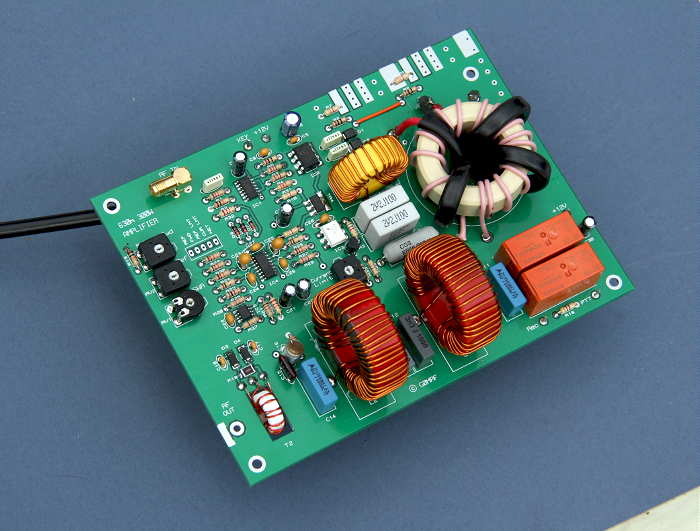 |
| courtesy: www.g0mrf.com/ |
Dave, GØRMF, long time LF proponent and ardent home-brewer has recently posted construction details of his new 630m transmitter.
It is a readily reproducible design that may be of interest to those looking for a transmitter capable of developing full ERP power output.
From Dave's description:
This amplifier is based on the ‘300W Class D Transmitter for 136kHz’ published by the RSGB in Radio Communication and reproduced in the LF Experimenters Handbook by Peter Dodd G3LDO.
This circuit, updated and modified for 630m, uses 2 MOSFETs in push pull driven by square-waves from a CMOS D-type flip flop. The power can be varied from around 25 to 300W by increasing the supply voltage over a 12 to 32V range. Circuits are included to protect against excessive supply current and high reflected RF power.
The amplifier is suitable for any non-linear mode. Examples include CW, QRSS, WSPR, JT-9, JT-65 and FSK.
The circuit has been built on a dedicated double-sided PCB measuring 164 x 120mm. For ease of construction 90% of the components are leaded but it has been necessary to use a few surface mount devices as the normal DIP versions of some ICs are increasingly difficult to find.
In many respects, this circuit is similar to my own homebrew transmitter which can be used on both 630 and 2200m. Although Dave has built his circuit on double-sided PCB, the project would be equally at home on one-sided board or even constructed 'Manhattan' style, the method I chose. This latter style lends itself to easy component swapping to optimize circuit performance.
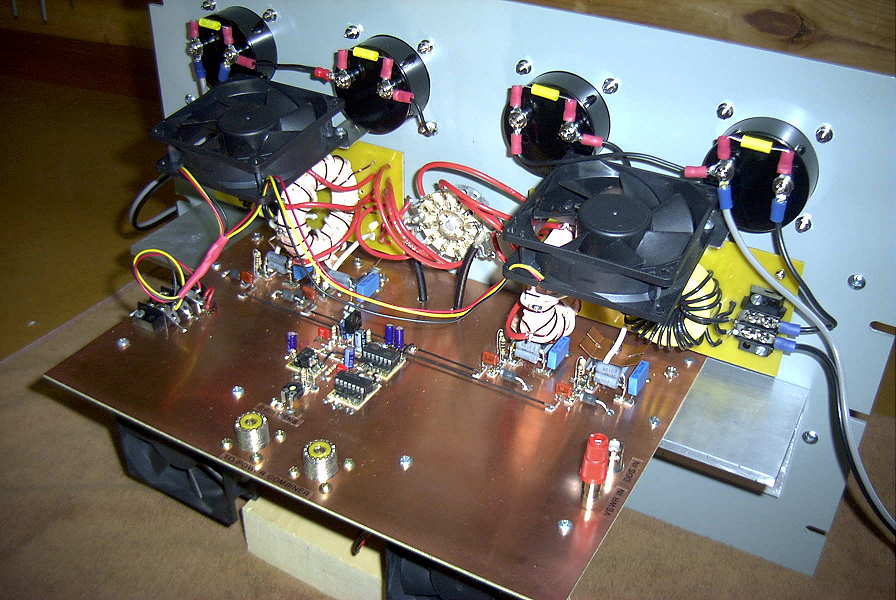 |
| VE7SL 2200m / 630m Manhattan-style Transmitter |
In addition, Dave's website contains several interesting circuits that might be of interest to those getting started on 630m.
Steve McDonald, VE7SL, is a regular contributor to AmateurRadio.com and writes from British Columbia, Canada. Contact him at [email protected].
Amateur Radio Weekly – Issue 128

ARES responds to Hurricane Matthew
ARES volunteers in Florida, Georgia, and the Carolinas are helping or gearing up to support communication during the response to Hurricane Matthew.
ARRL
Frequencies in use in conjunction with Hurricane Matthew response
Please avoid interfering with these frequencies, and do not check into any emergency nets unless you genuinely have something of importance to contribute.
ARRL
How to use Amazon Echo in Ham Radio
Putting the voice activated computers on line, we can send voice commands followed by DTMF and access the Internet directly.
Southgate
Circular SWR ruler
This tool can calculate gain, loss, SWR and return loss in a second with enough precision for most amateur works.
TK5EP
Catching CubeSat chatter? There’s an app for that!
Estévez’s gr-satellites project provides a collection of applications to decode satellite telemetry.
The Register
What I pack for the Chicago Marathon
For the fourth year, I will be part of the Medical Communication Team at the Chicago Marathon this weekend.
N4AE
An end fed halfwave antenna for portable ops
My main reason for not putting much effort into portable operation is that when I go out into nature, I want to enjoy my surroundings and not be distracted by radios.
AA7EE
Inverter generators: What you need to know
Inverter generators convert the high frequency, three phase AC into DC current via a solid state rectifier, and from there the electricity goes into a conventional 60 Hz.
Off Grid Ham
American Morse Code
American Morse Code was first used on the Baltimore-Washington telegraph line, a telegraph line constructed between Baltimore, Maryland, and the old Supreme Court chamber in the Capitol building in Washington, D.C.
Wikipedia
Video
12V battery performance comparison
Sealed Lead Acid vs A123 and Bioenno LiFePO4
KF7IJZ
Amateur Radio Weekly is curated by Cale Mooth K4HCK. Sign up free to receive ham radio's most relevant news, projects, technology and events by e-mail each week at http://www.hamweekly.com.
 Ham Radio Deluxe |
 W5SWL Electronics |
 Ham Radio Prep |
 KB3IFH QSL Cards  Hip Ham Shirts  HamRadioAuctions HamRadioAuctions Reliance Antennas Reliance Antennas Enigma Shop Enigma Shop |  morseDX  Ni4L Antennas  R&L Electronics R&L Electronics antennas.us antennas.us QRV QRV |
- Matt W1MST, Managing Editor
