 |
 Amateur Radio Weekly – Issue 136
 3 December 2016 | by
SSTV active from ISS December 8-9
The SSTV images will be transmitted as part of the MAI-75 Experiment on 145.800 MHz FM using the Kenwood TM-D710 transceiver located in the Russian ISS Service module.
AMSAT UK
Last call to press for Senate passage of Amateur Radio Parity Act
The House of Representatives approved the bill in September, and the Senate must follow suit if the bill is to succeed.
ARRL
Hurricane Center on air for SKYWARN Recognition Day
WX4NHC at the National Hurricane Center in Miami will participate in SKYWARN Recognition Day (SRD) on Saturday, December 3.
ARRL
Santa Net 2016
Every year on 3916, we give good little boys and girls a chance to talk to Santa Claus at the North Pole!
The 3916 Nets
2 element dual-rectangle beam for 70cm
The antenna described here is a direct-connect dual-rectangle beam for use on 70 cm between 440 and 450 MHz.
jedsoft.org
Easy homemade Outernet antenna
An antenna for less than $1 total cost, doable without power tools and soldering, in less than 30 minutes.
Radio for Everyone
Emergency preparedness on the road
If it is required that I spend the night away from home for whatever the situation, I am prepared, as I carry all the required gear that will keep me safe if I become stranded.
VE6AB
A review of the Elecraft KX2 general coverage QRP transceiver
The KX2 is a feature-rich pocket QRP transceiver. For those who are familiar with the Elecraft product line, it’s like a KX3 (feature rich portable rig) in a KX1-sized (much smaller, handheld/pocket) package.
The SWLing Post
Looking back at Cycle 23
Cycle 23 was a much bigger cycle with higher sunspot numbers than Cycle 24.
NY4G
Disturbing the peace: Can America’s quietest town be saved?
There’s a town in West Virginia where there are tight restrictions on mobile signal, wifi and other parts of what most of us know as simply: modern life.
BBC
Special event
Members of the ‘Battleship Iowa Amateur Radio Association’ (BIARA) will be active as NI6BB between 1600-2359z on Wednesday, December 7th, in memory of the 75th anniversary of the attack on Pearl Harbor in 1941.
Southgate
Video
How to set up an Outernet receiver
Outernet continuously sends out useful data like weather reports, news, APRS data as well as files like Wikipeda pages, images, videos and books.
RTL-SDR.com
Amateur Radio Weekly is curated by Cale Mooth K4HCK. Sign up free to receive ham radio's most relevant news, projects, technology and events by e-mail each week at http://www.hamweekly.com.
Mailbox, Coffee And The ‘Stew’

Recent mail has brought two nice surprises. As I am preparing for this weekend's ARRL 160m CW affair, a certificate from the ARRL arrived ... from last year's 160m CW Contest!
It seemed that I had somehow stumbled into top score from VE7 land for the single-op, low power division and since I haven't seen a QST in decades, this came as a complete surprise.
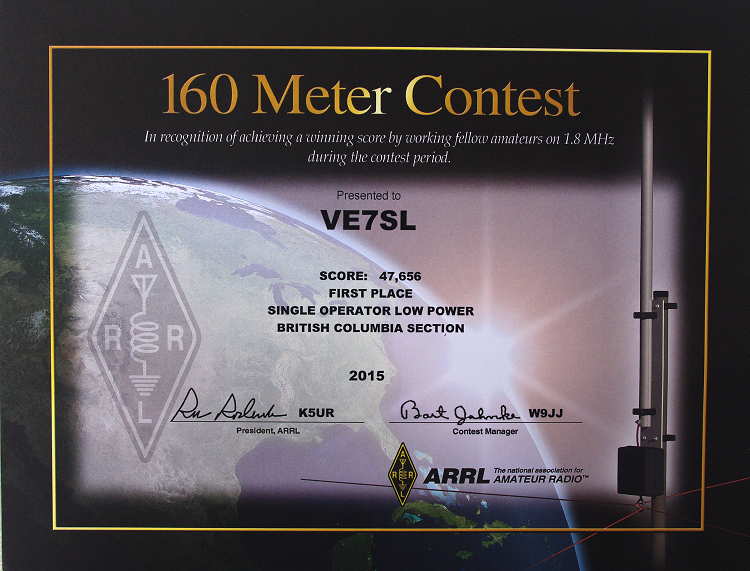
Over the years I've always tried to test the 160m waters at contest time just in case conditions are amazingly good ... which they haven't particularly been for the past few years of solar angst. Even piddly Cycle 24, for most of its lifespan, has proven powerful enough to mess up the Topband.
The 160 contest I enjoy the most is the December Stew Perry. It's the only one that's scored fairly and QSO points are determined by distance. Compared to working something close, any of the east coast grids from out west will get you a sack-load of points ... anything off continent earns you a boat-load. My strategy in the Stew has always been to 'search & pounce' the FN and FM grids for their high value point reward. If I had more late-night staying power in any of these affairs I could probably do a better job but I've found my fondness for the warm fleece-sheeted bed beckoning earlier each year. I'm sure it has nothing to do with getting older ... right?
I honestly don't know how some guys, much older than myself, can hang in there 'til dawn. Maybe it's coffee, which would certainly do it for me. If I even look at a coffee after the noon hour, I'm still counting sheep past midnight. A late night contest-coffee for me would guarantee no sleep until the following night unfortunately.
The second surprise was a nice QSL from Mark, WA9ETW in Wisconsin, confirming our recent crossband QSO ... 630m to 80m CW. Notice Mark's receiving antenna used on 630m, just a 100' wire about 15' off the ground! It doesn't take much to hear domestic signals on 630m so if you already have the WSPR software installed and are familiar with its operation, why not set your receiver to 474.200 in USB mode and see what you can hear. There are stations from coast to coast beaconing every night on this band. Be sure to set your software to upload your decodes to the WSPRnet site so that everyone, especially the beacon operators, can see who you are hearing.
If we worked in the recent 630m crossband event and you'd like a card, please let me know ... I'll be happy to put one in the mail for you.

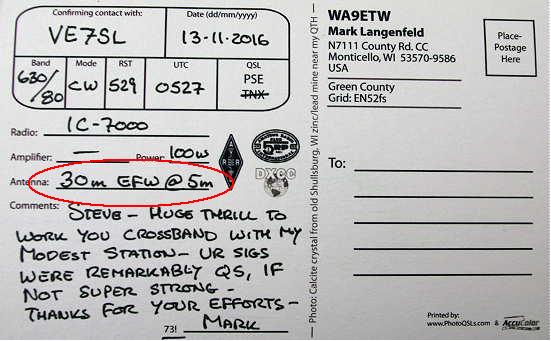
How I do wish that the FCC would get on with it and legalize the 630m band in the U.S.A. Hopefully the turnovers in Washington will not translate into further delays as is often the case when big governmental changes are in the works. In the meantime, hopefully we can at least work each other in the ARRL CW 160 this weekend!
Steve McDonald, VE7SL, is a regular contributor to AmateurRadio.com and writes from British Columbia, Canada. Contact him at [email protected].
Mailbox, Coffee And The ‘Stew’
Recent mail has brought two nice surprises. As I am preparing for this weekend's ARRL 160m CW affair, a certificate from the ARRL arrived ... from last year's 160m CW Contest!
It seemed that I had somehow stumbled into top score from VE7 land for the single-op, low power division and since I haven't seen a QST in decades, this came as a complete surprise.
Over the years I've always tried to test the 160m waters at contest time just in case conditions are amazingly good ... which they haven't particularly been for the past few years of solar angst. Even piddly Cycle 24, for most of its lifespan, has proven powerful enough to mess up the Topband.
The 160 contest I enjoy the most is the December Stew Perry. It's the only one that's scored fairly and QSO points are determined by distance. Compared to working something close, any of the east coast grids from out west will get you a sack-load of points ... anything off continent earns you a boat-load. My strategy in the Stew has always been to 'search & pounce' the FN and FM grids for their high value point reward. If I had more late-night staying power in any of these affairs I could probably do a better job but I've found my fondness for the warm fleece-sheeted bed beckoning earlier each year. I'm sure it has nothing to do with getting older ... right?
I honestly don't know how some guys, much older than myself, can hang in there 'til dawn. Maybe it's coffee, which would certainly do it for me. If I even look at a coffee after the noon hour, I'm still counting sheep past midnight. A late night contest-coffee for me would guarantee no sleep until the following night unfortunately.
The second surprise was a nice QSL from Mark, WA9ETW in Wisconsin, confirming our recent crossband QSO ... 630m to 80m CW. Notice Mark's receiving antenna used on 630m, just a 100' wire about 15' off the ground! It doesn't take much to hear domestic signals on 630m so if you already have the WSPR software installed and are familiar with its operation, why not set your receiver to 474.200 in USB mode and see what you can hear. There are stations from coast to coast beaconing every night on this band. Be sure to set your software to upload your decodes to the WSPRnet site so that everyone, especially the beacon operators, can see who you are hearing.
If we worked in the recent 630m crossband event and you'd like a card, please let me know ... I'll be happy to put one in the mail for you.
How I do wish that the FCC would get on with it and legalize the 630m band in the U.S.A. Hopefully the turnovers in Washington will not translate into further delays as is often the case when big governmental changes are in the works. In the meantime, hopefully we can at least work each other in the ARRL CW 160 this weekend!
Steve McDonald, VE7SL, is a regular contributor to AmateurRadio.com and writes from British Columbia, Canada. Contact him at [email protected].
An SWR anomaly….that suddenly popped up!!
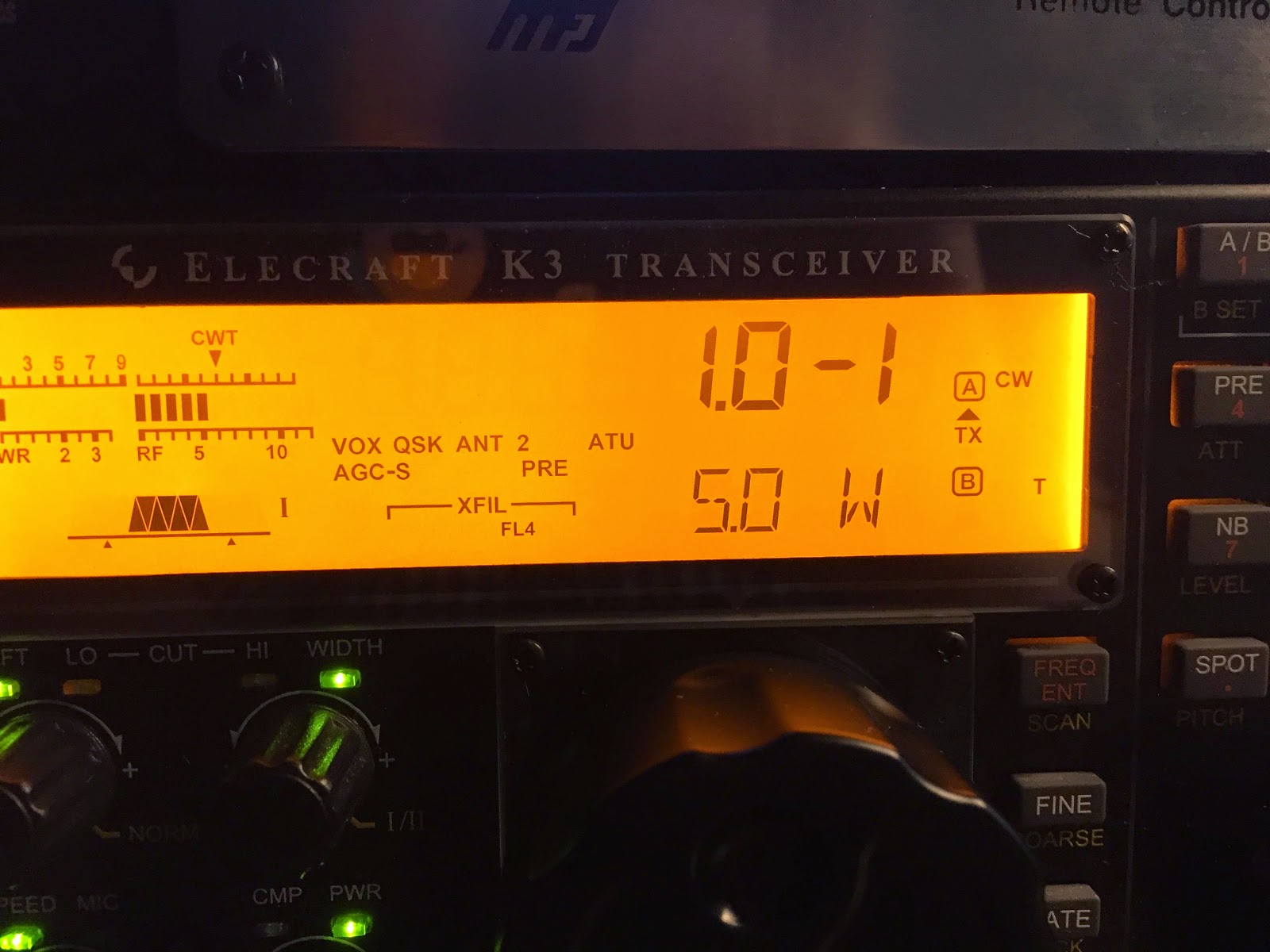 |
| SWR on 15m...and hoping to see it again on 20m |
Mike Weir, VE9KK, is a regular contributor to AmateurRadio.com and writes from New Brunswick, Canada. Contact him at [email protected].
An SWR anomaly….that suddenly popped up!!
|
| SWR on 15m...and hoping to see it again on 20m |
Mike Weir, VE9KK, is a regular contributor to AmateurRadio.com and writes from New Brunswick, Canada. Contact him at [email protected].
CLE 213 Results
As usual, the wonderful LF and MF conditions experienced during the week went into the dumper as the CLE weekend arrived.
Looking back, most of this can be blamed on our monthly (~28 days) repetitive schedule which nicely matches the rotation of the Sun. It seems that the same large coronal hole stream that whacked us during CLE 212, is the same one that showed up for CLE 213 right on schedule. Perhaps we need to shift our schedule by a week in case it wants to hang around for yet another rotation.
Conditions were not as bleak as I make them sound but they were a far cry from those enjoyed earlier in the week. The skip seemed fairly long on all three nights, but most signals were on the runty side, with only a few making strong appearances here on the left coast.
As shown below, conditions were quite 'flat' for the entire weekend and propagation did not vary much in quality other than favoring slightly different regions each night. Interestingly, 'YLH - 247' in Landsdowne House, Ontario, whose antenna was pictured on my last blog, was not heard at all on both Friday or Saturday but had a booming signal on Sunday night.
Date 27 27 27 27 27 28 28 28 28 28 28 28 28 29
UTC 0900 1200 1500 1800 2100 0000 0300 0600
SFlx 81 81 81 81 83 83 83 83 83 83 83 83 85 85
A-in 12 12 12 12 10 10 10 10 10 10 10 10 7 8
K-in 3 3 2 1 2 2 2 2 2 1 2 3 2 3
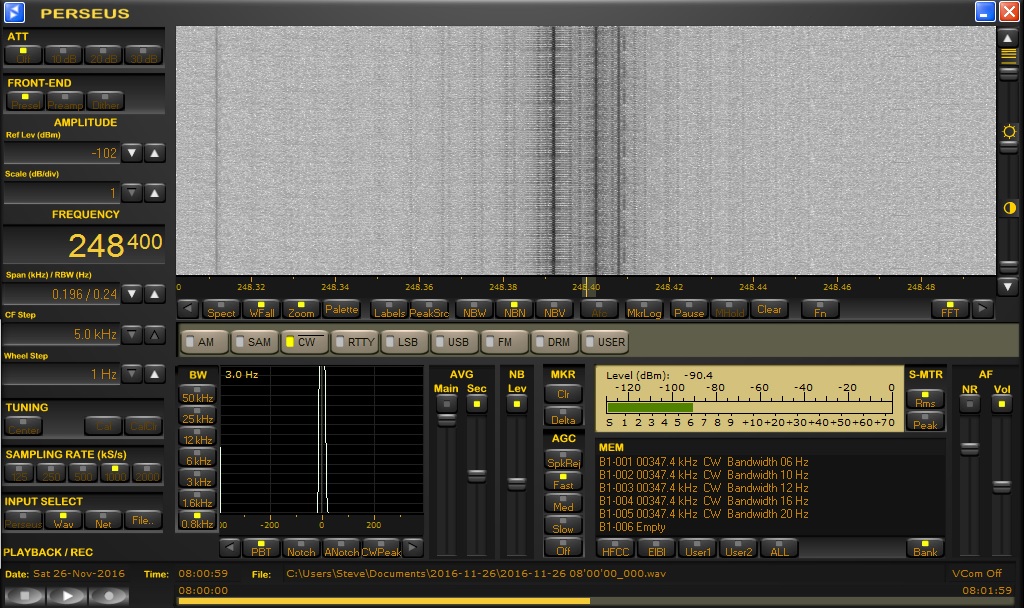
My usual procedure with the Perseus SDR is to record the CLE segments of the band for two minutes, every hour and every half-hour, from shortly after sunset to local sunrise. It then requires several hours of carefully going through the recordings to see what CLE signals were recorded ... sometimes spending up to an hour on one frequency only, sorting out what was coming through.
I have also found that the classic blue-screen waterfall does not yield the best contrast for finding weak signals ... the 'photo-negative' screen shown above is far superior, with signals in black appearing on a white background.
26 02:00 240.0 BVS Burlington, WA, USA
26 03:00 241.0 YGT Igloolik, NU, CAN
27 03:00 242.0 ZT Port Hardy, BC, CAN
26 03:00 242.0 XC Cranbrook, BC, CAN
27 08:00 242.0 MMI Athens, TN, USA
26 07:30 242.0 EL El Paso, TX, USA
27 06:30 244.0 TH Thompson, MB, CAN
27 06:30 245.0 YZE Gore Bay, ON, CAN
28 15:00 245.0 HNS Haines, ALS
27 06:30 245.0 CRR Circle, MT, USA
27 06:00 245.0 CB Cambridge Bay, NU, CAN
27 09:30 245.0 AVQ Marana, AZ, USA
27 04:00 246.0 ZXJ Fort St. John, BC, CAN
27 09:00 247.0 YLH Lansdowne House, ON, CAN
27 08:00 248.0 ZZP Queen Charlotte Is, BC, CAN
27 08:00 248.0 QL Lethbridge, AB, CAN
27 08:00 248.0 QH Watson Lake, YT, CAN
27 07:30 248.0 PQF Mesquite, TX, USA
27 06:30 248.0 GLA Gulkana, ALS
27 08:00 248.0 FRT Fairmont, SC, USA
27 08:00 250.0 FO Flin Flon Municipal, MB, CAN
27 08:00 250.0 2J Grand Forks, BC, CAN
27 08:00 251.0 YCD Nanaimo, BC, CAN
27 15:00 251.0 OSE Bethel Apt, ALS
28 08:00 251.0 JZY Macomb, IL, USA
27 06:30 251.0 BR Brainerd, MN, USA
27 08:00 251.0 AM Amarillo, TX, USA
27 10:00 253.0 GB Marshall, MN, USA
27 08:00 254.0 ZYC Calgary, AB, CAN
27 08:00 254.0 SM Fort Smith, AB, CAN
27 04:00 254.0 EV Inuvik, NT, CAN
27 04:00 256.0 LSO Kelso, WA, USA
27 14:00 256.0 EB Edmonton, AB, CAN
27 14:00 257.0 XE Saskatoon, SK, CAN
27 05:00 257.0 SQT Melbourne, FL, USA
27 07:00 257.0 SAZ Staples, MN, USA
27 08:30 257.0 PEA Pella, IA, USA
27 07:00 257.0 MB Saginaw, MI, USA
27 14:00 257.0 LW Kelowna, BC, CAN
27 12:00 257.0 HCY Cowley, WY, USA
27 08:00 258.0 ZSJ Sandy Lake, ON, CAN
27 06:30 420.0 V7BE2 XOC, XUU
27 08:00 420.0 PK Olathe, KS, USA
27 08:00 420.0 FQ East Chain, MN, USA
27 04:00 421.0 VLY McKenney, TX, USA
27 08:30 422.0 EA Kearney, NE, USA
27 06:30 424.0 RVJ Reidsville, GA, USA
27 06:00 425.0 PFL Fort Sill, OK, USA
27 06:00 426.0 FTP Fort Payne, AL, USA
27 08:00 426.0 EN Council Bluffs, NE, USA
27 07:30 428.0 POH Pocahontas, IA, USA
27 07:00 432.0 IZN Lincolnton, NC, USA
The logging at 0630Z of 'V7BE2' is a large drill ship, the "Deepwater Thalassa", located near the center of the Gulf of Mexico.
Steve McDonald, VE7SL, is a regular contributor to AmateurRadio.com and writes from British Columbia, Canada. Contact him at [email protected].
CLE 213 Results
As usual, the wonderful LF and MF conditions experienced during the week went into the dumper as the CLE weekend arrived.
Looking back, most of this can be blamed on our monthly (~28 days) repetitive schedule which nicely matches the rotation of the Sun. It seems that the same large coronal hole stream that whacked us during CLE 212, is the same one that showed up for CLE 213 right on schedule. Perhaps we need to shift our schedule by a week in case it wants to hang around for yet another rotation.
Conditions were not as bleak as I make them sound but they were a far cry from those enjoyed earlier in the week. The skip seemed fairly long on all three nights, but most signals were on the runty side, with only a few making strong appearances here on the left coast.
As shown below, conditions were quite 'flat' for the entire weekend and propagation did not vary much in quality other than favoring slightly different regions each night. Interestingly, 'YLH - 247' in Landsdowne House, Ontario, whose antenna was pictured on my last blog, was not heard at all on both Friday or Saturday but had a booming signal on Sunday night.
Date 27 27 27 27 27 28 28 28 28 28 28 28 28 29
UTC 0900 1200 1500 1800 2100 0000 0300 0600
SFlx 81 81 81 81 83 83 83 83 83 83 83 83 85 85
A-in 12 12 12 12 10 10 10 10 10 10 10 10 7 8
K-in 3 3 2 1 2 2 2 2 2 1 2 3 2 3
My usual procedure with the Perseus SDR is to record the CLE segments of the band for two minutes, every hour and every half-hour, from shortly after sunset to local sunrise. It then requires several hours of carefully going through the recordings to see what CLE signals were recorded ... sometimes spending up to an hour on one frequency only, sorting out what was coming through.
I have also found that the classic blue-screen waterfall does not yield the best contrast for finding weak signals ... the 'photo-negative' screen shown above is far superior, with signals in black appearing on a white background.
26 02:00 240.0 BVS Burlington, WA, USA
26 03:00 241.0 YGT Igloolik, NU, CAN
27 03:00 242.0 ZT Port Hardy, BC, CAN
26 03:00 242.0 XC Cranbrook, BC, CAN
27 08:00 242.0 MMI Athens, TN, USA
26 07:30 242.0 EL El Paso, TX, USA
27 06:30 244.0 TH Thompson, MB, CAN
27 06:30 245.0 YZE Gore Bay, ON, CAN
28 15:00 245.0 HNS Haines, ALS
27 06:30 245.0 CRR Circle, MT, USA
27 06:00 245.0 CB Cambridge Bay, NU, CAN
27 09:30 245.0 AVQ Marana, AZ, USA
27 04:00 246.0 ZXJ Fort St. John, BC, CAN
27 09:00 247.0 YLH Lansdowne House, ON, CAN
27 08:00 248.0 ZZP Queen Charlotte Is, BC, CAN
27 08:00 248.0 QL Lethbridge, AB, CAN
27 08:00 248.0 QH Watson Lake, YT, CAN
27 07:30 248.0 PQF Mesquite, TX, USA
27 06:30 248.0 GLA Gulkana, ALS
27 08:00 248.0 FRT Fairmont, SC, USA
27 08:00 250.0 FO Flin Flon Municipal, MB, CAN
27 08:00 250.0 2J Grand Forks, BC, CAN
27 08:00 251.0 YCD Nanaimo, BC, CAN
27 15:00 251.0 OSE Bethel Apt, ALS
28 08:00 251.0 JZY Macomb, IL, USA
27 06:30 251.0 BR Brainerd, MN, USA
27 08:00 251.0 AM Amarillo, TX, USA
27 10:00 253.0 GB Marshall, MN, USA
27 08:00 254.0 ZYC Calgary, AB, CAN
27 08:00 254.0 SM Fort Smith, AB, CAN
27 04:00 254.0 EV Inuvik, NT, CAN
27 04:00 256.0 LSO Kelso, WA, USA
27 14:00 256.0 EB Edmonton, AB, CAN
27 14:00 257.0 XE Saskatoon, SK, CAN
27 05:00 257.0 SQT Melbourne, FL, USA
27 07:00 257.0 SAZ Staples, MN, USA
27 08:30 257.0 PEA Pella, IA, USA
27 07:00 257.0 MB Saginaw, MI, USA
27 14:00 257.0 LW Kelowna, BC, CAN
27 12:00 257.0 HCY Cowley, WY, USA
27 08:00 258.0 ZSJ Sandy Lake, ON, CAN
27 06:30 420.0 V7BE2 XOC, XUU
27 08:00 420.0 PK Olathe, KS, USA
27 08:00 420.0 FQ East Chain, MN, USA
27 04:00 421.0 VLY McKenney, TX, USA
27 08:30 422.0 EA Kearney, NE, USA
27 06:30 424.0 RVJ Reidsville, GA, USA
27 06:00 425.0 PFL Fort Sill, OK, USA
27 06:00 426.0 FTP Fort Payne, AL, USA
27 08:00 426.0 EN Council Bluffs, NE, USA
27 07:30 428.0 POH Pocahontas, IA, USA
27 07:00 432.0 IZN Lincolnton, NC, USA
The logging at 0630Z of 'V7BE2' is a large drill ship, the "Deepwater Thalassa", located near the center of the Gulf of Mexico.
Steve McDonald, VE7SL, is a regular contributor to AmateurRadio.com and writes from British Columbia, Canada. Contact him at [email protected].
 Ham Radio Deluxe |
 W5SWL Electronics |
 Ham Radio Prep |
 KB3IFH QSL Cards  Hip Ham Shirts  HamRadioAuctions HamRadioAuctions Reliance Antennas Reliance Antennas Enigma Shop Enigma Shop |  morseDX  Ni4L Antennas  R&L Electronics R&L Electronics antennas.us antennas.us QRV QRV |
- Matt W1MST, Managing Editor
