 |
 Even better low-pass filters for transmitters
 27 November 2016 | by
 The last issues of QEX have featured two interesting articles by Gary Cobb, G3TMG. He outlines the advantage of using Zolotarev designs for the harmonic suppression filters of transmitters, giving even better suppression of the second harmonic than the more common Chebyshev or quasi-elliptic filters.
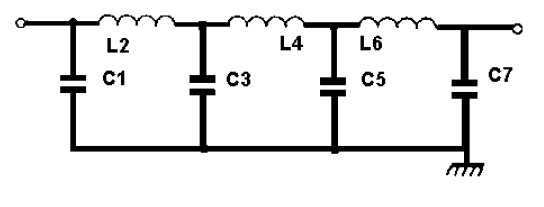 |
| Chebyshev low-pass filter from the GQRP data sheet (issue 1) |
My interest in this was triggered by the test of the Ultimate 3 QRSS/WSPR kit from QRP Labs in the Nov 2016 QST. The review was positive overall, but it was remarked that the harmonic suppression does not meet FCC requirements (-43 dBc or better). I am not sure whether this is due to PCB layout issues, or if better filters can alleviate it, but I note that the design uses the simplest filter of the ones I have listed here.
The evolution of filters for use for harmonic suppression follows at least these three steps:
- Chebyshev type I filters with equiripple in the passband and a monotonically falling, maximally flat stopband. A 7-pole version with three inductors and four capacitors in a pi-network has been around for a while, in e.g. the old recommendation from the GQRP club. It was based on the QST paper “Low-pass filters for amateur radio transmitters,” Ed Wetherhold, W3NQN, Dec. 1979. Two designs for a 20 m filter were given there:
1) Max. ripple in passband: 0.00731 dB, attenuation at 28 MHz: 40.7 dB
1) Max. ripple in passband: 0.00960 dB, attenuation at 28 MHz: 34.5 dB 
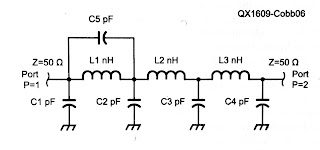
Second-harmonic optimized low-pass filter from the
GQRP data sheet (issue 2)An improved stopband was the topic of W3NQN’s article “Second-harmonic optimized low-pass filters” in QST Feb. 1999. Here there is one additional capacitor as the central inductor is made into a parallel resonance which gives a zero in the stopband, based on an idea by Jim Tonne, WB6BLD. The design goal is that this zero should be at the second harmonic frequency. W3NQN proposed to call this a Chebyshev filter with a zero (CWAZ) filter, but it is more correct to call it a quasi- or pseudo-elliptic filter as remarked by G3TMG. It increases the attenuation at the second-harmonic in the 20 m design to better than 60 dB. This design is the basis for the current (Issue 2) G-QRP technical sheet. This would also be interesting to test in the QRP Labs Ultimate 3 transmitter kit.
Zolotarev low-pass filter from the Nov/Dec 2016 QEX article G3TMG in the new QEX articles has noticed that the passband is over-specified in the above filters as the lower 60% or so of the passband is unused. The Zolotarev design allows for more passband ripple in this part where it does not matter. The advantage is even better stopband attenuation. A measured example for a 60 m filter has a passband ripple of 0.17 dB and a stopband attenuation at the second harmonic of 71 dB. This filter has the same component count as the previous one, but the filter is no longer symmetric like the two previous ones. The increase in second-harmonic suppression is not as great as the going from the first filters to the second, but should still be worth the effort.
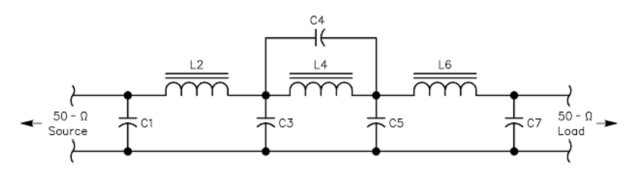
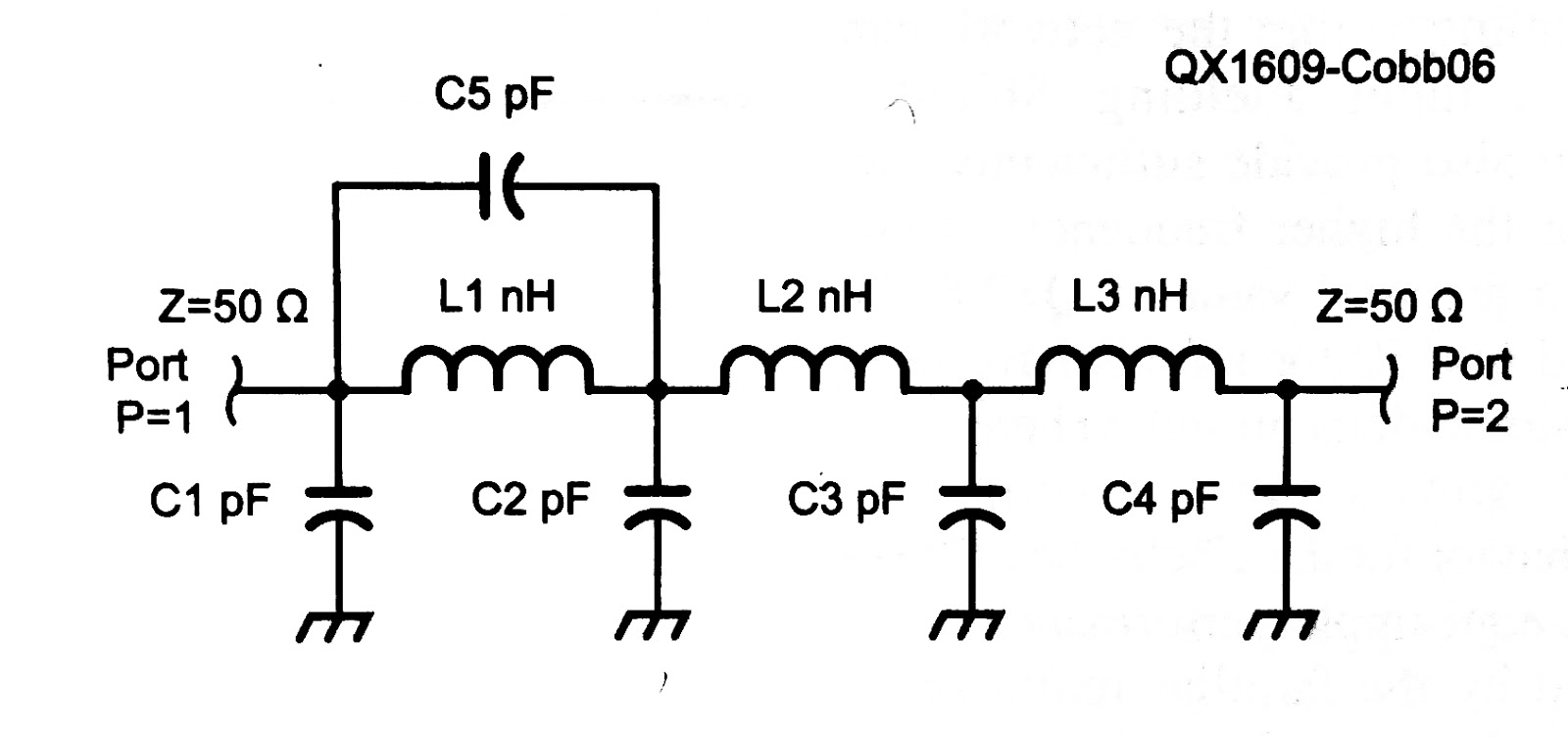
- Gary Cobb, G3TMG, Zolotarev low-pass filter design, QEX, July/Aug 2016.
- Gary Cobb, G3TMG, A more efficient low-pass filter, QEX, Nov/Dec 2016.
Sverre Holm, LA3ZA, is a regular contributor to AmateurRadio.com and writes from Norway. Contact him at [email protected].
Even better low-pass filters for transmitters
The last issues of QEX have featured two interesting articles by Gary Cobb, G3TMG. He outlines the advantage of using Zolotarev designs for the harmonic suppression filters of transmitters, giving even better suppression of the second harmonic than the more common Chebyshev or quasi-elliptic filters.
|
| Chebyshev low-pass filter from the GQRP data sheet (issue 1) |
My interest in this was triggered by the test of the Ultimate 3 QRSS/WSPR kit from QRP Labs in the Nov 2016 QST. The review was positive overall, but it was remarked that the harmonic suppression does not meet FCC requirements (-43 dBc or better). I am not sure whether this is due to PCB layout issues, or if better filters can alleviate it, but I note that the design uses the simplest filter of the ones I have listed here.
The evolution of filters for use for harmonic suppression follows at least these three steps:
- Chebyshev type I filters with equiripple in the passband and a monotonically falling, maximally flat stopband. A 7-pole version with three inductors and four capacitors in a pi-network has been around for a while, in e.g. the old recommendation from the GQRP club. It was based on the QST paper “Low-pass filters for amateur radio transmitters,” Ed Wetherhold, W3NQN, Dec. 1979. Two designs for a 20 m filter were given there:
1) Max. ripple in passband: 0.00731 dB, attenuation at 28 MHz: 40.7 dB
1) Max. ripple in passband: 0.00960 dB, attenuation at 28 MHz: 34.5 dB Second-harmonic optimized low-pass filter from the
GQRP data sheet (issue 2)An improved stopband was the topic of W3NQN’s article “Second-harmonic optimized low-pass filters” in QST Feb. 1999. Here there is one additional capacitor as the central inductor is made into a parallel resonance which gives a zero in the stopband, based on an idea by Jum Tonne, WB6BLD. The design goal is that this zero should be at the second harmonic frequency. W3NQN proposed to call this a Chebyshev filter with a zero (CWAZ) filter, but it is more correct to call it a quasi- or pseudo-elliptic filter as remarked by G3TMG. It increases the attenuation at the second-harmonic in the 20 m design to better than 60 dB. This design is the basis for the current (Issue 2) G-QRP technical sheet. This would also be interesting to test in the QRP Labs Ultimate 3 transmitter kit.
Zolotarev low-pass filter from the Nov/Dec 2016 QEX article G3TMG in the new QEX articles has noticed that the passband is over-specified in the above filters as the lower 60% or so of the passband is unused. The Zolotarev design allows for more passband ripple in this part where it does not matter. The advantage is even better stopband attenuation. A measured example for a 60 m filter has a passband ripple of 0.17 dB and a stopband attenuation at the second harmonic of 71 dB. This filter has the same component count as the previous one, but the filter is no longer symmetric like the two previous ones. The increase in second-harmonic suppression is not as great as the going from the first filters to the second, but should still be worth the effort.
- Gary Cobb, G3TMG, Zolotarev low-pass filter design, QEX, July/Aug 2016.
- Gary Cobb, G3TMG, A more efficient low-pass filter, QEX, Nov/Dec 2016.
Sverre Holm, LA3ZA, is a regular contributor to AmateurRadio.com and writes from Norway. Contact him at [email protected].
ICQ Podcast Episode 225 – What is VSWR
In this episode, Martin M1MRB / W9ICQ is joined by Chris Howard M0TCH, Martin Rothwell M0SGL, Dan Romanchik KB6NU and Ed Durrant DD5LP to discuss the latest Amateur / Ham Radio news. Colin M6BOY rounds up the news in brief, and this episode’s features - What is VSWR
- Students FM transponder Satellite Launched
- WWII Veteran Still Taps out Morse code
- Enrol for UK Advanced Distance Learning Course
- Lowest Sunspot Cycle for 5 Years
- Suggestions Requested for Technician Pool
- New Greenlandic Beacon - OX4M
- HF Antenna Tester
Colin Butler, M6BOY, is the host of the ICQ Podcast, a weekly radio show about Amateur Radio. Contact him at [email protected].
ICQ Podcast Episode 225 – What is VSWR
In this episode, Martin M1MRB / W9ICQ is joined by Chris Howard M0TCH, Martin Rothwell M0SGL, Dan Romanchik KB6NU and Ed Durrant DD5LP to discuss the latest Amateur / Ham Radio news. Colin M6BOY rounds up the news in brief, and this episode’s features - What is VSWR
- Students FM transponder Satellite Launched
- WWII Veteran Still Taps out Morse code
- Enrol for UK Advanced Distance Learning Course
- Lowest Sunspot Cycle for 5 Years
- Suggestions Requested for Technician Pool
- New Greenlandic Beacon - OX4M
- HF Antenna Tester
Colin Butler, M6BOY, is the host of the ICQ Podcast, a weekly radio show about Amateur Radio. Contact him at [email protected].
Amateur Radio Weekly – Issue 135

Virtual Build-a-thon
Using either Skype or Webex we will present each week for about 30 minutes showing you the next stage of building the project. You can then ask questions and show us how you are getting on.
Chertsey Radio Club
Toyota Tacoma Mobile HF Install
Surprisingly the 590SG is compact enough IMHO for a nice mobile install, however someone with a smaller vehicle might not have the luxury of so much space. I rarely use the access cab except to throw junk in, so why not utilize it better?
K5ACL
Upcoming solar years… Can they be too quiet?
In 2008 there were 265 ‘zero sunspot’ days and the following year saw another 262 days of blank suns!
VE7SL
Should amateur radio be used for military purposes?
If the Border Patrol or Army asked you to listen for potential terrorist communications, would you do so?
KB6NU
Podcast: Foundations of Amateur Radio
A weekly, 4 minute podcast. The building blocks for Amateur Radio, one concept at a time
VK6FLAB
FCC’s Laura Smith – Your Repeater; Your Rules
We haven’t heard a lot from FCC Special Counsel Laura Smith lately, but she spoke at Pacificon.
Southgate/Ham Radio Now
Solar powered Ham Radio for beginners
I am going through the gear one will need to operate with a solar power source, how to use it and a couple of things to avoid.
Ham Radio Reviews
SKYWARN Recognition Day on-the-air event is December 3rd
SKYWARN Recognition Day was developed in 1999 by the National Weather Service and ARRL to honor the contributions that SKYWARN volunteers make to the NWS mission.
ARRL
Special Event K7Z: Zane Grey’s 145th Birthday
Zane Grey was an author and master of the American western novel.
K7Z
Special Event W1T: Mark Twain’s 181st Birthday
ARRL staff will be operating as W1T from November 28 – December 4, in honor of Mark Twain’s 181st birthday.
W1T
Video
D-Star DVmega Raspberry Pi 3 hotspot
This hotspot is using a Raspberry Pi to operate as a full D-star hotspot.
HamRdioConcepts
Compact Homebrew End Fed QRP Antenna
I built this antenna specifically for low wattage QRP use to be compact and inexpensive. It utilizes a 9:1 balun wrapped on a T106-2 torpid and minimal hardware to be lightweight.
KD9EAS
W2LI: Dry Tortugas NPOTA Activation
Rob (K2RWF) and Craig (KD2INN) activate Dry Tortugas National Park in the Gulf of Mexico.
YouTube
Amateur Radio Weekly is curated by Cale Mooth K4HCK. Sign up free to receive ham radio's most relevant news, projects, technology and events by e-mail each week at http://www.hamweekly.com.
Hunting For NDBs In CLE 213
 |
| 'YLH' - 247 courtesy: http://www.ve3gop.com/ |
This coming weekend will see another CLE challenge, this time in two ranges: 240.0 - 259.9 kHz plus 420.0 - 439.9 kHz.
A 'CLE' is a 'Co-ordinated Listening Event', as NDB DXers around the world focus their listening time on one small slice of the NDB spectrum.
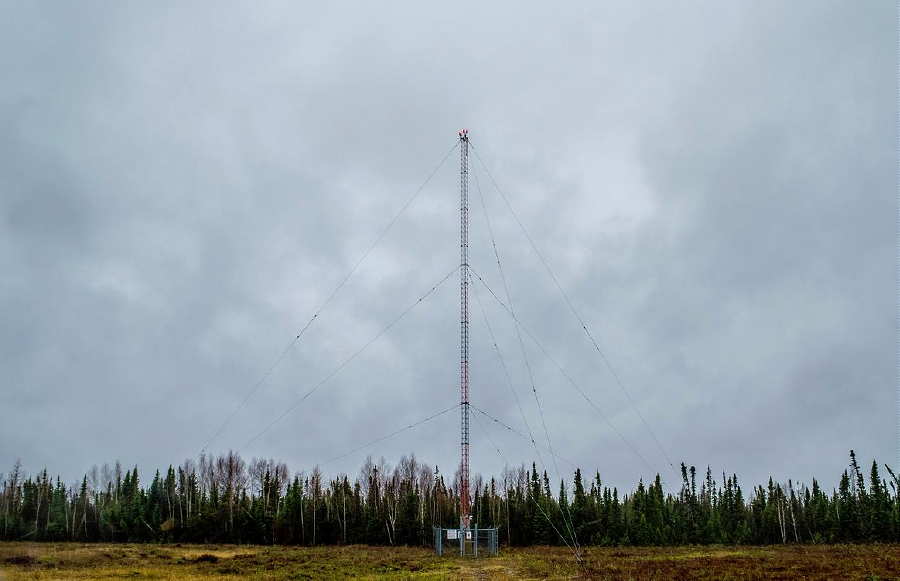
A nice challenge in this one is to hear the Lansdowne House, Ontario, NDB, 'YLH' on 247 kHz. This one runs 250 watts and gets out well, having been logged from coast to coast. Listen for it on 247.417 kHz with your receiver in the CW mode.
From CLE organizer Brian Keyte, G3SIA, comes the usual 'heads-up':
Hi all,
Here are the final details for our 213th co-ordinated listening event this
weekend. First timer logs too? Yes, please!
Days: Friday 25 Nov. to Monday 28 Nov.
Times: Start and end at midday, your LOCAL TIME
Range: 240.0 - 259.9 kHz plus 420.0 - 439.9 kHz
(BOTH ranges are for ALL listeners)
Please log NDBs that you can positively identify in the ranges, plus any
UNIDs that you come across there.
The lower frequency range will be really hard for most Europe listeners,
the higher range not at all easy for most others.
Send your CLE log to the List, if possible as a plain text email and
not in an attachment, with CLE213 at the start of its title.
Show on EVERY LINE of your log:
# The Date (or day 'dd') and UTC (the day changes at 00:00 UTC).
# kHz - the beacon's nominal published frequency (if you know it).
# The Call Ident.
Please show those main items first on each line, BEFORE any optional
details (Location, Offsets, Cycle time, Distance, etc.)
If you send interim logs, do make sure that you also send a 'Final' log
containing all your loggings. As always, please make your log useful and
interesting to everyone by including your own location and brief details
of your receiver, aerial(s) and any recording equipment that you used.
I will send the usual 'Any More Logs?' email at about 18:00 UTC on
Tuesday so that you can check that your Final log has been found OK.
Do make sure that your log has arrived on the List at the very latest
by 09:00 UTC on Wednesday 30th November.
I hope to complete the combined results later on that day.
To help you with your search you can find lists of your target NDBs at
http://www.ndblist.info/cle.htm Select the SEEKLIST link there.
(To also see a MAP of the seeklist NDBs, just change 'List' to 'Map',
select 'All Results' and uncheck 'Clustering')
Good listening
Brian
----------------------------------------------------------
From: Brian Keyte G3SIA ndbcle'at'gmail.com
Location: Surrey, SE England (CLE co-ordinator)
----------------------------------------------------------
(Reminder: You could use any one remote receiver for your loggings,
stating its location and owner - with their permission if required.
A remote listener may NOT also use another receiver, whether local or
remote, to obtain further loggings for the same CLE).
These listening events serve several purposes. They:
- determine, worldwide, which beacons are actually in service and on-the-air so the online database can be kept up-to-date
- determine, worldwide, which beacons are out-of-service or have gone silent since the last CLE covering this range
- will indicate the state of propagation conditions at the various participant locations
- will give you an indication of how well your LF/MF receiving system is working
- give participants a fun yet challenging activity to keep their listening skills honed
Final details can be found at the NDB List website, and worldwide results, for every participant, will be posted there a few days after the event. If you are a member of the ndblist Group, results will also be e-mailed and posted there.
The very active Yahoo ndblist Group is a great place to learn more about the 'Art of NDB DXing' or to meet other listeners in your region. There is a lot of good information available there and new members are always very welcome. As well, you can follow the results of other CLE participants from night to night as propagation is always an active topic of discussion.
If you are contemplating getting started on 630m, listening for NDBs is an excellent way to test out your receive capabilities as there are several NDBs located near this part of the spectrum.
You need not be an ndblist member to participate in the CLEs and all reports, no matter how small, are of much value to the organizers.
'First-time' logs are always VERY welcome!
Reports may be sent to the ndblist or e-mailed to either myself or CLE co-ordinator, Brian Keyte (G3SIA), whose address appears above.
Please ... give the CLE a try ... then let us know what NDB's can be heard from your location! Your report can then be added to the worldwide database to help keep it up-to-date.
Good hunting!
Steve McDonald, VE7SL, is a regular contributor to AmateurRadio.com and writes from British Columbia, Canada. Contact him at [email protected].
Hunting For NDBs In CLE 213
|
| 'YLH' - 247 courtesy: http://www.ve3gop.com/ |
This coming weekend will see another CLE challenge, this time in two ranges: 240.0 - 259.9 kHz plus 420.0 - 439.9 kHz.
A 'CLE' is a 'Co-ordinated Listening Event', as NDB DXers around the world focus their listening time on one small slice of the NDB spectrum.
A nice challenge in this one is to hear the Lansdowne House, Ontario, NDB, 'YLH' on 247 kHz. This one runs 250 watts and gets out well, having been logged from coast to coast. Listen for it on 247.417 kHz with your receiver in the CW mode.
From CLE organizer Brian Keyte, G3SIA, comes the usual 'heads-up':
Hi all,
Here are the final details for our 213th co-ordinated listening event this
weekend. First timer logs too? Yes, please!
Days: Friday 25 Nov. to Monday 28 Nov.
Times: Start and end at midday, your LOCAL TIME
Range: 240.0 - 259.9 kHz plus 420.0 - 439.9 kHz
(BOTH ranges are for ALL listeners)
Please log NDBs that you can positively identify in the ranges, plus any
UNIDs that you come across there.
The lower frequency range will be really hard for most Europe listeners,
the higher range not at all easy for most others.
Send your CLE log to the List, if possible as a plain text email and
not in an attachment, with CLE213 at the start of its title.
Show on EVERY LINE of your log:
# The Date (or day 'dd') and UTC (the day changes at 00:00 UTC).
# kHz - the beacon's nominal published frequency (if you know it).
# The Call Ident.
Please show those main items first on each line, BEFORE any optional
details (Location, Offsets, Cycle time, Distance, etc.)
If you send interim logs, do make sure that you also send a 'Final' log
containing all your loggings. As always, please make your log useful and
interesting to everyone by including your own location and brief details
of your receiver, aerial(s) and any recording equipment that you used.
I will send the usual 'Any More Logs?' email at about 18:00 UTC on
Tuesday so that you can check that your Final log has been found OK.
Do make sure that your log has arrived on the List at the very latest
by 09:00 UTC on Wednesday 30th November.
I hope to complete the combined results later on that day.
To help you with your search you can find lists of your target NDBs at
http://www.ndblist.info/cle.htm Select the SEEKLIST link there.
(To also see a MAP of the seeklist NDBs, just change 'List' to 'Map',
select 'All Results' and uncheck 'Clustering')
Good listening
Brian
----------------------------------------------------------
From: Brian Keyte G3SIA ndbcle'at'gmail.com
Location: Surrey, SE England (CLE co-ordinator)
----------------------------------------------------------
(Reminder: You could use any one remote receiver for your loggings,
stating its location and owner - with their permission if required.
A remote listener may NOT also use another receiver, whether local or
remote, to obtain further loggings for the same CLE).
These listening events serve several purposes. They:
- determine, worldwide, which beacons are actually in service and on-the-air so the online database can be kept up-to-date
- determine, worldwide, which beacons are out-of-service or have gone silent since the last CLE covering this range
- will indicate the state of propagation conditions at the various participant locations
- will give you an indication of how well your LF/MF receiving system is working
- give participants a fun yet challenging activity to keep their listening skills honed
Final details can be found at the NDB List website, and worldwide results, for every participant, will be posted there a few days after the event. If you are a member of the ndblist Group, results will also be e-mailed and posted there.
The very active Yahoo ndblist Group is a great place to learn more about the 'Art of NDB DXing' or to meet other listeners in your region. There is a lot of good information available there and new members are always very welcome. As well, you can follow the results of other CLE participants from night to night as propagation is always an active topic of discussion.
If you are contemplating getting started on 630m, listening for NDBs is an excellent way to test out your receive capabilities as there are several NDBs located near this part of the spectrum.
You need not be an ndblist member to participate in the CLEs and all reports, no matter how small, are of much value to the organizers.
'First-time' logs are always VERY welcome!
Reports may be sent to the ndblist or e-mailed to either myself or CLE co-ordinator, Brian Keyte (G3SIA), whose address appears above.
Please ... give the CLE a try ... then let us know what NDB's can be heard from your location! Your report can then be added to the worldwide database to help keep it up-to-date.
Good hunting!
Steve McDonald, VE7SL, is a regular contributor to AmateurRadio.com and writes from British Columbia, Canada. Contact him at [email protected].
 Ham Radio Deluxe |
 W5SWL Electronics |
 Ham Radio Prep |
 KB3IFH QSL Cards  Hip Ham Shirts  HamRadioAuctions HamRadioAuctions Reliance Antennas Reliance Antennas Enigma Shop Enigma Shop |  morseDX  Ni4L Antennas  R&L Electronics R&L Electronics antennas.us antennas.us QRV QRV |
- Matt W1MST, Managing Editor
