 |
 ICQ Podcast Episode 222 – RFinder & Raynet Unification
 16 October 2016 | by
 In this episode, Martin M1MRB / W9ICQ is joined by Leslie Butterfield G0CIB Edmund Spicer M0MNG, Matthew Nassau M0NJX and Chris Howard M0TCH to discuss the latest Amateur / Ham Radio news. Colin Butler M6BOY rounds up the news in brief, and this episode’s feature is RFinder & Raynet Unification.
- Young UK Amateur Causing Emergency Services Havoc
- New Ofcom website
- Round-the-World Cyclist OZ1AA Returns
- 42 Years in Space for AO-7
- New Icom IC-7300 HF/50/70MHz Transceiver Firmware Update
- NZ 77-81 GHz Radiolocation and Vehicle Radar
- UNGO Ukrainian Amateur Radio League
Colin Butler, M6BOY, is the host of the ICQ Podcast, a weekly radio show about Amateur Radio. Contact him at [email protected].
ICQ Podcast Episode 222 – RFinder & Raynet Unification
In this episode, Martin M1MRB / W9ICQ is joined by Leslie Butterfield G0CIB Edmund Spicer M0MNG, Matthew Nassau M0NJX and Chris Howard M0TCH to discuss the latest Amateur / Ham Radio news. Colin Butler M6BOY rounds up the news in brief, and this episode’s feature is RFinder & Raynet Unification.
- Young UK Amateur Causing Emergency Services Havoc
- New Ofcom website
- Round-the-World Cyclist OZ1AA Returns
- 42 Years in Space for AO-7
- New Icom IC-7300 HF/50/70MHz Transceiver Firmware Update
- NZ 77-81 GHz Radiolocation and Vehicle Radar
- UNGO Ukrainian Amateur Radio League
Colin Butler, M6BOY, is the host of the ICQ Podcast, a weekly radio show about Amateur Radio. Contact him at [email protected].
A simple approach to VHF contesting
The UK Activity Contests (UKAC) are a series of VHF contests that happen every Tuesday night. There is a different band each week. The general set up is a signal report (genuine, not a 59 default), serial number and locator. The locator is used for multipliers. The calendar is as follows:
Every 1st Tuesday 2000-2230 (Local) 144MHz
Every 2nd Tuesday 2000-2230 (Local) 432MHz
Every 3rd Tuesday 2000-2230 (Local) 1.3GHz
Every 4th Tuesday 2000-2230 (Local) 50MHz & SHF
Every 5th Tuesday 2000-2230 (Local) 70MHz
So, its a pretty full calendar. I participate in the low power section, which is <10w but I actually run 5w from my FT817nd. Almost always portable and at most the 6m, 2m and 70cms sections. Antenna’s have been a mixture with some pretty substantial beam’s (for /p anyway) but my preference is for the now defunct Sotabeams SB270 for 2m and 70cm’s and a Nuxcom lightweight 6m yagi. I have moved away from heavy telescopic poles to a Harris 5m telescopic decorators pole.
The theme is to simplify some things but with a view to focus my spending on lightweight improvements. I find that this keeps my interest in building up as well as operating. Lets make this very clear, I’m not in it to win in, but to make use of the normally quiet VHF spectrum for some fun. DX is unusually no further than the south coast or the north of Scotland and the occasional trip a little bit further but conditions need to be exceptional.
So the latest addition is a more appropriate support for the pole. I was sick of using a drive on plate that was frankly destroying my £16 investment in a decorating pole. My car has a tow bar. I bought a ball attachment several years ago as it was right in front of me and very cheap. I now have a use for it.


The tow bar mount is made from a few off cuts of 47mm x 100mm (or 2″ by 4″ if you prefer) and a piece of rough sawn timber that was being used for shuttering for the summer house foundations. I used a 38mm hole saw so that the base is snug, but the upper support needs some kind of removable wedge.


It has been painted with Wilko’s timber paint left over from some other work (which is very good). I’ve yet to try it out but I’m impressed how quick it was to make. Let’s see how it performs, its certainly a lot simpler than buying an expensive drive on plate.
It remains to be seen if this is a worthwhile addition but it only has to deal with a little over a 1Kg in static mass so chances are even the most severe winds. In which case I won’t be out /p anyway. Next stop the antennas. To increase gain or not to increase gain, that is the question. I kind of know the answer really.
Alex Hill, G7KSE, is a regular contributor to AmateurRadio.com and writes from Cumbria, UK. Contact him at [email protected].
One stop daily Amatuer radio news update!

Mike Weir, VE9KK, is a regular contributor to AmateurRadio.com and writes from New Brunswick, Canada. Contact him at [email protected].
One stop daily Amatuer radio news update!
Mike Weir, VE9KK, is a regular contributor to AmateurRadio.com and writes from New Brunswick, Canada. Contact him at [email protected].
Amateur Radio Weekly – Issue 129

Current rules holding Hams back from state-of-the-art technology
ARRL told the FCC in its comments that the current HF symbol rate “speed limit” reflects 1980s technology and has no place in an experimental radio service.
ARRL
Outernet broadcasting APRS packets globally
Outernet is a low data rate worldwide satellite downlink carried on three geostationary Inmarsat L-band sateliltes to provide web content (downlink files only) to remote areas anywhere in the world.
aprs.org
Building a Ham Radio power supply
After spending $820 for the radio, I wasn’t in the mood (or the financial state) to drop another $100 to $150 on an Alinco Power Supply.
Soliloquy Blog
Building your own GSM basestation
Having your own GSM basestation allows you to create your own private and free GSM network, or for more malicious illegal users it can allow you to create a system for intercepting peoples calls and data.
RTL-SDR.com
Open source, cross-band repeater board for high altitude ballooning
Project Echoloon is an Amateur Radio cross-band repeater device that can be lifted by a few helium or hydrogen-filled party balloons.
N0SSC
Top 10 Amateur Radio uses for the Raspberry Pi
The Raspberry Pi has proved to be a phenomenal hit with hobbyists around the world.
Adventures in Ham Radio
How the phonetic alphabet emerged
For a time the Able, Baker alphabet, derived from WWII when the US air force entered the war, hung around in aviation for years.
Southgate
Rehab for the KØNR Repeater
The SCOM 7K repeater controller has been in service for decades, handling multiple receivers and transmitters.
K0NR
What is Near Vertical Incident Skywave?
This series focuses on short-haul communication during a disaster in the Amateur Radio Service.
N4AE
Video
MMDVM home brew repeater demonstration
Here is a quick video clip showing the flexibility and ease of use when switching between the 3 digital modes DMR/DSTAR/FUSION.
N2LEM
Sean McQuillan: Engineer, farmer, pirate radio pioneer
Sean McQuillan single-handedly set up one of the first land-based pirate radio stations in the country. Sean recounts tales of many events in his life with humour, eloquence and humility.
Vimeo
Amateur Radio Weekly is curated by Cale Mooth K4HCK. Sign up free to receive ham radio's most relevant news, projects, technology and events by e-mail each week at http://www.hamweekly.com.
630m VK’s Light-Up North America
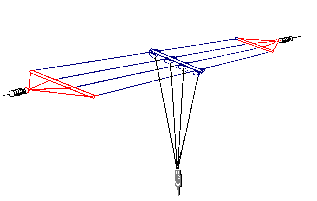
It seems that all of my blogspots of late have focused on 630m propagation ... but what has been happening down there recently has been both amazing and somewhat unexpected. With the growing number of active stations listening and transmitting, the band's propagation capabilities and mysteries are quickly revealing themselves.
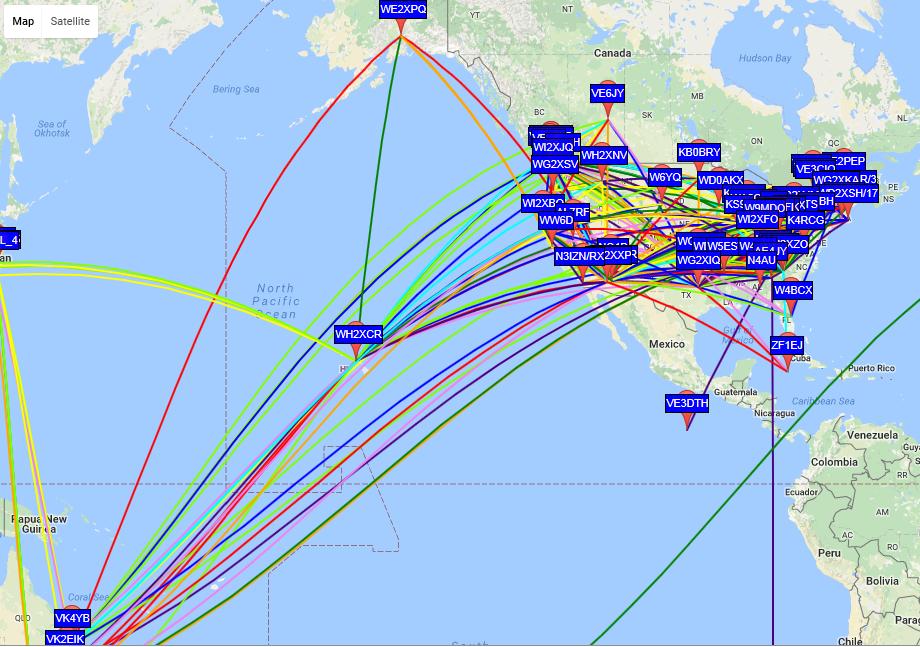
Last night was a great example but perhaps the WSPRnet prop map illustrates this best.
 |
| courtesy: http://wsprnet.org/drupal/wsprnet/map |
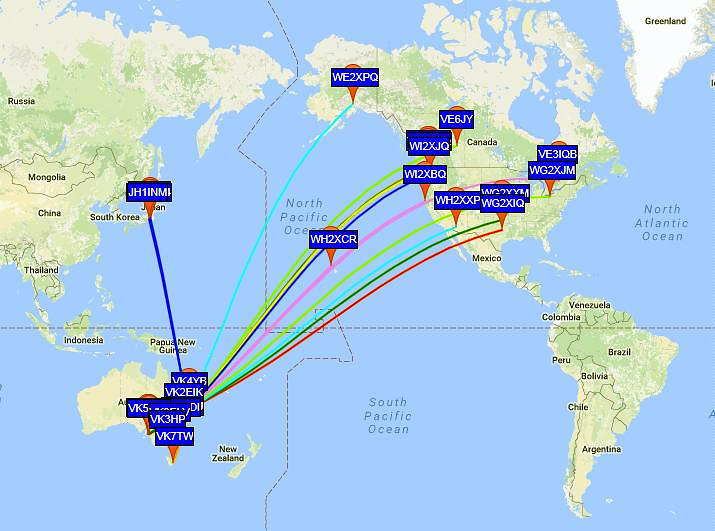
Particularly striking was the long haul propagation from VK to North America, with northernmost VK4YB leading the pack. His 90 watt signal made it all the way to VE3IQB, near Ottawa as well as to NO3M, in Pennsylvania! To provide further hope to those that have little room for big receiving antennas, VE3IQB uses a typical small active e-probe antenna, 20' above ground!
 |
| courtesy: http://wsprnet.org/drupal/wsprnet/map |
 |
| courtesy: http://www.swpc.noaa.gov/ |
I'm theorizing that Roger's signal was arriving today at much lower angles than normal, evidenced by its far-reaching east coast reception and the fact that it couldn't get over my 600' local obstruction to the west. I've always believed that it takes higher angled signal arrival for me to hear Roger and today's events seem to support this.
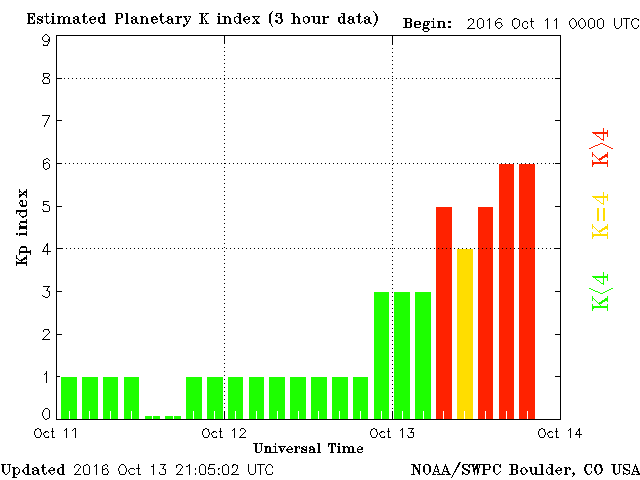
Exactly what would cause this to be the case, I'll leave to the experts but I imagine that the sudden surge in geomagnetic activity played a significant role in today's very different propagation paths.
Roger was not the only VK lighting-up the map today. A much more detailed account of all the action can be found on the KB5NJD's daily 630m report here ... all very inspirational and hopefully enough to spur even more new activity on the MF band.
Why not give a listen and see what you can hear?
Steve McDonald, VE7SL, is a regular contributor to AmateurRadio.com and writes from British Columbia, Canada. Contact him at [email protected].
 Ham Radio Deluxe |
 W5SWL Electronics |
 Ham Radio Prep |
 KB3IFH QSL Cards  Hip Ham Shirts  HamRadioAuctions HamRadioAuctions Reliance Antennas Reliance Antennas Enigma Shop Enigma Shop |  morseDX  Ni4L Antennas  R&L Electronics R&L Electronics antennas.us antennas.us QRV QRV |
- Matt W1MST, Managing Editor
