 |
 June Moonbounce Heats Up
 6 July 2017 | by
With fixed elevation and not having the ability to track the moon as it rises, I can only operate for about two hours before the moon gets too high. The highest elevation that I am able to work seems to stop near 20 degrees.
With QSLs from earlier sessions still arriving, I noted last week's activity was down somewhat from the previous month ... summertime activities usually take priority over EME for most moonbouncers.
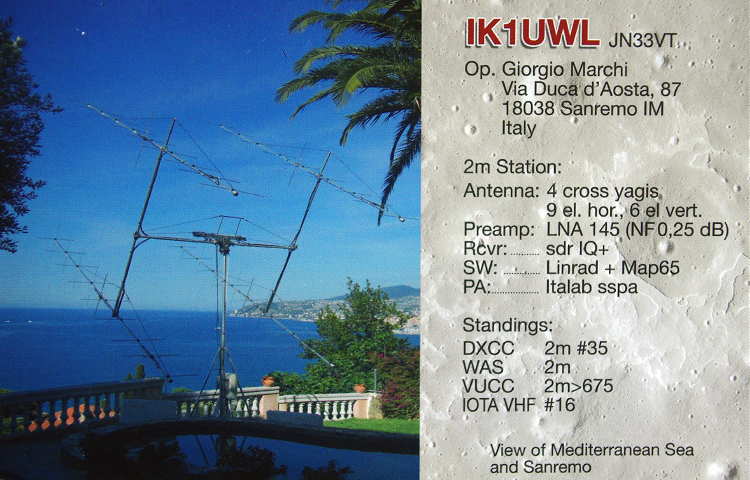
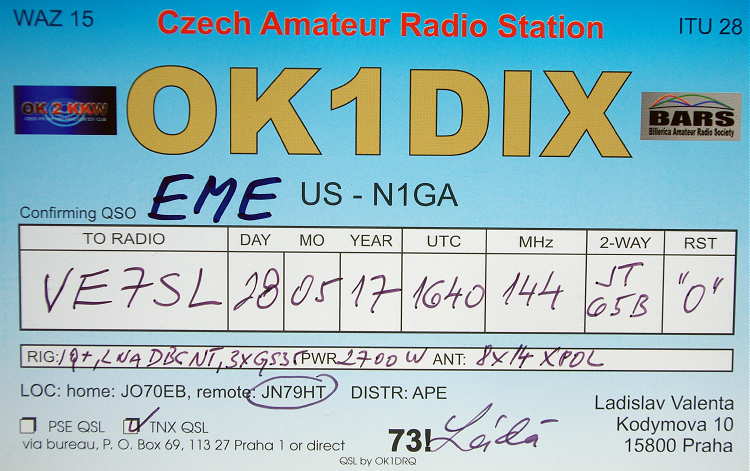
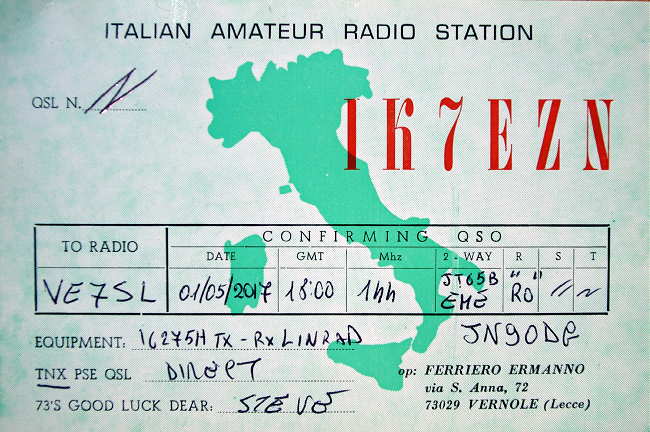
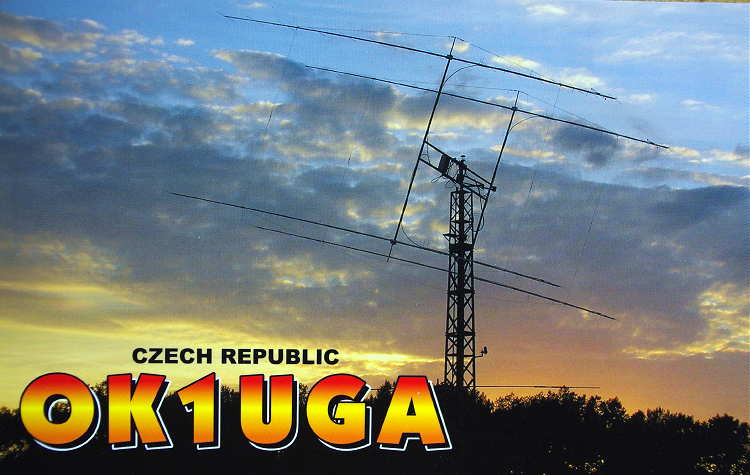

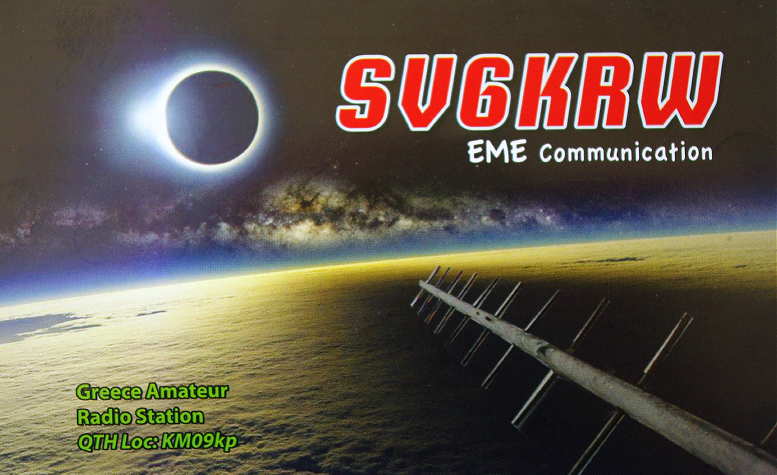
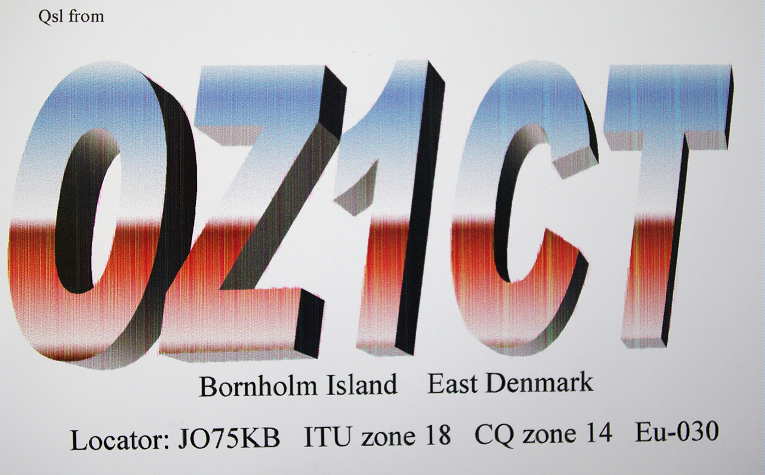
During my two mornings of moon time I worked five stations which included two new DXCC countries, bringing my 2m DXCC total to 30. Stations worked at the end of June were:
ON4AOI #106 (new country)
OH3AWW #107 (new country)
I2RV second QSO
DK9WI #108
IK6CAK #109
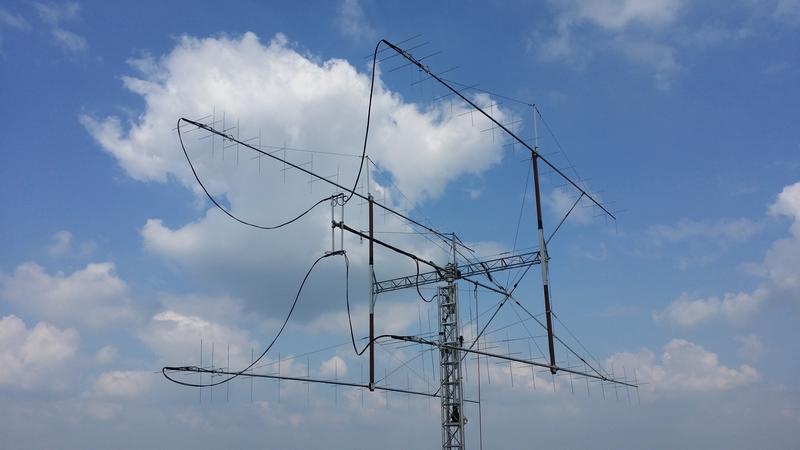 |
| ON4AOI - 4 X 14V / 14H array |
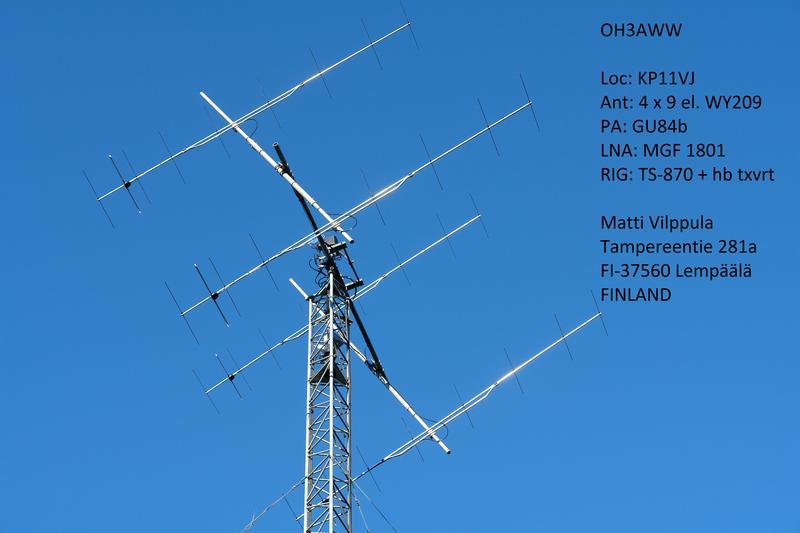 |
| OH3AWW - 4 X 9el array |
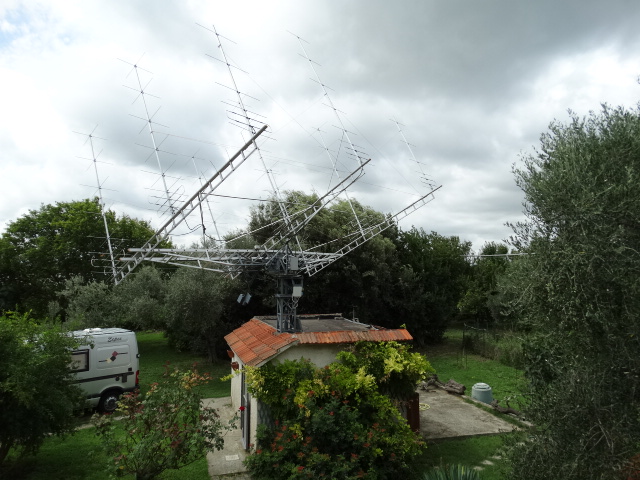 |
| IK6CAK - 9H / 6V 8el LFA array more |
In the middle of a CQ following my QSO with IK6CAK, I heard a faint 'crack' sound from my amplifier, an aging RF Concepts 2-135, followed by the unmistakable whiff of a 'too hot' electronic component ... every ham is familiar with this always unwelcome odor and it usually spells trouble.
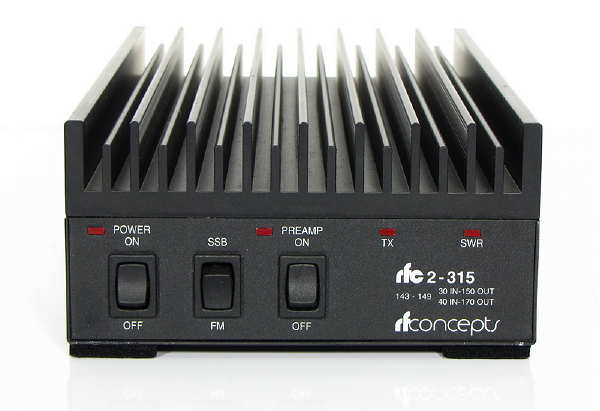
During the next CQ, I saw a trace of smoke coming out of the amp's back corner vent holes, at which point I reluctantly shut things down in the middle of some superb EME conditions.
After tearing into the amplifier, the only thing that looked stressed was a small inductor (L14 below), part of the output filtering / impedance matching circuitry.
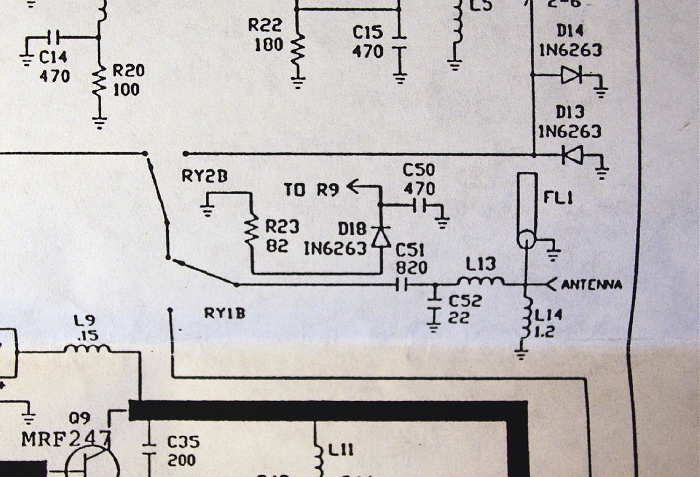
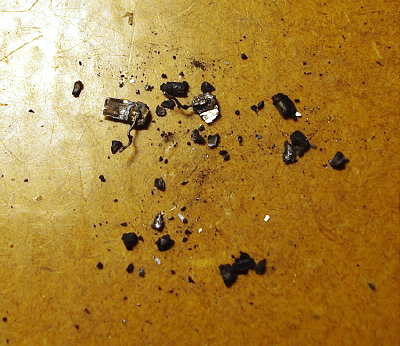
It looked a little darker and somewhat stressed and as I gave it a poke with a screwdriver blade, it immediately disintegrated into what you see below.
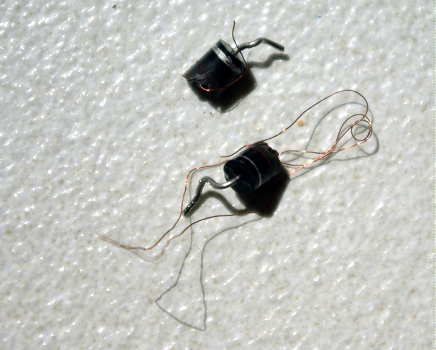
It was a small (1.2uH) encapsulated RFC which appeared to be wire-wound on a core material that I did not recognize and likely suitable for VHF. I surmised that after several years of 100% duty-cycle JT65 operation, the inductor had been over-stressed to the point of failure ... helping to filter all of those nasty high frequency harmonics can't be an easy job!
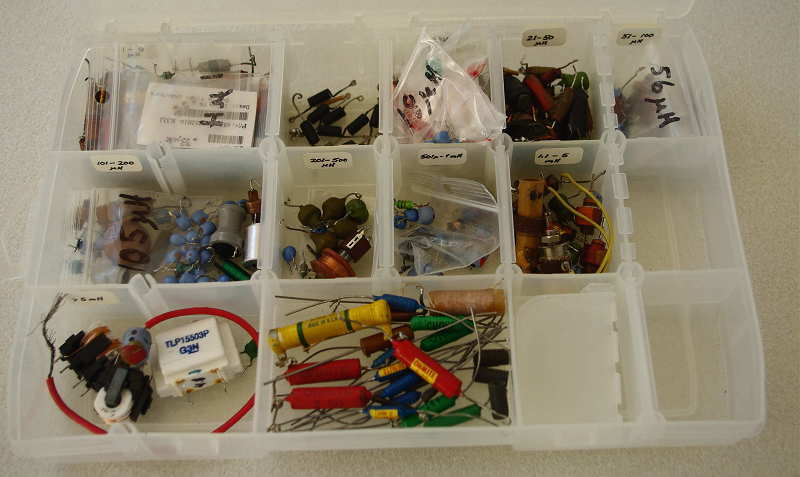
After a search of my RFC collection (see below), salvaged mostly from junked TVs, monitors, VCRs and other electronic cast-offs temporarily 'borrowed' for stripping from our local recycle center here on Mayne Island, I settled on a 1.2uH choke that I hoped would be a suitable replacement. It had just a few turns so I assumed it was wound on some sort of powdered iron or ferrite form. Whether or not it would behave at 144MHz was another question.
After reassembling the amplifier the following morning, I keyed up at full power during the EME window but halfway through my initial CQ I saw smoke and then flames coming from the inside of the case ... yikes! Shutting down immediately killed the fire and after tearing into the amp yet again, I saw that this time, the output coupling capacitor (C51) had completely destroyed itself.
The new inductor (L14) appeared a little heated, but I assumed it was only smoke-damaged from the nearby flameout of the capacitor. I replaced C51, an 820pF silver mica, with a higher rated one of the same value and, once again, gave it the smoke test ... literally.
After a few seconds, a whiff of smoke appeared from the back of the amp, followed by the SWR trip-out kicking in and shutting the amp down.
This time it appeared that the inductor was definitely complicit in the destruction of the capacitor as it was charred and black. I surmised that whatever core material the little inductor was wound upon, definitely was not suitable at 144MHz and had caused the little inductor to either change value or to saturate ... whatever it was doing had created a highly reactive condition in the output circuit, changing the output load impedance and sending the SWR sky-high.
This time I replaced the inductor with a homebrew one, wound on a plain phenolic former, hoping to avoid any ferro-magnetic / frequency compatibility issues. After reassembling the amplifier, it seemed to be happy once again and ran nicely for several 60 second JT65B sequences at full power with no smoke or component heating!
By this time I had run out of favorable EME windows as my moonrises were now too far to the south to keep me away from the neighbour's trees ... I'll just have to be patient and wait until the end of the month for the next definitive test. Let's hope there's no more smoke.
Steve McDonald, VE7SL, is a regular contributor to AmateurRadio.com and writes from British Columbia, Canada. Contact him at [email protected].
Software Defined Radios with Ria Jairam, N2RJ – ETH076
In this episode we talk about Software Defined Radios  with Ria Jairam, N2RJ. Ria has been a ham since she was a teenager but we won’t say how old she is now, that just wouldn’t be right. She is very knowledgeable about amateur radio, as well as IT topics as that is what she does for a living. She is another example of how amateur radio can help you in your professional career, because she was able to find and get her job through her amateur radio contacts.
We start out by giving just a general overview of what software defined radio is and where it came from. Did you know that you can actually see like 30 MHz of bandwidth on your screen at one time. Some radios allow you to select up to eight different frequency radios and show an individual waterfall display for each of them! How cool is that.
We talk about some uses for SDR’s in amateur radio and some of the equipment that you need to use one.
I also have a special offer that yall might be interested in as well, but I can’t tell you what it is, you have to check out the show notes or listen to the episode to find out.
Curtis Mohr, K5CLM, is the author/owner of Everything Ham Radio Blog and Youtube channel. Contact him at [email protected].
AWA in Chippendale
I’ve always been fascinated by the vibrant early history of the radio industry in Australia and in my hometown, Sydney. I was browsing through some early photos on Flickr in the ABC’s Radio History series and I noticed this photo from 1922.
I’ve been aware of so many sites of early radio manufacturers disappearing – including AWA’s gigantic campus at Ashfield – and ones closer to where I live in the inner west of the city. I didn’t realise AWA had a factory in Chippendale, or that it would be so close to a corner I travel through twice a day! But I suspected this was still there and it was – at least in 2016 when this Google Streetview image was snapped.
There’s been quite a lot of development in this part of the very inner city and it’s now a choice place to live. It’s also a few steps from the newly refurbished Lansdowne Hotel.
I was also surprised by what I saw in the old photograph. It looks like the crane hook cable is dangling across the electric power line. It looks like the crane operator has just noticed it as the photo was being taken, or maybe it was because of having to pose for the photo that the cable is where it is. In any case, the test transmissions led to the beginnings of regular radio broadcasting in the city in 1923.
JT65’s success. Who’s next?
Recent articles here on AmateurRadio.com by VE7SL on digital modes made me ponder about why JT65 is so popular nowadays. Like Steve I’ve also noticed rather empty CW and SSB portions of the band. Even psk31 signals hard to find, while the JT65 slice is overflowing with signals, often S9 plus many dBs in strength.
Steve lists the usual reasons often cited for its popularity: the waning sun, increased urban spectrum noise, working DX contacts at very low power levels and with modest antennas, no-code hams etc. But frankly, I think there is more to it.
Because, apart from JT65 there are many other modes that work well under difficult conditions. Take Olivia and all its derivatives. Like the JT-modes all based on MFSK and even deep in the noise you can still use them for meaningful communication over long distance. So why is JT65 king and Olivia not? Here is my list:
1) Lost voices
The smart phone has taken over as our main means of communication. However, 99% of its use is for written communication, not for voice. That written content is often not very extensive or deep: simply short bursts of information and often even in code like geek speak or emojies. I think many people either don’t want to, are too lazy to, or forgot how to talk in a meaningful way. The complaint about PSK31 was that is was mostly used for 599-73 macro QSOs. With JT65 you don’t even have the possibility to go deeper than 599-73, because it’s all that you can do with it. QSOs in Olivia can take an hour or more, because you can write whatever you like and engage in real conversation. The choice of the majority here: JT65.
2) No language barrier
Living in Asia I know that many hams here are intimidated by English. Speaking English is most awkward for many Chinese, Japanese and Korean. Part of it is lack of proper English education and part of it is saving face. Digital modes are far less intimidating. If your language and typing skills are sub-par then you rather not engage in more than a basic exchange. Thus JT65 is your best choice, Olivia clearly not.
3) The app generation
Whatever you use for the JT-modes, it’s basically like a smart phone app. Everything has been hashed out already and is presented on a silver platter. A few clicks of a mouse and you have made a QSO, automatically uploaded to a logbook on the web, probably including some form of QSLing. Compare that to Fldigi (the Swiss army knife of digital modes) where you have to find the right frequency, choose the right mode, zero in on the signal and only then you can start playing. For ease of use JT65 software is the master, Fldigi the not so convenient Jack-of-all-Trades.
3) Fixed frequencies with multi-decodes
Standards are a great thing and hard to come by. You can use JT-modes on any frequency, but there are designated meeting grounds if you are looking for a QSO. Added bonus is that on HF you monitor a 2 kHz wide portion of the spectrum, so you can quickly find the most interesting stations. Olivia has designated frequencies, too, but they are not set in stone, thus you are less likely to meet someone on air. FLdigi doesn’t guide you to a set frequency, that task is up to you. And with signals nowadays that can be received far below the noise floor and many not even visible on a waterfall the challenge of meeting someone on air is immense without fixed frequencies. The advantage here goes to JT65.
4) Standards, standards, standards
Oliva comes in the following varieties: 4/250, 8/250, 4/500, 8/500, 16/500, 4/1000, 8/1000, 16/1000, 32/1000 and 64/2000. Oh yes, the slightly improved version is called Contestia and sounds so similar that you can’t tell the difference by ear or on your waterfall. JT65 comes in one variety, its improved successor JT9 in one as well. Choice is a good thing, too much of it and it becomes hindrance. It should not be a problem to have and use multiple digi-modes on air, because the solution in IDing digi modes is RSID (or Reed-Solomon Identification). Unfortunately, not many programs offer this option and as a user you will have to turn this feature on by yourself. So, JT-modes know how to kiss (keep-it-simple-stupid), Olivia doesn’t (even though she is very sweet).
5) We’re still sheep
Apart from being hams we are also human. And humans display sheep-like behavior, following whatever trend or fad that is the talk of the day. Is JT65 a trend or a fad? I think both. The trend is towards more text based communication based on complex transmission protocols that can be used far below noise levels. JT65 falls in that category. The fad is “an intense and widely shared enthusiasm for something, especially one that is short-lived and without basis in the object’s qualities,” and JT65 falls in that category as well. Once something better, brighter, flashier comes along the herd of sheep will change course and follow the new kid in town.
Who will this new kid be? The one that plays it the smartest. And here, in my humble opinion, is the smart kid’s checklist:
– easy to use and understand app-like program
– fixed frequencies selectable inside the program
– a program that is build for all platforms including smart phones
– one standard transmission protocol or the auto-detection of it
– monitoring capabilities over a large frequency range
– lots of macros
– automated logging and QSLing
– fast transmission cycles
Now my hope is that the next mode that will reign the bands will allow for some more in-depts communication. From a technical standpoint JT-modes are very interesting and what can be achieved by them is phenomenal. But from a human standpoint I think they degrade the interaction between us hams to something that has very little meaning anymore.
I’ll leave you with this: a new digi mode called FSQ (Fast Simple QSO) has been getting some attention lately. If you take the above into consideration, will it be the next best thing?
Hans "Fong" van den Boogert, BX2ABT, is a regular contributor to AmateurRadio.com and writes from Taiwan. Contact him at [email protected].
Easy SOTA: Blue Mountain (W0C/SP-123)
Joyce K0JJW and I were preparing to drive back home from the mountains and began to consider what Summits On The Air (SOTA) peaks might be on the way and easy to access. I consulted with Steve WG0AT, who had a number of good suggestions but we ultimately decided on Blue Mountain (W0C/SP-123). This is an easy summit to get to and an easy summit to hike.
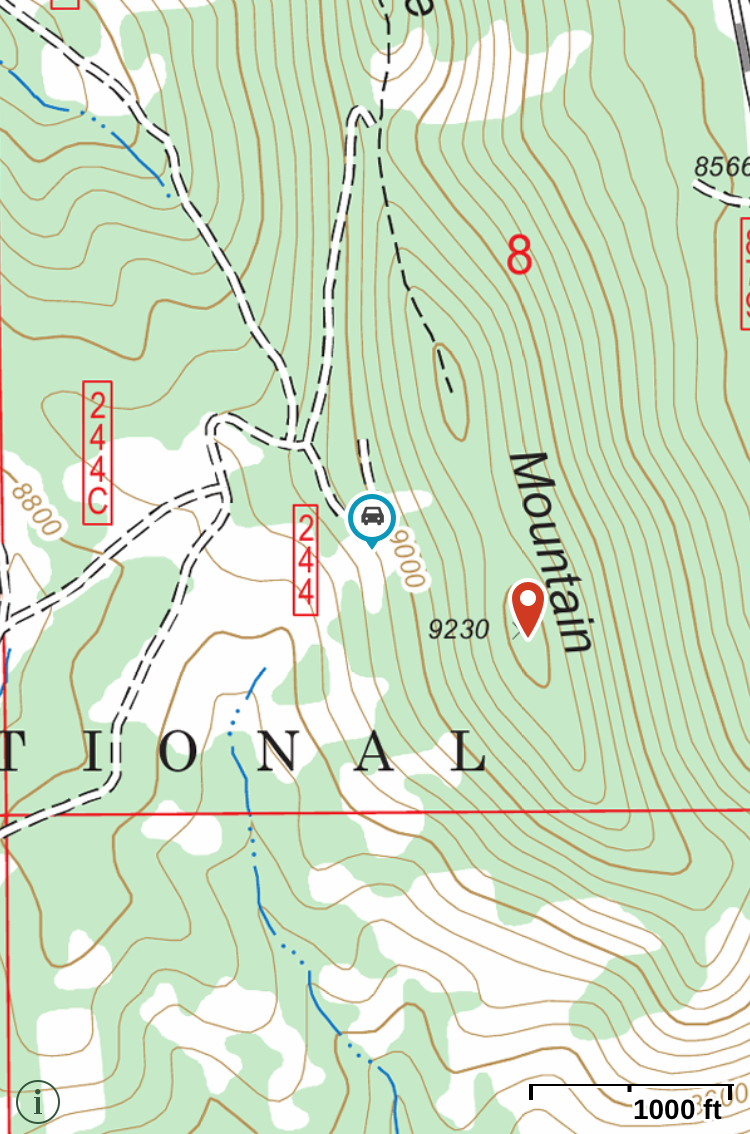 I found Carey’s (KX0R) trip report to be helpful, so I suggest reading that information. To get to Blue Mountain, just get on Blue Mountain Road (CR 61) heading south out of Lake George. Looking at your Pike National Forest map (you do have a National Forest map, right?), you’ll see that this road passes by Blue Mountain on the east side and then turns west. Take forest service road FS 244 to the right (north), which takes you up to the west side of Blue Mountain.This road turns into easy 4WD (challenging 2WD with high clearance). We just kept going on FS 244 (ignoring the side roads) and parked at the very last turn, as shown on the map (38.93108N, 105.35597W). At this point, you can just take aim at the summit (40.33530N, 105.28100W) and hike your way up. Approaching the slope at an angle makes it not quite so steep.
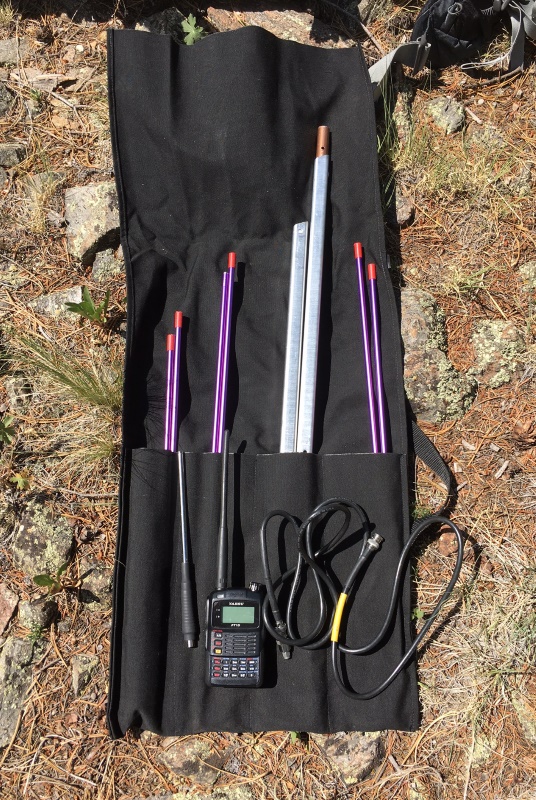 For this activation, we took along gear for 2m, 70cm and 23cm, FM only. Basically, this amounts to a pile of HTs and a few compact antennas. All of our contacts were on 2m FM except I did work Paul W0RW on Wilkerson Pass using 1.2 GHz (23 cm). At an elevation of 9230 feet, this location does pretty well on VHF and higher, so we easily worked stations in Buena Vista (W0BV), Woodland Park (WA6TTY) and Como (KD0VHD). We also worked a hiker (Jim, KD0MRC) on the side of Mount Yale, about 50 miles away.
The photo on the left shows my portable 2m FM station: Yaesu FT-1DR handheld transceiver, 1/2-wave Flex antenna (Smiley Antenna), and the dismantled 3-element Yagi (Arrow Antenna). I recently started using the Smiley halfwave antenna because it flexes on the connector end, making it more resilient to on trail use.
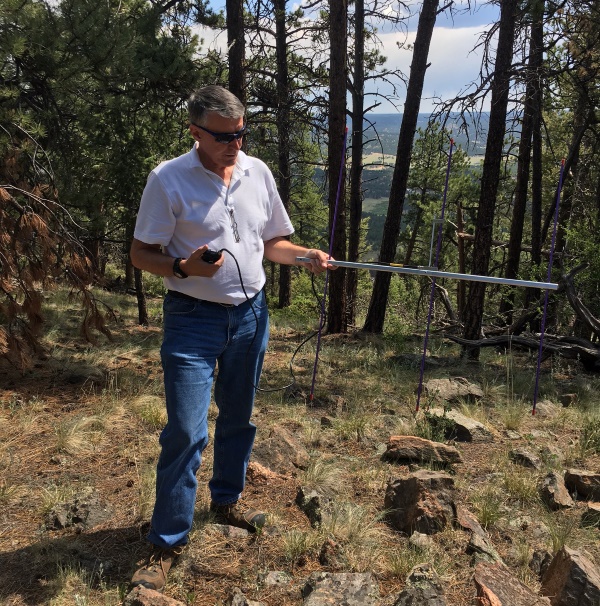 In the photo to the left, I’ve got the yagi antenna assembled and I’m using it to make contacts. With a little practice, the Arrow antenna screws together quickly and provides some nice gain over the halfwave vertical (about 6 dB).
We had excellent weather today so that helped make for a fun day. If you are in the Lake George, CO area consider Blue Mountain for an easy and fun activation.
73, Bob K0NR
The post Easy SOTA: Blue Mountain (W0C/SP-123) appeared first on The KØNR Radio Site.
Bob Witte, KØNR, is a regular contributor to AmateurRadio.com and writes from Colorado, USA. Contact him at [email protected].
Bike Ride and DX from East Andover
Judy and I rode our bikes on the old Northern Rail trail this afternoon. The weather was stunning. I worked England, Greece, Germany and the 13 Colonies station in North Carolina.

We started out across from the East Andover post office and rode our bikes east toward Dyers Crossing. Soon we came to the picnic table at Sucker Brook. I tossed a 33 foot wire over a maple tree and set up the KX3 on 20 meters.

The antenna wasn’t great because it was going in several directions… sloping this way and that around branches. But it worked well enough for me to make a quick QSO with my old friend Tom G3HGE in England. He had some interference and gave me a 449.

K2J in North Carolina was really strong. This is one of the 13 Colonies special event stations. Down the band a bit SV1CQN was calling CQ from Greece. We also made a quick exchange.

I was about to pack up when I heard DL2CC in Germany just finishing up a QSO. Frank was very strong to me and gave me a 559. He sent that he hoped I was having fun QRP portable. I assured him that it was fantastic to be out.
On the way back, Judy reminded me that we’re almost half way through summer.

Jim Cluett, W1PID, is a regular contributor to AmateurRadio.com and writes from New Hampshire, USA. Contact him at [email protected].
LHS Episode #193: All About AREDN
 This is the 193rd episode of Linux in the Ham Shack. In this episode, your hosts discuss ARRL Field Day, JT65 and new modes like it, the wonder of 6m and the E Layer, the NSA, patent trolls, useful command line utilities and more. We also have a great interview with Joe Ayers, AE6XE, about AREDN, the Amateur Radio Emergency Data Network. This one runs a bit long, but we thought it was worth it.
73 de The LHS Crew
Russ Woodman, K5TUX, co-hosts the Linux in the Ham Shack podcast which is available for download in both MP3 and OGG audio format. Contact him at [email protected].
 Ham Radio Deluxe |
 W5SWL Electronics |
 Ham Radio Prep |
 KB3IFH QSL Cards  Hip Ham Shirts  HamRadioAuctions HamRadioAuctions Reliance Antennas Reliance Antennas Enigma Shop Enigma Shop |  morseDX  Ni4L Antennas  R&L Electronics R&L Electronics antennas.us antennas.us QRV QRV |
- Matt W1MST, Managing Editor
