 |
 AmateurLogic 127: Winter Projects
 17 February 2019 | by
AmateurLogic.TV Episode 127 is now available for download.
Emile and the Ozone ARC participate in Winter Field Day. Winter is the perfect time to catch up on projects. Tommy shows how to update the firmware of a DVMega. After six years, George revisits Echolink on the Raspberry Pi. SVXlink part-1. Plus your viewer email.
1:11:25
George Thomas, W5JDX, is co-host of AmateurLogic.TV, an original amateur radio video program hosted by George Thomas (W5JDX), Tommy Martin (N5ZNO), Peter Berrett (VK3PB), and Emile Diodene (KE5QKR). Contact him at [email protected].
LHS Episode #272: The Weekender XXIV

Good grief! It's the latest edition of the Weekender! In this episode, the hosts put together a list of amateur radio contests and special events, upcoming open source conferences and a hefty does of hedonism that blends together and goes down like a luxurious sippin' whiskey. Thank you for tuning in and we hope you have an amazing upcoming fortnight.
73 de The LHS Crew
Russ Woodman, K5TUX, co-hosts the Linux in the Ham Shack podcast which is available for download in both MP3 and OGG audio format. Contact him at [email protected].
SOTA News: Joyce/K0JJW Is Half a Goat
Recently, my SOTA Activating Partner and Spousal Unit Joyce/K0JJW racked up more than 500 activating points for Summits On The Air (SOTA). This is halfway towards the coveted Mountain Goat award, so naturally this is referred to as Half Mountain Goat. Steve/WG0AT noticed this achievement and created this certificate for her.

She has activated 108 summits in 13 different associations (including HB Switzerland). All radio contacts have been on the VHF/UHF bands. She really likes it when another woman gets on the air with her, which she calls F2F (Female-to-Female) radio contact.
Congratulations, Joyce!
73 Bob K0NR
The post SOTA News: Joyce/K0JJW Is Half a Goat appeared first on The KØNR Radio Site.
Bob Witte, KØNR, is a regular contributor to AmateurRadio.com and writes from Colorado, USA. Contact him at [email protected].
A Blog a day: The Daily Antenna
The maestro of the Ham Video VK3YE , writer of a growing Amateur radio book collection along with his superb website to support his hobby vk3ye.com Has done it again, and now come up with a new challenge a new daily Blog called The Daily Antenna
The idea is to produce One blog per day on antennas, accessories and related topics.
I don't know how Peter finds the energy to fit it all in, but I certainly will be dropping in and reading from time to time and wish him well with his new venture
I will also drop the link into My Blog list on the right handside, because I know it will be a very valuable source of material.
Steve, G1KQH, is a regular contributor to AmateurRadio.com and writes from England. Contact him at [email protected].
LHS Episode #271: The Discord Accord

Welcome to Episode 271 of Linux in the Ham Shack. In this week's episode, the hosts discuss ARISS Phase 2, the Peanut Android app for D-STAR and DMR linking, a geostationary satellite from Qatar, open source software in the public sector, a new open-source color management tool, Linux distributions for ham radio and much more. Thank you to everyone for listening and don't forget our Hamvention 2019 fundraiser!
73 de The LHS Crew
Russ Woodman, K5TUX, co-hosts the Linux in the Ham Shack podcast which is available for download in both MP3 and OGG audio format. Contact him at [email protected].
FT8 on 20m this afternoon

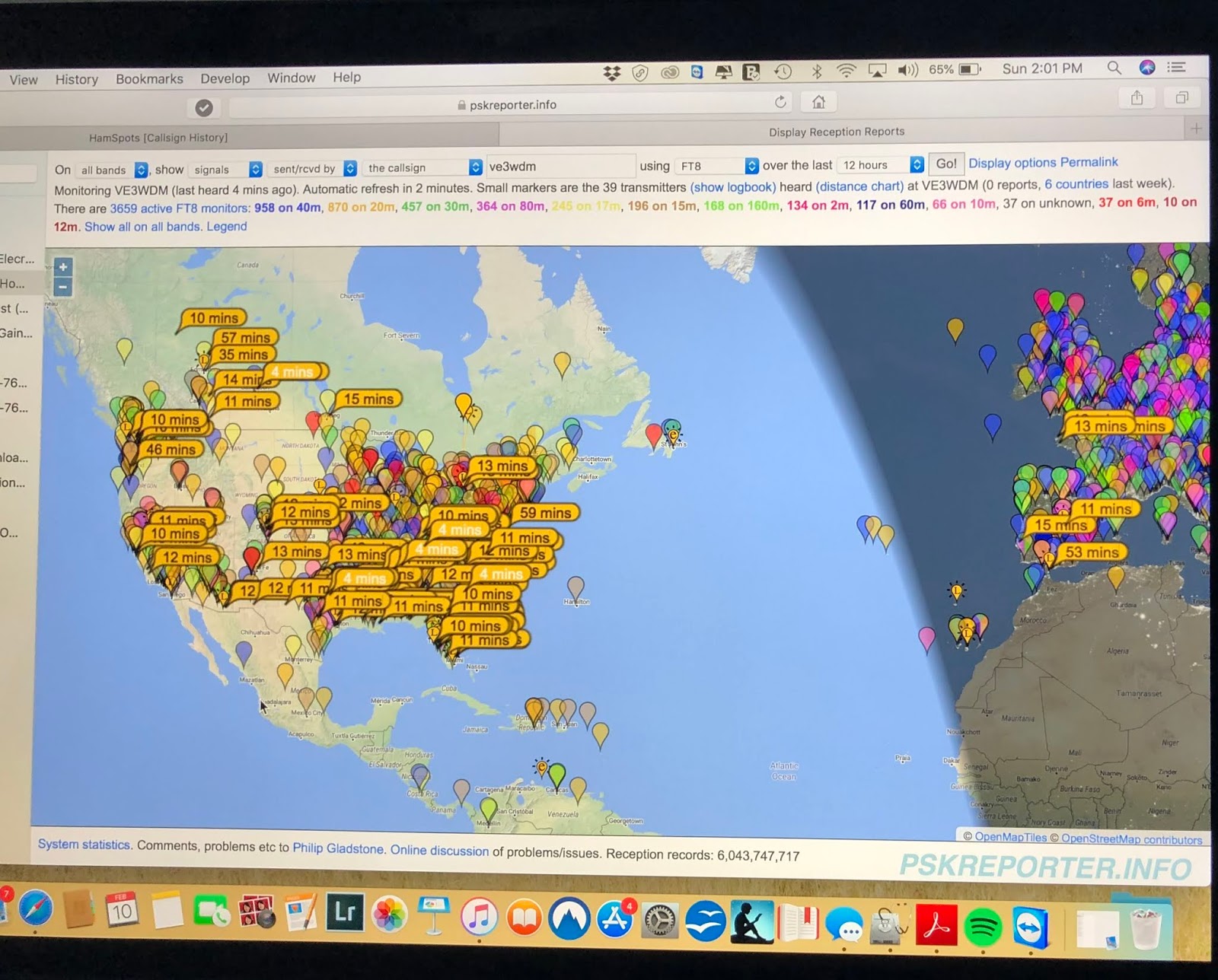
Mike Weir, VE9KK, is a regular contributor to AmateurRadio.com and writes from New Brunswick, Canada. Contact him at [email protected].
Mr. Carlson’s Lab – A YouTube Treasure
I recently watched two superb YouTube videos. The first described exactly how to determine the 'shielded' side of a fixed capacitor and the importance of knowing this information.
As you have probably noticed, most modern fixed capacitors no longer indicate the 'grounded' end or the lead going to the internal shielding. At one time, the capacitor's polarity was commonly marked with a band on one end but this is no longer the case ... even though one side is indeed still the shielded side. Depending on exactly what part of the circuit your fixed capacitor is being used in, connecting it in the reverse direction (shield going to signal side), can introduce hum, RF pickup, instability and generally result in poorer capacitor / circuit performance ... and all it takes to determine which lead is which is an oscilloscope!
The second video I viewed shows the process used to resurrect a Yaesu FT-1000MP in truly terrible condition. In a very professional step-by-step process the video shows the logical and systematic approach at making the radio better than new.
Both videos are done by a truly gifted engineer, Paul Carlson, VE7ZWZ, and are exceptionally well done ... the quality one would expect to have to pay for rather than freely view on YouTube.
If you visit Paul's YouTube channel, you'll find a host of other radio and audio-related videos and I guarantee that you will learn something of value ... and probably hang around to watch several more. They are really well done.
Steve McDonald, VE7SL, is a regular contributor to AmateurRadio.com and writes from British Columbia, Canada. Contact him at [email protected].
 Ham Radio Deluxe |
 W5SWL Electronics |
 Ham Radio Prep |
 KB3IFH QSL Cards  Hip Ham Shirts  HamRadioAuctions HamRadioAuctions Reliance Antennas Reliance Antennas Enigma Shop Enigma Shop |  morseDX  Ni4L Antennas  R&L Electronics R&L Electronics antennas.us antennas.us QRV QRV |
- Matt W1MST, Managing Editor
