 |
 VHF SOTA Near Fairbanks
 8 July 2019 | by
 Joyce/K0JJW and I were planning a trip to Alaska to visit several of the national parks. We had some time available while in Fairbanks to do some SOTA activations. We were traveling very light, so we took minimal SOTA gear: a pair of VHF/UHF handhelds and simple antennas.

We used my newly-fashioned antenna mount on a trekking pole we had with us. The trekking pole served us as as a trekking pole for hiking, a camera monopod and now an antenna support. It provides a handy way of supporting a vertical antenna and provides a little more antenna height when held up in the air.

I checked the SOTA database to identify easy-to-access summits near Fairbanks. There are several 1 and 2 point summits in the area with easy access. We were not looking for drive-up summits but we did want an easy hike.
I found that Dale/KL7R and Peter/K3OG had been activating in the area, so I contacted them via email and they both gave me helpful advice. We were a bit concerned about getting our four QSOs on VHF, but that turned out to not be a problem. We worked Dale from all three summits and he helped rustle up a few more stations to work. We had pretty good luck just calling CQ on 146.52 MHz. And I announced our presence and need for simplex contacts on the KL7KC repeater (146.88 MHz, 103.5 Hz tone).
We activated three summits:
Chena Ridge (KLF/FN-205)
We drove up Chena Ridge Road, then took a gravel road uphill towards the summit (I think it was labeled North Becker Ridge Road). At this point, we encountered a locked gate and parked there. Some locals wandered by and said that they hike up to the top every day, so come along. The hike was easy, less than one quarter of a mile with some elevation gain. At the summit is an FAA VOR site enclosed by a chain link fence.
Pedro Dome (KLF/FN-164)
Next, we drove north out to Pedro Dome, which has a substantial radio site on top. We took Steese Highway north from Fairbanks to Pedro Dome Road, a gravel road that goes right to the top of the summit. There are opportunities to make a wrong turn on the way up Pedro Dome Road but with a little care we were able to drive to the top. Despite the fact there are plenty of radio transmitters on the summit, we did not experience any interference on 2m and 70 cm. That summit has an excellent radio horizon, so it was easy to work stations in the Fairbanks area.

Wigwam Benchmark (KLF/FN-204)
Wigwam Benchmark is a summit that pokes up just north of Fairbanks. It is a bit more difficult to navigate because it in a rural residential area with lots of twisty-turny roads. I plugged “Noel Drive, Fairbanks, AK” into google maps, which got us very close. Then we drove to where Noel Drive meets Mia Drive and operated from the road. The area is heavily wooded and we did get attacked by the famous Alaskan mosquitoes, so we made our radio contacts and escaped quickly.
Summary
At one point, I told Dale that if we made one contact from one summit, we would be happy. But, of course, we tried for more than that and got it. It turned out to be a great day running around these summits near Fairbanks and making some radio contacts. Thanks to KL7R and K3OG for the assistance!
73 Bob K0NR
The post VHF SOTA Near Fairbanks appeared first on The KØNR Radio Site.
Bob Witte, KØNR, is a regular contributor to AmateurRadio.com and writes from Colorado, USA. Contact him at [email protected].
Magic Band Mid-Season Observations
 |
| courtesy: KC8RP FT8 Info |
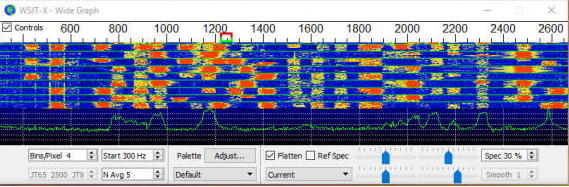
We are now half-way through this summer’s Sporadic-E season, normally the magic band’s best time of the year. The only exception to this being the winter months of those solar cycles that are robust enough to raise the F2 MUF up as far as 50MHz ... something that occurred for only two or three days during the peak of Solar Cycle 24.
Unfortunately, it really looks as if the old reliable bread and butter modes on 6m, CW and SSB, are fast going the way of the dodo bird, as very few signals on either of these modes have been heard here this summer. As speculated last year at this time, it seems as though the weak signal (WSJT) FT8 mode now reigns supreme on the band, which has come as a great disappointment to myself and many other diehard CW ops.
At the start of this year’s season I reluctantly decided to pay more attention to this mode and see if it could put any new DXCC entities into my 6m log ... if so, it would be time well-spent.
For the past several years, my main 6m interest has focused on European or South / Central American openings, which are usually unpredictable and short-lived. As usual, most of the season’s openings have been domestic, with signals from the central and south-eastern states being the ones most often heard. Usually, signals during these openings are strong and fairly reliable and lend themselves to easy two-way work on either CW or SSB. For the vast majority of summer time openings, FT8 is not needed, as signals are not weak.
For some reason, the popularity of this weak-signal mode on 6m continues to grow in popularity even though signals are so strong! Where this mode really shines is on the short-lived long haul openings to EU or on similar long paths from the PNW, of which there have been very few this season.
With everyone crowded into a narrow passband of ~ 2kHz, it doesn’t take much to mess things up for your neighbours if you don’t think carefully about how your operating can affect other users of that small sliver of space.
One of the most common examples of poor operating skills that I see is the seemingly endless CQ. This is much easier to do on FT8 than with conventional modes, as the software used can do this automatically for you, every 15 seconds ... while you fiddle with something else in the shack. I’ve seen some nearby stations call CQ continuously for over 60 minutes at a time, with no replies. What this does is make it difficult for other nearby users to actually hear / decode any weak signals on the band that are being covered by the loud CQing station(s) during this entire span of time. Strong local signals can wreak considerable havoc with weak-signal mode software as it's just not designed to happily handle strong signals and do a good job of decoding weak ones at the same time! Please think about this if you are one of those long CQers ... you are not the only one trying to use the band.
Another observation has to do with 'sequencing'. FT8 users must decide if they will transmit on the ‘even’ or on the ‘odd’ 15-second sequence. If you, and all of your neighbours are loud with each other, then it makes sense that everyone is better off operating on the same sequence. This way, all locals are transmitting at the same time which means they are all listening at the same time as well ... nobody causes QRM for one another if everyone uses the same sequence.
This comes off the rails very easily when just one or two strong neighbours choose to transmit during the receive sequence being used by everyone else.
There has been a long-standing precedent for sequencing, established and utilized by meteor-scatter operators for several decades. It calls for stations on the eastern-most end of a path (Europeans for example) to transmit on ‘evens’ ... the ‘0-15’ and ‘30-45’ second segment of each minute. Stations on the western-end of the path (NA) transmit on the ‘odds’ ... ‘15-30’ and ‘45-60’ second portion of each minute. When looking towards JA later in the day, everything reverses for NA stations, as they now become the eastern-end of the path.
Some operators seem to get totally confused by this or don’t check to see what sequence is being used locally before starting to operate ... while some don’t really seem to care.
I’m not complaining about what a given amateur chooses to do but simply describing some of the roadblocks to better use of FT8 and why it is not necessarily very well-suited for 90% of the typical propagation seen on 6m Es.
Many of the newer stations often seem to be using poor or makeshift antenna systems on 6m and are often not able to hear stations responding to their CQs, which may be strong enough locally to disrupt reception for those that are able to hear weaker signals.
I have deliberately made a point of never calling CQ on FT8. From decades of CW DXing I have come to understand that it’s much easier to work DX, on any band, by spending your time listening ... and then calling when the time is right. It’s no different with FT8, yet I see CQs that go on forever. Some will argue that if nobody called CQ, then there would be nobody to hear, which is of course valid ... the reality is, most amateurs cannot resist calling CQ, especially DX stations who enjoy working a pileup. There seems to be no shortage of CQers and those seeking DX should take advantage of that fact.
One loud station was seen yesterday calling another for over 90 minutes-straight. Perhaps he had wandered away from his shack and had forgotten to ‘Halt Tx’ before leaving! FT8 users need to understand how to use their software efficiently.
As for PNW to EU propagation this summer, it has been almost non-existent although I have worked CT1HZE in Portugal and JW7QIA in Svalbard ... by listening ... listening ... and calling briefly, both on FT8. In both cases, signals were brief but strong enough for CW! During the short-lived appearance of the JW7, two NA stations were noted calling ‘CQ JW’ the entire time. Perhaps if they had spent this wasted time more wisely by listening, they would have worked JW.
I’m happy to report that Svalbard was a new DXCC entity for me on 6m, #88, and the first 'new one' in a few years.
It seems that when used sensibly, FT8 is a useful application to have in your DX toolbox ... but for most daily summer Es operation, it’s just not needed. CW or SSB is well up to the task most of the time, even for small stations. Where FT8 shines is on the very brief, often unstable, long haul (EU-NA or JA-NA) paths and then, only if your neighbours don’t do things that will get them into the naughty-corner!
Now, let’s see what the second half of the season has in store for the magic band .... maybe the best is yet to come.

Steve McDonald, VE7SL, is a regular contributor to AmateurRadio.com and writes from British Columbia, Canada. Contact him at [email protected].
ICQ Podcast Episode 298 – Ham Radio 2019
In this episode, Martin (M1MRB) is joined by Chris Howard (M0TCH), Dan Romanchik (KB6NU) and Frank Howell (K4FMH) to discuss the latest Amateur / Ham Radio news. Colin M6BOY rounds up the news in brief and this episode’s feature is Ham Radio 2019.
ICQ AMATEUR/HAM RADIO PODCAST DONORS
We would like to thank our monthly and annual subscription donors for keeping the podcast advert free. To donate, please visit - http://www.icqpodcast.com/donate
- UK Amateur Radio Exam Statistics for 2018 Released
- Using AIS Metadata to Monitor Propagation in the 2m Band
- 16-year-old Ham Radio Satellite Builder
- New 8-Meter Amateur Band?
- 144 MHz and the WRC Process
- ARRL Amping up Code Proficiency Awards
- Walmart Parking Lots on the Air 2019
- Scientist Cathryn Mitchell, M0IBG, Honored for Ionospheric Imaging Research
- Friedrichshafen Ham Radio - Attendance Falls Again
- AM3WRG - World Roller Games
Colin Butler, M6BOY, is the host of the ICQ Podcast, a weekly radio show about Amateur Radio. Contact him at [email protected].
TX Factor Episode 23 is Live!
We explore the process of music audio mastering at Mike Marsh G1IAR’s studio in south Devon. Mike shows us how the latest TX Factor theme tune was mixed and mastered, and demonstrates the process of cutting the audio onto vinyl disc – such nostalgia! Nick Bennett 2E0FGQ visits the National Radio Centre at Bletchley Park where Noel Matthews G8GTZ and Graham Shirville G3VZV demonstrate how set up and operate over the new geostationary satellite, Oscar 100. Plus, Bob McCreadie G0FGX visits the folks at Icom UK with a full review of Icom’s long-awaited VHF / UHF all-mode transceiver the IC-9700.
Nick Bennett 2EØFGQ co-hosts TX Factor with Bob McCreadie GØFGX and Mike Marsh G1IAR. Contact the team at [email protected]
Things were just going to smooth……….
Mike Weir, VE9KK, is a regular contributor to AmateurRadio.com and writes from New Brunswick, Canada. Contact him at [email protected].
A Day at the Beach (DX and 13 Colonies Event)
Judy and I went to the beach today. Holy cow! It was so perfect… 85F and sunny. The propagation was pretty good too. I worked Colombia, a bunch of the 13 Colonies Special Event stations and had a great QSO with Jim N3JT.
While Judy was swimming, I set up at a bench overlooking Rye Harbor. I used the KX3 and a 33 foot mast with a half wave wire, strapped to the bench.

I used a 9:1 unun between the rig and the wire. It tuned perfectly
on both 20 and 40 meters.

Right away after tuning up on 20 meters, I heard Frank HK1/DL5PV calling CQ. I was surprised that he was so strong. We completed the exchange easily. Then I worked five of the 13 Colonies stations. They were all very strong and I received quick replies.
From the bench I could gaze out at the expanse of the ocean beyond the harbor entrance. In the foreground was a hedge of wild roses (Rosa Rugosa).

The fragrance of the roses enveloped the whole area.

I operated about a half an hour. Here’s my log:
2 Jul-19 1940 14.008 HK1/DL5PV CW 599 599 Colombia
2 Jul-19 1944 14.039 K2L CW 599 599 SC
2 Jul-19 1952 14.023 K2B CW 599 599 VA
2 Jul-19 1958 7028 K2M CW 599 599 PA
2 Jul-19 2000 7034 K2H CW 599 599 MA
2 Jul-19 2010 14.031 K2F CW 599 599 MD
2 Jul-19 2011 14.028 N3JT CW 599 599 VA
Certainly the most fun QSO was the last. Jim N3JT was operating from Virginia with 15W. We had a great path. At one point Jim turned on the amp and ran a KW. His signal jumped several S units. But it still sounded great when he returned to low power. After a few minutes the QSB hit us and we signed.
While I was still at the beach, I received a nice email from Jim.
“Fun QSO for as long as it lasted, Jim! You were honestly S9 at the very beginning, then settled to about S7. But at the end your signal went into the noise.”
No matter. It was a perfect day for an adventure at the beach…. and a perfect spot to play radio for a while.
Jim Cluett, W1PID, is a regular contributor to AmateurRadio.com and writes from New Hampshire, USA. Contact him at [email protected].
Canada Day Contest at the Pemigewasset
Judy and I rode our bikes down to the Pemi today. It was an incredible summer day… perfect. I operated the Canada Day contest and made a dozen nice QSOs including Panama.

We headed north along the old road and stopped at a bend in the river about a mile upstream. A nice breeze kept the mosquitoes at bay. The edge of the road was strewn with wildflowers. Here’s a yarrow plant that grew next to me as I operated.

The river was unusually full from recent rains.

I tossed a 30 foot wire over a pine branch and sat down at the edge of the road. I set up the KX3 and operated exclusively on 20 meters.

The band was surprisingly good given the recent conditions. There was a lot of activity in the Canada Day contest. Here’s my log. I only operated for 15 minutes:
1 Jul-19 2042 14.019 VE1AYY CW 599 599 NS
1 Jul-19 2044 14.024 W7F CW 599 599 AZ
1 Jul-19 0247 14.029 VE3CX CW 599 599 Ont
1 Jul-19 2048 14.037 K8JQ CW 599 599 WV
1 Jul-19 2050 14.038 N8AA CW 599 599 OH
1 Jul-19 2051 14.041 W4PM CW 599 599 VA
1 Jul-19 2052 14.049 WA0MHJ CW 599 599 MN
1 Jul-19 2054 14.043 K2J CW 599 599 NC
1 Jul-19 2055 14.034 VE5MX CW 599 599 SK
1 Jul-19 2057 14.021 K3KU CW 599 599 MD
1 Jul-19 2058 14.014 HP3SS W 599 599 Panama
K2J wasn’t in the contest. This is a designated station in the 13 colonies event.

It’s hard to believe it’s already July. Tomorrow Judy and I are heading to the seashore. I’ll bring the rig.
Jim Cluett, W1PID, is a regular contributor to AmateurRadio.com and writes from New Hampshire, USA. Contact him at [email protected].
 Ham Radio Deluxe |
 W5SWL Electronics |
 Ham Radio Prep |
 KB3IFH QSL Cards  Hip Ham Shirts  HamRadioAuctions HamRadioAuctions Reliance Antennas Reliance Antennas Enigma Shop Enigma Shop |  morseDX  Ni4L Antennas  R&L Electronics R&L Electronics antennas.us antennas.us QRV QRV |
- Matt W1MST, Managing Editor
