Rising Dues Lifts CEO & CFO’s Boats…
SUMMARY: The roiling of the membership over the recent dues increase and annulments of multi-year subscriptions is significant, causing a substantial share of the membership to reach a Howard Beale moment. They are mad as Hell and not going to take it anymore by just not renewing their memberships. These defections have reduced League membership to only 18 percent or less of the full licensed ham radio market. It was little known, however, that in the two-year run-up to the July 2023 dues increase were significant compensation adjustments to the CEO and CFO of the League. These amounted to some $150,000 over the two budget cycles, as reported to the IRS. Some on the Board say privately they were not aware that these raises were bundled into the full budgets when they were put forth for a vote. This procedure is clearly not consistent with IRS guidance to non-profits receiving tax exemptions under the 501c3 code. An arms-length assessment of CEO compensation reported here shows little to no evidence supporting the pay increases. The practices of the League in how these matters are conducted are not consistent with best practices in the non-profit industry.
There has been almost no issue that has raised the hackles of the ARRL membership like the July 2023 Board decision to raise dues. They also decided not to honor existing two- or three-year memberships that members had bargained for and paid their money. The often-used phrase, a rising tide lifts all boats, comes to mind here but in a rather perverse way. While President Kennedy used the phrase to great political benefit, it doesn’t translate well to all budgetary situations. Raising dues for the League might to some sitting around a Boardroom table be a means to cover shortfalls that the main attraction, QST, has accrued due to rising glossy color paper costs. But it won’t if that dues increase causes members to simply not renew! In fact, it might be a very poor fiduciary decision by the Board that is detrimental to the best interests of the non-profit corporation.
It is a bit more than that, it seems to me. The broken promise made to those with existing two- or three-year ARRL subscriptions was just downright unethical. It made many feel like the character Howard Beale in the movie Network who famously yelled at the top of his voice: I’m mad as hell and I’m just not going to take it any more! And, they haven’t, to the tune of over 1,000 per month a current Board member tells me in confidence. (The League typically doesn’t publicly speak of such things.) Another Board member says that it’s closer to 2,000 per month. Either way, it’s a lot of former members who decided to not take it anymore. It certainly appears to be moving in that direction.
In essence, rising dues lifted the CEO and CFO’s boats. Let me explain the sequence of actions that leads to that conclusion. It’s detailed so bear with me as it is something that most members may well not be aware of since the League considers such matters corporate secrets (but they shouldn’t, according to the IRS Guidance for non-profits).
In essence, rising dues lifted the CEO and CFO’s boats.
The Salt in the Wound of the Dues Increase
I’ve written a bit about those who are not renewing their ARRL memberships. This article focuses on the salt in the wound. Because the League publicized how “hard” the decision was to increase the dues burden on members, I want to reproduce what the President, Rick K5UR, said on the League website here:
Yesterday [author’s note: July 22, 2023], the ARRL Board of Directors completed their second annual meeting. I’m writing to let you know that they made the tough, but necessary, decision to increase the regular membership dues rate to $59 a year starting January 1, 2024 (see 2024 Dues Rates). Additionally, we have chosen to separate the printed, mailed magazine from regular membership. Members will be able to choose whether they want to add-on a print subscription to any of our magazines including QST, On the Air, QEX, and NCJ. All members will continue to have online, digital access to each of these four magazines and the digital archive as part of their regular membership benefits.
Since it was financial pressure that the League used to justify the dues increase, they referred to a survey conducted by them of over 20,000 members who opted-in to the online survey. I’ve included the main slide below for reference, under the Fair Use copyright clause. I will note in passing that this is very under-analyzed as a survey. I requested a copy of the raw survey data at my annual ARRL Delta Division Convention in January 2025 held by Director Norris K5UZ at the Capital City Hamfest. He publicly said he would obtain it for me. I sent a follow-up e-mail to David and President Roderick K5UR officially requesting the raw data and documentation. I’ve yet to receive any reply from this request.
Only 18 percent said they would pay more to get a print edition of QST…The Board as a group largely ignored these results in their final decision.
Only 18 percent said they would pay more to get a print edition of QST. Almost half (43%) said they wanted the printed magazine as part of their membership dues. Over one-third (39%) said they’d just go digital. (Personally, I go digital in everything I read if I can.) But this was the membership speaking through this survey. The Board as a group largely ignored these results in their final decision. I’m told that it was a contentious discussion, with one Board member having “run the numbers” to say they wouldn’t lose many members but claiming his work was “proprietary” when another Board member asked to see how he computed that result. (Try telling your math teacher that your work is “proprietary” on your math test.) That is no way to manage a non-profit organization, especially as it is at variance with the IRS guidance to non-profit Boards regarding transparency in business dealings.

Here is the ARRL’s statement by President Roderick K5UR on the Board decision, speaking as Chair of that Board of Directors.
The cost of doing business goes up every year. During the last couple of years, the costs associated with printing and postage have increased significantly. We’ve cut and delayed hiring for some positions on our professional staff – one of the smallest teams we’ve had staffing our headquarters in Newington, Connecticut, in years. We are also continuing to examine other cost-saving measures, but we cannot go further without reducing or eliminating benefits and programs which our members have told us are important to them. I can assure you that the ARRL Board exercises due diligence and oversight in making sure your association is a good steward of your membership dollars. The reality is that ARRL does a lot – in fact much more than dues cover. President Roderick, July 23, 2023, ARRL Bulletin.
It rises to a Howard Beale moment, however, that the League was not under such financial pressure the previous two years that they could not give their CEO a $100,000 raise in total compensation. They also gave their CFO a $50,000 raise. Please go back and reread the previous sentence to let that sink in a bit. Let me put it in the context of dues-paying members. The $150,000 raises for the CEO and CFO is what 2,542 members pay per year for dues. How much of those raises would have offset the increase of $49 to continue receiving the printed edition of QST? OK, it’s 3,061 members. That would not have covered all of it so I want to be clear about that. It just comes to a subjective, ethical viewpoint, it seems to me. It’s the principle of the thing that tends to make members mad as Hell and not take it anymore.
It rises to a Howard Beale moment, however, that the League was not under such financial pressure the previous two years that they could not give their CEO a $100,000 raise in total compensation. They also gave their CFO a $50,000 raise.
Trends in ARRL Executive Compensation
Maybe I’m wrong. So let’s look at the numbers. The League must file Form 990 each year to the IRS to maintain their non-profit status under the 501c3 regulations. They file a version of the form here. I also get the same forms of data directly from the IRS as I’ve used 501c3 data in my research on social movements for a couple of decades now so I’m familiar with it.
Here are the trends in annual compensation for three ARRL executive positions, the CEO, CFO and the COO/Director of Operations. With the turnover in the CEO position, there are partial years of salary and fringe benefits which I’ve indicated by expressing “partial years” in fractions (e.g., 2018, 2018.3, 2018.6). This presents some challenge for the reader to follow explicitly but I’ll add a simpler summary chart below. I wanted to present the data as accurately as I can from the declarations that the ARRL has made to the IRS through the annual Form 990.
The CEO’s compensation has moved from about $150,000 a year to over $350,000 a year during the past 13 years. The spikes with each CEO’s name (or CFO, etc.) reflect the “full year” salary but I’ve also shown those in a follow-up set of charts, too. The timeline taken from the League’s website is also shown in the chart’s legend. The clear changes in this set of trends are the escalation in both the CEO and CFO’s compensation package since Mr. Minster’s arrival at League HQ. The CEO’s raises are two consecutive $50,000 increases which were just prior to the July 2023 Board decision on the dues increase. I’ve added a vertical line to illustrate the official Board decision date for the dues increase and change in subscription terms. This illustrates the Board actions taken in the run-up to the controversial dues increase and regeging on multi-year subscriptions.
It’s difficult for the average member to understand President Roderick’s published statement, “We’ve cut and delayed hiring for some positions on our professional staff – one of the smallest teams we’ve had staffing our headquarters in Newington, Connecticut, in years,” when they’ve given the CEO a 40 percent raise and 18 percent for the CFO. Let’s put it into a clearer picture by compiling the “full year” of service and compensation levels for the League’s CEO position.
The bar chart gives the “full year” equivalency to each CEO’s compensation since 2010 and ignores the partial years in the line graph above. After Sumner retired, the hiring of Gallagher for three years reflected an 18 percent increase. It was stable in the transition from Gallagher to Michel at about $230,000 per year for each. Shelley was already on staff and functioned as both CFO and CEO during 2020 at a lower salary as Interim CEO. The hiring of Minster initially represented a raise of just over 5 percent compared to the previous CEO (Michel). At that time, however, the League increased CEO Minster’s compensation from some $249,000 to $305,000 to $348,000, a full one hundred thousand dollar enhancement.
The other main executive, the Chief Financial Officer, was not left out of this pay enhancement package. For the CFO position, it is clear that when Middleton replaced Shelley in 2018, she received a lower entry salary of about $30,000 less. However, it was increased by about $50,000 in 2019 and subsequently to about $237,000 for 2023. This reflects an approximate 18 percent increase, over $50,000 since she was hired into the position. We are not told what qualifications that Mr. Shelley or Ms Middleton hold for the CFO position or what precipitated these dramatic raises, especially at a time of supposed financial exigency over the flagship product to the membership, the QST magazine.
Were the Executive Raises Justified?
How is such a decision about executive compensation reached? We’ve all read about scandals involving some non-profits who pay exorbitant compensation to the top executive and do little to benefit the common good claimed to the IRS in exchange for a tax exemption. This is why the IRS provides specific rules for guiding non-profit charities in these matters. The IRS requires that 501c3 non-profits tell them the method used for executive compensation. This is a mechanism to keep “good faith” principles in play for corporations receiving non-profit charity status, relieving them of paying taxes on revenues received during the year. This statement is contained in Schedule O of Form 990 filed for tax year 2023. I’ve reproduced the League’s legal statement to this effect below:
The ARRL’s official filing with the IRS in 2023 says that the CEO is compensated as determined by the Board of Directors based on the recommendation of the Administration and Finance Committee. This committee is appointed by the President. This official committee of the full Board bases this recommendation on their assessment of the performance of the CEO in comparison to a set of goals and objectives for the organization and the individual. There is no definition of these goals and objectives in the document or anywhere on the League’s website. Members thus have no idea what the specific directions for the League are as established by their Board of Directors. Is this sufficiently transparent vis-a-vis the IRS guidance for non-profit charities?
The ARRL has stated to the IRS that there have been NO changes in the method used to determine CEO compensation since 2008. There was no mention of any external salary survey conducted by a consultant (see below)…It smacks of boiler-plating narrative that has little relevance to the operational activities of the organization. And it does not follow best practices for the non-profit industry. Not by a long shot!
I’ve reviewed all of the ARRL Form 990 filings back to 2001. This statement on CEO compensation is constant verbatim from 2008, the first year the IRS added the Schedule O declaration, to the present filing. The ARRL has stated to the IRS that there have been NO changes in the method used to determine CEO compensation since 2008. There was no mention of any external salary survey conducted by a consultant (see below). Frankly, it reads like an attorney wordsmithed the narrative so that the Board could just act on a current whim of the person in the CEO position rather than on external criteria that retain objective job performance assessments. I’ve seen this before. It smacks of boiler-plating narrative that has little relevance to the operational activities of the organization. And it does not follow best practices for the non-profit industry. Not by a long shot!
Here’s where the story gets very squirrely indeed. Several of the current Board members have told me that they never saw this recommended compensation increase from the Administration and Finance Committee. Yet, it is clearly and specifically part of the IRS guidance for the full Board to officially adjudicate such raises as part of their fiduciary responsibilities. When the A&F Committee was questioned about this afterwards, I’m told that the reply was it was bundled into the full annual budget for the League which the full Board voted to approve. Since the CEO’s raises occurred over two budget years, it is puzzling how the full Board would vote in the affirmative the second year after being hoodwinked during the first year’s budget approval process. Very puzzling. From what the average person can read from the IRS website for guidance to 501c3 charities, this is at variance with those guidelines and does not maintain high fiduciary standards required of the Board of Directors. Remember: the Directors can’t talk about “company” work with the members who elected them but they can’t seem to talk to one another either.
Moreover, one Board member told me something even stranger. He said that he was told by the A&F Committee that a salary survey was conducted by an external company as hired by the League at the behest of the current CEO. The actual report was not shown to the Board member even though he demanded a copy as part of his fiduciary obligation to the corporation. The external company they hired is, I’m told, out of business as of shortly after the report was tendered. That report was not shared with Board members outside of the Administration & Finance Committee although it was requested by several of them. My source on the current Board said he was told that there were no “comparable” non-profit charities in the Newington area so for-profit corporations were used to establish the comparable worth of the CEO and the CFO. If so, this is an egregious departure from best practices to establish objectively-based CEO compensation standards by a non-profit 501c3 charity.
Best Practices on Determining CEO Compensation for Non-Profit Charities
The best practices for non-profit corporations are rather clear. But the ARRL does not seem to have had staff who are experienced in the non-profit world and few Board members’ biographies seem to indicate such management experience either. The apparent culture of the organization is to have “ham operators” run the corporation, regardless of their background, training or experience. So let’s briefly review what are the relevant non-profit guidelines used as best practices in the industry.
The IRS issued a guidance document some years ago regarding non-profits who qualify as charities.
IRS-Governance-PracticesI encourage the reader to take the time to review this document if you are concerned about the ARRL and what it does for the hobby. It is part of the bargain made by a corporation to receive an exemption from paying federal taxes on revenues and to give donors protection that their own declarations to the IRS are valid charity donations. Here are some pertinent excerpts [emphasis added]:
- A charity may not pay more than reasonable compensation for services rendered. Although the Internal Revenue Code does not require charities to follow a particular process in determining the amount of compensation to pay, the compensation of officers, directors, trustees, key employees, and others in a position to exercise substantial influence over the affairs of the charity should be determined by persons who are knowledgeable in compensation matters and who have no financial interest in the determination.
- The Internal Revenue Service encourages a charity to rely on the rebuttable presumption test of section 4958 of the Internal Revenue Code and Treasury Regulation section 53.4958-6 when determining compensation of its executives. Under this test, compensation payments are presumed to be reasonable if the compensation arrangement is approved in advance by an authorized body composed entirely of individuals who do not have a conflict of interest with respect to the arrangement, the authorized body obtained and relied upon appropriate data as to comparability prior to making its determination, and the authorized body adequately documented the basis for its determination concurrently with making the determination.
- Comparability data generally involves looking to compensation levels paid by similarly situated organizations for functionally comparable positions. One method is to obtain compensation surveys or studies from outside compensation consultants for this purpose. The Internal Revenue Service will look to the independence of any compensation consultant used, and the quality of any study, survey, or other data, used to establish executive compensation. Once that test is met, the Internal Revenue Service may rebut the presumption that an amount of compensation is reasonable only if it develops sufficient contrary evidence to rebut the probative value of the comparability data relied upon by the authorized governing body.
Thus, there should be an independent review by knowledgeable and independent persons on executive compensation based on “rebuttable” comparable data. This comparability date involves examining the compensation levels for comparable positions in other non-profit charities.
The Foundation Group suggests using “arms-length” procedures when assigning salaries. “You can do all the due diligence you want, and come up with the nation’s most reasonable compensation package, but if your compensated executives effectively decide their own pay, then trouble awaits you.” I have to wonder about the supposed outside company who did the salary assessment. Was that company hired by the CEO? We just do not know. And neither do members of the Board who are not on the Administrative and Finance Committee!
The Council for Nonprofits says this. “The independent body should take a look at “comparable” salary and benefits data, such as that available from salary and benefit surveys, to learn what nonprofit employers with similar missions, and of a similar budget size, that are located in the same or a similar geographic region, pay their senior leaders. Example: it would not be comparable to compare the compensation of a CEO of a large urban hospital or university to that of a rural day care center’s CEO.“
The key part of these best practices for executive compensation is: “The independent body that is conducting the review should document who was involved and the process used to conduct the review, as well as document the full board’s decision to approve the executive director’s compensation (minutes of a meeting are fine for this). The documentation should demonstrate that the board considered the comparable data when it approved the compensation.“
To follow best practices for non-profit charitable corporations, the ARRL would have to share a document of how the A&F Committee used comparable external data to inform them about the very large raises given to the League’s CEO and CFO in the past couple of years. (Here is a sample cover policy from the Council for Nonprofits.) No review of the minutes would document this process. If what I’m told by current Board members not on the A&F Committee is true, they were never shown the report but only told that for-profit corporate executive compensation data “had” to be used. My reading is that this approach, to hide the increases in the full budget without clear and explicit consideration by the full Board of Directors, is very much at variance with both the IRS guidance and best practices in the non-profit charity arena.
To illustrate how a comparable non-profit charity classified in the same NTEE category as the ARRL handles this, I’ve extracted the Schedule O statement from Form 990 filed by Chicago Public Media Inc. Notice how this non-profit follows a close compliance with the IRS Guidance on external, arms-length data to determine benchmarks and performance with which to compensate their Chief Executive Officer. They, too, have a compensation committee. But unlike the ARRL, what their committee does and how it goes about recommended executive compensation is shared with the full Board in official minutes. This is far afield from what I’m told by current and former Board members as to how this works in the ARRL.
So we are left to conclude from what the League has told the membership and most of the Board that we simply do not know if the significant compensation increases are justified or not or even how they were derived by the Committee. But we can do that analysis our self so the reader can make a determination of that justification themselves.
Establishing Comparable Worth for the ARRL CEO Position
What are comparable non-profit charities with which the ARRL should be compared? There are several factors that shape CEO compensation. Size of the organization in terms of employees and expenses; geographical area of the labor market, and mission of the non-profit charity. I have taken the IRS non-profit charity dataset for 2022 for the employees and annual expenses, geocoded each corporation’s address to a location and identified the Bureau of Labor Statistics Labor Market Area for Newington CT, and used the IRS taxonomy on the mission of 501c3 corporations, the NTEE code. The ARRL is classified as A34-Radio as its mission classification.
Here is a representation of all non-profit charities with 501c3 status in the Newington CT area. The BLS Labor Market Area is outlined in tan with points in blue used for the charitable organizations. The NTEE classification for ARRL (A34) is shaded in red for reference. The reader can see the number of non-profits located within the Labor Market Area containing Newington. I’ve not shown the entire State of Connecticut but I will use that geography as well as the U.S. as a whole in my analysis of comparable worth for the CEO position.
The following chart is from Statistica, a leading data company who compiles data on many social and economic topics. This graphic shows average CEO compensation by fiscal size of the non-profit (annual expenses). The ARRL reported $13,744,234 to the IRS in 2022 for total expenses. The reader can see that for the nation as a whole, the average CEO compensation for this size non-profit was $244,690. To reach the current ARRL CEO salary and fringe benefits package of $352,793, the League would need to have more than four times more expenditures to be commensurate with national norms.
If we compare just Connecticut non-profits, the CEO salary is substantially above the median compensation of $158,000. In fact, it’s over twice the median compensation for Connecticut non-profit CEOs.
The mission focus of a non-profit charity also shapes CEO compensation. The National Taxonomy of Exempt Entities (NTEE) used by the IRS to classify these non-profits is how comparable charities are evaluated. I’ve taken the NTEE A34-Radio class for the ARRL and compared it nationally with all other classes in the chart below. On the first view, ARRL-class charities have CEO compensation far less than do others. This is largely because of some very large health-related charities whose CEOs are compensated in the millions of dollars. (These include entities like the Kaiser Foundation Health Plan Inc., Santa Fe Healthcare Inc., and so forth.) There are no similarly compensated Chief Executives in the ARRL-class of charities.
In general, A34-Radio class charities have a higher median CEO compensation per year ($160,000) than others ($97,000). The range is very large for the other class but runs to $667,835 as the highest for those in A34-Radio. The aspect of note is that the ARRL CEO compensation, at $352,793, is the third highest paid CEO in the class. The highest is at Chicago Public Media Inc., at $667,835. For the A34-Radio class of charities, the ARRL’s CEO compensation ranks at the very top of the scale.
Another factor that is said to be related to CEO compensation is the size of the charity. Mainly, this is the number of employees and the total expenditures during the year. I’ve analyzed the relationship between what CEO’s make and the employee size of the charity in a scatterplot below. The data were used to fit a cubic model so as to capture a relationship since a linear model is virtually flat (e.g., no relationship). There’s a statistical reason for this. Unlike the statements in the overall literature on non-profits, the key result using actual data reported to the IRS is that it takes 1,000 or more total employees for the compensation to become larger. The ARRL has reported somewhere around 100 total employees for a decade or more but only 89 during 2022. Thus, the scope of the data wherein the ARRL’s employment lies is not related to higher CEO compensation.
A very similar result is obtained for comparing CEO compensation by total non-profit expenses. The scatterplot below used the logged form of expenses for clarity and also fit a cubic regression model to capture the effect of scale of expenses on compensation. The increase in compensation only begins when the total charity expenses reach $10M. The total expenses reported by the ARRL to the IRS in 2022 is slightly more than that threshold: $13,744,234. While very small overall, the League’s total expenses ranks second among the A34-Radio NTEE class of non-profit charities.
It is important to note that for both of these scatterplots, the compensation scale is what gets the non-profit literature’s attention. What I find is that it is only at the extremes of the scale of employees and expenses does CEO compensation begin to have any relationship at all. It is therefore not a sound justification for determining CEO compensation at the scale of employment or expenses reported by the ARRL to the IRS.
To examine the Labor Market Area where the ARRL is located, there are a total of 55 non-profit charities under 501c3 status with the IRS in the 2022 dataset. These are listed in the table below. Among these non-profits, the ARRL is ranked 5th in CEO compensation. It is 7th in total employees and 13th in total expenses. To compare with other non-profits in the same labor market area, the ARRL’s CEO compensation appears high versus others with more employees and the same or more annual expenditures.
- Hartford Public Library annually spends about the same amount ($14,329,983) but pays its CEO less than one-half that of the ARRL ($164,764). (They staff the library with volunteers, a total of 73 in their 2022 Form 990 filing.)
- United Way of Connecticut Inc has three times the number of employees (387) and almost three times the annual expenditures ($37,754,386) but pays their CEO almost a hundred thousand dollars less ($261,445).
- Connecticut Science Center Inc pays their CEO about $50,000 more ($404,370) with 50% more employees (122) and less expenditures ($11,984,629). Areas of core science tend to have higher scales for CEO compensation, says the Nonprofit Quarterly.
These examples as well as the others in the table below demonstrate in the Newington CT Labor Market Area what I observed in the national data for non-profit CEO compensation and organization size. It is at the extremes of numbers of employees and annual expenditures that CEO pay escalates. The ARRL as a mid-capitalized non-profit charity is not at those levels of size or complexity either on a national, state or local area for the current compensation levels of the CEO to be consistent through comparison to the comparable non-profits I’ve studied here. There is no reasonable justification for the CEO compensation reported by the ARRl to the IRS.
Newington-CT-LMA-501c3sWhat have we learned?
There are several results here that seem very clear.
The ARRL does not use best practices for establishing or monitoring CEO compensation. They pale in comparison to others in their NTEE mission class. They may misrepresent these practices in their IRS Form 990 filings if what some Board members have revealed to me is true. This is a direct consequence of the lack of corporate transparency in the routine practices of the League.
The substantial compensation increases given to the CEO and the CFO in the two years prior to the highly controversial dues hike and subscription agreement annulments were not handled in either an ethical or consistent manner as instructed by IRS Guidance for non-profits benefiting from tax relief under the 501c3 code. It is doubtful that the membership was even aware of these compensation enhancements since some Board members state privately that the Administration & Finance Committee did not bring it directly to them, instead bundling them into the full budget put before the Board for approval. How the IRS would evaluate such behavior is unknown but it seems very clear that the practice is tantamount to a serious violation of stated IRS Guidance.
The internal assessments of membership loss that might occur from the dues hike are problematic. When one Board member prepares some data analytic estimate for the benefit of the corporation, it is simply an unethical practice to claim it is “proprietary” to the Board member himself. Such actions are fiduciary. They must be shared completely with the full Board or the latter are seriously hampered from acting in the best interests of the corporation and the membership to which they serve. For whatever unknown reason, these estimates of membership loss were simply in error, reflective of either a serious lack of judgment or competence in doing such assessments.
The compensation levels for the Chief Executive are not consistent with arms-length data on comparable non-profits, either within the ARRL’s mission class or outside of it. They are higher than comparable non-profits in the State of Connecticut and in the official BLS Labor Market Area where the ARRL is located (Newington CT). In fact, the current CEO compensation figure is almost exactly what Connecticut CEO staff in the for-profit sector make each year. This is consistent with what one Board source told me about the outside consulting study which could not find any comparable non-profits in the area so comparisons with for-profit corporate CEOs were substituted. This is not how the process should be done by professionals working in the non-profit sector.
It is very difficult for members to take the “hard” choices that President Roderick said had to be made after these largely unknown $150,000 of compensation enhancements were awarded in the two years just prior to the dues increase. It was no surprise that a dues increase was likely all the while any executive compensation was quietly being considered by members of the Administration & Finance Committee, appointed by the ARRL President.
Crocodile tears come to mind in the pleadings made by the ARRL Officers to the membership when they do business in this manner. I pointed out to my Director, David K5UZ, at the recent 2025 Delta Division Convention in Jackson (MS) that it is not too late to make amends to those members whose two- or three-year subscriptions were rescinded. The ARRL knows who they are and how to contact them. Norris did state that the League has over-print copies of QST such that they could indeed be shipped to those affected members, whether they are current in their membership or not. The loss of trust and goodwill will ultimately be greater than any Boardroom math of cost-savings (whether the Board member reveals his work or not) might save in the short-term. To learn that $150,000 of executive compensation increases had just occurred under the cover of Board confusion is just a lot of salt in the wound that the dues hike incurred.
Frank Howell, K4FMH, is a regular contributor to AmateurRadio.com and writes from Mississippi, USA. Contact him at [email protected].
LHS Episode #571: Boxing Day
Hello and welcome to the 571st episode of Linux in the Ham Shack. In this short topics episode, the hosts discuss recent upheaval at the ARRL, hacking of some DX clusters, the latest GIMP, changes at Asahi Linux, Fedora and Flatpak and much more. Thanks for listening and have a great week.
73 de The LHS Crew
Russ Woodman, K5TUX, co-hosts the Linux in the Ham Shack podcast which is available for download in both MP3 and OGG audio format. Contact him at [email protected].
ARRL CW DX contest was a no go!
| I had to use the snowblower to dig out the antenna base |
I had to take a pass on this year's ARRL CW DX contest I was not happy about it but I wanted to play it smart. I did not want to be looking back and saying "I should have sat this one out". Here was the issue, here in the Maritimes we had an incoming snowstorm which is not an issue. This one had the potential of freezing rain and high winds. On Friday the storm had passed and we did not get much freezing rain and the Hustler 4BTV was fine. Around 9 am on Friday, the winds began to pick up, and then there were powerful gusts of wind. These were the speed of the maximum rating for the antenna and were not forecast to be this strong. I have the luxury of being able to take the vertical antenna down which I did. The plan was to put it back up on Saturday if the winds died down, come Saturday they had lessened but not by much and on Sunday another storm was headed our way with wind gusts of 90km or more.
With heavy snow, winds and freezing rain, I made the decision then and there to sit this contest out. I did not want to put the antenna up for Saturday to then again take it down for Sunday. Besides I was checking the solar weather and Saturday was showing a Kp5 along with the Bz index dipping into the negatives. Ultimately, I did not want a damaged antenna for the sake of one contest knowing the potential weather that was coming. On Sunday evening we had lots of freezing rain and I am very glad I left the antenna down along with winds peaking again at 90 Km. ![]()
Removing ice coating
Mike Weir, VE9KK, is a regular contributor to AmateurRadio.com and writes from New Brunswick, Canada. Contact him at [email protected].
Seems Clusters have been possibly hacked.
One of my morning routines is to check on the clusters to see what's happening. I check DX Heat, DX Summit, and Holy Cluster. This morning, I noticed the same station was being spotted over and over nonstop. Holy Cluster was not as bad as the other two, but it still had issues with continued repeat spots. I noticed on Holy Cluster the same station is spotted on SSB, CW and Digi all at the same time. A sure sign of a hack I believe. I'm not sure how long this has been going on, as I just checked this morning.
Mike Weir, VE9KK, is a regular contributor to AmateurRadio.com and writes from New Brunswick, Canada. Contact him at [email protected].
Ham Radio License Class – Monument CO
The Tri-Lakes Monument Radio Association is offering an amateur radio license class that includes the Technician (beginner) license material and the General license material. You can pursue Technician, General, or both!
Starts March 1st
• Earn or upgrade your FCC Amateur Radio License.
Earn the FCC Technician license or upgrade to the FCC General license.
• Convenient online learning with personal assistance and demos.
• Learn to operate ham radio for emergency communications.
• Learn to use the many VHF/UHF FM radio repeaters in Colorado.
• License exam session included, all learning materials included.
Instruction:
• A 20-hour, paced course of study
• Initial session equipment demonstrations
• Student self-study with the Ham Radio School Technician or General License Course, includes eBook readings, Video instruction, Focused reviews and quizzes, Optional in-depth learning media, Practice exams
• One-on-one personalized support from a knowledgeable and experienced ham radio operator
• Regular review sessions for Q&A, extra help
Schedule:
• Introductory Session, In Person Sat March 1, 1-4 pm Woodmoor Barn, Monument
• Zoom Instructional Review Sessions: Thursdays 7 to 8 pm
• FCC License Examination Sat March 29, 10:30 am Monument Library
• Get On the Air Session, In Person Sat April 5, 1-4 pm Woodmoor Barn, Monument
Class registration fee: $50 Technician or General ($40 under age 18)
Register for Technician
Register for General
For questions, contact Bob Witte KØNR: b[email protected]
Sponsored by the Tri-Lakes Monument Radio Association
The post Ham Radio License Class – Monument CO appeared first on The KØNR Radio Site.
Bob Witte, KØNR, is a regular contributor to AmateurRadio.com and writes from Colorado, USA. Contact him at [email protected].
Amateur Radio Weekly – Issue 369
Introducing wen goat 🐐 app
App tracks progress toward SOTA Mountain Goat award.
GM5ALX
RigExpert’s administrative office destroyed in Russian missile attack
All employees are safe and production remains intact.
RigExpert
The coming 21st century Amateur Radio networking revolution
Amateur Radio is poised to experience the equivalent of the Packet Radio Revolution, but in the 21st century, with 21st century technology.
Zero Retries
HamCation presentation shows how to ramp up club participation
KN2D gave a presentation on how to increase your club’s member participation. He’s a marketing guy by profession, and it shows.
KB6NU
The unlikely story behind Mauritius’ first satellite
How a small island nation built and deployed its first satellite.
ZME Science
Building an automated NavTex receiver using a Raspberry Pi and SDRplay
NavTex is a safety and navigational information radio text broadcast system for mariners.
RTL-SDR
SatNOGS network has reached 11 million observations
The 11 millionth observation received data from satellite Orbcomm FM113.
SatNOGS
Eric’s go-to low-cost, self-supporting antenna system for POTA
A 28½’ end-fed random wire (EFRW) antenna with three 17’ counterpoise wires.
QRPer
“H” is for Heathkits and Hams
The 1970s was a period of sustained growth for the Heath Company.
EE Journal
Video
Hamcation floor walk 2025
Take a walk with me around the main building at Hamcation 2025.
KM4ACK
Grimeton Radio Station – The early days of wireless communication in Sweden
A film about the history and function of the radio station.
wocomoTRAVEL
Get Amateur Radio Weekly in your inbox.
Sign-up here
Amateur Radio Weekly is curated by Cale Mooth K4HCK. Sign up free to receive ham radio's most relevant news, projects, technology and events by e-mail each week at http://www.hamweekly.com.
VP2V/K0NR: Another Slacker DXpedition
Operating from countries outside the US can be a lot of fun. I just completed another Slacker DXpedition, this time to the British Virgin Islands. The formula for this type of operation is simple: identify an interesting vacation spot that is also considered DX, travel there with friends and family, take along some compact radio gear, and get on the air.
A key point is not to overdo the radio operating, or the friends and family will veto any radio activity on future trips. This was not a super-gonzo turbo-charged DXpedition. I just worked in some radio action in between snorkeling and exploring the island. This is referred to as a “holiday style” DXpedition, or maybe it’s just the slacker approach.
VP2V British Virgin Islands
The idea for this trip originated with a group of friends who often travel together to fun places, often an island in the Caribbean. BVI had been on our list for a while, and we had a trip planned back in 2020, but the COVID-19 pandemic caused us to cancel it at the last minute. It has taken us some time to get a plan back together, but here we are doing the trip five years later.
When a travel opportunity like this surfaces, I check out the implications of amateur radio licensing for that country. For a US radio amateur (and probably most other countries), getting a radio license for VP2V is easy. The Telecommunications Regulatory Commission (TRC) website has clear instructions on how to apply. Joyce/K0JJW and I filled out a form, provided copies of our passports and FCC licenses, and paid a $20 license fee. This did require a trip to a notary public to have these documents notarized. My friend, Paul/KF9EY was on the trip so he also obtained his VP2V license.
Location
We rented a fantastic house (Ana Capri Estate) on the north side of the island of Tortola. This house has a great view out over the water. Tortola is the main island of the BVI, and international flights are available at the airport on the east end.

The Ham Station

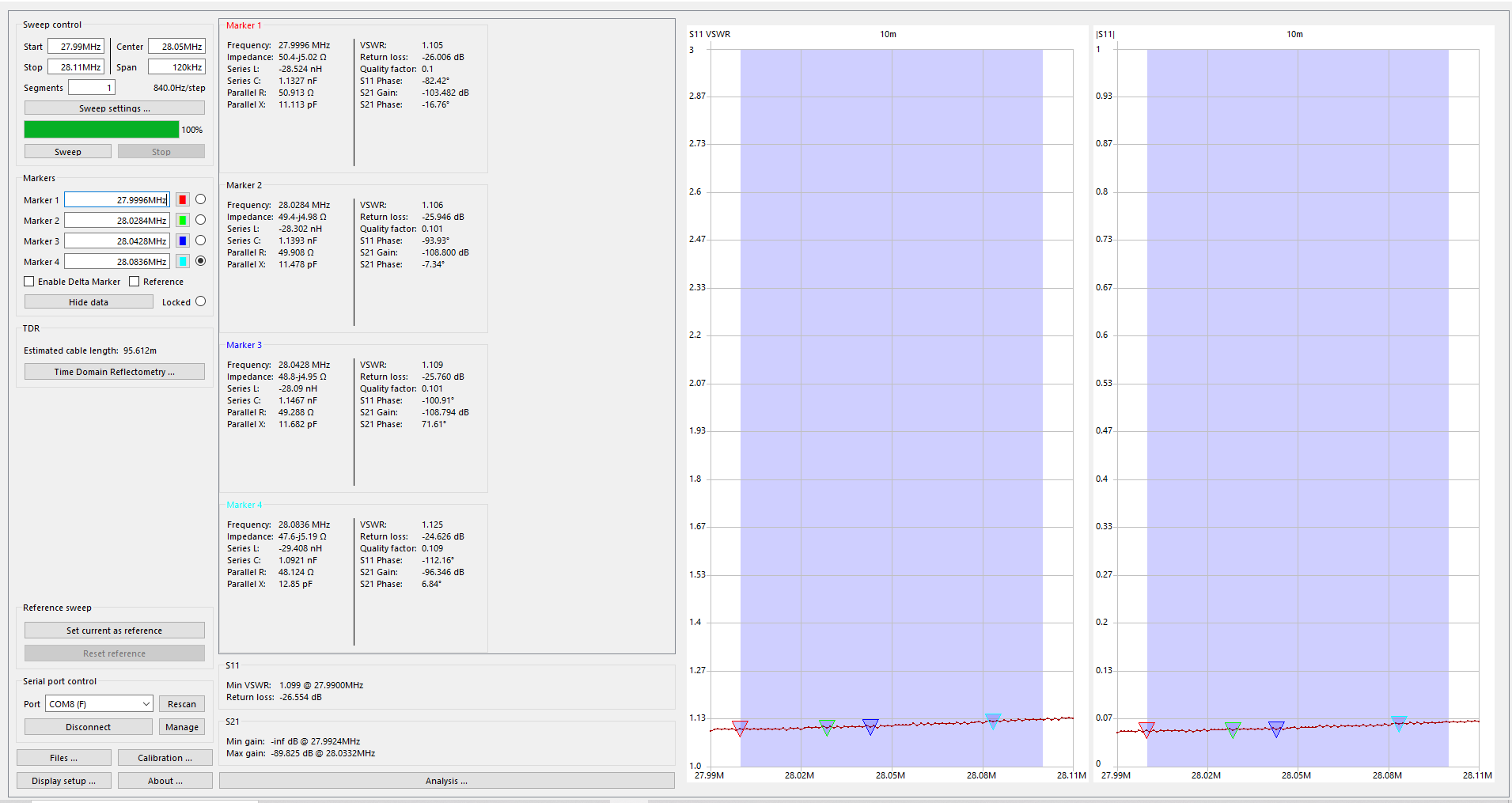
We took along our usual portable ham station, with a few updates. Our Yaesu FT-991 has served us well for POTA, SOTA, and island activations in the past, so it is our go-to radio for this sort of operation. The key features include a 100-watt RF output, a built-in sound card for digital modes, an internal antenna tuner, and a small enough size. This radio has HF plus 6m, 2m, and 70cm, which can be handy. Add a compact Samlex switching power supply, and we are ready. Recently, we have moved away from using End-fed Halfwave (EFHW) antennas and started using an End-Fed-Random Wire (EFRW), also called an End-Fed Long Wire (EFLW). The difference is subtle but important. The EFRW uses a wire length that is intentionally not resonant on any band, fed by 9:1 UNUN matching device. This setup radiates well over a range of frequencies but does require an antenna tuner because it is not a consistent 50-ohm impedance on all bands. I’ve found this to be a reasonable tradeoff between quick-changing band coverage and performance.

For this trip, we used the Palomar Engineers Bullet-9 UNUN, rated for 500 watts PEP. A variety of wire lengths can be used with this approach, with longer wires supporting lower frequencies. The 34-foot wire element supports operating on all bands from 40m to 6m, supported by the SOTABeams Travel Mast. The Travel Mast compacts to just 26.5 inches and extends to 32 feet. Actually, I modified the top of the mast to make it stronger, so the net height is closer to 29 feet. The end-fed wire antenna is almost vertical when deployed in this manner.
In past portable efforts, I’ve encountered issues with inconsistent antenna match and RF getting back into the FT-991. I checked this out carefully before the trip and adopted some mitigation practices that seem to help. First, I made sure the wire antenna could be supported almost vertically. This is not a strict requirement but it seems to help with getting a good match across all bands. I don’t use a counterpoise, but I do have 50 feet of RG-8X coax lying on the ground, which provides a bit of counterpoise. This length of coax also lets me keep the antenna separated from the transceiver by a reasonable distance, reducing the opportunity for RF to get back into the transceiver. Finally, I use a short USB cable, with ferrite cores on both ends, to connect my notebook PC to the FT-911. In the past, the USB connection between my PC and radio sometimes quit. These precautions appear to have paid off, as the station worked without any issues.

Operating
We set up the station outdoors under a covered patio to enjoy the fantastic view and (mostly) great weather while operating. This was not optimal, as we did get chased inside a few times when rain squalls moved in. They never lasted long, so I think the tradeoff was worth it.
The propagation on the HF bands has been quite good lately, and we continued to enjoy that while in BVI. We did not have much of an operating plan (“slacker style”) but intended to operate on the higher HF bands, mostly 20m and higher, using SSB, FT8, and FT4. Bob/W0BV pointed out that VP2V is somewhat rare, showing up at number 114 on the ClubLog Most Wanted List. Sure enough, whenever we called CQ, we were greeted with a nice pileup.

My VP2V/K0NR log has 1030 contacts, including 61 DXCC entities and 23 CQ Zones. I focused mostly on keeping the run rate up and just making contacts. About half of the Qs were with the US. The logs of VP2V/K0JJW and VP2V/KF9EY are not included in these numbers. I tended to stay on the higher bands as they were working quite well.
VP2V/K0NR Log Band Phone Dig Total % 30 0 79 79 8 20 0 46 46 4 17 0 90 90 9 15 0 161 161 16 12 44 349 393 38 10 0 260 260 25 2 1 0 1 0 -- ---- --- --- -- Total 45 985 1,030 100
As you can see from the numbers above, I made a lot of digital contacts (FT8/FT4). I found FT8 to be slow, and the normal FT8 frequency became crowded. There was much less congestion on FT4, and the run rate was better, so I found that to be effective. I enjoyed the SSB pileups for a while but found it to be a challenge to manage them. While I can work CW, I did not try to manage a pileup on that mode.
I found a 2m repeater on the island 146.73 MHz (—offset, no tone) and made a few calls on it, but I did not receive a reply.
QSLs will be via Logbook of The World only. I won’t be printing cards for this effort but the logs for VP2V/K0NR and VP2V/K0JJW are already loaded into LoTW. Thanks to everyone that worked us!
British Virgin Islands
BVI was a fantastic place to vacation. During our ten days there, we enjoyed the beaches, snorkeling, and sailing excursions. If you are interested in that, there are many online tourism sites to explore.

Thanks for stopping by.
73 Bob VP2V/K0NR
The post VP2V/K0NR: Another Slacker DXpedition appeared first on The KØNR Radio Site.
Bob Witte, KØNR, is a regular contributor to AmateurRadio.com and writes from Colorado, USA. Contact him at [email protected].