My 10’ x 20’ Active Loop

courtesy: americanradiohistory.com


After recently installing a new coax run out to the loop and after five years of summer sunlight, the plastic food-storage container used to house the loop’s preamp (Wellbrook ALA100LN ... LF-30MHz) finally bit the dust ... literally.


Last week I replaced the housing with a slightly larger plastic box but I’ll still be faced with the UV bombardment and eventual deterioration of the clear plastic and lid unless I do something different.


I’ve a couple of thoughts but am hoping for some other suggestions from blog readers.

I have thought about spray painting the container, which may (or may not) prevent UV damage, but wonder if paint will stick to the smooth plastic surface? Maybe if scuffed-up a bit it would stick ... if so, the coating could be annually renewed.

Another idea is to cover it with duct tape ... not pretty, but possibly doing the job. Any other thoughts out there?


Part 2 and Part 3 of this blog were originally published when the loop was first built (2014) and describe the antenna details as well as showing the loop in action ... listening on the NDB and broadcast band as well as showing its nulling capability. It’s been a great performer and  I can highly recommend the ALA100LN for a large aperture receiving loop. I’m looking forward to what will hopefully be a good winter of exciting loop DXing.

Part 2 - New LF / MF Loop


Some may recall my blog back in July (Wellbrook Loop Plans) describing a new loop that I had been thinking about as a possible replacement for my 10' shielded loop. I had been doodling various construction ideas using PVC tubing in an effort to keep it as light as possible, without introducing any metal near the loop. On Monday of this week, I dismantled the 10' loop in preparation for my new experimental rectangular loop.
I've had the Wellbrook loop preamp here for a few months, so it was now or never, while the weather was still 'antenna-friendly'. Now I do understand that this goes against one of ham radio's long-standing traditions that dictates all antenna work must wait until the weather can't get any worse. Antennas built in the winter rain always work much better than ones put up in the summer. Hopefully it's not Wouff-Hong or Rettysnitch punishable but the fall DX season is almost upon us and I'm not waiting for the rain!

The new 'loop' is not really loop-shaped but is rectangular (10' x 20') and more like a Flag antenna shape. I considered a Flag but really don't need any back-end nulling capability since I'm mainly interested in listening to the east and to the north.


The main boom section is composed of two sections of 1" PVC thick-wall (Schedule 40) pipe joined at the center and reinforced with a 10' section of 2" x 2" Douglas Fir. In addition, the boom has a truss of 1/4" Dacron to take out any end-loading sag. The vertical end sections are 3/4" Schedule 40 PVC pipe, fastened with a T at the boom end. The center mast is made of 2" Schedule 40 ABS pipe with a long section of 1 1/2" ABS nested inside that telescopes upward to anchor the truss ropes and give some additional rigidity to the mast.


Main boom and mast construction
This type of construction would lend itself well to anyone interested in a rotating Flag antenna for the BCB / LF or 160m. The costs are very low, the structure is lightweight and the materials are readily available at most hardware outlets.


Looping E/W


Although the preamp is completely sealed and weatherproofed, I still decided to mount it inside a container. The container also provided a convenient anchor to terminate the loop end wires (PVC-coated #18 stranded) without putting any tension on the soldered terminals.

Although I have not had much time to listen, and conditions are still in 'recovery' mode from earlier disturbances, initial indications are that everything is performing as well, if not better, than expected. It certainly outperforms my 10' active shielded loop by a large margin. I have yet to do any serious S/N comparisons between it and my primary LF receive antenna, a large inverted L, which must be tuned to resonance for the desired listening range. I believe that the very quiet loop / Wellbrook combination will provide an overall S/N improvement.

I have always believed that smaller loops provide deeper and sharper front-to-side nulls so I was pleasantly surprised to measure (using Perseus) null depths from 25-30db, on various groundwave signals ... more than expected. Skywave signals also deliver sharp deep nulls in the order of 22 - 25db ... again surprising, but I'll take them!

A brief listen while pointing S-E last evening turned up good signals from 1 kW'ers KYHN (1650kHz) in Fort Smith, Arkansas and KKGM (1630kHz) in Fort Worth, Texas. An early morning listen revealed good audio from JOIK (567kHz) Sapporo, Japan and JOAK (595kHz) in Shobu. Down in the ndb band, little 25-watter 'IP' on 210kHz was an all-time new catch from Mobile, Arizona.

There is still much to learn from this new antenna system but the biggest challenge will be keeping it up all winter. I did lose one of my 10' loops after several years, due to wind, when the main (un-reinforced) PVC mast eventually failed from flexing fatigue. I will tie the ends of the new antenna down when the winds get strong to reduce as much mast flexing as possible. I could however, run the risk of violating another long-standing radio adage ..."if your antenna stays up all winter, it's not big enough". I just can't win.

Part 3 - Loop Listen 


As Murphy would have it, and in spite of the low amount of solar activity, LF/MF propagation has been very poor since getting my new 10' x 20' loop in place. The few front-to-side nulling checks that I have done, have produced results varying from around 20db to 30db, depending upon the signal. I suspect the depth of null is also affected by the signal's arrival angle but there is still more to learn. The pattern seems to be very close to that of a typical circular loop...the classic figure-8 pattern illustrated below as shown on the Wellbrook data that came with my ALA100LN preamp.

Courtesy: http://www.wellbrook.uk.com

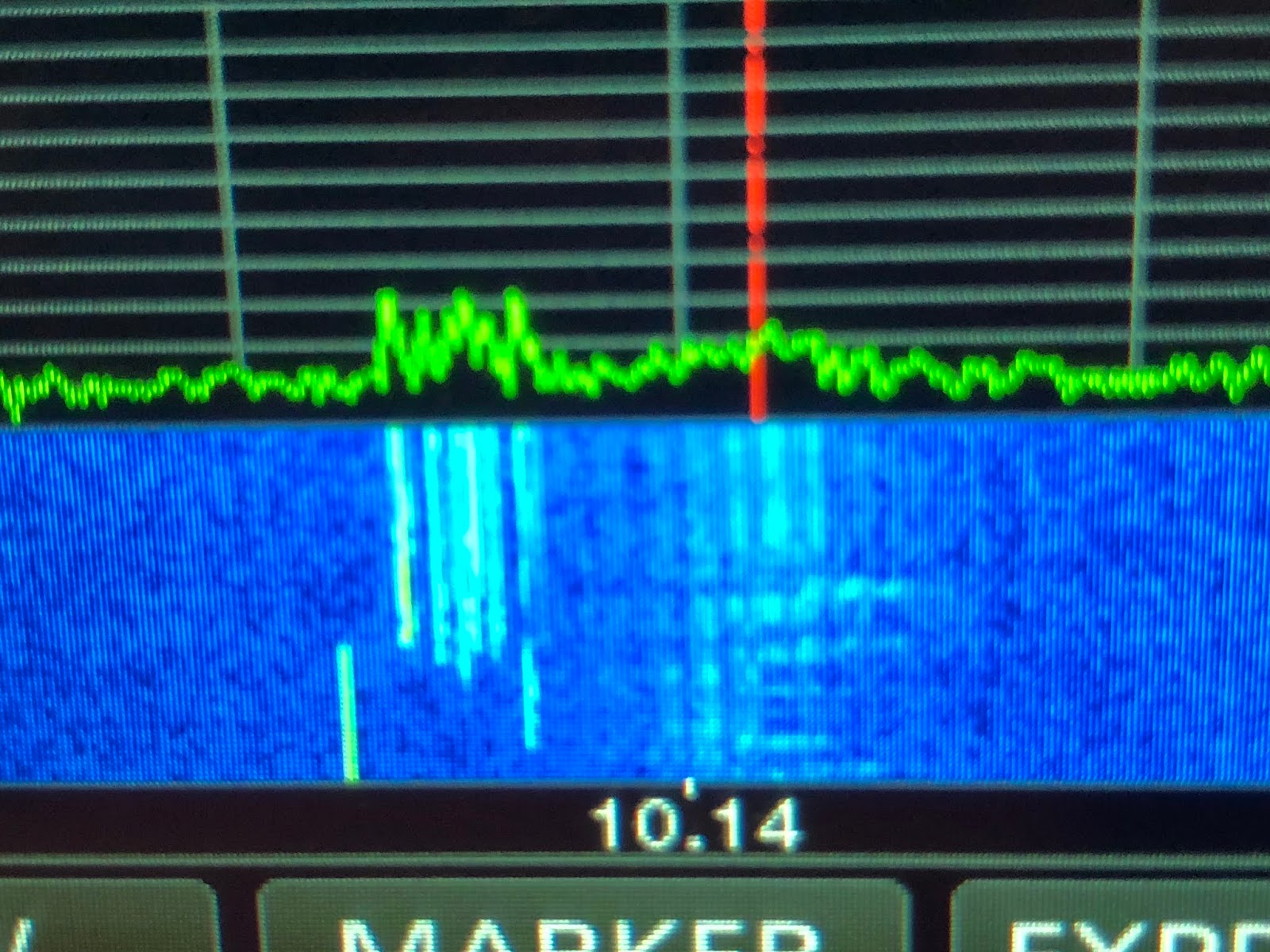
More typically, the null is around 21-22 db as shown on this test while listening to the ground wave carrier of the 'YZA' NDB (236kHz) located in Ashcroft, B.C., about 150 miles to the NE. As expected, the null is fairly sharp and the front / rear lobe, fairly broad.


One short check at dusk produced nice signals from  CJBC, the French-language station in Toronto. The past few nights it has been very strong but with a strong echo effect. I wonder if there is more than one CBC outlet here (860kHz), such as a low-power repeater, causing the echo.


At the same time, while still fairly light outside, WCCO in Minneapolis had a nice signal just before sunset.


No matter how poor conditions become, it seems that the Hinchinbrook (Alaska) NDB, 'ALJ' (233kHz), is always strong ... looping north.


Courtesy: https://www.google.ca/maps
My apologies for the video quality. If you know of any software available for making full-screen Perseus video captures so that I might improve my technique, please let me know. Presently I am just capturing them on my I-Pad which leaves a lot of room for improvement.

(Since originally posting the above, I have been using the Tiny Take free screen capturing software, to produce better quality catures of my Perseus recordings. It's also probable that my new iPhone would produce a high quality video of my computer screen compared to the older iPad used for these ones, but it's something yet to be tried.)

Hopefully conditions will only get better as the season progresses and I am able to give the loop a good workout ... before it gets too windy!


Steve McDonald, VE7SL, is a regular contributor to AmateurRadio.com and writes from British Columbia, Canada. Contact him at [email protected].

How Difficult Is That SOTA Summit?

When planning for the next Summits On The Air (SOTA) hike, I want to understand the difficulty of the climb. The main things to evaluate are the length of the hike (horizontal distance), the vertical (elevation) gain and other contributing factors.

Most of the SOTA summits in Colorado have a simple profile: pretty much uphill on the way to the summit and then mostly downhill on the way back to the trailhead. Yes, there may be flat sections and sometimes there will be a downhill section or two on the ascent, which means you give back some elevation gain only to regain it later. Usually, we think of going downhill as “easy” but if you have sensitive knees or other joints, you may disagree.

The first question is how far do I need to hike? Clearly, hiking 10 miles is a lot harder than hiking 1 mile, all other things being equal. However, I usually find the vertical gain to be more important. (Typically, the horizontal distance of a SOTA hike is within my capabilities and the vertical gain is my real concern.) I also do a back-of-the-envelope calculation on slope. My benchmark for slope is 1000 vertical feet in one mile, which is an uphill slope that will get my heart pumping but is not too difficult (corresponds to ~20% slope).  Anything steeper than that starts to feel more challenging. A slope less than that is easier.  Be careful with average calculations. You might find that a particular trail is flat for 3 miles and then gains all of the vertical in the last mile. Having a good topographical map is a must for understanding the route. I generally use GAIA GPS, an online mapping website and smartphone app.

Certainly the condition of the trail and its inherent terrain are an important factor to consider. The SOTA hikes I do are typically Class 1, 2 or 3. I don’t do summits that require ropes or technical climbing.

Difficulty ratings from 14ers.com

Class 1. Easy hiking – usually on a good trail.

Class 2. More difficult hiking that may be off-trail. You may also have to put your hands down occasionally to keep your balance. May include easy snow climbs or hiking on talus/scree. Class 2 includes a wide range of hiking and a route may have exposure, loose rock, steep scree, etc.
Class 3. Scrambling or un-roped climbing. You must use your hands most of the time to hold the terrain or find your route. This may be caused by a combination of steepness and extreme terrain (large rocks or steep snow).

Example summits

Let’s take a look at some specific summits as examples.

Note: there are often multiple routes to the same summit, so don’t use this information for trip planning. Do your homework.

Mt Herman (W0C/FR-063): a bit steep in spots but typical of many SOTA hikes: 1000 feet vertical gain in about one mile, right at my benchmark of 1000 feet vertical per mile. I consider that an easy hike.

Genesee Mountain (W0C/FR-194): is one of the easiest and enjoyable SOTA summits in Colorado, only 0.7 miles and 300 vertical feet. The average slope is 430 feet per mile, so not very steep at all.

Mt Sherman (W0C/SR-061): is considered to be one of the easiest fourteeners, but it is still a fourteener: 2100 feet vertical gain in 2.6 miles (807 feet per mile).

Mount Elbert (W0C/SR-001): A more challenging (middle of the road?) fourteener with 4700 feet vertical gain over 4.75 miles). The average slope is 1000 feet per mile so it’s not that steep but 4700 vertical feet will definitely wear me out.

Other Factors

Not to be overlooked, the condition of the route can make a big difference. Often, there is no established trail to a SOTA summit, which means you’ll need to hike offtrail or “bushwack”. If the ground is uncluttered and the trees well-spaced, bushwacking can be easy. On the other hand, if there is a lot of downed timber, you have to climb over and around obstacles to get to the summit. Some summits have willows or other scrub brush that gets in the way. Intense bushwacking can make a huge difference, making the hike more difficult by a factor of two (or more). Many times, I’ve looked at the route to a summit on a  topographical map, judged it to be not so bad and later discovered that it requires serious bushwacking. Hikes like that really help me to appreciate a well-designed and maintained trail.

High altitude and the resulting lack of oxygen contribute to the difficulty of the climb. This is going to vary considerably between individuals. Almost everyone feels the effects at 14,000 feet but at lower elevations individual performance will vary dramatically. Normally, I don’t have an issue at 10,000 feet, notice some effect at 12,000 feet and I’m definitely huffing and puffing above 13k.

Finally, weather can play a big role in increasing the difficulty of a hike. In the winter, it is common to use snowshoes when deep snow is present on the route. The snowshoes tend to sink into the snow with each step, causing more effort to be expended hiking the route. Ice can also be present requiring microspikes or other traction devices.

So that’s a quick look at how I judge the difficulty of a SOTA hike. The SOTA database often has trip reports from other SOTA activators, which can be extremely helpful. It is always great to learn from the experiences of other folks.

73 Bob K0NR

The post How Difficult Is That SOTA Summit? appeared first on The KØNR Radio Site.


Bob Witte, KØNR, is a regular contributor to AmateurRadio.com and writes from Colorado, USA. Contact him at [email protected].

LHS Episode #298: JOTA Deep Dive and Feedback-o-Rama

Hello and welcome to the 298th installment of Linux in the Ham Shack. In this episode, we take a close look at getting Scouts on the air with the JOTA and JOTI programs. It's a great way to get involved in amateur radio, whether or not you're into Scouting. Also, we address a bunch of feedback that's been queuing up over the last few weeks. Lots of great information there as well. Hope everyone has a great week and, as always, thank you for downloading and listening!

73 de The LHS Crew


Russ Woodman, K5TUX, co-hosts the Linux in the Ham Shack podcast which is available for download in both MP3 and OGG audio format. Contact him at [email protected].

Weekly Propagation Summary – 2019 Aug 26 16:10 UTC

Weekly Propagation Summary (2019 Aug 26 16:10 UTC)

Here is this week’s space weather and geophysical report, issued 2019 Aug 26 0541 UTC.

Highlights of Solar and Geomagnetic Activity 19 – 25 August 2019

Solar activity was very low. The visible disk was spotless with no Earth-directed CMEs observed.

No proton events were observed at geosynchronous orbit.

The greater than 2 MeV electron flux at geosynchronous orbit was at moderate levels throughout the forecast period.

Geomagnetic field activity was at quiet levels under nominal solar wind conditions throughout the forecast period.

Forecast of Solar and Geomagnetic Activity 26 August – 21 September 2019

Solar activity is expected to remain very low throughout the outlook period.

No proton events are expected at geosynchronous orbit.

The greater than 2 MeV electron flux at geosynchronous orbit is expected to reach high levels on 02-13 Sep due to recurrent CH HSS influence. Moderate levels are expected thoughtout the remainder of the period.

Geomagnetic field activity is likely to reach G2 (Moderate) geomagnetic storm levels on 01 Sep, active levels on 26-27 Aug, 02 Sep, with unsettled levels on 28 Aug, 03, 06-07 Sep due to recurrent CH HSS effects.

Don’t forget to visit our live space weather and radio propagation web site, at: http://SunSpotWatch.com/

Live Aurora mapping is at http://aurora.sunspotwatch.com/

If you are on Twitter, please follow these two users: 1. https://Twitter.com/NW7US 2. https://Twitter.com/hfradiospacewx

– – – – – – – – – – – – –

Be sure to subscribe to our space weather and propagation email group, on Groups.io

https://groups.io/g/propagation-and-space-weather

Spread the word!

– – – – – – – – – – – – –

Links of interest:

+ Amazon space weather books: http://g.nw7us.us/fbssw-aSWSC
+ https://Twitter.com/NW7US
+ https://Twitter.com/hfradiospacewx

Space Weather and Ham Radio YouTube Channel News:

I am working on launching a YouTube channel overhaul, that includes series of videos about space weather, radio signal propagation, and more.

Additionally, I am working on improving the educational efforts via the email, Facebook, YouTube, Tumblr, and other activities.

You can help!

Please consider becoming a Patron of these space weather and radio communications services, beginning with the YouTube channel:

https://www.patreon.com/NW7US

The YouTube channel:
https://YouTube.com/NW7US

..


Visit, subscribe: NW7US Radio Communications and Propagation YouTube Channel

ICQ Podcast Episode 302 – Howard Michel ARRL Report Summer 2019

In this episode, Frank Howell (K4FMH) talks to ARRL CEO and Secretary Howard Michel (WB2ITX), who provides an update from the recent ARRL committee meeting. Martin (M1MRB) and Colin (M6BOY) rounds up the Amateur Radio announcement this week.

ARRL BoD Minutes - http://www.arrl.org/files/file/2019%20Board%20of%20Directors/Final%20Minutes%20July%202019.pdf


Colin Butler, M6BOY, is the host of the ICQ Podcast, a weekly radio show about Amateur Radio. Contact him at [email protected].

MFJ JOINS CORPORATE PRIZE DONOR LIST

RIDGELAND, MS – August 23, 2019 – The list of corporate prize donors is growing for the Homebrew Heroes Awards program. MFJ Enterprises of Starkville MS has agreed to donate a key prize for the workbench of the Hero in 2019. “We owe our corporate success to the practice of homebrew electronics in amateur radio,” said MFJ Founder and President Martin F. Jue. “MFJ is delighted to support this annual award. We sell a high volume of parts to the homebrew and maker community. It’s in our business interests to encourage and support hams and other enthusiasts to design and build things that contribute to this space in the hobby. And, it’s just good business to encourage it, too!” Martin added.

MFJ has identified the popular HF/VHF Two-Port Graphic Antenna Analyzer sold as product number MFJ-225. The 225 uses free downloadable software to access the vector analyzer through a PC. Richard Stubbs, Customer Services Manager at MFJ says that “It has all the basic analyzer functions plus a host of advanced features like a built-in LCD graphics screen, two-port VNA measurement, PC-Interface using IG-miniVNA freeware, precise DDS frequency control, and is self-calibrating.” Mike Enis, Manager at MFJ, says that the MFJ-225 should enhance most every workbench that uses RF circuits, especially through the S-parameters that the device measures, all without a lot of computations required without a two-port vector device.

We owe our corporate success to the practice of homebrew electronics in amateur radio.

MFJ Founder and President Martin F. Jue
MFJ 225 Dual-Port Analyzer
George W5JDX on the MFJ-225 Dual-Port Analyzer

Homebrew Heroes Award Steering Committee member, Frank Howell K4FMH said that “MFJ’s joining our corporate donor list with this test gear shows leadership in the amateur radio maker space. We are delighted that this corporate list is growing in support of our annual award winner.” Details on the new awards program can be found at its website.

MFJ Enterprises, Inc., was founded in 1972 by Martin F. Jue. The company began operations in a small rented hotel room in the old Stark Hotel in downtown Starkville, Mississippi. The company began marketing its products in October of 1972. The first product was a high selectivity filter that would enable a receiver to separate one Morse code signal from scores of other signals that were being transmitted over the radio airwaves and was offered as a kit to homebrew builders in amateur radio.


Frank Howell, K4FMH, is a regular contributor to AmateurRadio.com and writes from Mississippi, USA. Contact him at [email protected].

Leadership Opportunity for QRP / Portable Ops

The World’s Friendliest Hamfest!”
Since 1954

Hello everyone! I’m letting you know that Bob Heil K9EID and I are trying to identify a person or group who wishes to take over leadership of a two-day event that has been held right before the Huntsville Hamfest at Monte Sano State Park there.

What’s needed is for someone to step forward to directly work with the Huntsville Hamfest Committee to organize a QRP or Portable Operations workshop/seminar over the two days there at Monte Sano.

Monte Sano is a beautiful park with very nice facilities. The Huntsville Hamfest is held at the world-reknowned Von Braun Center in Huntsville, known as Rocket City because of the substantial NASA presence along with many high tech companies and contractors. The Embassy Suites is connected by a sky bridge to the Von Braun Center with other high quality hotels very close by.

Entrance to Monte Sano State Park

Craig Behrens N4MT, former QRP Quarterly Editor, had developed this “two days in Huntsville” concept but had to drop it this year because of very serious health problems. Mark Brown, HH Committee Chairman, says that Craig is unfortunately no longer in the picture for this event. It was held at the cabin complex at Monte Sano State Park on Thursday and Friday before the hamfest started on Saturday morning.

What’s needed is for someone to step forward to directly work with the Huntsville Hamfest Committee to organize a QRP or Portable Operations workshop/seminar over the two days there at Monte Sano. If you’re familiar with the Ten-Tec Rebel QRP rig, it was largely designed there over a two year period thanks to Craig’s leadership. This two day workshop has indeed done remarkable work. And the Huntsville Hamfest is a great venue through which to organize and network with leading amateur radio organizations and operators.

The Lodge at Monte Sano State Park

Bob Heil K9EID and I agreed to do the front leg-work to convey this strong interest to various QRP or portable operations communities on behalf of Mark Brown. We are seeking to have a balloon launch during the Thursday session at Monte Sano with live APRS tracking continuing during the hamfest using temporary monitors situated around the vendor arena. Donors of prizes for the recovery of the payload have already been committee.

In addition, Ted Randall of WTWW has agreed to attend the Thursday-Sunday period, broadcasting live on commercial shortwave near Nashville from Monte Sano and the Von Braun Center. Presenters at the Monte Sano two day seminar would be interviewed along with other attendees. This should help showcase your activities and work internationally.

WTWW Transmitter # 1

Please contact me at [email protected] if you have serious interest on which you can commit to establish leadership for continuing the very fine work that Craig N4MT and his colleagues have built over the past number of years at the Huntsville Hamfest. This can be a superb chance for you or your group to attach to one of the largest hamfests in the U.S. to enjoy sharing your knowledge and passion for QRP or Portable Ops!

73,

Frank Howell, K4FMH

Bob Heil, K9EID


Frank Howell, K4FMH, is a regular contributor to AmateurRadio.com and writes from Mississippi, USA. Contact him at [email protected].

Subscribe FREE to AmateurRadio.com's
Amateur Radio Newsletter

 
We never share your e-mail address.


Do you like to write?
Interesting project to share?
Helpful tips and ideas for other hams?

Submit an article and we will review it for publication on AmateurRadio.com!

Have a ham radio product or service?
Consider advertising on our site.

Are you a reporter covering ham radio?
Find ham radio experts for your story.

How to Set Up a Ham Radio Blog
Get started in less than 15 minutes!


  • Matt W1MST, Managing Editor