 |
 Icom IC-705
 5 February 2020 | by
 Ray Novak, N9JA came for a visit with a great new QRP Radio that’s soon to be released.
George Thomas, W5JDX, is co-host of AmateurLogic.TV, an original amateur radio video program hosted by George Thomas (W5JDX), Tommy Martin (N5ZNO), Peter Berrett (VK3PB), and Emile Diodene (KE5QKR). Contact him at [email protected].
LHS Episode #323: Sloppy Seconds

Welcome to the 323rd installment of Linux in the Ham Shack. In this episode, the hosts discuss amateur radio and the fires in Australia, state QSO parties, Brexit and CEPT, new extra pool questions, CERN, Facebook, Jericho, UNICEF and much, much more. Thank you for downloading and listening. We hope you have a fantastic week.
73 de The LHS Crew
Russ Woodman, K5TUX, co-hosts the Linux in the Ham Shack podcast which is available for download in both MP3 and OGG audio format. Contact him at [email protected].
‘Barn Door’ CLE
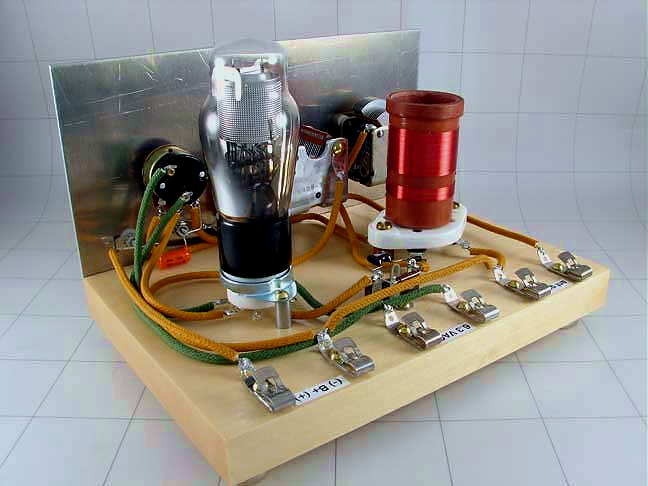 The next CLE, coming up at the end of the month, will be another ‘barn-door’ event where listeners are encouraged to use wider bandwidths than normal ... typically something that will allow you to hear beacons at least 2kHz each side of the frequency that you are tuned to.
Your ears will be the only filter that you need!
This will be the first winter event of this type and results could be very interesting! In the past, many participants have used their homebrew regens including the popular ‘1AD’ (1 Active Device) MOSFET regen, built for the NDB part of the spectrum.
The last time this event occurred, I whipped together a 1AD regen in a day which proved amazingly effective in spite of the mid-summer propagation.

There is still plenty of time for you to put something simple together and you can find some helpful suggestions in my previous '1AD' blog here.
I will have more details later, before the event, so please stay tuned and consider getting something ready ... maybe all you need to do is wind a new coil for your favorite regenerative receiver!
Steve McDonald, VE7SL, is a regular contributor to AmateurRadio.com and writes from British Columbia, Canada. Contact him at [email protected].
Weekly Propagation Summary – 2020 Feb 03 16:10 UTC
Here is this week’s space weather and geophysical report, issued 2020 Feb 03 0217 UTC.
Highlights of Solar and Geomagnetic Activity 27 January – 02 February 2020
Solar activity was very low. Region 2757 (N05, L=089, class/area Cso/100 on 27 Jan) decayed to played before rotating around the W. limb. No Earth-directed CMEs were observed in available coronagraph imagery.
No proton events were observed at geosynchronous orbit.
The greater than 2 MeV electron flux at geosynchronous orbit was at normal to moderate throughout the reporting period.
Geomagnetic field activity range from quiet to active. Isolated active conditions were observed on 30 Jan while unsettled conditions were observed on 28-27 Jan, 31 Jan and 02 Feb. Solar wind measurements suggested all enhancements in geomagnetic activity were in response to intermittent influence from the Southern Crown coronal hole. The remainder of the reporting period was quiet.
Forecast of Solar and Geomagnetic Activity 03 February – 29 February 2020
Solar activity is expected to be very low throughout the outlook period.
No proton events are expected at geosynchronous orbit.
The greater than 2 MeV electron flux at geosynchronous orbit is expected to range from normal to high levels. High levels are expected on 07-13 Feb, in response to a negative polarity CH HSS. The remainder or the outlook period is expected to be at normal to moderate levels.
Geomagnetic field activity is expected to range from quiet to active levels. Active conditions are likely on 06 Feb and 26 Feb; unsettled conditions are likely on 07-09 Feb, 25 Feb and 27 Feb. Enhancements in geomagnetic activity are in response to influence from multiple, recurrent, coronal hole high speed streams. The remainder of the outlook period is expected to be at quiet levels.
Don’t forget to visit our live space weather and radio propagation web site, at: http://SunSpotWatch.com/
Live Aurora mapping is at http://aurora.sunspotwatch.com/
If you are on Twitter, please follow these two users: 1. https://Twitter.com/NW7US 2. https://Twitter.com/hfradiospacewx
– – – – – – – – – – – – –
Be sure to subscribe to our space weather and propagation email group, on Groups.io
https://groups.io/g/propagation-and-space-weather
Spread the word!
– – – – – – – – – – – – –
Links of interest:
+ Amazon space weather books: http://g.nw7us.us/fbssw-aSWSC
+ https://Twitter.com/NW7US
+ https://Twitter.com/hfradiospacewx
Space Weather and Ham Radio YouTube Channel News:
I am working on launching a YouTube channel overhaul, that includes series of videos about space weather, radio signal propagation, and more.
Additionally, I am working on improving the educational efforts via the email, Facebook, YouTube, Tumblr, and other activities.
You can help!
Please consider becoming a Patron of these space weather and radio communications services, beginning with the YouTube channel:
https://www.patreon.com/NW7US
The YouTube channel:
https://YouTube.com/NW7US
..
Visit, subscribe: NW7US Radio Communications and Propagation YouTube Channel
Bring it on!
 |
| Using Dual watch |
The kickoff (Super bowl lingo) to the ARRL QSO party challenge was very busy with 3 QSO parties this weekend. The BC QSO party, Minnesota QSO party and the Vermont QSO party were in full swing this weekend. The challenge to me was how to participate in 3 contests using only one contest software program? The software I have used in the past for contests were N1MM+ and N3FJP's contest software. I did read regarding Scott's N3FJP's contest software that you can run multiple contests using API (application program interface). Now I never claim to be a computer guru and API meant nothing to me until Thursday last week when I read about it on the N3FJP software user group site. For this weekend I used N1MM+ and loaded all three QSO parties and just loaded the contest I was logging in and for the time being, it worked just fine for me until I can read up on this API thing.
Why has the ARRL QSO party challenge appealed to me:
- I have the weekends more or less free now.
- These contests are not a full 48-hour effort.
- They are local meaning North America and low sunspots do not have as much of an effect.
- Maximum power is 100 watts so most of us are on the same level of playing field.
- The modes are CW, Phone and in some QSO parties, the digital mode (FT8 and FT4) has been embraced so there are lots of opportunities no matter what your choice of operating is.
- If CW is your forte I have found the speeds are slower and sometimes a TU (thank you) and 73 is added to a contact.
 |
| BC QSO party shot |
So how did the first weekend of QSO party contest go.......
Vermont QSO party:
This was a tough one as I made only 2 contacts both on 40 meters and I felt because Vermont is close to home my contacts would be ground wave. I was not able to hear any Vermont stations on 20m at all. I had to settle for 2 contacts with a score of 16. When I visited the contest score webpage 3830 I was shocked to see that all others had scored low as well.
Minnesota QSO party:
There was more action in this contest but for some reason, the only station I heard were ones I already worked (Dupes). I ended making a whole 7 contacts in this contest for a final score of 98.
BC QSO party:
In this contest, I was able to hear lots of BC stations but the conditions were changing very fast such that I would make the contact but then they went below the noise level. I ended up making 6 completed contacts with a score of 116 but lots of contacts that ended up being incomplete as they were washed up in the noise floor.
The benefits of the these QSO party contests:
- It gets me on the radio as most of the time just planning to get around to it never happens.
- I want to enter the CW category this will help me improve my code.
- When CW slows and if the contest allows digital FT8/FT4 I will give this new way of contesting a go.
- Allows me to learn more about my Icom 7610 in contest situations.
Mike Weir, VE9KK, is a regular contributor to AmateurRadio.com and writes from New Brunswick, Canada. Contact him at [email protected].
ICQ Podcast Episode 317 – NanoVNA are they any Good?
In this episode, Martin M1MRB is joined by Leslie Butterfield G0CIB, Edmund Spicer M0MNG, Dan Romanchik KB6NU and Ruth Willet KM4LAO to discuss the latest Amateur / Ham Radio news. Colin M6BOY rounds up the news in brief and this episode’s feature is - NanoVNA are they any good?
ICQ AMATEUR/HAM RADIO PODCAST DONORS
We would like to thank Dave Pyle (KW1DX), Tim Price (G4YBU)and our monthly and annual subscription donors for keeping the podcast advert free. To donate, please visit - http://www.icqpodcast.com/donate
- Radio hams Rescue Teenage Girl from Kidnappers - Barry Shelley (N1VXY) - Interim ARRL CEO - Continued Access to 3GHz spectrum - New IARU Region 1 record on 134 GHz – 65km - Australian Bushfires Causing Major Telecommunication Outages - Maine Bicentennial Special Event - YOTA Matching Fund Drive - Greenland and Denmark Special Event
Colin Butler, M6BOY, is the host of the ICQ Podcast, a weekly radio show about Amateur Radio. Contact him at [email protected].
Plant the Seed! Sow the Future
There is much rhetoric in amateur radio about getting more people into the hobby. Especially young people. The ARRL has a Teachers Institute which reflects the conventional “train-the-trainer” model of getting K-12 school teachers (mostly) into ham radio in order to expose their students to the fun and learning. The challenge of this is that it’s quite small, even when effective.
Moreover, clubs face increasing challenges simply getting into schools, particularly public schools, to offer programs to students. It doesn’t take much imagination for a school administrator to evaluate the typical proposition. Hmm, a group of usually old guys want to spend time with students during or after school to talk about something called “ham radio.” I can say no and that’s that. I have no consequences in my decision. I can say yes but I need to do background checks to rule out folks on some nefarious list, find a teacher who will stay with them to watch over the process, deal with space requests and insurance liability (“Can we put up an antenna permanently?”) and so forth. If something bad happens, I have to deal with that and I could get demoted or worse, fired. Which option would you most likely take if you were the administrator and not a licensed amateur radio operator yourself? I have only spoken with a few Principals and Superintendents but I was told by these career professionals that this is likely to occur in many instances. It varies, of course, but this does illustrate the vagaries of getting programs from outside into schools these days.
Visiting the library remains the most common cultural activity Americans engage in, by far.
Gallup Poll Report, 2019
The ARRL and other EmComm groups often use the term, “served agency,” to indicate an agency or organization needing specific attention by amateur radio groups. We have yet to implement a similar perspective or approach for educational outreach, from everything I’ve read. Schools can be one. But so can public libraries. In fact, Gallup just reported from one of their surveys that “Visiting the library remains the most common cultural activity Americans engage in, by far.” Visits to libraries were 10.5 per year in 2019 which exceeds eight other leisure time activities. Library visits were about double annual visits to movies (5.3 per year).
The number of public libraries in 2016 (latest year data is available, covering 98% of the total public libraries in the U.S.) is more than 17,000 central libraries, branches, and bookmobiles in more than 9,000 public library systems. According to my analysis of the 2016 data, this includes a median of 122 children’s program per year, which means at least one half of the 9,000 or so public library systems had at least that many programs directed toward children. (This includes 205 that reported having zero programs directed towards children.) There is potential here!
Public libraries may well be a more efficient “served agency” within which to reach children, young adults and older persons in communities as compared to schools. I do not make this argument to lessen the attempts to get amateur radio curriculum and experiences into schools but simply want to emphasize the untapped potential that the Public Library System has for reaching the public to promote amateur radio.
Which Section can get the most libraries served by constituent ARRL Affiliated Clubs donating the League’s 10-book Library Set to libraries near them?
David Norris K5UZ ARRL Delta Division Director
Starting with the ARRL Louisiana Section Convention in Minden LA last December and continuing to last weekend’s Mississippi Section Convention in Jackson, Delta Division Director David Norris K5UZ and I created a new program just announced in Jackson. It’s the Plant the Seed! Initiative. It’s being rolled-out in the four Sections comprising the Delta Division as a Director’s Challenge to the Section Managers. Which Section can get the most libraries served by constituent ARRL Affiliated Clubs donating the League’s 10-book Library Set to libraries near them? The League offers these book sets, including the two big ones (Handbook, Antenna Handbook), for $200 including shipping. The contents and offer description from the ARRL website is as follows:
ARRL LIBRARY BOOK SET
Special money saving offer! This book set includes popular ARRL publications, intended for clubs or individuals that wish to make a gift to a local library or school. Only complete sets of these publications are available at the special price of $200 per set. Price includes ground shipping throughout the 48 contiguous states, only. Call for other shipping options. Editions sent will be those available at the time the order is received. Publications and prices are subject to change without notice. This special offer applies only to orders purchased directly from ARRL. Orders must be pre-paid.
ARRL No. Title Value (Retail Price)
 4050    ARRL Handbook $49.95
 6948    ARRL Antenna Book $49.95
 5965    ARRL Operating Manual $29.95
 #9857   ARRL Satellite Handbook $24.95
 0977    Ham Radio License Manual $29.95
 8119    ARRL General Class License Manual $29.95
 5170    ARRL Extra Class License Manual $29.95
 0823    Understanding Basic Electronics $32.95
 0915    RFI Book $29.95
 8737    ARRL Instructor's Manual $19.95
 9728    Getting Started with Ham Radio $19.95
 1173    FCC Rules and Regulations $5.95
 7717    ARRL Map of the World (Azimuthal) $15.00
As David said in his announcement to Section Managers on Friday, “This Initiative has indeed already begun. The Mississippi Section’s affiliated club, the Central Mississippi Amateur Radio Association, has already obtained two (2) commitments: one from the Board who challenged the membership to match which they quickly did. Other clubs can quickly follow suit. As described below, the affiliated club membership numbers show that the donation per-member to reach the $200 goal is minimal, ranging from $1.46 to $40.00 in the Division with an average of $7.36 (median is $5.00). So, for the average price per-member of less than ten dollars, ARRL-affiliated clubs can plant the seed of amateur radio and sow the future of the hobby.” CMSARA’s two sets of book have already been delivered and the club has identified two area libraries that will receive them shortly.
The median contribution throughout the Delta Division of just $5 per club member can potentially reach many people in the community for years to come. I constructed a map using GIS software and databases to identify which club is nearest each public library. These are shown by (tan) lines below. Spreadsheets were then exported for each of the four Sections and, within each Section, each club. These files are stored online with a link included in David’s email to each SM in the Delta Division. The Section Manager can email the club contact using information in each club’s spreadsheet with their customized listing of potential “served libraries” nearest them. This makes it very easy for Section Managers and local clubs to consider the Initiative and take action without much spin-up on their end.

Vice Director Ed Hudgens WB4RHQ added, “This is a very exciting Initiative that we are launching. It puts action in the hands of local ham groups who can easily make an impact in their communities with public libraries.” I’d have to agree with Ed’s sentiments. It’s not a vague idea to change the world waiting for “big things” to happen. The Plant the Seed! Initiative is something that for less than a pizza or hamburger lunch per member, a local club can get a broad set of books from the ARRL onto the shelves of a local public library. Getting a photo of the donation into the local newspaper wouldn’t be a bad thing for the club, either. I hope you’ll agree. You can spread the word by copying the logo I created for the Delta Division Initiative below and using it to promote the program in your club, section or Division. The Delta Division has already started and Malcolm’s (W5XX) Section is in the lead. You’re playing catch-up…but the competition is what this kind of “radiosport” is all about. And to Sow the Future of the amateur radio hobby.

Frank Howell, K4FMH, is a regular contributor to AmateurRadio.com and writes from Mississippi, USA. Contact him at [email protected].
 Ham Radio Deluxe |
 W5SWL Electronics |
 Ham Radio Prep |
 KB3IFH QSL Cards  Hip Ham Shirts  HamRadioAuctions HamRadioAuctions Reliance Antennas Reliance Antennas Enigma Shop Enigma Shop |  morseDX  Ni4L Antennas  R&L Electronics R&L Electronics antennas.us antennas.us QRV QRV |
- Matt W1MST, Managing Editor
