 |
 Can you see the issue?
 3 July 2025 | by
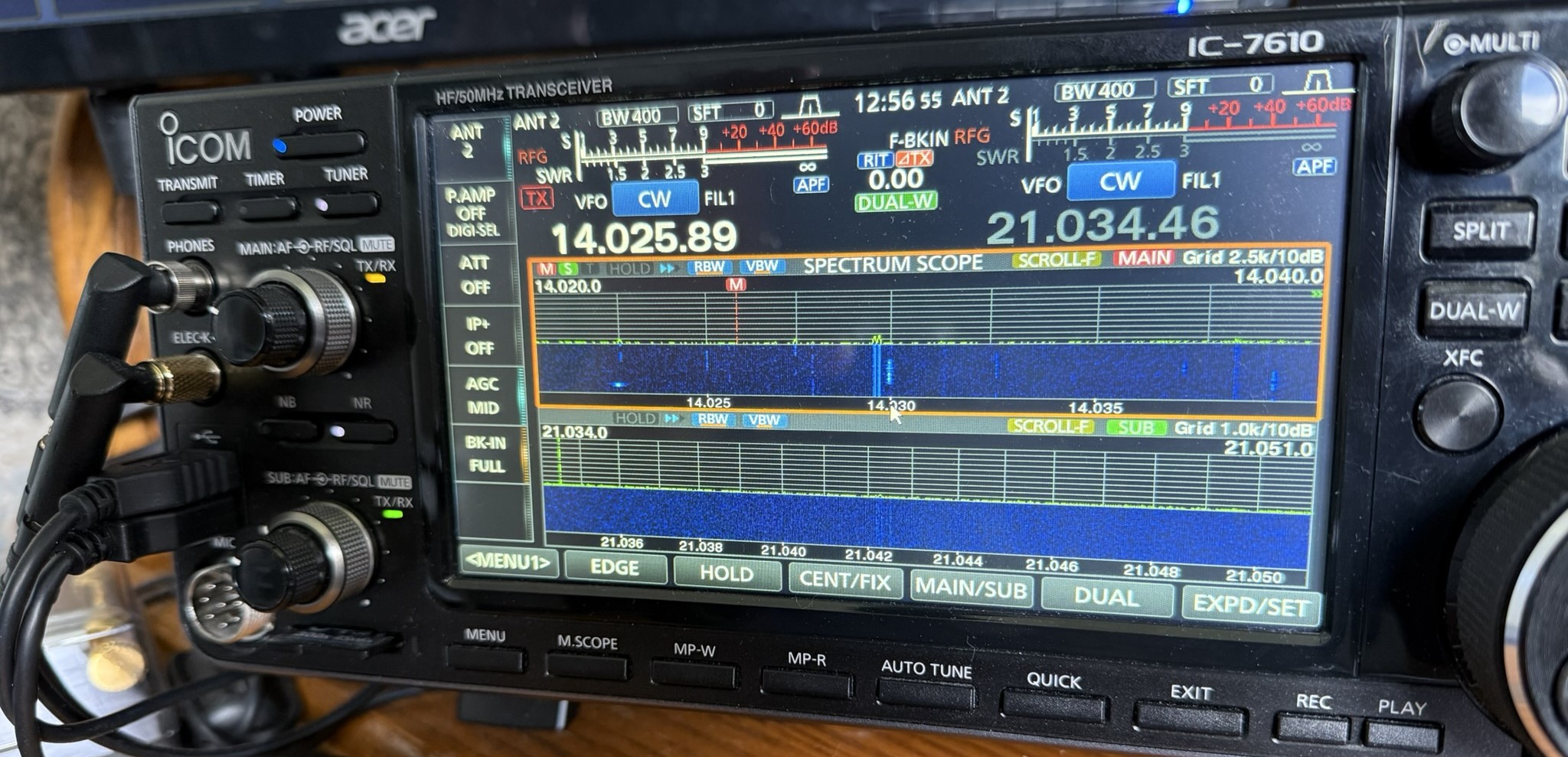
Have a look at the above picture and see if you can see an issue? I operate SO2V in contests now, and this shot was taken during the RAC Canada Day contest on July 1. Operating SO2V is new to me, and I am still getting used to things. If you are familiar with the Icom 7610, you may see the issue in the picture.
Now that you have looked at the picture, let me tell you what I did.....Since I am new to SO2V, I have been trying to get used to VFO A sound in my left ear and VFO B in my right ear. At this time, I had been listening and operating on 15m but just had 20m up on the screen with no audio. Things started to pick up on 20m and drop off on 15m. I then pressed a key on my keyboard (Pause key), and this put me back on 20m and set up N1MM+ to log contacts on 20m.
The odd thing was I was calling CQ contest on 20m for about 5 minutes and no answers. I could hear a noise floor, but I was not getting any replies to my CQ. Then it clicked, I looked at the radio and forgot to take VFO A off mute! The orange light you see in the picture on the main VFO AF/RF control means the audio is muted for the main VFO. I was hearing VFO B in my right ear but I did not click into that. Who knows how many ops called me, but I just could not hear them as the audio was muted. Live and learn, I guess.
Mike Weir, VE9KK, is a regular contributor to AmateurRadio.com and writes from New Brunswick, Canada. Contact him at [email protected].
Hustler 4BTV cleaning event.
My Hustler 4BTV has now been up for 5 years and is serving me very well, I might add. I felt it was time to take it down and clean it. I know, as Murphy would have it timed that something went wrong and it would be the middle of winter on a very cold and windy day. The items I used were a wire brush to get inside the tubing to clean, 99% alcohol for cleaning and a roll of 3M 33+ tape. This tape has a good temperature range. Finally, a Scotch Brite pad....which I never ended up using. I had read online that it was great for cleaning the aluminum tubing....found out not so much. It has been retired to the kitchen for pots and pans.

My plan was to take each section apart and clean it, and then back together again. I did not want to get too far ahead of myself by taking the whole antenna apart. Before taking a measure section of tubing apart, I measured it and also marked the tubing with a Sharpie marking pen. I wanted to take a measurement and mark it down just in case I removed the Sharpie mark while cleaning. Oh, speaking of cleaning, I thought the wire brushes would be great for cleaning the inside of the tubing, BUT....the 4BTV tubing is 1 1/4 diameter, and I used the 1 1/4 wire brush. The brush went into the tubing just fine, but the bristles refused to go in the opposite direction to bring the brush out! It did take me some time, but I did get the brush out and lesson learned. I used the 1-inch brush instead, which did a great job. All the traps looked great and were still nice and clean. The lower section of the tubing support needed some cleaning, as well as the section of tubing. Overall, for being up 5 years in the ocean air, the antenna looked great. The spider arm required the most cleaning, and I did find a broken spider arm. I do have replacements that I needed to drill a hole in, as I figured some time ago, the spider arms are the weak point of the antenna.
 |
| Top of spider arm |
 |
| Bottom of spider arm |
.JPEG) |
| Example of clean trap |
 |
| Damaged spider arm |
 |
| Inside tubing |
 |
| Base section before cleaning |
Read the rest of this post
Mike Weir, VE9KK, is a regular contributor to AmateurRadio.com and writes from New Brunswick, Canada. Contact him at [email protected].
The Communicator July – August 2025
We're coming up to our club's 50th Anniversary and this is another big issue, with a look back at our history, great articles, and our regular columnists.
Now read in over 165 countries, this issue brings you 130 pages of Amateur Radio content from the Southwest corner of Canada and around the globe. With less fluff and ads than other Amateur Radio publications, you will find Amateur Radio related articles, projects, profiles, news, tips and how-to's for all levels of the hobby.

Download the July - August 2025 Communicator in
LARGE or SMALL format, or read it on-line like a magazine
Previous Communicator issues:
Search for past Communicator issues
We now have a comprehensive searchable index back to 2007
HERE.
As always, thank you to our contributors, and your feedback is always welcome.
The deadline for the next edition is August 15th.
If you have news or events from your club or photos, stories, projects or other items of interest from BC or elsewhere, please contact us at [email protected]
73,
John VE7TI
'The Communicator' Editor
The Table of Contents for the July - August 2025 Communicator issue:
- The Unsung Pioneers - Some lesser-known early Amateur Radio experimenters and the dawn of wireless communication 4
- Some Early Surrey Amateur Radio Club History 7
- Telus Donates Tower/Trailer to SARC! 10
- News You Can’t Lose: The Centennial Gleissberg Cycle 12
- Page13—News You Can Lose: The Lighter Side 13
- Amateur Radio History In the Province of British Columbia 15
- Radio Ramblings: The Grab Bag 18
- Amateur Radio Contesting... But is your log accurate? 27
- Digital Library of Amateur Radio and Communications 30
- Remote WAN Operation and the Perils of CG-NAT Drive 32
- Six Meters: The SARC 50.070 MHz beacon 34
- Spooltenna Product review 36
- (ISED) Releases New Documents for Amateur Exams 39
- You’ve got the Power!! Monitoring your voltage 40
- Reinventing Spark Gap Radio 42
- 7300 SIG: Efficient SD Card Management 48
- Antenna Adventures: A compact 2m/70cm J-pole that wasn’t 52
- Fence Solar - Add a back-up power source 54
- The first interstellar software update: Voyager 1 58
- Update on the VE7NFR Pico Balloon 60
- AMSAT Designates SO-125: A New FM Repeater Satellite 61
- SkyRoof: New Amateur Satellite Tracking Software 62
- CQ: International Dog & Cat Days Special Event 63
- A Comprehensive Guide to Crafting an Engaging QRZ Bio 64
- Ham Radio Outside the box: An Improved Tank Circuit 67
- Top Ten Steps For successful portable QRP operation 70
- Small Pistols of Ham Radio Contesting 73
- The RSGB Looks at Morse Code 73
- "Too Many Antenna? What You Talking About Willis?" 74
- The World of CW - VE9KK Looks at a Contest Keyboard 76
- Zero Retries: Repeaters Are For Voice, Digipeaters Are For Data - NOT! 78
- KB6NU: What’s In Your Rubber Duck? 84
- Foundations of Amateur Radio: What's really happening at the IARU? 86
- Back to Basics: The Common Mode Choke 89
- No-ham Recipes: BBQ Chicken Marinade 93
- Profiles of SARC members: Fred Orsetti VE7IO 96
- Another SARC Founder: Ralph Webb VE7OM 100
- Here is a great new callsign search site 103
- SARC-SEPAR Field Day 2025: 3F at our Training Centre 104
- The RAC Canada Day Contest: Celebrating Canada’s 158th 107
- I have switched PDF readers! 108
- CQ WPX (CW) Contest: Using VB7MAN 109
- The New Look of Our Website 110
- Friends Lost... 111
- SARC General Meeting Minutes: May 2025 112
- SARC Annual General Meeting Minutes: June 2025 115
- The SEPAR Report: Field Day 2025 120
- QRT: OM, YL, and XYL: Are they still appropriate? 124
- Ham Leftovers... 127
- A look back at the Communicator—July 2015 128
ARRL Field Day 2025
This weekend was the running of the ARRL Field Day event. For some they get out into the elements and set up an emergency-type station. Both individuals and clubs take part all over Canada and the U.S. There is a category for home stations on mains power....that was my preferred setup. This year the solar conditions were a bit of a challenge which involved considerable fading. I find that during ARRL Field Day when calling CQ FD I had to really listen for stations. There were many QRP stations, those using minimal antenna setup and then the good old poor solar conditions. I found many stations coming back to me just at the noise floor. I entered CW only at 100 watts from my home station and to the noise floor stations who were running who knows what I could be booming into them. I wanted to make every effort to make the contact. It was a good workout of skill. Below is the final score I did pull the plug a bit early as I found myself just calling CQ FD without any responses.

Mike Weir, VE9KK, is a regular contributor to AmateurRadio.com and writes from New Brunswick, Canada. Contact him at [email protected].
HamAlert Is My Friend
 Many of you already know about this wonderful alert tool: HamAlert. From the HamAlert website:
HamAlert is a system that allows you to get notifications when a desired station appears on the DX cluster, the Reverse Beacon Network, SOTAwatch, POTA, WWFF Spotline, or PSK Reporter. No need to keep checking these resources manually if you’re looking for a certain callsign, DXCC, CQ zone, IOTA island, SOTA summit or WWFF/POTA reference.
HamAlert is quite versatile, allowing you to tune its alerts to meet your needs. You do this by defining triggers that, well, trigger an alert. I won’t cover all of the possibilities here, but I will show you how I have my triggers set:
 Most of these are just ham friends and family that I want to keep track of, see when they are on the air: K0JJW, KF9EY, KB9DPF, & W0BV. W0BV is a special case because he is an active DXer not too far from me, so it is helpful to see what he’s doing on 6 meters and HF. W0CLA and KV0CO are the callsigns of clubs I belong to. For these callsigns, the trigger is set for any activity on any band.
K0GU is a noted 6m enthusiast in Colorado that I follow because if something is happening on 6m, he is usually in the mix. (A major part of the challenge of 6 meters is knowing when the band opens.)
Probably the most important trigger for me is the Summit Association W0C, which alerts me whenever a SOTA activation is spotted in Colorado (W0C). I am only interested in working Activators on VHF/UHF, but I set the trigger for any band. Many times, activators are spotted only on HF, but they may still operate VHF/UHF. Similar to this is the POTA trigger for parks in Colorado. I just want to be alerted to park activations happening only in my state.
I have my callsign K0NR on the list because it is helpful to know where I am getting spotted. This can be very helpful when trying to work DX or activating a SOTA summit. If I am looking for a particular DX callsign, entity (country) or zone, I can add that to this list as well. When we travel, I may adjust these for local activity, depending on the situation.
I generally set up the triggers via the web interface and then receive the Alerts on my iPhone, via the HamAlert app, as shown below.
 Anyway, take a look at this handy app and let me know how you use it.
73 Bob K0NR
The post HamAlert Is My Friend appeared first on The KØNR Radio Site.
Bob Witte, KØNR, is a regular contributor to AmateurRadio.com and writes from Colorado, USA. Contact him at [email protected].
ICQPodcast Episode 459 – Kit Building Advice
In this episode, we join Martin Butler M1MRB, Martin Rothwell (M0SGL), Frank Howell (K4FMH), Edmund Spicer (M0MNG) and Leslie Butterfields (G0CIB) to discuss the latest Amateur / Ham Radio news. Colin Butler (M6BOY) rounds up the news in brief, and the episode's feature is Kit Building Advice.
We would like to thank Denny Morrison (GM1BAN) and our monthly and annual subscription donors for keeping the podcast advert free. To donate, please visit - http://www.icqpodcast.com/donate
- Exam Standards Committee Annual Report
- Radio Signals Have 'Upward Propagation' Through Ice, Stone
- Wireless Institute of Australia Highlights Concerns Regarding IARU Restructuring Plan
- Senate Confirms Olivia Trusty to FCC
- ARRL Announces Logbook of The World® Systems Upgrade
- Local, County, and State Governments Proclaim Value of Amateur Radio
- 2025 ARRL Field Day this Weekend
Colin Butler, M6BOY, is the host of the ICQ Podcast, a weekly radio show about Amateur Radio. Contact him at [email protected].
ICQPodcast Episode 459 – Kit Building Advice
In this episode, we join Martin Butler M1MRB, Martin Rothwell (M0SGL), Frank Howell (K4FMH), Edmund Spicer (M0MNG) and Leslie Butterfields (G0CIB) to discuss the latest Amateur / Ham Radio news. Colin Butler (M6BOY) rounds up the news in brief, and the episode's feature is Kit Building Advice.
We would like to thank Denny Morrison (GM1BAN) and our monthly and annual subscription donors for keeping the podcast advert free. To donate, please visit - http://www.icqpodcast.com/donate
- Exam Standards Committee Annual Report
- Radio Signals Have 'Upward Propagation' Through Ice, Stone
- Wireless Institute of Australia Highlights Concerns Regarding IARU Restructuring Plan
- Senate Confirms Olivia Trusty to FCC
- ARRL Announces Logbook of The World® Systems Upgrade
- Local, County, and State Governments Proclaim Value of Amateur Radio
- 2025 ARRL Field Day this Weekend
Colin Butler, M6BOY, is the host of the ICQ Podcast, a weekly radio show about Amateur Radio. Contact him at [email protected].
 Ham Radio Deluxe |
 W5SWL Electronics |
 Ham Radio Prep |
 KB3IFH QSL Cards  Hip Ham Shirts  HamRadioAuctions HamRadioAuctions Reliance Antennas Reliance Antennas Enigma Shop Enigma Shop |  morseDX  Ni4L Antennas  R&L Electronics R&L Electronics antennas.us antennas.us Ears to Our World Ears to Our World |
- Matt W1MST, Managing Editor
