 |
 Handiham World for 14 October 2009
 14 October 2009 | by
 Welcome to Handiham World!
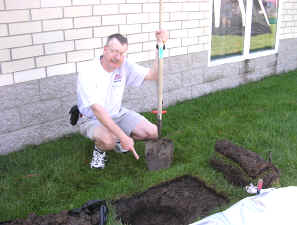
Photo: Here I am pointing to the spot we had to excavate for repairs after putting a ground rod directly through an irrigation system pipe during Field Day one year.
A story you will be hearing about in the weekly amateur radio news is a tragic one. ARRL and commercial media are reporting the deaths of three family members by electrocution during an antenna project. Says ARRL, “At approximately 8:40 PM on Monday, October 12, a man, woman and their 15 year old son were killed while trying to erect a 50 foot vertical antenna at the home of the man’s mother, Barbara Tenn, KJ4KFF, in Palm Bay, Florida. The deceased were not licensed amateurs.”
You can read the rest of the story on the ARRL site, and you should, because one of the best ways to follow up on a serious accident like this one is to take a look at the facts and begin a serious discussion about what went wrong and how to prevent another accident in the future. I will let you read the ARRL story and watch the TV news report for the details, but this story did serve to remind me of the days long ago, when Don, W0DN, now a silent key, and I started the little antenna company in Butternut Township, Blue earth County, Minnesota. Don lived in an old, rural schoolhouse, and the property was actually pretty good for an antenna business because even back in the mid-1970’s it was served by underground power lines. There was no chance at all to inadvertently swing a piece of aluminum tubing up into a power line while you were busy thinking about running another SWR check and trying to be as quick about it as possible so as to get as many tests in as possible. Of course there were always other things to be careful about, but the “work area” was clear of overhead hazards, and it needed to be, because in the day in, day out routine of putting up antennas, complacency would inevitably set in and one would lift a vertical antenna up without looking skyward first.
Complacency. It’s a phenomenon that is well understood and respected by trainers in aviation, driving, firearms, law enforcement… The list is endless. The way it works is that you learn about procedures that ensure the highest level of safety in whatever endeavor in which you engage, and you follow these “best practices” faithfully many times until they become routine. Nothing bad has ever happened, so you become a bit complacent – maybe you don’t really need to go through that checklist each time. After all, you have never had an accident, and you know what you are doing.
Than, without warning, it happens. An “accident” that causes property damage, injury, or even death. In firearms training, it is the time even an experienced range instructor, a fellow who had given me instruction, leaves a loaded weapon within reach of a toddler – I will never forget the tragedy that his family had to live through when distracted, he left for only a moment, and one of his twins picked up a pistol and shot the other twin. In ham radio, it happens when someone works on powered up equipment or rushes to put up an antenna without looking for wires.
I doubt that it is even possible to buy a commercial antenna designed to be installed outdoors that does not carry a hazard warning about looking up and avoiding powerlines. We put them on our products way back then, but manufacturers cannot control the installation of their antennas. Amateur antennas are certainly safe enough to install and use, but they are likely to be put up in places that are full of compromises. Unlike commercial antenna installations, amateur antennas are usually not at a site designed for antennas. There might be a need to mount the antenna on a residential roof. There could be power lines running along one side of the property and a “drop” from the power pole to the house. Neighboring houses might be relatively close by. There may be vegetation or trees. All of these things are potential hazards that must be considered before you even decide what kind of antenna to install.
Starting with a plan is a good idea. If you cannot see the proposed installation yourself because you are blind or cannot access the site for some other reason, you need to get some help from your radio club. I like to take a look at a proposed site and sketch a rough drawing that includes the house, the dimensions of the property, the locations of overhead powerlines and underground utilities, and any trees, other buildings, or possible obstructions. Although there is usually a “one call” service that a homeowner can phone to get a free location assessment of underground powerlines, water pipes, and natural gas lines, you are still on your own when it comes to underground lawn sprinkler systems. Since those will not be located by the “one call” service, you will likely not have them on your sketch and will have to dig carefully.
It is always a good idea to plan antenna work for a time when you will have at least one “spotter” to help you out. A spotter is a person who does not necessarily climb towers or pull coax, but who will be there for you if you have an accident and help needs to be summoned.
Be sure you begin a big project early enough to assure that you will have daylight to complete it. If Murphy intervenes and you fall behind schedule, stop working before darkness falls and continue your project another day. In the tragic story that opened this piece, the antenna crew had run out of daylight and were working in the dark.
Be aware of the limitations your work crew might have. The people helping with a project may be enthusiastic and well-intentioned, but they may not know the safety basics. In this case, the crew were family members who were not licensed amateurs.
There is a fine line between “Monday morning quarterbacking” and a thoughtful discussion of what went wrong in the Florida story. One thing I do have control over is what happens the next time I put up an antenna myself. I can take charge of the project and have a plan. While that won’t necessarily ward off every possible accident, it will certainly make the project safer – hopefully as safe as it can be.
For Handiham World, I’m…
Patrick Tice, [email protected]
Handiham Manager

Pat Tice, WA0TDA, is the manager of HANDI-HAM and a regular contributor to AmateurRadio.com. Contact him at [email protected].
LHS Episode #025: APRS and Xastir
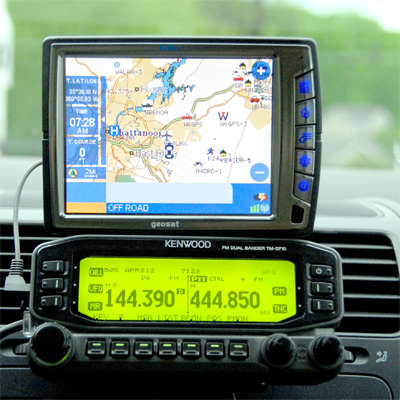 Richard and I have been busy over the last couple of weeks. He spent a day at the Belton Hamfest near Waco, Texas on October 3rd. The weekend before that, I spent a few days in Columbus, Ohio at Ohio Linux Fest. This is our first episode back from those events. I have a few hours of audio I need to sift through, but I managed to get a couple of clips from my interviews and commentary from OLF included in the second segment of this episode of the podcast. Because I had a visit from my parents and my brother and sister-in-law from New Hampshire, I haven’t been able to get the podcast out in a timely manner. I suppose after 25 releases, I should probably stop apologizing for being late but I do like it when we release on time. Anyway, enjoy our interviews and Richard’s discourse on APRS and Xastir, and stay tuned for a lot of great audio from our live endeavors coming up in future episodes. Thanks for downloading, and have a great couple of weeks.
Russ Woodman, K5TUX, co-hosts the Linux in the Ham Shack podcast which is available for download in both MP3 and OGG audio format. Contact him at [email protected].
ICQ Podcast Series Two Episode Twenty-One (11 October 2009) – Why QRP (why not)
- Grant for WWII code-breaking site
- Pirate banned from rooftops
- Ontario Provincial Police Force special event
- Free Yagi antenna design
- New Magnetron developed
- Preparing for WRC-12
- Successful launch of Amateur Radio CubeSats
- Melbourne Digital Amateur Television – update
- Special Mine Activity - Finland
- RSGB goes legal over Power Line Adaptors
- Anti-wi-fi paint offers security
- AO-51 configuration to support JOTA
- Antique Wireless Association Valve QSO Party
- FM satellites - Antarctica to VK and ZL
- New version of PocketDigi
Your feedback, Martin, M1MRB discusses QRP, and the first in our new series, hint, tips and tricks.
Colin Butler, M6BOY, is the host of the ICQ Podcast, a weekly radio show about Amateur Radio. Contact him at [email protected].
More DX during the solar minimum
Despite the poor propagation conditions occurring during the current solar minimum (which I, and practically every other ham has written about ad nauseam), I continue to make some good, and sometimes outstanding DX contacts. A couple of weeks ago, I had a CW contact with Richard, 9M2CNC in West Malaysia on 20m at around 8pm local time. While I’d worked West Malaysia before (in fact with Richard as well, then operating as 9M2/G4ZFE during an RTTY contest), that was the first CW contact that I had with that DXCC entity. I’m happy to say that the contact has been confirmed via Logbook of the World already.
Yesterday afternoon, I was working from home and took and saw a spot for Bill, E51NOU on 17m CW. The interesting thing was that it was the middle of the afternoon (not normally a good time for propagation to that part of the world), but I was easily able to make the contact.
Best of all, early this afternoon, I saw some spots for Wim, XU7TZG in Cambodia on 20m phone. The time was around 1PM local time, which means it was around midnight in Cambodia, late for this type of contact. I tuned to the frequency and was surprised to hear Wim working a (surprisingly small) pileup. I needed a contact with Cambodia as an “all-time new one” for DXCC purposes, so I figured that I might as well try to call him. Wim slowly worked the pile down (presumably getting the stronger stations out of the way), and after 30 minutes or so, I was very pleased him respond to my call, and the contact was completed.
All three of the contacts I’ve just discussed were made under fairly poor solar conditions. The solar conditions when I worked Wim in Cambodia were about as bad as you can get. The solar flux number was 69, which I believe is the minimum value possible (I’ll have to go read up and see why it doesn’t go to zero) and there were no sunspots at all. Both of those values indicate poor propagation. Fortunately, like the urban legend (check out that link, it’s a good explanation of that legend) that says that it’s aerodynamically impossible for bees to fly, radio waves don’t bother to listen to scientists nor do they study physics.
As I’ve said before: Stop complaining about how poor the conditions are. Turn on your radio. Listen around and if you don’t hear anything, call CQ. You might be surprised at the kind of wonderful contacts you can make.

David Kozinn, K2DBK, is a regular contributor to AmateurRadio.com and writes from New Jersey, USA. Contact him at [email protected].
Handiham World for 07 October 2009
Welcome to Handiham World!
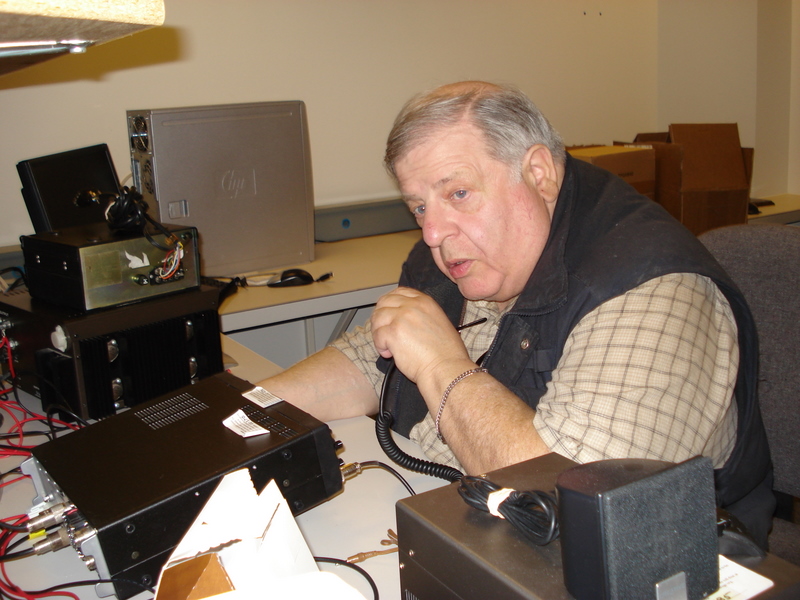
Photo: Last QSO from Courage Center marks end of an era – Avery Finn, K0HLA, is net control for the last Handiham net and made the last radio contact from the station at Courage Center in Golden Valley, MN.
The Handiham headquarters station was moved this week from Courage Center to Camp Courage, Maple Lake, Minnesota. The last day of operation was Monday, October 5, 2009, when Avery, K0HLA, ran the daily Handiham net. The stations who checked in will receive QSL cards from us, thanks to Avery’s diligence in keeping a log and filling out the cards for today’s mail. We did not make any official announcement ahead of time, so whether or not you were a member of this select group of stations simply depended upon your being there. So always show up for your nets – you never know when something special will happen.
This reminds me of when Jerry Kloss, N0VOE, and I were talking about our kids. At that time, my son Will was just a little guy – probably in Kindergarten.
Jerry told me, “Enjoy it while you can – all those wonderful experiences – they grow up before you know it.”
That really did turn out to be true. Will, KC0LJL, is 20 now and studying in Tokyo. Over the years I have remembered Jerry’s words, and I now think back to the times I carried my son up the stairs and put him to bed. I thought to myself each time, “I wonder if this will be the last time I carry Will upstairs.”
Then, one time it was.
I don’t remember exactly what day it was, but that last time did arrive and I’m sure I wondered if it would be the last time I held my son in my arms and climbed the stairs. There were plenty of other last times to remember, too. A last time I fed him while he sat in his high chair. A last time he played with his stuffed Big Bird toy. A last time he rode his tricycle. His last day of elementary school. That last day of high school.
The point is that last times happen all the time. Life is relentless that way. Oh, sure, we may plan to visit a relative we have not seen in years, but circumstances may change and instead we are attending a funeral. That trip you have always wanted to take, and could have when you had the chance, might be out of reach today because of the recession. That radio club meeting you didn’t attend at the end of last season’s meeting season… well, that might have been the last time you got to visit with your friends, some of whom have moved to other places and jobs.
Don’t miss a chance to enjoy life, to stay in touch with your friends, to be a part of ham radio. There is an old joke reminding us that no one ever said on their deathbed, “Gee, I wish I had sat on the couch and watched more television.”
Now, get out there and get on the air. Don’t pass up an opportunity to talk with your friends. Go, go, go!
For Handiham World, I’m…
Patrick Tice, [email protected]
Handiham Manager

Pat Tice, WA0TDA, is the manager of HANDI-HAM and a regular contributor to AmateurRadio.com. Contact him at [email protected].
Scandinavian Activity Contest
eally slick thing is that as soon as you upload it, they do an immediate syntax check (so you’ll know if there are any errors), then post your claimed score on their website along with everyone else in your category.

I submitted as Outside Europe, Single Operator, Multi-band, low power and I guess I’m kind of in the middle of the pack at the moment. Of course, this is subject to log checking (I may have made an error logging a station or two) and it will change as others submit their logs, but it’s nice to get immediate feedback. Another excellent use of technology by the contest organizers.
One nice side-effect of just “playing around” in the contest was that I did not only work OH0Z on Aland Island on 75m, but as soon as I uploaded my log to Logbook of The World this afternoon I got a confirmation of that contact, bringing me to 97 countries confirmed on that band. I’m getting pretty close to being able to submit for the 5 Band DXCC award.

Posted via email from K2DBK’s Ham Radio Blog

David Kozinn, K2DBK, is a regular contributor to AmateurRadio.com and writes from New Jersey, USA. Contact him at [email protected].
ICQ Podcast Series Two Episode Twenty (27 September 2009) – ClusterClient
News Stories include:-
- Promoting Amateur Radio from the 'Fourth Plinth'
- New version of GJTRACKER available
- Jamming sellers to be fined
- Young amateur to join DXpedition
- UK HF Propagation Predictions
- Hams invited to join new emergency corp
- D-STAR on AO-27
- GB7NB D-STAR repeater operational
- DRM Receiver Profiles released at IBC 2009
- RSGB PLT Leaflet
- IARU Region 3 Conference Papers
- BBCTV Vintage video received in New York
- Wireless Communication Lectures
- Maldives operation
- Jamboree On The Air
Charlie Davey, M0PZT, joins use to discuss ClusterClient and your feedback.
Colin Butler, M6BOY, is the host of the ICQ Podcast, a weekly radio show about Amateur Radio. Contact him at [email protected].
 Ham Radio Deluxe |
 W5SWL Electronics |
 Ham Radio Prep |
 KB3IFH QSL Cards  Hip Ham Shirts  HamRadioAuctions HamRadioAuctions Reliance Antennas Reliance Antennas Enigma Shop Enigma Shop |  morseDX  Ni4L Antennas  R&L Electronics R&L Electronics antennas.us antennas.us QRV QRV |
- Matt W1MST, Managing Editor
