 |
 Watch Hill
 2 May 2010 | by
 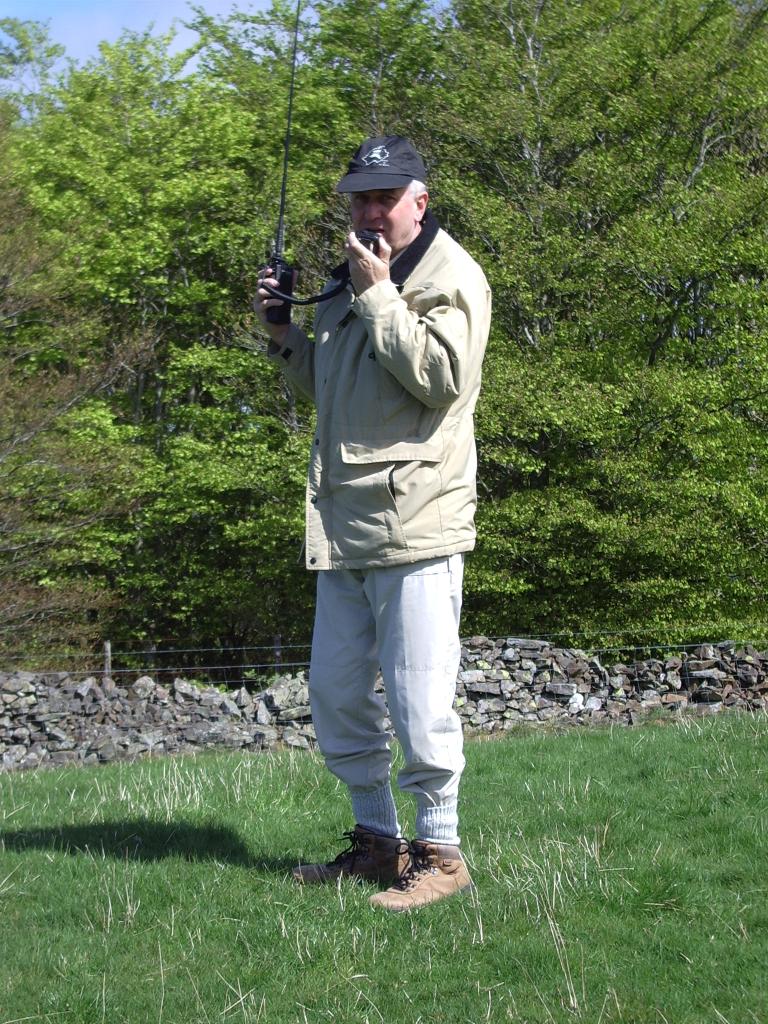 It was a fine sunny morning. I remembered – having worked a couple of activators yesterday – that it was the Summits On The Air (SOTA) Activity Weekend, so I thought we would go to Watch Hill, G/LD-054, and see what I could work from there.
Compared to all the people who have slogged up thousands of feet to get to their summits Watch Hill is a bit of a cheat. It’s a 15 minute stroll from the nearest car park, with only the last couple of hundred metres being a bit steep. But as it is a less than 10 minute drive from home it’s a popular walk for Olga and I and we often take a picnic lunch up there.
I took with me the Motorola GP300 and the Kenwood TH-205E with the 5/8 telescopic whip. Getting the 4 contacts required for a SOTA activation can be a challenge from there, as it is a fairly low hill and there isn’t a huge amount of 2m FM activity round here. Many have tried and gone away disappointed. However on Sunday morning the Workington Radio Club has a 2m FM net. I broke into that and soon had 5 contacts logged. Future would-be activators of Watch Hill please note.
I also made a summit to summit with 2M0NCM/P on Lamachan Hill SS-061 in Dumfries and Galloway, and then caught Geoff G4WHA/P who was just stopping for lunch on Wether Hill, WOTA summit LDW-103. I wouldn’t have heard him from home, so that was a nice WOTA chaser point for me.
The Motorola produced great, loud audio which is ideal for listening on a windy hill-top, and I got an unsolicited report of “BBC quality” audio on my transmissions, so it seems to be working well. However I noticed that some stations seemed to chop up a bit. I’m not sure if they were weak and the squelch is very sharp or whether their deviation is a bit wide for the Motorola IF filters. I will need to investigate this further.
The TH-205E came in handy after the Motorola gave a few beeps to warn, I think, that the battery was exhausted. There is no visual indication of battery state on the Motorola so I had no advance warning. The station I was working said that he could hear a carrier but no audio after the battery went. Still, it does seem to be a nice radio and rugged enough for this type of use.

Julian Moss, G4ILO, is a regular contributor to AmateurRadio.com and writes from Cumbria, England. Contact him at [email protected].
40 Meters Tonight: A Box of Chocolates

Anthony Good, K3NG, is a regular contributor to AmateurRadio.com and writes from Pennsylvania, USA. Contact him at [email protected].
The shack is back
I finally completed phase 1 of the shack renovation. G4ILO is back on the air!
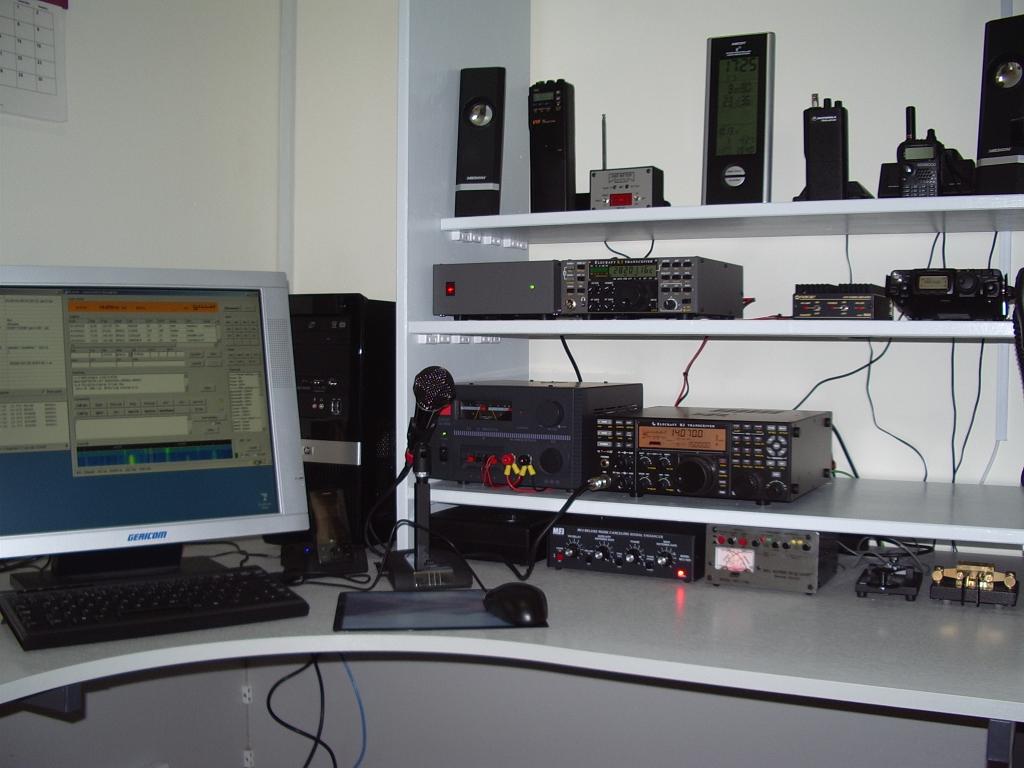 The floor is now covered in wood laminate, and there is a shelf unit on the desk that displays all my radio equipment “ready to go”.
On the “ground floor” is the VHF antenna rotator, the MFJ noise canceling unit, the tuner for the MFJ magnetic loop and my two Morse keys.
On the next level is my Diamond GSV3000 power supply and my Elecraft K3. There is space for a new addition to the right of the K3. This will not be a P3 panadapter, the pictures of which haven’t excited me at all, nor will it be the recently announced Elecraft 500W linear amplifier – as if I could use one with my attic antennas!
The shelves above the K3 lift out to make it easier to access the back of the radio for changing cables. On the second storey is my QRP K2 with its matching power supply. The K2 is really there just for display, as it isn’t actually connected to any antennas, though I could easily swap an antenna from the K3 to the K2 if I wanted to. The K2 power supply runs a few other items including the FT-817ND, seen on the right with the Microset R50 144MHz amplifier. The 817 is doing duty as my 2m rig at the moment – I have given up the transverter due to a number of issues including poor memory ergonomics of the K3 and the fact that it is convenient to be able to monitor or even operate on 2m while the K3 is otherwise occupied.
The top shelf holds the Medion computer speakers that deliver decent-sounding audio out of the K3, my KK7UQ PSK IMD Meter and my collection of VHF/UHF hand-held radios and their chargers.
The opposite wall is still a hodge-podge of shelves screwed to the wall. Phase 2 is to install a custom designed system of shelves and cupboards so the boxes of “junk” can be hidden away behind closed doors. There is a firm that has a web site where you can design your own unit from standard modules and it arrives as a giant flat pack which you assemble. Olga is designing it as she is much better at that sort of thing than me.
I’m not very skilled at joinery and my home made shelf unit doesn’t look all that professional but it’s better than what I had. Having all (well, most of) my radios at my fingertips I feel for the first time in my life like I have an actual radio station. I made a few contacts today including a PSK31 QSO with Greece on 12m, two SOTA stations on VHF and a nice slow morse contact with Helge, LA1PRA on 80m.

Julian Moss, G4ILO, is a regular contributor to AmateurRadio.com and writes from Cumbria, England. Contact him at [email protected].
This Weekend In RadioSport | Lucky 7QP
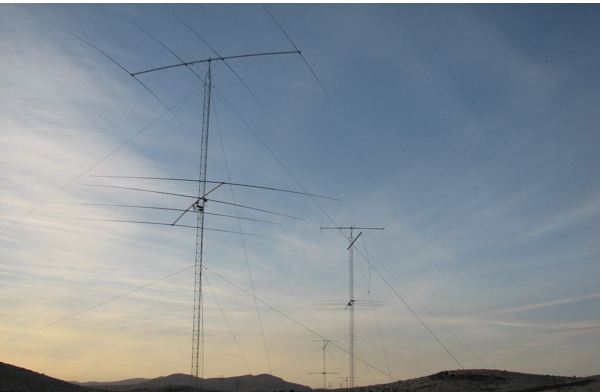 RadioSport USA | 7th Call Area QSO Party.
The party includes seven states and a whole lot of ham radio fun through the weekend. This event is one of my favorites because it is regional and low power friendly while Cycle 24 figures itself out. Has anyone noticed the astonishing decline in sunspot numbers? Perhaps it is part and parcel or is Cycle 24 completely different, whatever the case, it is an amazing scientific phenomena.
I plan on deploying my vertical tomorrow morning after walking Radio Dawg. She really needs a little exercise afterward fire up the radio and go for ionospheric fun. I’ll focus on the high bands 20, 15, and 10m while sending Morse Code straight off the paddles. It’s been awhile and CQ WPX CW is around the corner.
Rules (link).
SFI = 79 | A-index = 3 | K-index = 1 | Sunspot count is 0 @2111UTC.
See Also.
Radio-sport dot net | While N4PN Rules NEQP, W0BH Looks For Fifth Straight Single Op Victory In 2010.
P.S. The Beach Boys Amateur Radio Club meets this evening for our founder’s photograph. The only requirement for membership is a Hawaiian print shirt. 73s.

Scot Morrison, KA3DRR, is a regular contributor to AmateurRadio.com and writes from California, USA.
Not To Toot My Own Horn…
....but I placed first for the third year in a row competing in the QRP division in the Pennsylvania QSO Party. It's the only contest I get excited about these days and it has reasonable hours that let you get some sleep between Saturday and Sunday operating. And it helps that I actually live in Pennsylvania.... :-)

Anthony Good, K3NG, is a regular contributor to AmateurRadio.com and writes from Pennsylvania, USA. Contact him at [email protected].
Handiham World for 28 April 2010
Welcome to Handiham World!
When did “anything goes” become acceptable?

Today we are going to try something completely different. I want you to relax and close your eyes and empty your mind of all of the worries and details of what you are doing right now. Turn down the radio, turn off the television, and prepare to take a trip backward in time. Now, I don’t want to admit that I am “old”, but I have been an amateur radio operator for quite a few decades — since 1967, in fact. For me, this trip back in time will take me to those teenage years in the 1960s when amateur radio first appeared on my horizon and ultimately grabbed my attention with its promise of communications technology and cutting-edge connections to science and learning. These were the days of the great space race when science and technology were really cool things and everyone knows that teenagers go for the “cool” stuff. Gee, today I’m not sure the word cool is even so cool anymore.
Some of you will be older than I am and will be able to remember World War II and the exciting and interesting role communication played during those years. Others will be younger but will still be able to remember a time when they became fascinated with amateur radio and its promise of civic engagement in public service communications, new and exciting technologies, and a great way to make new friends.
One thing that will be common to all of us traveling backward in time today and remembering those first days of fascination with amateur radio will be a good feeling about those who helped us to learn amateur radio and the civil and friendly nature of the amateur radio service. Sure, there may have been more rules about Morse code and keeping a log book, but the more important consideration was the fact that the amateur radio bands were by and large a safe place for a teenager to hang out, for a kid to learn basic electronics, and even for a grandma to work DX.
In fact, no matter how old you are you can probably remember kindergarten or your first few grades of elementary school and how you learned basic civil behaviors like sharing, being polite, not talking while others are talking, and what is and what is not appropriate language and behavior. Your teacher would certainly not allow you to wear a cap in the classroom or get up and start running around during a history lesson. If one of your classmates let loose with a swear word, even a mild one, it would certainly result in a trip to the principal’s office and some sort of punishment. Oh, how we hated to stay after school on a sunny Spring day while the rest of our classmates headed out the school door to enjoy the rest of the afternoon.
Can you guess where this little essay is going?
Well, I have to bring you back to today and reality. Yesterday I was tuning around on the HF bands. Propagation has been rather poor these last few days and I was anxious to find out if there was something wrong with my station after I had been away on vacation for a couple of weeks. You never know; perhaps a feedline had gone bad or something had happened to the antenna system. Anyway, in the course of my travels up and down the HF spectrum I came across a conversation on the 20 m band. As is often the case, I could hear some of the stations on the frequency but not others. Listening for a while allowed me to find out whether propagation conditions allowed communication to the east and west coasts from my location in Minnesota.
It turned out to be a more or less informal roundtable net without a formal net control station. In this kind of a situation, stations just take turns and remember who is next in the roundtable discussion. It generally works pretty well in a small group situation where all of the stations can hear each other. Of course I would not consider entering this roundtable myself, because I could not hear at least two of the other stations, but it certainly wouldn’t hurt to listen along for awhile to see if propagation conditions would change.
That certainly proved to make for some interesting listening.
One of the stations started to go on what I could only describe as a rant about former VP Al Gore and how terrible he is and what a liar he is, and on and on and on. Another station picked up on that theme and spiced it up with several derogatory words that I can only say would not be acceptable in polite company — and that certainly would have gotten him sent to the principal’s office for detention had he been in Mrs. Cunningham’s third-grade class.
Of course at this point my ear was glued to the speaker. How bad could this train wreck of a QSO possibly get? It wasn’t long before I found out.
The roundtable continued along these lines of character-bashing and complaining with nary a single positive thing to say. In due course, one of the stations started tearing into President Obama, saying, “I won’t even call him president; just Obama.”
But wait, folks — that’s not all. This poor guy got himself so worked up about how awful President Obama is that he dropped the proverbial “F-bomb”. Mind you, this is all going out on the air for anyone and everyone with a short-wave receiver to hear. No one in the roundtable group complained about this jeremiad and inappropriate language, at least as far as I could tell. It seemed like everyone in the group was like-minded, joining together in their celebration of stupid, boorish behavior.
Okay, so that’s bad language being used on the air. My wife and I both drive and since we are often in the car together, we observe other drivers and their behavior. We have developed a theory about bad drivers: “When they’re bad, they’re bad.” What this means is that when we see a driver failing to signal or wandering around the road while using a cell phone or some other careless behavior, it is also highly likely that that same driver will exhibit bad behavior across the driving spectrum. For example, that same inattentive driver is more likely to blow a stop sign if they fail to signal and wander back and forth across the driving lane. “When they’re bad they’re bad.”
This same concept applied to the guy in the roundtable who dropped the F-bomb while trashing the President. He went on and on and on talking and talking even though band conditions were changing and the other stations in the roundtable complained over the top of him that they were only getting every third word or so. An operator who has one egregiously bad habit is more likely to exhibit other undesirable and perhaps illegal behaviors on the air, such as failing to comply with identification requirements as set forth in Part 97. When they’re bad they’re bad.
As part of our ongoing operating skills review, I think we need to not only revisit the necessity to comply with basic station identification rules, but we also need to recall a time long ago when we were taught in elementary school to be nice to each other and play well together. Courtesy, respect, thoughtful consideration of other people’s feelings — all of these things are basic to a civil society and good communications skills. Please don’t get me wrong; I am not saying that no one should discuss politics or political figures on the amateur radio bands. What I am saying is that respectful civil language is called for at all times when we are using the shared resource of the amateur radio spectrum. Anyone could be listening. Furthermore, coarse, rude, or inflammatory language demeans and degrades the amateur radio experience for all of us — even for those who were participating in that ghastly roundtable on 20 meters. A coarsening of language pulls everyone down and makes it more difficult to have an honest discussion about any topic.
I don’t care what your politics are or what your religious or other personal preferences might be. When I first got started in amateur radio, I read and heard from others of the time that it was always best to stay away from topics like sex, religion, or politics while on the air. Of course times have changed. Commercial talk radio and cable television news channels cross over into territory where we don’t want to go. Bad language and insulting and demeaning comments along with sexual innuendo might have found their way into these other services, but they are still not welcome in the amateur radio service. If you want to talk about politics, there is no rule against your doing so. If you want to talk religion, you can do that as well. The thing to remember is that as an amateur radio operator you have an obligation — a duty, if you will — to maintain the amateur radio bands as a place for anyone to safely visit for a listen. Political discourse can be polite and civil. Name-calling and bad language will only ruin the bands for everyone else.
So that is my operating skills lesson for today. Think before you speak and always be polite and civil even when you disagree with someone else. Share the bands and remember that children or newcomers to the short-wave bands may be listening anywhere and at anytime. Always be kind and helpful.
And won’t you please use your callsign? Use it every 10 minutes during a conversation and at the end of a series of transmissions to comply with the legal requirements, but use it even more than that to help avoid confusion about who is talking and when. When I teach the Technician class for my local radio club, I tell these new hams to be, “Use your callsign often — you won’t wear it out.”

Pat Tice, WA0TDA, is the manager of HANDI-HAM and a regular contributor to AmateurRadio.com. Contact him at [email protected].
GP300 success
 Two more items for the Motorola GP300 arrived from Hong Kong today, an 1800mAH NiMH battery pack and a charger. I’m a bit dubious about the charger. I put the battery pack on the radio and started charging it, and when I checked six hours or so later the battery pack and radio were really hot. I would have thought the charger should have shut off by that point. So I’ll have to watch the charge times.
I wanted to have another try at programming the radio using a newer version of the software from the hampedia site but when I started up the Toshiba Satellite 1800 and tried to go into the Bios to re-enable the cache (which I disabled yesterday to slow the computer in the hope of overcoming the programming problem) it asked for a password. Somehow when I disabled the cache I must have accidentally enabled a Bios password, but of course as I didn’t do it intentionally I have no idea what the password is. I tried to start Windows 98SE but it took 20 minutes to load and was unusable once it eventually did. So that’s that.
But in the end another solution was found. I registered with the forum at the curiously named Batwing Laboratories website, which apparently is the fount of all knowledge for all things Motorola, and posted about my problem there. Tom in D.C. (W2NJS) replied that the DOS in Windows 98SE wouldn’t do, I must use MS-DOS 6.22.
Now I was programming micros since before IBM invented the PC. I’ve read Ray Duncan’s “Programming MS-DOS” from cover to cover several times so I was pretty much an expert on the subject at one time (though I’ve forgotten just about all of it now) and I would never have thought that there were any differences between the two versions affecting the use of the serial port. But Tom was firm enough in his advice that I downloaded an MS-DOS 6.22 boot CD image and made myself a boot disk. It wouldn’t recognize my Windows 98SE partition so I had to vape that, reformat under MS-DOS 6.22 and set everything up from scratch. Fortunately I still remembered enough about things like config.sys and autoexec.bat to get it to work.
I reinstalled the programming software, connected the interface, and this time I got “Radio Communication OK!” Tom in D.C. probably heard my cheers from there. So I was finally able to program eight 2m frequencies into the radio – five simplex channels plus the three local repeaters – and have just completed two QSOs on the GB3LA repeater from inside the house using a quarter wave telescopic whip, so it works!
The Motorola GP300 seems to work a bit differently to ham radios. For example, there are three power levels but the power level is fixed for each channel, so if I set High power in order to access a repeater from home I can’t reduce the power to Low to save batteries when I’m in line of sight of it from a hilltop. And if you want a Scan function you have to dedicate a channel to that.
Possibly there are some tips for setting up these radios for ham band use that I’m not aware of yet. But even if there aren’t, it’s still a nice radio for £1. Even if by the time you add in the cost of the programming interface, the battery pack, the charger and the adapter that converts the Motorola proprietary antenna socket into a BNC it ended up costing more like £40.

Julian Moss, G4ILO, is a regular contributor to AmateurRadio.com and writes from Cumbria, England. Contact him at [email protected].
 Ham Radio Deluxe |
 W5SWL Electronics |
 Ham Radio Prep |
 KB3IFH QSL Cards  Hip Ham Shirts  HamRadioAuctions HamRadioAuctions Reliance Antennas Reliance Antennas Enigma Shop Enigma Shop |  morseDX  Ni4L Antennas  R&L Electronics R&L Electronics antennas.us antennas.us QRV QRV |
- Matt W1MST, Managing Editor
