 |
 Scratching the SDR itch
 18 May 2010 | by
 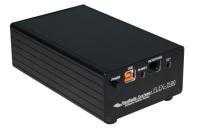 One of the blogs I regularly read is that of Larry W2LJ. Larry has been watching some of the streamed video presentations about software defined radio (SDR) coming out of Dayton and believes that SDR is now mainstream and the shape of things to come.
I would be dishonest if I said that I have never looked at some of the SDR products and wished that I had one to try. SDR is becoming an itch that many of us would like to scratch. But I suspect that, in my case at least, it is an itch that once scratched would go away. Although I’m sure that software defined radio technology will find increasing use in tomorrow’s radios – as it already does in the Elecraft K3 – I hope that “black boxes” controlled via a computer console never completely usurp standalone hardware radios.
Dedicated hardware “just works”. General purpose computers are just too much hassle. There are the security issues, the updates, the driver incompatibilities, the crashes, the unfathomable problems. You switch on a radio and it is ready to use. You switch on an SDR and you must then start the computer and wait for it to boot, then start the SDR application and wait for it to load. Is this progress?
Dedicated hardware works until it dies. Computer based devices only work until a new version of Windows comes out that doesn’t support it. How many perfectly good printers and scanners have you had to throw away because they wouldn’t work with your new computer?
Real radios have an aesthetic and provide a sensory experience that simply cannot be matched by a computer interface. Isn’t turning a knob preferable to moving a slider with a mouse? Isn’t making a real audio cable easier than trying to configure a virtual one? Many of us prefer a real S-meter to a graphical simulation. Most of us spend far too much time staring at computer screens already.
With real radios you can look at the schematic and get in there with your soldering iron and make modifications or fix faults. With SDR you are dependent on somebody else unless you are a skilled programmer and have access to the source code and development tools.
I can’t see myself swapping any of my radios for a black box and a computer application interface any time soon. I’ll still work the same bands and the same modes, so what benefits would an SDR give me? A hardware radio is instant-on, intuitive, virus-proof and crash-proof, can’t be broken by some application I install on my PC, doesn’t lock me into using a particular brand of operating system and won’t be made obsolete by the next version.

Julian Moss, G4ILO, is a regular contributor to AmateurRadio.com and writes from Cumbria, England. Contact him at [email protected].
Satellite antenna
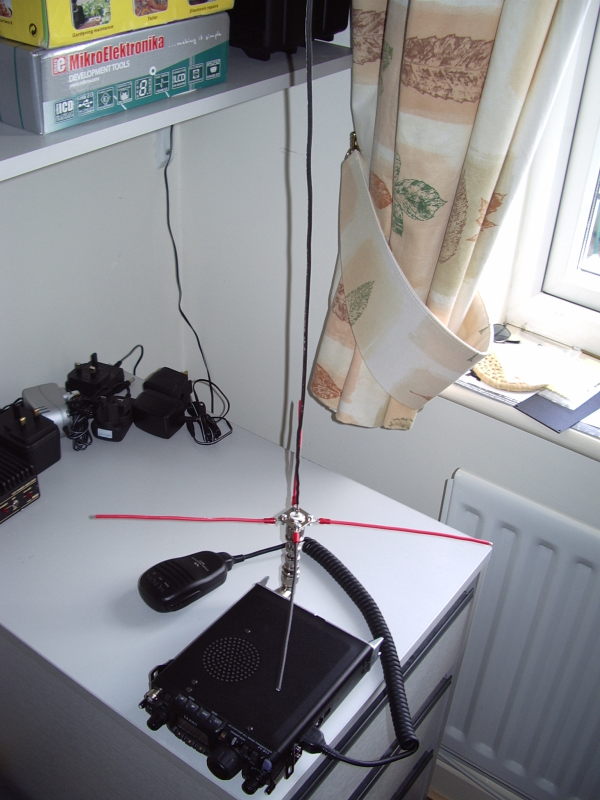 I attempted this morning to make a 5/8 wave ground plane antenna for 70cm out of some solid copper mains cable and a chassis mount SO-239 connector. I tried two designs for the radiating element with a coil at the bottom, but both gave “High SWR” from the FT-817 and were so far away from a match that there seemed no hope of getting anywhere. My SWR analyzer doesn’t go above 200MHz so that wasn’t any help in finding out what was wrong.
After these abortive attempts I decided to straighten out the coil and make a 3/4 wave ground plane instead. This gave a perfect match with barely perceptible reflected power being shown on the SWR meter.
The four radials are each 165mm (6.5in.) long and the vertical element 483mm (19in.) The radials need to be horizontal for the best match, not slanting down as they usually are for a quarter wave vertical.
Hopefully I will be able to receive satellite downlinks with this. There are no 70cm repeaters in this area and no 70cm activity that I know of so it will not be much use for anything else.

Julian Moss, G4ILO, is a regular contributor to AmateurRadio.com and writes from Cumbria, England. Contact him at [email protected].
My 10,000 Hour RadioSport Challenge | 9,804 – 1 = 9,803 Hours To Go
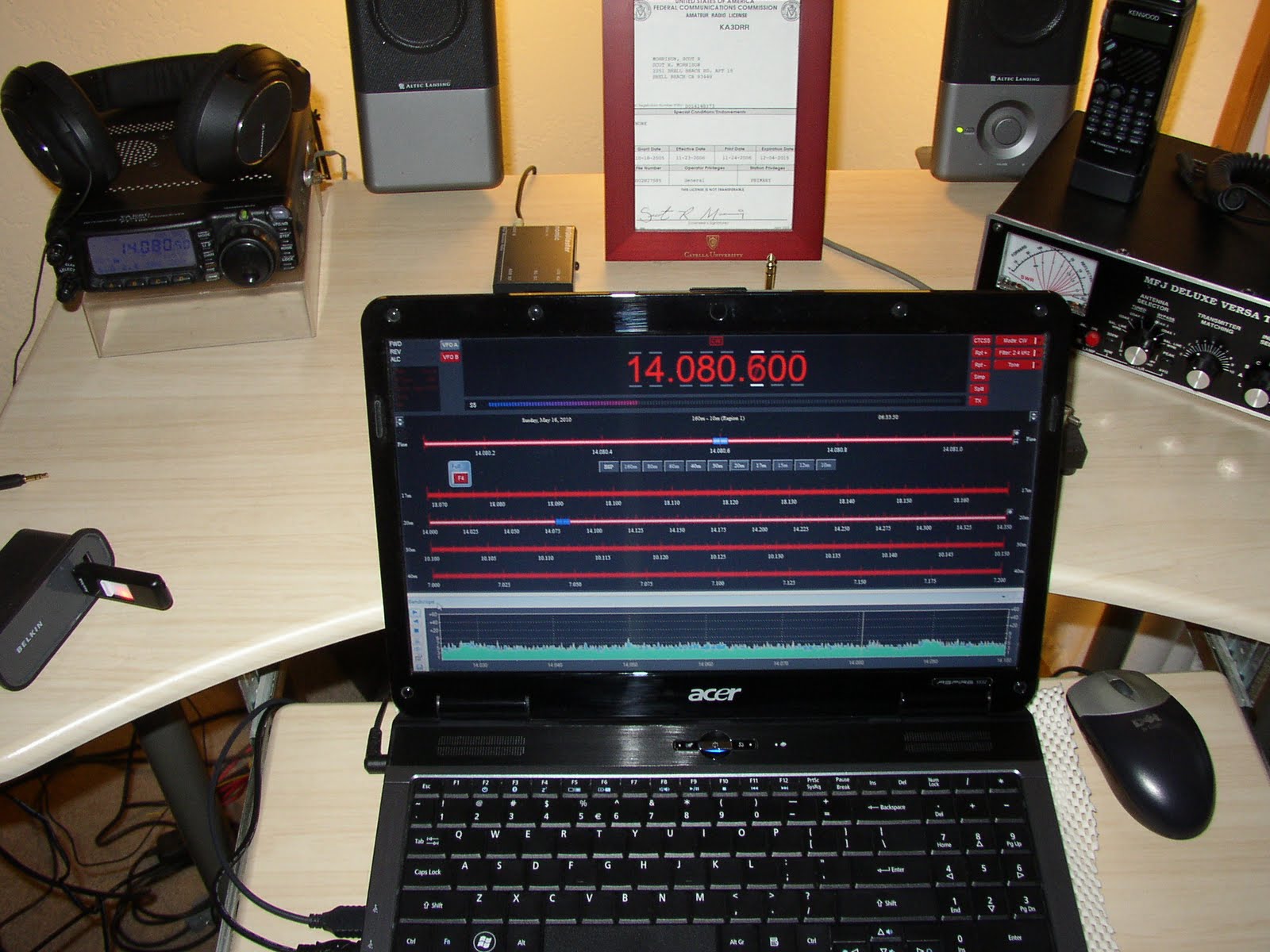 The lull between solar cycle sets allowed me an opportunity to configure Ham Radio Deluxe with bandscope capability. I’m impressed with its user interface and continuous scanning. The scope settings range between 6 dB through plus 60 dB in addition I’m monitoring 75 KHz of bandwidth.
QSO Party.
Recently, I operated in the 7th Call Area QSO Party, for an hour prior to a social commitment. The recent downward sunspot trend suppressed most signals, normally, signals from 7-land range between s5 through plus 10dB on the meter. This season seems exceptionally different unlike previous years.
The Beach Boys Amateur Radio Club is wondering where all the sunspots have gone?
Software Control.
I have reached a milestone inside the shack that is additional software controlling of the Yaesu FT100 because of Ham Radio Deluxe. However I have not completed the project that is interfacing my radio because of port issues. My goal is to resolve the conflict at the end of the month although not in time for CQ WPX CW.
Currently, both N1MM Contest Logger and Ham Radio Deluxe compete on port four, which is assigned to the CAT62 cable off of the FT100.
The DM780 program runs in CW mode and I’m fascinated by the spectral intensity of signals. I feel like ham radio moved to another level because, not only am I hearing the signal, it is also visualized on the liquid crystal display. Likewise, one can watch the Morse code interpreter and I’m curious how it will function at the end of the month for example; can I cut and paste a callsign from the interpreter into N1MM’s dialogue box when searching and pouncing?
CQ WPX CW.
I’m looking forward to the late Spring mega RadioSport event given WPX growth over the past few years. Likewise, I will have an opportunity at using the bandscope and waterfall although WPX is a rate competition. Perhaps, the big question is, will a set of sunspots flow across the solar disc later this month?
73 from the shack relaxation zone.

Scot Morrison, KA3DRR, is a regular contributor to AmateurRadio.com and writes from California, USA.
More ash disruption – hams stranded
 British and European hams who are in the US to visit the Dayton Hamfest may find it a bit tricky to get back next week. Changing weather conditions are likely to cause ash clouds from the Eyjafjallajokull volcano to return to the UK. The Department of Transport is predicting that UK airspace – including the busiest airports in the south east of the country – may be closed from Sunday until Tuesday. Travellers are advised to check with their airlines before setting off for the airport.

Julian Moss, G4ILO, is a regular contributor to AmateurRadio.com and writes from Cumbria, England. Contact him at [email protected].
10m portable whip
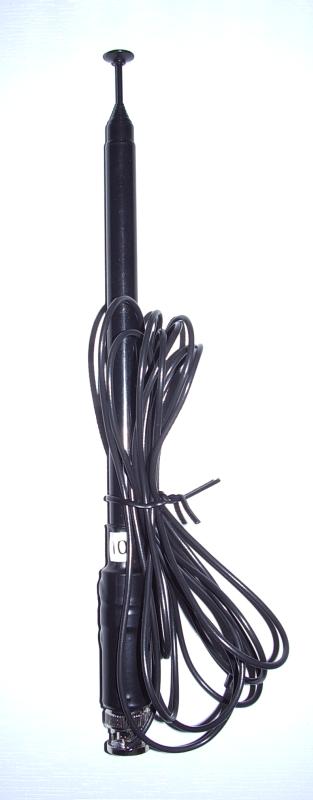 My reason for getting the Intek H-520 Plus hand-held was to try to work some Sporadic-E DX from the great outdoors. I didn’t think the supplied 18cm whip would be much good for that so I looked for the longest 10m BNC whip antenna possible. The best I could find was the AT-10 with a 4 foot telescopic whip which I believe is made by Sandpiper Antennas in Wales. It is sold by Waters and Stanton. I ordered one yesterday and it arrived in the post this morning – nice to see they can get it right sometimes.
The first thing I did with the antenna was put it on my AA-200 antenna analyzer. I was dismayed to find that the SWR on 10m was more than 10:1 and the best match was around 38MHz. I anticipated that this would be going straight back. However the instruction sheet “Getting the best out of your antenna” recommends using it with a counterpoise. I had expected to use one for best performance anyway, so I decided to try this before writing the antenna off completely.
The instruction sheet recommends a length of 6ft 5in for 10 metres, but I found that was too short as the best match was still well above 30MHz. By trial and error I eventually found a length of 7ft 6in was about right. The best SWR was still only 2:1 so I think the antenna is capable of improvement, but there is nothing else available to the best of my knowledge.
If a counterpoise is required you might think it would be a good idea for the manufacturers to provide somewhere to attach one. I tried using an alligator clip but it tended to slip off the BNC connector. In the end I managed to solder to the outer sleeve of the BNC connector using my biggest soldering iron turned up to maximum temperature so the counterpoise is now permanently attached to the antenna (until the wire breaks off, which it will probably do in the middle of a field just at the start of a massive band opening.)
Now I just need some Sporadic-E to see how far it is possible to work with a hand held radio.

Julian Moss, G4ILO, is a regular contributor to AmateurRadio.com and writes from Cumbria, England. Contact him at [email protected].
RadioSport History | CQ World Wide DX CW 1980

RadioSport is fun although the level of fun one seeks is another matter. Certainly, the sport where wireless technology meets human skill and intellect, is my favorite niche within ham radio. My passion remained even during those days in uniform or while attending graduate school. Whatever the measure of one’s station, what really counts at the end of the day, is how one shares their enthusiasm for the game.
Perhaps, after all the trophies and certificates are won, what really matters is the moment when a rookie operator gets it.
The measure of our success is best exemplified by Doug, N6DFY and his smile.
Nuts and Bolts.
I hope a frank and earnest discussion begins regarding the trajectory of RadioSport and a bold vision is developed. Afterall, this is Dayton weekend, when the movers and shakers of the game gather for pizza inside the Contesting Suite. I believe such a vision is beginning to develop out of the genesis of the World Wide Radio Operators Foundation (WWROF).
I’m not going to besiege with a list of complaints neither do I want to point a finger at anyone organization, institution, or individual. What I want is leadership, bold vision, courage, and something to believe in again.
The task before WWROF is not an easy one, in fact, why create a non-profit dedicated to improving the skills of amateur radio operators, if there was not a need?
Brockman and Cox (1981) pointed out padding in the logs, excessive dupes, sloppy copy, and operating outside one’s privileges to mention a few as problematic. However there something called honor, courage, and duty.
Please, if one is reading my blog in Dayton, take a moment and reflect about qualities rarely discussed anymore. Leadership. Honor. Courage.
I hope that in between all that is going on in Dayton that our movers and shakers take time to reflect as well. I believe WWROF is a good step forward in addition they are willing to confront the challenges ahead with leadership, vision, and courage.
73 from the shack relaxation zone.
Reference: Cox, B. K3EST, Brockman, L. N6AR (1981, October). CQ Magazine: 1980 CQ World Wide DX Contest: C.W. Results. pp. 13 – 16, 18 – 20, 22 – 27.

Scot Morrison, KA3DRR, is a regular contributor to AmateurRadio.com and writes from California, USA.
New DVAP dongle
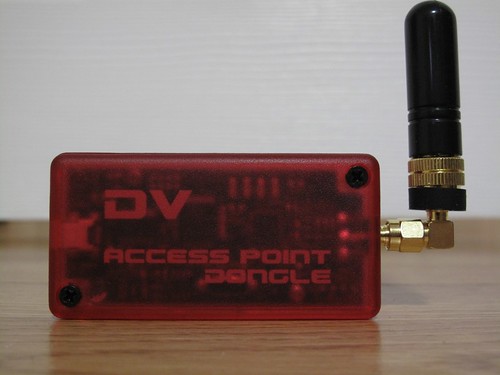
I recently acquired a DV access point (DVAP) dongle from HRO. This is a very interesting piece of D-STAR equipment. It is a 2m transceiver that is connected via a USB 2.0 port to a computer, which has to be connected to the internet. This then allows the dongle to be effectively a simplex repeater passing D-STAR signals on and off the D-STAR network. So using my IC-91AD HT I can link to either D-STAR gateway repeaters or reflectors and talk to other operators. The audio quality is very good. I have heard other operators using theirs and I have had good reports when using mine. Output power is 10mW (but can be lower) and I can link to the dongle from around the house. So I can make contacts around the World on the D-STAR network from the comfort of an armchair or whilst sitting outside on the deck.
The device is made in the USA and it is very well put together and packaged. Even the supplied USB cable was a quality molex brand cable. (Please note you must own a 2m D-STAR radio to use a DVAP, it will not convert FM to D-STAR. If you do not have a D-STAR radio consider the DV Dongle.)
Here are a few videos that talk about the DVAP dongle.
First an overview from the US National Capital Radio D-Star Association. They talk about the DVAP dongle for about the first 2 minutes then go on to talk about other equipment.

Next a detailed DVAP demonstration by Tim, G4VXE,
Finally HRO has them in stock!


Alan Steele, VA3STL, is a regular contributor to AmateurRadio.com and writes from Ottawa, Ontario. Contact him at [email protected].
 Ham Radio Deluxe |
 W5SWL Electronics |
 Ham Radio Prep |
 KB3IFH QSL Cards  Hip Ham Shirts  HamRadioAuctions HamRadioAuctions Reliance Antennas Reliance Antennas Enigma Shop Enigma Shop |  morseDX  Ni4L Antennas  R&L Electronics R&L Electronics antennas.us antennas.us QRV QRV |
- Matt W1MST, Managing Editor
