 |
 Project Future Of Ham Radio | Rochester Institute Of Technology Amateur Radio Club
 30 May 2010 | by
 They are the Rochester Institute of Technology Amateur Radio Club and from small beginnings a future is shaped.
73 from the shack relaxation zone.
P.S. Surfing the ionosphere this weekend and post-storm conditions continue challenging my low-power, low-profile station. It feels like paddling into double overhead while the waves are breaking top-to-bottom.

Scot Morrison, KA3DRR, is a regular contributor to AmateurRadio.com and writes from California, USA.
This Weekend In RadioSport | 2010 CQ WPX CW

Finally, the weekend is here, and time to enjoy RadioSport in the shack relaxation zone. It is all about ham radio fun.
Contest on!

Scot Morrison, KA3DRR, is a regular contributor to AmateurRadio.com and writes from California, USA.
Report on my QRSS signal from Michigan

QRSS report from AJ8T
Thad, AJ8T, sent me a nice report on my 30m 160mW QRSS signal. A screenshot of what he received is above and clearly shows the ‘a3stl’ part of my signal. In his e-mail he reported
It was received about 20:40Z on May 26,2010 using Spectran, a Signalink interface, a Yaesu FT-897d and an 80m horizontal loop up about 10m fed by ladder line. I’m located in Sturgis, Michigan (grid EN71hs) half way between Chicago and Detroit.
My transmitter has been running continuously now for a few weeks and it is good to see how stable it is. For those readers unfamiliar with QRSS those frequency changes that give the CW are about 5 or 6 Hz steps. Which gives an idea of the stability, as well as the challenge to detect these signals (the 30m QRSS ‘band’ is just 100Hz wide).
He also reported that he too will be putting a QRSS transmitter on the air soon. I look forward to seeing AJ8T’s signal on the grabbers.
Thanks for the report Thad!


Alan Steele, VA3STL, is a regular contributor to AmateurRadio.com and writes from Ottawa, Ontario. Contact him at [email protected].
Letter from Handiham Radio Camp
Dear Family & Friends,
Here I am at Handiham Radio Camp, and I’ve been having a great time. It’s hard to believe that we are already leaving camp tomorrow morning. The week has gone by so fast!
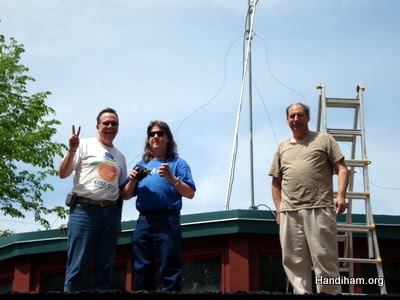
Several of us arrived a day early to begin setup of antennas and stations. The photo I’ve included here shows Phil, K9HI, Matt, KA0PQW, and Don, N0BVE, posing midway between antenna projects and smiling for the camera. The volunteers who help us through the week are really the experts at making things happen – whether it is setting up computer networks, running coax, stringing up Field Day antennas, setting up and testing station gear, teaching licensing classes, teaching operating skills, getting campers out onto the lake to operate marine mobile, and all of the other things that happen during the week.
Nancy, our Handiham Secretary, met the campers for the first time this week. She had never been at a radio camp session before and was quite a celebrity, since everyone knew her voice from talking with her on the phone. When the radio camp was at Courage North, it was too far for Nancy to drive. Now that we are at Camp Courage, we are close enough to Minneapolis to make the drive practical.
This morning we met the V.E. team for breakfast, then the campers who were taking exams gave it their best shot. Those who got the good news were really happy, and those who didn’t quite make it – well, they were happy to have an excuse to come back to camp next year. After lunch, we started taking down the antennas, at least the temporary ones, and packing up the station gear. It seemed as if we had just gotten that stuff out of the boxes and set it up, but that’s the way it goes: Time really does go fast when you are having fun.
The afternoon weather is perfect today, and we are having a pool party. The campers and staff are enjoying our swimming pool while I am packing boxes. Poor me. Oh, heck, I really didn’t want to go swimming anyway. While I was packing, I was listening to Jerry, N0VOE, conducting a mini-net connecting a group of our campers with an elementary school class studying geography. Arlene, KE7KNM, teaches school in Salt Lake City, UT, and invited us to speak with her students, who would locate our home QTHs on a map.
Joe, N3AIN, agreed to share a few thoughts about radio camp week with you, so keep listening, and have a great Memorial Day weekend.
The Handiham office will be closed through Tuesday, opening again on June 2.
73,
Patrick Tice, Handiham Manager
[email protected]

Pat Tice, WA0TDA, is the manager of HANDI-HAM and a regular contributor to AmateurRadio.com. Contact him at [email protected].
Morse USB keyboard
This is a really cool little project.
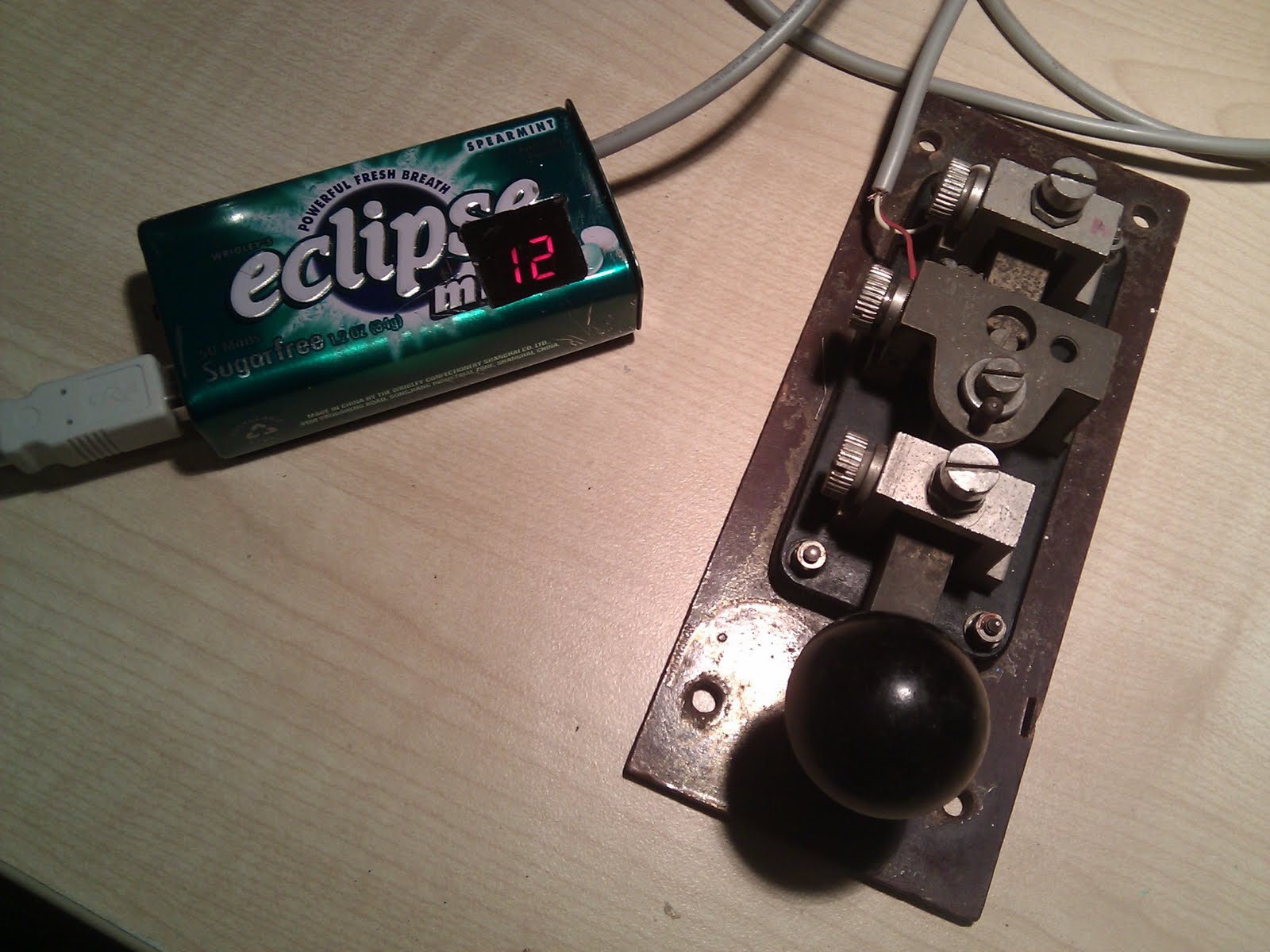 It isn’t clear what it does from the picture, but it’s a device that makes a Morse key look to a computer like a standard USB keyboard. So you can type into your word processor, blog or whatever by sending Morse.
I want one of these. If I had to type all my blog posts using Morse I’m sure I would really get my speed up! Shame it isn’t available as a kit.

Julian Moss, G4ILO, is a regular contributor to AmateurRadio.com and writes from Cumbria, England. Contact him at [email protected].
Baffled
I don’t know if it’s just my advancing years but increasingly I find new technology and the direction it is going in completely incomprehensible. Phones are becoming so complicated that they can now only be understood by teenagers. But the topic of today’s rant is computer sound cards.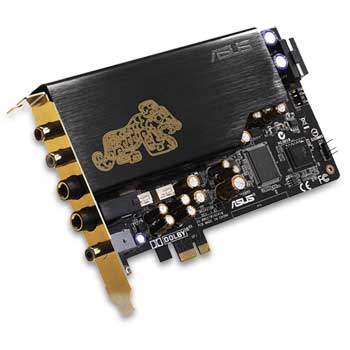 One of the reasons I prefer a desktop or tower PC in the shack is that you can install additional soundcards in them. This allows you to interface with one or more radios for digital modes, EchoLink and so on and still have normal computer sound available. Yes, you could do this with a laptop and external USB soundcards. But it has always seemed to me to be better RF practise to have the digital electronics inside the nice tightly screened metal PC case with only screened cables going from the PC to the radio. USB looks like a radio amateur’s nightmare with these often unscreened cables carrying high speed data and the USB devices usually in completely unscreened plastic cases radiating digital hash everywhere. In fact I would not be surprised to find that the proliferation of USB devices is mainly responsible for the increasing HF noise environment that one day soon will result in my giving up HF altogether.
Once upon a time you could buy a 16-bit soundcard for £15 – £20 ($25 – $30) that was more than good enough for computer sound or amateur digimodes. But one of the advances in computer technology has been the disappearance of PCI slots. The new computer I bought a few months ago, to my surprise, turned out to only have something called PCI Express slots, for which the cheapest sound cards available cost around £70 ($100.)
The specifications of these “bottom end” PCI Express soundcards are way above what I need to either listen to computer sounds and video soundtracks on my PC speakers or decode PSK31 signals. Why do ordinary computer users need 24-bit 96kHz recording or a direct digital input? What on earth is “sound output 7.1” and why do I need three or four different speaker outputs (the presence of which make finding the socket for the PSK31 TX audio by trial and error while groping round the back of the PC in the dark about as likely as winning the lottery?)
I understand that some people might want these features but those who didn’t want them weren’t forced into buying them because more basic products were available. Who decided the simple, stereo 16-bit soundcard without 3D special effects such as computers had for years was no longer needed by anybody?

Julian Moss, G4ILO, is a regular contributor to AmateurRadio.com and writes from Cumbria, England. Contact him at [email protected].
What frequency standard?
I think the frequency readout of my IC-910H is out by about 400Hz and unfortunately I can’t receive any accurately calibrated beacons like GB3VHF to set it with. I also like to check my K3’s calibration from time to time and would like to take advantage of the option to lock it to a 10MHz frequency standard should Elecraft ever provide it as originally promised. So I decided to have a look on eBay for frequency standards.
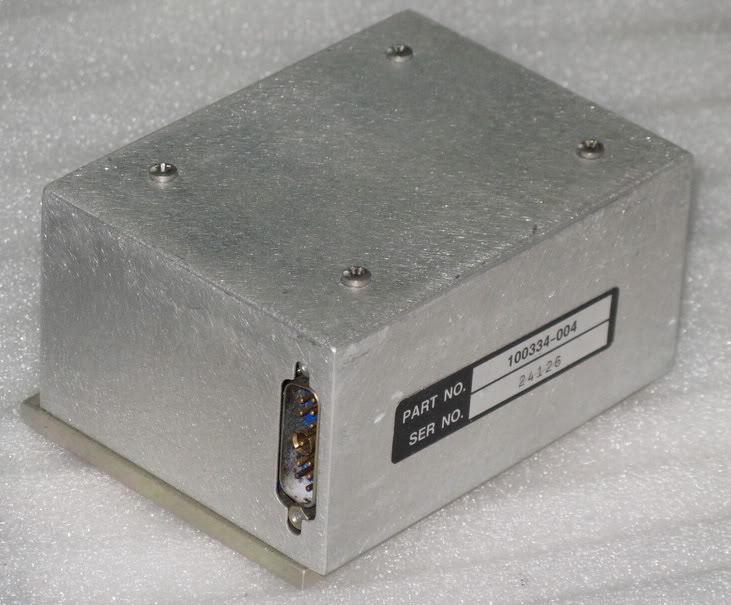 There seem to be a number of ex-equipment 10MHz rubidium frequency standards at prices starting from around £50 – which is about the right level for me – available from China. For a bit more you can have a GPS locked time and frequency standard, though where time is concerned the NTP software is good enough for me. There is also a smart looking Quartzlock off-air frequency standard, though that is a bit outside my price bracket for this and would take up a bit too much space for the G4ILO shack.
I don’t know anything about this equipment and aren’t sure if any of these things would be any use to me. The rubidium frequency standard pictured has a frequency adjustment setting which surely defeats the object. If you need to calibrate it against something else then that’s no use to me. I want something of known accuracy to calibrate my radios against. Perhaps the GPS type would be more useful?
Does anyone know about these things?

Julian Moss, G4ILO, is a regular contributor to AmateurRadio.com and writes from Cumbria, England. Contact him at [email protected].
 Ham Radio Deluxe |
 W5SWL Electronics |
 Ham Radio Prep |
 KB3IFH QSL Cards  Hip Ham Shirts  HamRadioAuctions HamRadioAuctions Reliance Antennas Reliance Antennas Enigma Shop Enigma Shop |  morseDX  Ni4L Antennas  R&L Electronics R&L Electronics antennas.us antennas.us QRV QRV |
- Matt W1MST, Managing Editor
