 |
 Handiham World for 23 June 2010
 23 June 2010 | by
 Welcome to Handiham World!
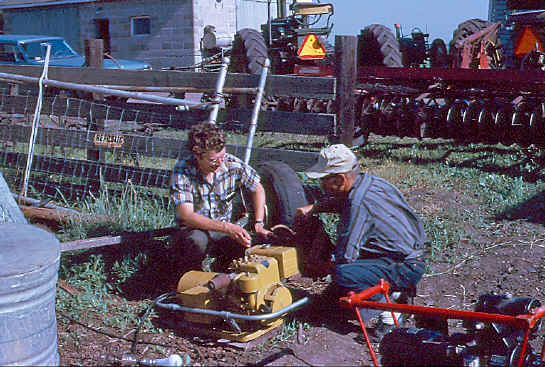
Photo: Pat, WA0TDA, left, and friend Newt, a farmer who let us use his barn for a Field Day ham shack, set up a generator. This was a Field Day with a real field – the end-fed Marconi antenna was hundreds of feet long, extending from a high point on the barn out to a solitary tree in a soybean field. Look at that head of curly hair I had back then, which I think was sometime in the early 1970’s! The old gas generator made considerable racket, so it was located as far as we could manage from the operating position. This rustic setting for the generator was in the farmyard next to Newt’s machine shed. Field Day has changed quite a bit for some of us…
Field Day is this coming weekend, June 26 and 27, 2010. We are looking forward to joining the SARA group, a Handiham-affiliate as well as an ARRL Special Service Club, for this annual operating event. Look for W0JH, our club callsign, and give us a shout. We will be operating on the HF bands as well as on 2 m, and you may even find us on Echolink.
Yes, I know that Echolink contacts do not count for Field Day points, but we will be in this contest for fun, fellowship, the promotion of amateur radio to the general public, and to use and have fun with new technologies. Earning Field Day points is far down on our list of priorities, and that brings me to what I have mentioned before in my columns and podcasts: Different clubs and individual amateur radio operators have different priorities for operation on ARRL Field Day. Some will be in aggressive contesting mode and will work hard to earn as many points as possible, often with multiple CW stations earning double points for Morse code contacts. Considerable effort will be put into impressive antenna systems and station staffing will include the best and most experienced operators. The logging system will be state-of-the-art and the entire operation will be carried off with military precision. Other clubs, like ours, will not consider high point scores as our first goal. The success of our operation will be whether or not we had fun getting on the air. I’ve had decades of ham radio experience, and that has given me a chance to approach Field Day from different angles. This leads to the observation that Field Day rules, while designed to be broad enough to include a variety of interests and goals, also set up a certain tension between contesting and the other goals, such as showcasing amateur radio to the general public, training new operators by getting them on the air, exposing seasoned operators to new technology, preparing for and operating in a simulated emergency situation, and drawing in family members to observe and participate.
Tension? What do you mean by that?
Well, here’s the deal. If a club is really in it for the points, the top priority will be finding a location for the event that enhances operating, setting up stations with elaborate antenna systems, spending a significant amount of time operating CW for the double point score, designing and deploying bulletproof supporting systems that include multiple power sources independent of the grid and a shared logging system. Serious clubs will prepare all year long for this event and operator training will be a significant part of the preparation. All of this is well and good, and all of it is rewarded handsomely in the point scoring system. And who can argue with extensive preparation and training? Both are important aspects of emergency preparedness.
The problem is that the very nature of this kind of operation is that it can suffer enormously if it is compromised by allowing inexperienced operators to run the stations. True, those inexperienced operators may hold General or Extra licenses, but they may have little or no Morse code experience. If they do operate CW, they may do so at a much slower speed than the experienced operators in the club. Relegated to the phone stations, these relative newcomers to HF operation may still work stations at a far slower rate than experienced phone operators. The best Field Day location for antenna systems that are really competitive may not be the easiest site to get to. Club members who have family, work, or school obligations will find it difficult to participate in multiple planning and training sessions in the months prior to the contest. Do you see what I’m getting at? It might be said that “winning” in contest mode requires quite a different mindset and singular dedication toward scoring points than the other goals typically associated with a more inclusive Field Day experience. Let’s take a look at the object of Field Day, as stated in the official rules:
“To work as many stations as possible on any and all amateur bands (excluding the 60, 30, 17, and 12-meter bands) and in doing so to learn to operate in abnormal situations in less than optimal conditions. A premium is placed on developing skills to meet the challenges of emergency preparedness as well as to acquaint the general public with the capabilities of Amateur Radio.”
Okay, working as many stations as possible probably means a no holds barred contest station. However, developing skills to meet the challenges of emergency preparedness is quite a different matter unless you are willing to compromise your point score to spend a significant amount of time during the event training relative newcomers to HF. Furthermore, if your site is optimally placed for contesting but inaccessible to people who can’t hike up a rocky slope, I would have to argue that you would not only be shutting out club members with disabilities but also discouraging observation by the general public.
Some considerable effort over the years has been made to meld these otherwise incompatible goals. The “GOTA”, or “Get on the Air” station concept was designed to fulfill the goal of getting newbies on the air while still allowing the more experienced operators to run up the point score on the other stations. The GOTA station could then also served as a point of demonstration to members of the press or general public who happened to show up. Still, there remains a sort of stigma about the GOTA operation in some clubs, where it is looked upon as a necessary but inconvenient compromise to the primary goal, which is to earn lots of points. Still, the rules do allow bonus points for locating in a publicly accessible place and having an information table. The question for any serious contest group will be how to compromise between optimal contest operation and putting on a show for the general public and training new operators. Some points are awarded for copying or passing messages. Again, this remains somewhat of a sideline activity to simply working as many stations as possible, preferably in a mode that allows for a higher point score.
Can you imagine a real-life emergency situation in which amateur radio repeaters, if they were available, would not be used? When the Interstate 35W bridge collapsed here in the Twin Cities several years ago, you can bet that the repeaters were buzzing with activity. Nonetheless, making Field Day contacts on repeater systems for points is prohibited by the rules. Some clubs will use their repeater systems for so-called “talk-in” information to guide participants to the Field Day site or to give out information of interest to the greater amateur radio community. Of course Echolink and IRLP contacts are not valid for points, either. If your club wishes to use these new technologies, you may not list the contacts for point scoring purposes, though they may be of great interest to the general public.
Extra consideration is given for CW operation, which earns two points for every contact as opposed to a phone contact, which earns only one point. Similarly, digital mode operation counts for two points per contact. From what I have observed over the years, CW is a highly efficient mode of operation that lends itself to really racking up the points, at least at the hands of experienced operators. I’m not sure exactly why it needs the extra boost of a point subsidy, but I suppose this could encourage the old timers to let a couple of newer, less experienced CW operators take over for a shift or two. The two point subsidy for digital contacts might be somewhat more justified as a means to promote more digital operation. Still, if special point considerations are given for digital operation and satellite contacts (bonus points), I do have to confess that I am somewhat at a loss as to why Echolink, IRLP, or WIRES capability isn’t at least recognized in some kind of bonus point scheme if not outright point scores per contact. After all, these technologies will define amateur radio operation for a significant part of the ham radio population in the years to come — as they do right now in this rather disappointing lingering sunspot minimum when HF operation has been lackluster at best.
Yes, I have heard all the arguments before about how repeaters cannot be tied up with any sort of contesting activity and how Echolink isn’t real ham radio. I understand the reluctance of clubs to step too far outside the bounds of tradition. There are good and compelling reasons why unleashing contest activity onto repeater systems might be a really bad idea. Visions of repeaters tied up for hours on end come to mind. A repeater tied up with contest activity would be unavailable in an emergency. Contacts through an Echolink repeater would be said to make use of non-ham radio technology, doing an end run around the purpose and scope of amateur radio. These are all valid concerns, but I would counter that one can drive across the country these days scanning for repeater activity and finding city after city where the repeaters sit virtually dormant if not outright comatose. What would be wrong with actually using these resources? I’m going to stick my neck out and say that the horror stories of repeaters being tied up and in constant use will not come to pass. If using a repeater as a talk-in station or just to make random contacts to demonstrate the repeater and ham radio to the general public suits you, go for it. Believe me, with most repeaters going hours and sometimes days on end with no activity, you probably won’t stand much chance of causing a problem.
And what if you make an Echolink contact or two? Don’t count it in the Field Day log, but at least use the opportunity to enjoy the latest communications technology.
For Handiham World, I’m…
Patrick Tice
[email protected]
Oh, and if you want to join the Field Day fun with us, check out the Oakdale Discovery Center, starting at 10:00 a.m. on Saturday, June 26, when we will be starting the station setup. The SARA Field Day will include a cooperative project with University of Minnesota students to launch a helium balloon, which will be tethered to fly above the Field Day site and transmit ATV – Amateur Television – pictures to the ground from aloft. Points? No. Fun? Yes.
Oakdale Discovery Center
4444 Hadley Ave N
St Paul, MN 55128-2651
W0JH Repeater Talk-In
The SARA 2m repeater is on 147.060 MHz, with a positive offset (transmit on 147.660 MHz). It is an open repeater. You need a tone of 114.8 Hz on your transmit signal.

Pat Tice, WA0TDA, is the manager of HANDI-HAM and a regular contributor to AmateurRadio.com. Contact him at [email protected].
A different route to work – different things to listen to
I took a different route to the station this morning. Leaving home a little bit earlier than normal, I popped into Oxford to see our friends at Jack FM. It’s lovely to see them and see how effortless they make producing a great show appear.
As I was driving down the A34 from Oxford to Didcot, I popped the FT8900 on and had a listen around. To my surprise the GB3CF repeater at Charnwood Forest in Leicestershire was coming in very strongly – approaching S8 on some of the hills to the south of Oxford..
What was interesting to me was that my route this morning wasn’t more than 10 miles or so from my usual one – but it’s quite unusual to hear GB3CF on the normal route – certainly at that sort of signal strength.

Tim Kirby, G4VXE, is a regular contributor to AmateurRadio.com and writes from Oxfordshire, England. Contact him at [email protected].
New DVAP firmware available – fixing TX problems
An e-mail from Robin, AA4RC to the DVAP Dongle Yahoo group today announces the arrival of the latest release of firmware (v1.05) for the DVAP. Robin notes that he hopes that this should resolve the transmit issue that some people (including me!) have been having. Moe, AE4JY is credited with finding and resolving the problem. Thanks Moe!
The revised firmware may be downloaded from the Downloads section at http://www.dvapdongle.com

Tim Kirby, G4VXE, is a regular contributor to AmateurRadio.com and writes from Oxfordshire, England. Contact him at [email protected].
Yaesu VX-8G
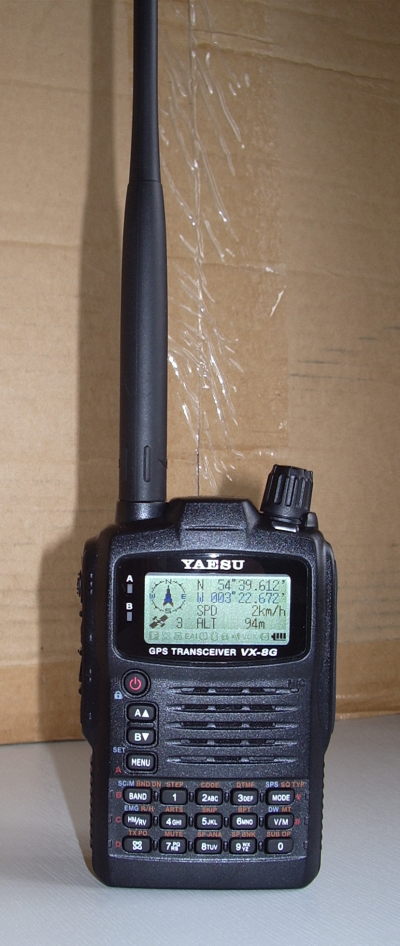 A recent addition to the G4ILO shack is a new Yaesu VX-8G hand held transceiver. In case you are thinking that I need professional help over my addiction to hand held radios you may be right – however a week or so ago I received an email from someone who has a collection of 150!
Long-time followers of my blog may recall that less than a year ago I bought a Yaesu VX-8E APRS transceiver with GPS. However I found that the usefulness of APRS was limited by the lack of digipeaters and internet gateways in this part of the world. I decided to use a smartphone based APRS client, APRSISCE instead and sold the VX-8E shortly afterwards.
Using the cellular network instead of amateur radio has its advantages but it eliminates the interest of seeing how far a little 2m RF can go. Interest in APRS has increased in this area over the last few months so I decided to give RF another go. In the meantime, Yaesu brought out an improved version of the original VX-8R called the VX-8DR and a lower cost version called the VX-8G. So I didn’t regret my decision to sell the VX-8R as it allowed me to acquire the updated version.
One of the things I really disliked about the VX-8R was the clunky way the GPS attached externally to the radio (and the absurdly expensive fixing bracket.) The VX-8R (and the updated DR) has a number of other features that I never used and didn’t need in an HT: 50MHz coverage (including AM), short wave receive (which was useless anyway without an external wire antenna), a barometer/altimeter and a temperature sensor. Nor did I care that it was submersible. I did lose a brand new HT in the Solway several years ago, but as I didn’t immediately notice it had fallen off my belt I never found it again.
The VX-8G lacks these unwanted features and can be set to vibrate when you receive an APRS text message – a new way to get a thrill out of amateur radio! More importantly it has the GPS built into the radio which makes for a much neater package. It costs about the same as a VX-8DR without the GPS option.
The VX-8G is not available yet in the UK so I purchased it from Solid Radio, an eBay trader based in Hong Kong. This was the most expensive thing I have ever bought from a Far Eastern trader and I felt like I was taking a bit of a gamble, but the radio arrived in just over a week and with no unpleasant surprise on delivery.
The VX-8G looks very similar to its older brother but is a little slimmer and lighter. I seem to remember that the body of the VX-8R was metal, or else it had a substantial chassis that added to the weight. With the standard battery installed the VX-8G is noticeably lighter than my Kenwood TH-F7E.
The Yaesu’s GPS takes much longer than the one in my hTC smartphone to acquire a signal. In fact after waiting several minutes on first turning on the radio I started to worry that the GPS wasn’t working so I stood it out in the garden on a table where it eventually established its position. On subsequent occasions it has still taken a few minutes to fix its position which is a bit annoying.
Operationally the radio appears to be the same as the VX-8R and the menus are very similar. One of the new features is SmartBeaconing which varies the frequency of position reports according to your speed and whether you have changed direction. There are different settings for this depending on whether you are walking, cycling or driving. The original model would only send position reports on a fixed time interval. Once I had enabled SmartBeaconing it sent a very accurate track of my walk.
It is too early to say with any precision what battery life is like but initial impressions are that with the GPS enabled it is pretty poor – a criticism that unfortunately is also true of the smartphone. I used to have a navigational GPS called an iFinder GO2 which ran for about 18 hours on two AA batteries so low current consumption GPS devices do exist – why doesn’t Yaesu use them? In the VX-8 radios when you use APRS the problem of short battery life is compounded by the need to disable the power saver (which causes the receiver to listen in short bursts rather than all the time) so you don’t miss the start of a beacon or message sent by another station. The VX-8G uses the same batteries as the VX-8R and DR models so a higher capacity pack available, but it is quite expensive.
I am pleased with the VX-8G so far and am looking forward to discovering where I can be tracked from. I think APRS holds some of the same fascination as WSPR on the HF bands in that it is interesting and sometimes surprising to see how far your low powered signals can travel.
I don’t know when the VX-8G will be introduced in the UK or what its UK retail price will be but I expect it will still be quite an expensive radio. A pity, as I think the cost puts a lot of people off discovering APRS for themselves.

Julian Moss, G4ILO, is a regular contributor to AmateurRadio.com and writes from Cumbria, England. Contact him at [email protected].
More on the Minimalist Transceiver

'The Bay' minimalist transceiver (without component values)
Back in March I wrote about my experiments with a minimalist transceiver design that was published in Sprat earlier this year. Today I received an e-mail from Claude, W5FYI, who enquired about this work. He wrote:
I, too, am interested in building G0EBP’s FET transceiver. One thing that puzzles me is reference in the Sprat article to the 560pF C5. Tony says it is for the final filter. Is he referring to the FET’s capacitance, or his value for the pi filter’s capacitors.
When you get your schematic ready, please let me know.
I thought I would share my reply as others may be interested:
Thanks for the e-mail.
Yes I wondered about that reference to C5 too. I presumed it was the 100nF cap connected to the drain and the inductor on one side and the filter on the other.
I have done quite a few mods to this circuit and still tinkering trying to get a 700Hz freq. offset on transmit, so avoiding issues if someone is zero beat. My first attempts were poor, using an idea in Solid State Design for the Radio Amateur, which plays with some feedback in the oscillator circuit (Fig 6 p36 if you have that book). I see a brief freq. shift and then it seems from my freq. counter the oscillator locks back again. Perhaps I need to switch in the capacitance with the crystal which I think will work better. Been too busy recently with work to finish this experimentation.
Back to my main changes that I did.
1. I changed the oscillator to a FET based Colpitts with a J310. Better waveform, but lower output than a 2n2222 and hence only about 1/4W out with 9V.
2. I have used a different muting process. On keydown I put +Vsupply to pin 7 of the LM386. That mutes the audio op-amp. See LA3ZA, Sverre’s notes on this at http://www.qslnet.de/member/la3za/Pixie_mute.htm
3. Rather than have the key in line with the supply I included another transistor (PNP BJT) so key is connected to ground for transmit. This helps if you mount an un-isolated socket for the key jack in a metal chassis.I need to finish off the experimenting with the offset and then write up the changes for SPRAT.
I looked in my notes and see I blocked out the basic circuit but have not added any component values, so I attach it here, to help you. The offset circuitry is not included. I think you will be able to work out the component values from the original diagram. If you need the calculated values for the Colpitt’s oscillator, let me know and I can supply those.
Hope the above helps you.
By the way I have started to call this transceiver “The Bay” after Morecambe Bay where G0EBP lives and coincidentally where I was born and grew-up.
The draft circuit diagram is above. It is unfinished but still gives a good idea of what I have done with Tony’s, G0EBP circuit.
When I get time to return to this circuit I will report findings and updates here on the blog.


Alan Steele, VA3STL, is a regular contributor to AmateurRadio.com and writes from Ottawa, Ontario. Contact him at [email protected].
Now I’ve got too much to write about
It’s been quite a while since I wrote last, mostly because I didn’t have all that much that I felt was interesting. There were a few bits here and there, but none worth writing about. All of a sudden, I have a lot to write about.
I’ll start with a couple of relatively quick things here, and try to get another update out in a couple of days with more.
First, I may be on the air at some point next Wednesday, Thursday and/or Friday as K2DBK/VP9 from Bermuda. I’m going to be there on vacation and while I hadn’t planned on getting on the air, through a series of events I wound up connecting with Ed, VP9GE. If you’ve worked VP9 on 6m, chances are that you’ve worked Ed. This was all very last minute, but I’m trying to arrange at least an “eyeball QSO” (that’s a face-to-face meeting for any non-hams out there) with Ed while I’m in town, and Ed’s already said that he’s going to try to get me a license to operate from there. I don’t know how much I’ll know before leaving, but hopefully if I make it on the air I’ll get spotted on the packet clusters, and if possible I’ll try to post here, on my page at qrz.com, and even on twitter.com (@k2dbk).
The other quick thing that I wanted to post about was that fellow blogger Jeff, KE9V, has started a new podcast called “Cornbread Road”. As Jeff describes it, it’s a “different kind of podcast”, and here’s what his “About” page says:
Deep in the Heartland a small group of ham radio enthusiasts enjoy an idyllic existence of wide open spaces, no antenna restrictions, low-noise levels, dark skies, and good fellowship. But things aren’t exactly as they seem on Cornbread Road. Unexplained lights in the night skies, satellite signals masked from the ether, strange late night visitors to this small farming community…
Cornbread Road is a ham radio mystery delivered in tiny audio giblets.
I listened to the first episode during my ride into work this morning and I really enjoyed it.

David Kozinn, K2DBK, is a regular contributor to AmateurRadio.com and writes from New Jersey, USA. Contact him at [email protected].
AES 10, SGC -2
After using the tuner for about year, one camping trip it stopped tuning altogether. I popped it open and the PIC chip was hot and the tuner was down for the count. In disgust I tossed the SG-211 in a closet for a year and forgot about it. I decided to give the tuner another chance and sent it to SGC to have it repaired for the flat $55 rate. Reading online reviews, I figured the unit might tune better with new firmware which was probably updated since this unit was manufactured. I got the SG-211 back about two months later; the tech said the PIC was bad and they ended up replacing the whole circuit board with a reworked board. Upon getting it back I tested it with the FT-817 and it couldn't find a match on any band with any antenna. The "reworked" board was a mess. You could tell someone spent a lot of time messing with this board when they were repairing it; it looked like it had been through a war. There were cold solder joints on the antenna terminals and on many of the matching network capacitors. I sent the unit back to SGC again and in a few more weeks it was repaired. The tech said a relay was burnt, probably from high power. I never had the unit connected to anything other than the FT-817 which runs only five watts. I got the unit back and it worked, though it still can't tune its way out of paper bag when connected to a 50 ohm load and it takes forever to find a match on several bands.
Fast forward a year later. I'm looking for a remote antenna tuner for a 100 watt setup so I can get rid of open ladder line coming into the shack. I had been working on a homebrew remote balanced antenna tuner for some time, but it's obvious I'm not going to complete the project in the next decade, so I'm just going to break down and buy a commercial unit. I look at Icom's remote tuner and it looks like you have to mate this with an Icom rig, so I shy away from it. MFJ offers a unit, though from the reviews it sounds like one of their indoor autotuners thrown into an outdoor box. I like MFJ to an extent, but you just never know what the solder job is going to look like inside any of their products and I don't want to risk it with an outdoor unit. SGC offers the SG-237 which is in a nice package and gets good reviews. After my experience with the SG-211, I'm not sure why I did it, but I went ahead and bought one. Call me stupid, but I thought I would give a "Made in America" company a second chance. The unit arrived and I hooked it up to my 60m dipole fed with ladder line. It tunes most of the bands fairly well, but on 80 meters it can't find a match anywhere. Grumble. I mounted the tuner outside in an enclosure as its permanent home and shortened the ladder line. Then it would match on the lower end of 80m, but it was still befuddled with the middle and high end. I futzed around adding sections of ladder line and after several iterations it would begrudgingly match the entire band though it would often need coaxing from the bottom of the band up through to get a match on the top end. So it worked "good enough".
Fast forward a week later. I had been on a business trip for a week, and I came back and connect up the power to the remote tuner. I key up on several bands and I can tell the remote tuner isn't trying to match at all. Grumble. I go outside to troubleshoot it. Everything is connected correctly and the unit is getting power. I disassembled the outdoor setup, brought it inside, connected it up on the bench and it indeed won't tune at all. I popped the tuner open and it's definitely sensing RF but it doesn't sense any SWR, so it thinks everything is hunky-dorey, no need to tune. No burn marks and nothing popped inside, so I've got a doorstop that lights an LED.
I contacted SGC over email and spent several days troubleshooting the unit. After getting to the limit of what we could do over email they said to return it for repair or talk with AES where I bought it and see if they would exchange it. Having experienced SGC's glacial repair speeds before, I called up AES and spoke to the service department. The guy there didn't even ask for any details like my account or order number, he said just box it up, send it in and they'll get a new one out to me. I did just that and AES shipped a new unit rather quickly.
The new SGC unit works, but I'm afraid to do much with it. After such a bad experience with two different models, this unit is likely going to be used only for Field Day and other select outings, and I'll always have a backup manual tuner around. I certainly won't put it into permanent use.
I have to give kudos to AES for their outstanding service over the years. I've never been disappointed with them.

Anthony Good, K3NG, is a regular contributor to AmateurRadio.com and writes from Pennsylvania, USA. Contact him at [email protected].
 Ham Radio Deluxe |
 W5SWL Electronics |
 Ham Radio Prep |
 KB3IFH QSL Cards  Hip Ham Shirts  HamRadioAuctions HamRadioAuctions Reliance Antennas Reliance Antennas Enigma Shop Enigma Shop |  morseDX  Ni4L Antennas  R&L Electronics R&L Electronics antennas.us antennas.us QRV QRV |
- Matt W1MST, Managing Editor
