 |
 APRS on HF
 1 July 2010 | by
 A post about the French ban on D-Star on QRZ.com has predictably become a platform for everyone who dislikes D-Star to reiterate their views on why it should be banned altogether, not just in France. These reasons boil down either to its use of a proprietary codec or the fact that it involves linking radios using the internet.
 I admit to toying with the idea of making a post on the lines of “what if internet linking of radios was banned worldwide? Wouldn’t that be a real catalyst for innovation, to try to replicate internet facilities using entirely amateur radio RF based methods.?” But further thought as to what would be the effect on APRS if it were denied the use of the APRS-IS internet backbone made me realize that the effect would be catastrophic. The amount of traffic would be far too great to be carried over any HF network, while the number of hops needed using a VHF network to achieve worldwide coverage would also be far too many and far too slow. You might be able to do something using a sophisticated network of amateur satellites, but that would be far too expensive. While some uses of the internet do devalue the use of radio itself, in my opinion, many of them make possible things that could not otherwise be achieved. The internet is an integral part of APRS just as it is probably an integral part of whatever D-Star is meant to achieve.
Which led me to the question of what exactly is the point of APRS over HF radio? I understand the purpose of the VHF APRS infrastructure, which is to capture the messages from local APRS stations and pass them to APRS-IS. But given that it would be impractical for messages from one side of the world to be conveyed reliably to the other using RF, what is the point of APRS networks on HF?
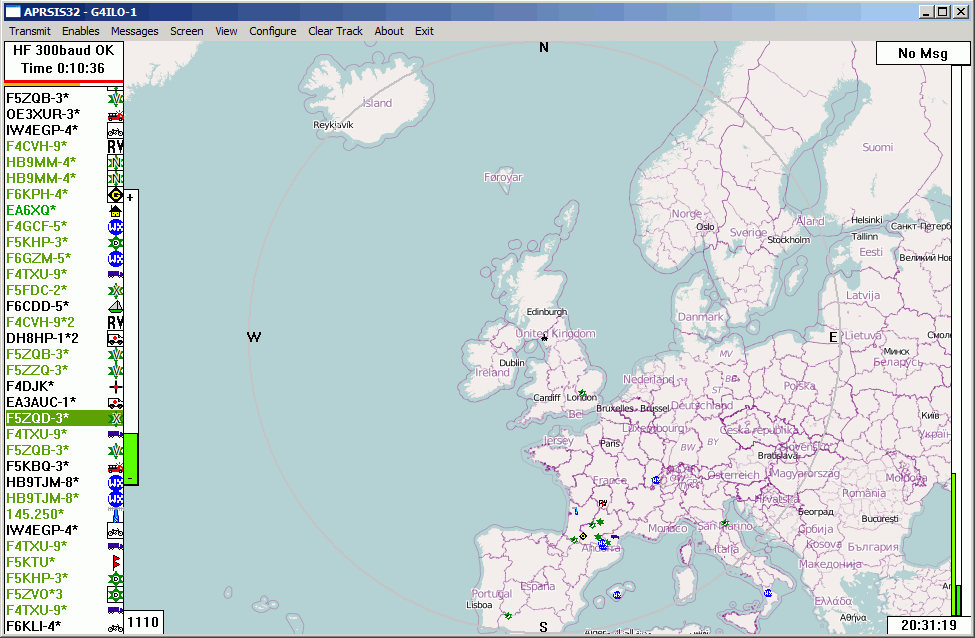
I started off the day trying the latest version of Cross Country Wireless’s APRS Messenger software. This is an interesting product in itself, in that it enables APRS traffic to use various PSK data modes, which are arguably more reliable on HF than the 300baud packet most people use. Unfortunately there are not many users. I switched to using 300baud packet and my screen quickly filled up with callsigns from all over Europe. But when I looked at aprs.fi to see its map of stations received by my station I saw only one.
The reason, I surmised (since I am far from being an expert on this) is that my client software, APRSIS32, is doing “the right thing” and not forwarding most of the messages I received as they had already propagated by the maximum number of hops. The one station whose messages I did pass on, F6KPH-4, had against it the note “Seriously bad path.” Following this was the explanation: “This station is transmitting packets with a configured path of over 3 digipeaters. This causes serious congestion in the APRS network and errors when plotting the station’s route on a map. Please consider using a path of WIDE1-1,WIDE2-1 or WIDE2-2, or even WIDE1-1,WIDE2-2 if you are moving very far away from an iGATE.”
I don’t really understand this WIDEx-x business, I just do what I am told. But I think I get the gist, which is that APRS messages sent over HF should be configured to take no more than three hops. If they don’t reach a gateway by then, they will be lost, which is just tough luck, because the HF channels can’t handle the congestion that would be caused by messages being rebroadcast more than three times.
Which brings me back to the question of what exactly is the point of APRS over HF for the average amateur? It is certainly interesting to see what you can hear using your own equipment. But if it is impractical for an RF based network to ensure that a message could get from Sydney, Australia to New York, New York without touching the internet, what useful purpose is achieved by transmitting and receiving APRS on the HF bands?

Julian Moss, G4ILO, is a regular contributor to AmateurRadio.com and writes from Cumbria, England. Contact him at [email protected].
Handiham World for 30 June 2010
Welcome to Handiham World!
Raining on a parade

Now that Field Day is over, we can look forward to a relatively quiet time on the HF bands. Summer thunderstorms are making a lot of racket, and even the 6 m band may have already peaked for the summer season. June is typically a good month for 6 m, and some activity was still being heard early yesterday morning. Sometimes sporadic-E skip can help make the VHF bands exciting during the high summer months, but you have to be on the lookout. Ducting can occur and enhance long distance communications, even on 2 m repeaters. One way to check conditions is to set your radio to scan, especially in the early morning hours. You never know what you might hear!
So let’s get to the topic at hand. I’m sure you have heard the expression “raining on a parade”. What it means is that someone has mostly negative or uncomplimentary things to say about someone else’s idea or event. After all, no one enjoys going to a parade and then having a rainstorm come up so that everyone gets soaked and the parade is ruined, right? When someone disrupts an activity for someone else, whether by simply proselytizing against it and saying negative things or by actually getting in the way of that activity, that is “raining on the parade.”
I was tuning the HF bands, listening for potential contacts, as were many other people during last weekend’s Field Day event. While my interest lies mainly in the social aspects of the contest rather than the point score, I do still enjoy listening around the bands to find out who is making contacts and what the HF propagation conditions are like. I ran across an unfortunate QSO — if you can even call it that — around 14.270 MHz. There seemed to be some kind of argument or perhaps even a monologue going on about one guy suing another guy, and then there was a CQ for a “no contest contest”, during which the caller went on and on without much listening time and sparse identification. It didn’t take long to figure out that he hated Field Day and was not shy about letting everyone else know his opinion.
Of course anyone is entitled to an opinion and the regulations say that you only need to identify your station at the end of the series of transmissions and once every 10 minutes. While making domestic contacts, there is actually no requirement to identify your station right away. The thing I find disturbing is that it seems so confrontational to behave in this ungentlemanly manner. Field Day is a popular operating activity, and this really amounts to “raining on the parade”. Why not just let people enjoy the contest during this one weekend out of the year and let it go at that? Or, if one really wanted to operate without competition from contesters, one could just as easily get on one of the bands that is not used in the contest.
Most of the amateur radio operators one meets either in person or on the air are really friendly, but a single loudmouth can give our service a bad name.
My advice?
Ignore the loudmouths and lead by giving good example yourself. Avoid the temptation to make a contact with anyone who seems primed for a verbal confrontation. Avoid giving them the satisfaction of knowing that they got your attention. This is pretty much the same thing we have been told by seasoned operators about how to deal with people who cause interference on repeaters or during scheduled nets. While it is seemingly passive to let someone blather on and simply ignore them, it is probably the most effective course of action because it does not lead to an escalation of the situation on the air. Of course willful violations of rules and regulations should be documented and reported to the governing authority, the FCC in our case, if the situation is ongoing and serious.
Wise old Elmer says:
| Always identify your transmissions. | |
| Be polite while sharing the bands. | |
| Welcome those who are new to operating, and be patient with them when they make mistakes. | |
| Be thoughtful and kind to others. | |
| Respect the fact that other operators may have different operating goals, and give them their time and space on the bands to pursue them. |
For Handiham World, I’m…
Patrick Tice
[email protected]

Pat Tice, WA0TDA, is the manager of HANDI-HAM and a regular contributor to AmateurRadio.com. Contact him at [email protected].
French get extra 40m allocation
Today French radio amateurs have finally been granted permission to operate in the region 7.1 to 7.2MHz. Vive la France!

Julian Moss, G4ILO, is a regular contributor to AmateurRadio.com and writes from Cumbria, England. Contact him at [email protected].
GPS Interference
A week ago I received a Yaesu VX-8GR VHF/UHF APRS hand held transceiver with GPS. The transceiver performs as expected except in one extremely annoying respect – its GPS takes a very long time to get an initial fix on its position after switching on the radio. It cannot get a fix from inside the shack at all. By contrast, my HTC smartphone will get a fix in a couple of minutes whilst sitting in its charger cradle on the shack desk. Or at least, it did.
This morning I noticed on aprs.fi that the last reported position of my smartphone, G4ILO-10, was somewhere in Somerset. I started the APRSISCE application with the intent of “bringing it back home” by sending a position report with the correct location. But after ten minutes the phone had not managed to get a fix.
I switched off all my radio equipment in case one of them was an interference source, and rebooted the phone, and eventually after several more minutes it obtained an accurate fix. I am beginning to suspect that something is interfering with GPS reception in the area of my house.
If you Google “GPS interference” you will find links to numerous articles and research papers raising concerns about what is apparently an increasingly common problem. One article states that a directional television receiving antenna widely available in the consumer market contains an amplifier which can emit spurious radiation in the GPS L1 frequency band with sufficient power to interfere with GPS reception at distances of 200 meters or more. Other potential interference sources include spurious outputs from TV transmitters.
Another website states that “We are seeing increasing evidence of GPS interference and also apparent erratic behaviour (e.g. mis-reported location)” and provides a form for reporting cases of interference. This page provides links to two reports on the issue which unfortunately require registration in order to access them.
Have other amateur GPS users experienced difficulty in receiving the satellites or an increase in inaccurate position reports? For many GPS applications the effects of this could have rather greater impact than a radio ham’s inability to report his position to aprs.fi. Perhaps the US administration was rather hasty in its decision to decommission Loran.

Julian Moss, G4ILO, is a regular contributor to AmateurRadio.com and writes from Cumbria, England. Contact him at [email protected].
D-STAR Illegal In the US and Now France
I'm sure Internet forum and 80 meter evening roundtable hamdom in the US is going to be confused over which side to take as many of the older crusty hams in our ranks hate D-STAR but also have a disdain for France, to the point of wanting to change the name of French Fries to Freedom Fries. It should make for some interesting conversations. But I digress.
Obligatory disclaimer: I don't hate D-STAR, I just have issues with the proprietary vocoder, and rest assured that the FCC has not declared D-STAR illegal in the US.

Anthony Good, K3NG, is a regular contributor to AmateurRadio.com and writes from Pennsylvania, USA. Contact him at [email protected].
Supporting D-STAR activity in France
You might remember that back in April, following a conversation with Neill, F5VLD, I wrote that I had learned that D-STAR activity (at least on-air) is illegal in France.
I read today on Twitter that there is a petition to support French amateurs in their campaign to use D-STAR. I’m not normally a fan of petitions – I’m more inclined to write or speak to the personal responsible – but on the other hand, a petition is a good measure of support.
So, anyway – here’s a link to the European Parliament petition

Tim Kirby, G4VXE, is a regular contributor to AmateurRadio.com and writes from Oxfordshire, England. Contact him at [email protected].
LHS Episode #042: 1.21 Gigahertz Badgers
 Yes, we’re running behind AGAIN. It’s the story of Linux in the Ham Shack lately. Because of that, this episode turned into an expose on our backlog of feedback. As it turns out, feedback is a good thing. We were able to address several questions and comments from listeners to the show. Hopefully the information we give out as answers to questions will also answer the questions and fulfill the needs of other listeners who are hoping someone will ask their questions for them. We’d like to encourage everyone to send in feedback and we will address it as soon as we’re able. You can send an e-mail to the show, call our hotline at +1-888-455-0305 or +1-417-200-4811, or leave us a comment on the Web site. We encourage all our listeners to tell us what you like, tell us what you don’t like, tell KA9WKA he’s awesome, ask a question, or just tell us whatever’s on your mind. Also, if you happen to have a few extra dollars kicking around, send us a donation to help with our expenses. Keep Linux in the Ham Shack moving into the future and we’ll give you proper recognition! And if you buy some of our cool swag, you’ll also be helping out the show. Thanks so much for being a part of our world. We love you. It’s a big ol’ love fest.
73 de The LHS Guys
Russ Woodman, K5TUX, co-hosts the Linux in the Ham Shack podcast which is available for download in both MP3 and OGG audio format. Contact him at [email protected].
 Ham Radio Deluxe |
 W5SWL Electronics |
 Ham Radio Prep |
 KB3IFH QSL Cards  Hip Ham Shirts  HamRadioAuctions HamRadioAuctions Reliance Antennas Reliance Antennas Enigma Shop Enigma Shop |  morseDX  Ni4L Antennas  R&L Electronics R&L Electronics antennas.us antennas.us QRV QRV |
- Matt W1MST, Managing Editor
