 |
 This Weekend In RadioSport | VHF Is Shackadelic
 17 July 2010 | by
  I’m trying something new this weekend and operating VHF RadioSport is a first inside the shack relaxation zone. My operating location isn’t a hilltop nor am I located inside my vehicle either. It is one of those fantastic days when weather conditions fall into place. The marine layer isn’t rolling in early or lingering late without a hint of sunshine.
Our Cycle 24 generator has heated ambient air into the comfortable seventies. The sound of Morse code mingles with finches and scrub jays creating wonderful conditions both inside and outside the shack.
CQ World Wide VHF Contest (link).
VHFDX (link).
Certainly, this weekend isn’t going down as epic 6m, instead, it is taking on a new challenge and propagating a little radio frequency toward unknown destinations.
73 from the shack relaxation zone.
SFI = 79 | A-index = 1 | K-index = 0 | Sunspot count is 17 @ 2111UTC.

Scot Morrison, KA3DRR, is a regular contributor to AmateurRadio.com and writes from California, USA.
3 Reasons Why You Should Buy a Callsign Hat

Image courtesy of Astrid's Embroidery
- Quick Identification
It’s very important that other hams can identify you quickly at hamfests, classes, license tests, club meetings, and other events. A callsign hat lets others know, from across the room, who you are. If you are involved in EmComm, being recognizable is even more important.
- Conversation Starter
If you have your call on your license plate, you’ll be able to relate to this. “What does WA7MDE mean?” There are a few ways to answer this, but it really is a great opportunity to educate the public about our hobby and the contributions Amateur Radio operators make to society. By displaying your callsign proudly, you’ll be surprised how many people will ask you what it means. You might also meet other hams in your area, at the grocery store or a local restaurant, and have the chance to have an eyeball QSO with a new friend. Use the opportunity! Network and grow the hobby in your area. While our hobby is often about talking to people all over the world, the real fun happens in your own community when you have the chance to interact with others who share your interests.
- Support Our Hobby
Are you proud to be in this hobby? Are you proud of the service we offer to the community? Then why aren’t you showing it? There is something special about the camaraderie that the men and women in our hobby share. You’ve worked hard for your Extra (or General or Technician) call. You should wear it on your person proudly.
Where can you buy one? Most communities have local embroidery shops that will make you a hat for under $15 or $20. If you don’t have a shop in your area or you would rather buy one from a fellow ham, Todd WM8C owns and operates Astrid’s Embroidery in Michigan. They ship all over the United States and offer a huge selection of styles. They even have a huge gallery for you to browse through. Not comfortable ordering online? Call them at (269) 795-7297.
Know of other embroidery shops owned by hams? Post them in the comments!
Matt Thomas, W1MST, is the managing editor of AmateurRadio.com. Contact him at [email protected].
Bletchley Park archives will soon go online
 As I’ve stated in the past, I’m fascinated by the use of radio communications by governments for espionage and wartime use. When I came across this little nugget, I couldn’t resist. What a joy it will be for those of us that can’t quite make it over to visit Bletchley Park.
The BBC has an article at:
http://www.bbc.co.uk/news/10239623
Bletchley Park (really hard to resist using “BP” for this one…..) has been trying to do this for quite some time. Dwindling funds, repairs needed for the site have just made this one of those “round to it” projects. Many documents are too fragile to handle at this time and will take awhile to get posted online, but it will indeed make for a fascinating online resource.
I’ve had the pleasure of actually getting my hands on real, wartime Enigma machine and it was REALLY NEAT!!! You can read about it, but there is nothing like actually using one to get you even more interested in this topic. Professor Tom Perera gives a number of great discussions at the New England ARRL Division convention in Boxboro Mass (I spoke to Tom at Dayton and he said there may not be a presentation this year). His site is a HUGE wealth of information on this topic (and CW keys). If you ever get the chance to hear him give a presentation – JUMP ON IT!!!!
His website is:
http://chss.montclair.edu/~pererat/telegraph.html
If you want to visit the actual Bletchley Park site and look at the offerings there, check them out at:
http://www.bletchleypark.org.uk/
Jonathan Hardy, KB1KIX, is a regular contributor to AmateurRadio.com and writes from Connecticut, USA. Contact him at [email protected].
Rubbishing the RigBlaster
The West Mountain Radio RigBlaster has always seemed to me to be evidence that most ham radio enthusiasts have more money than sense. Why spend all that when you could easily manage using a couple of cables?
 Even if you wanted switching and level controls like you get with a RigBlaster, a sound card interface is not exactly rocket science to build, nor should it be expensive to manufacture. It’s hard to see how the cost is justified, given that the RigBlaster doesn’t contain an actual sound card.
You would think that someone forking over $200 or more for an interface would expect it to contain a sound card so as to preserve the one in the computer for normal use. But no! West Mountain Radio actually try to make a virtue out of this lack. Under the heading “Why RIGblasters don’t have built in sound chips” they state:
We designed RIGblasters to leave your computer’s sound fully functional as it was before. Plugging in any external audio device with Windows automatically disables the computers built in sound system. There is a work around’s to restore your computer’s normal function but this leaves most of the Amateur Radio sound card programs non functional. Re-configuring the few programs that can be re-configured is a chore that is not necessary with any present RIGblaster.
We do not use sound chip VOX circuits either; as any sound generated by a computer will go out over the air whether you want it to or not. We don’t want illegal transmissions of Windows melodies or “You have mail”!
Since every Amateur Radio sound card program, without exception, has provision for positive PTT control via a RS232 serial port we provide a software controlled PTT circuit in every RIGblaster, via USB, instead unpredictable VOX PTT operation.
Also the majority of Amateur Radio sound card programs work perfectly with any sound card! The only programs that require anything special are those written for transmit speech processing or digital audio over HF, and those only require a standard full duplex sound card, which is what most computers have anyway. Using transmit speech processing and digital audio is only possible with one interface on the market: the RIGblaster Pro!
What utter nonsense! The first paragraph is completely untrue, while the risk of unwanted announcements being broadcast if you use VOX is only present if you use the computer’s one and only sound card which the RigBlaster’s lack of one encourages you to do. An interface with its own sound card that you could dedicate to radio use would eliminate the risk entirely.
Whilst PTT control using a serial port is technically better than audio derived VOX, the fact that the majority of digital modes work quite happily with VOX combined with the fact that most computers don’t have serial ports make the VOX based solution by far the most convenient. And convenience is presumably what you are paying for.
What’s more, the lack of VOX forced many people who used RigBlasters to use TWO serial ports, one for the CAT control and one for the PTT, because the RTS and DTR lines, though unused by the CAT interface, were inaccessible to the RigBlaster.
At the other extreme, there are several ham websites that state that the quality of the built-in sound cards in computers is so poor that they cannot be used to operate digital modes satisfactorily. The only answer is to buy another plug-in board or use a SignalLink external sound card. I have never used a SignalLink, but the quality of all the low-cost USB sound cards I have tried has been demonstrably too poor to work with most digital modes. I have never had a problem using the built-in sound hardware, usually based on a Realtek chip. Another example of the nonsense talked about sound cards. The only problem is, each computer contains only one, which isn’t enough if you want to interface two or more radios or retain the ability to hear the sound from online video and audio.
Modern sound cards are getting very expensive due to the fact that they must perform as home cinema systems with surround sound, special effects and so on. There is a real need for more reasonably priced ham radio dedicated interfaces that include plain and simple sound cards. Currently the only products that I know of that do this are the SignalLink and the RigExpert interfaces. It’s time the RigBlaster started living up to its name and becoming a complete radio to computer interface instead of an expensive fancy alternative to a couple of home made cables.

Julian Moss, G4ILO, is a regular contributor to AmateurRadio.com and writes from Cumbria, England. Contact him at [email protected].
It’s all down to your ears
There was a lot of excitement on the Elecraft email reflector over the fact that the majority of participants in the World Radio Team Championship 2010 (WRTC 2010) were using Elecraft K3s. There was even more glee when it was discovered that Scott Robbins W4PA, former Ten-Tec product manager, and Tim Duffy K3LR of Team Icom had taken K3s. This was like the President of Coca Cola serving Pepsi at his anniversary party!
 There have not been many comments now the results are out, which show that the top two teams, from Russia and Estonia respectively, were using FT-1000MPs. The USA team of N6MJ and KL9A in third place used K3s, as did K5ZD and W2SC who came fifth, but the fourth placed S50A and S57AW again used FT-1000MPs as did the Lithuanian entry in seventh place.
So let’s get this straight: the winning stations and several others in the top ten used a now obsolete radio that was introduced in 1996 which has frequently been criticized as inferior to the K3? I suspect the fact that many international competitors took K3s may have more to do with the fact that the Elecraft radio is small enough and light enough to be taken on an aircraft as hand baggage. And I suspect that the reason for the success of the stations using FT-1000MPs is that there is more to winning a contest than having a receiver with the best performance numbers.
Anyone want to swap an Elecraft K3 for an FT-1000MP? (Only joking.)

Julian Moss, G4ILO, is a regular contributor to AmateurRadio.com and writes from Cumbria, England. Contact him at [email protected].
The End of the Internet
For those who don’t believe that the internet is flat.

Julian Moss, G4ILO, is a regular contributor to AmateurRadio.com and writes from Cumbria, England. Contact him at [email protected].
Handiham World for 14 July 2010
Welcome to Handiham World!
A volunteer summer
Eliot, KE0N, gets the remote base project underway
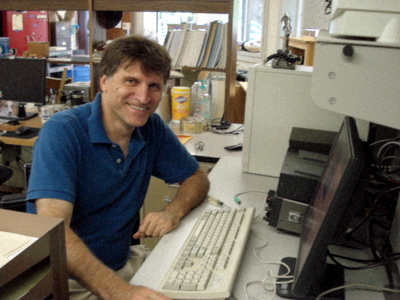
Eliot, KE0N, at the new remote base control point.
The Handiham Remote Base at Courage North has proven to be reasonably reliable and quite popular with the Handiham membership. Just in case you need a refresher, our Camp Courage North location is in far northern Minnesota near the headwaters of the Mississippi River. The station is at the location where we held many Handiham Radio Camp sessions over the past two decades. It consists of a Kenwood TS-480SAT, a rig control interface and computer, an LDG auto tuner, and a G5RV antenna. The station runs W4MQ software to control the radio and SKYPE to port the audio both to and from the remote control operator. Users sign in with their approved credentials and are able to control the radio, changing the frequency and other parameters, and use the radio for both transmit and receive functions. The idea is to provide a real radio for many of our members who cannot otherwise get on the air because of antenna restrictions or other impediments to installing an HF station. Some of our members who do have their own stations also appreciate being able to operate from a completely different location. In addition to the W4MQ software interface, up to five users without transmit privileges can listen to the radio by connecting to W0EQO-L on Echolink. If no transmit control operator is present, Echolink users may control the radio’s receive frequency using the text box feature of Echolink, simply by sending a frequency in the text and pressing enter. This feature is useful for a quick check of propagation conditions here in the Midwest. For example, a user might enter the number 10 to hear what The National Bureau of Standards station WWV sounds like here in Minnesota.

Since only one transmit control operator can run the station at a time, there is a need for a second remote base. That is why we are pleased to have the able assistance of Eliot, KE0N, and Lyle, K0LR, who are working together to help me with this second Handiham remote base. Our new callsign will be the traditional Handiham headquarters call of W0ZSW. We hope to have the station in operation by the end of July, and when Eliot visited Handiham headquarters yesterday to work on the project, he made a lot of progress. In case you were wondering, the radio we have chosen is a Kenwood TS-570S. This radio, which has the capability of operating 160 through 6 m, will be coupled through an MFJ autotuner to a W0OXB 300 foot “special” wire antenna at an average height of 45 feet. This arrangement will allow us to offer 160 m through 6 m capability from the new remote base location. The existing remote base station at Courage North operates only 80-10 m using a 102 foot wire antenna, so we think that this will be a significant addition to our member services. The rig control computer is a Windows machine configured and supplied by KE0N, and the interface is a RIGblaster Pro. The radio is equipped with the VS3 speech module for blind users.
Lyle, K0LR, engineer for the Courage North station, is helping us with the station configuration. Our goal is to copy all of the user credentials from the first remote base to the new remote base so that users will have easy access to either station. This will also help us with tech support issues, and as you might guess we hope to keep those at a minimum!
One advantage of having two remote base stations separated by a significant distance is that there will be more choice for operating when conditions are bad in one spot but not in another. In the event that one station goes down, the other one would still be available. Redundancy is a good thing if you want to keep a service like this up and running.
No project worth its salt ever gets through the installation process without a few glitches and a visit from our associate engineer “Murphy”. Sure enough, Murphy’s presence was felt when the necessary DB9 serial cable turned out to be missing in action. We still have some issues to figure out with port forwarding and a static IP address, for those of you who understand what that stuff means. Nonetheless, we are pleased with the progress to date and feel that we are on target to have this member service available very soon.
For Handiham World, I’m…
Patrick Tice
[email protected]
Handiham Headquarters spruced up

The Handiham headquarters entrance in the Camp Courage Reception Center.
You have seen photos of our headquarters before, but things are looking pretty good now at the Cyril Rotter Technology Center. Antennas rise to the left of the round building, and the 300 foot wire antenna is invisible high up in the trees to the left. The double doors can open wide to accommodate electric scooters or wheelchair users.
QSL cards
Since it is strictly “slow news” for ham radio this time of year, how about telling us about some favorite QSL cards you have either sent or received over the years? A photo or scan would be helpful, if you have one.
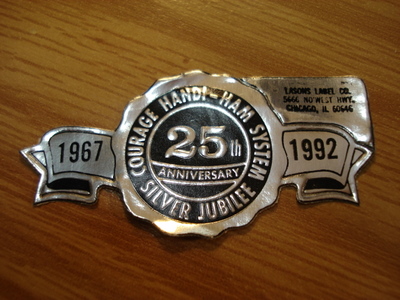
This photo shows a Handiham 25th anniversary sticker that we produced in 1992. The idea was to stick these onto your existing QSL cards and send them out to help promote the Courage Handiham System. They are pretty rare, so if you have a card with one of these Silver Jubilee stickers, hang onto it!
So what do you have? Send it to [email protected] with your comments.
Feedback

Howard, KE7KNN, writes:
Hello, Pat.
Could you please remind our readers and listeners that we need people to take part in the Handiham nets, both the daily net and the Wednesday evening net. Summer is a particularly slow time and we need more participants. Remember that these nets are open to everyone and that you do not need to be a Handiham member. So bring a friend and join us — you may even find the Handiham net a place to make new friends!
73,
Howard, KE7KNN, Handiham Net Manager

Pat Tice, WA0TDA, is the manager of HANDI-HAM and a regular contributor to AmateurRadio.com. Contact him at [email protected].
 Ham Radio Deluxe |
 W5SWL Electronics |
 Ham Radio Prep |
 KB3IFH QSL Cards  Hip Ham Shirts  HamRadioAuctions HamRadioAuctions Reliance Antennas Reliance Antennas Enigma Shop Enigma Shop |  morseDX  Ni4L Antennas  R&L Electronics R&L Electronics antennas.us antennas.us QRV QRV |
- Matt W1MST, Managing Editor
