 |
 The Next Level Part II
 9 August 2010 | by
 My weekend is wrapping itself up and NAQP CW delivered a lot of ham
radio fun. I’m also grateful for the friendships that follow our
hobby. Whatever one’s passion there is another who shares the same
albeit RadioSport or chasing DX or logging grid squares on 2 meters
when the ‘e’ goes plasmic on very high frequency.
I had fun this weekend sitting in front of a high frequency
transceiver pumping radio frequency toward destinations unknown. A
local ham opened his station for guest operation and my cans jumped to
the next level when monoband antennas surfed some serious radio waves.
It felt tubular and hang ten like while Q after Q went into N1MM
Logger.
Sometimes I wonder if ham radio forgets to emphasize friendship from
across the miles. I enjoyed making new friends this weekend especially
when a QRP operator in Texas mentions in his e-QSL, “Good ears. I
enjoy reading your blog.”
I want to say you are welcome and it is my pleasure sharing a personal
journal about ham radio. Our hobby is not for everyone that is okay. I
would like one Texan QRP operator committed to their passion instead
of ten Paris Hilton types committed to nothing other than nothing.
What will those new numbers translate into over the next five years?

Scot Morrison, KA3DRR, is a regular contributor to AmateurRadio.com and writes from California, USA.
Meeting up with Dave, G4BUO
It was great to meet with Dave, G4BUO last night. Though we have pretty regular QSOs in various contests, it was ages since we had met up for a beer and a chat, and very enjoyable it was.
Dave had been part of the UK team, with Andy, G4PIQ who’d achieved a brilliant 9th place in the recent World Radiosport Team Championship (WRTC) held in Moscow. It was interesting to hear how they’d achieved such a high QSO total in the contest, by using two radios on one aerial, with some fancy switchgear, allowing them to ‘interleave’ QSOs, ie one person transmitting whilst the other one was listening. Clever stuff.
As always, propagation varies from the different part of the world and the Great Circle paths took a bit of getting used to; UK is west, France and Germany is southwest and so on.
Temperature at their field day site was extremely hot, rising to around 38C at time, but the winds got high as well, with the tent almost blowing overnight; it being held down by the support team and referee whilst Dave and Andy kept on operating.

Tim Kirby, G4VXE, is a regular contributor to AmateurRadio.com and writes from Oxfordshire, England. Contact him at [email protected].
Making HF APRS MOR robust
I was surfing around looking at information about robust digital modes, as you do, and stumbled across something called the WINMOR Sound Card TNC. WINMOR is a free, open and documented protocol intended for reliable HF data communications. Originally developed as a low cost alternative to Pactor for emergency communications systems such as Winlink, it has been made available as a virtual TNC for other developers to incorporate in their products. I started to wonder if this is the solution people are looking for to make APRS over HF more reliable, rather than trying to use digital modes such as PSK63 or GMSK that weren’t designed for this type of application, as is being tried by G4HYG in APRS Messenger.

The documentation for the software is somewhat over my head, but from what I can deduce the Sound Card TNC (shown above) does not provide an interface like a regular packet TNC. However there is a module called BPQ32 that appears (from the description) to implement a TNC-like interface. I’ve probably misunderstood something – in which case hopefully someone will point this out to me – but it doesn’t seem beyond the bounds of possibility to connect an APRS client like APRSISCE to this TNC and then you would be able to send APRS using the reliable WINMOR protocol with forward error correction (FEC).
The only problem would be finding a place to operate, since SCS’s proprietary Robust Packet protocol seems to have already established itself below the FSK300 APRS channel on 30m.

Julian Moss, G4ILO, is a regular contributor to AmateurRadio.com and writes from Cumbria, England. Contact him at [email protected].
In the air
I haven’t had time since I got back from holiday to read every post of every blog that I follow, but I was glad that I caught the post about HFDL in Adam, M6RDP’s blog.

HFDL stands for High Frequency Data Link. It is also known as HF ACARS, which gives the game away as to what it is about, for ACARS stands for Aircraft Communications Addressing and Reporting System. In other words, it’s like APRS but for aircraft.
HFDL uses a proprietary protocol. Transmissions use USB with a symbol speed of 1800 baud. The modulation is 2-PSK, 4-PSK or 8-PSK with effective bit rates of 300, 600, 1200 or 1800 bits/sec. Aircraft log on to a ground station, of which there are currently 17 located around the world, each of which receives on several different and unique frequencies. The ground station assigns the aircraft a sequence ID number which is used in subsequent communications with it. HFDL is used by over 1200 aircraft operated by more than 60 airlines and allows pilots to always be able to communicate with the ground, no matter where they are located.
I downloaded the PC-HFDL software from the author G4GUO’s web page which unfortunately contains no information about the program itself. I also downloaded and installed Google Earth which is used to display the positions of the aircraft. I tuned my receiver to the frequency 6532kHz mentioned by Adam, which is one of the frequencies used by the ground station at Shannon. After a minute or so I received a loud signal that was obviously a burst of quite rapidly modulated data.
After a few minutes of head scratching when the program did not decode anything I found that it apparently sets the input level from the sound card to zero at start-up. PC-HFDL is “shareware” and this is presumably one of the annoyances authors of such programs put in to encourage users to pay up. It is more likely to encourage me to uninstall the software, but that’s another subject.
Once the program is receiving the audio from the radio, each burst results in a decoded message being displayed by the PC-HFDL program, while the aircraft position is plotted on Google Earth. You can see the results of about 10 minutes of listening on the 6532kHz frequency in the screen grab.
After 10 minutes or so of receiving the program shuts down, another limitation of using it without purchasing a registration. But 10 minutes is probably enough for most people to realize that, whilst the technology is interesting, as a pastime it would quickly get boring. Perhaps it would be possible to receive signals from more distant aircraft, but that’s about it. There’s a lot more happening on HF APRS, plus as a licensed amateur you can actively participate.
It doesn’t appear to be possible to submit position reports from PC-HFDL to a site like flightradar24.com (which I discovered from a comment to Adam’s post) which aggregates aircraft positions received by amateur enthusiasts to display a real-time radar map of all the commercial aircraft in Europe. Those position reports are sent using ADS-B (Automatic Dependent Surveillance – Broadcast) which uses a frequency of 978MHz and requires a dedicated receiver costing around £500.

Julian Moss, G4ILO, is a regular contributor to AmateurRadio.com and writes from Cumbria, England. Contact him at [email protected].
The Next Level
The heart of ham radio beats strong and the next level awaits. The
North American QSO Party CW is less than 24 hours away when operators
will compete for Box positions. Our high frequency spectrum will
ignite with signals juiced by the awesome power of solar Cycle Twenty
Four. The competive spirit of RadioSport underpinned by good
sportsmanship will certainly drive the beginning of our fall and
winter season.
There is something to be said about being in the right place at the right time.
I logged a station in Mexico this afternoon on 10m and it is a first
since my re-entry into ham radio. The numbers are steadily improving
with glimpses of epic high frequency conditions. I’d like at least one
of those memorable events worthy of three cups of Starbucks and better
than the best fish story. Perhaps?
Strategy is straightforward that is be in the right place at the right
time. I’m looking forward to moving to the next level and having a lot
of ham radio fun through Saturday evening. Also, the biggest secret in
RadioSport that does not require a non-disclosure statement is, call
CQ a lot.
73 from the anywhere, anytime shack.

Scot Morrison, KA3DRR, is a regular contributor to AmateurRadio.com and writes from California, USA.
The most valuable ham homepage?
Dan, KB6NU, often claims that he has the #1 ham radio blog because it tops the Google search results for “ham radio blog”. Today he posted a review of the top ham radio blogs according to Google. I was disappointed to find that mine wasn’t even mentioned.
I ran the search myself and found that Dan’s blog came third, while G4ILO’s Shack came right after it. I guess Dan didn’t mention it because the result wasn’t a blog. Curiously, my actual blog doesn’t appear as a search result in its own right at all, at least I hadn’t seen it by the time I got bored paging through the results. Google moves in mysterious ways. I wish I understood it, especially as my entire living depends on the fact that I own a website that ranks #1 for several quite profitable key phrases. The fact that this is completely out of my control gives me sleepless nights sometimes.
While I was trying various searches to see if my blog appeared I stumbled across a site called Biznut, which values G4ILO’s Shack at £23,517.27 – considerably more than the value of the contents of my actual shack! I don’t know how Biznut comes to that conclusion, but if anyone wants to pay me that they are welcome to the site. I’ll even knock off the £17.27!

Julian Moss, G4ILO, is a regular contributor to AmateurRadio.com and writes from Cumbria, England. Contact him at [email protected].
VX-8GR in Prague
As regular readers will have realized from my previous post, I have been on holiday in Prague, capital of the Czech Republic. I won’t bore you with details of where I went or what I did, though I have made a few comments about the holiday over on my other blog. So I will just describe my ham radio experiences over there.
 Prague is quite a hilly city. The picture above was taken from the Botanical Gardens to the north of the city, looking towards the famous Zizkov TV Tower. This building, looking from a distance like an Atlas rocket waiting to take an Apollo mission to the Moon, is widely regarded as the ugliest building in Prague. But from a radio point of view it would be a good QTH. I quite like it. Apparently you can go up it to see the view, but that is something we have yet to do.
I took with me on my travels my Yaesu VX-8GR dual band APRS hand-held. Due to the language difficulty (I don’t speak Czech) I didn’t anticipate having many contacts with locals but I could see from aprs.fi that there was quite a lot of APRS activity in the city and I was interested to experience it first hand. I was not disappointed.
From the moment the VX-8GR was first switched on the APRS channel on 144.800MHz began receiving packets. The station list, able to hold the 50 most recently received APRS packets, filled up in about ten minutes. I was receiving position reports from fixed stations and mobiles, not only in the Czech Republic but also sometimes from Germany, Poland and Austria. I also received local weather reports, including the position of lightning strikes over a more than 300km radius and weather bulletins sent out by OK1COM. Coming from West Cumbria where you can often go a whole day without receiving anything on VHF it was quite a revelation.
I sent a greeting using APRS to Colin, 2E0XSD. By checking aprs.fi I discovered that he received it, but I didn’t receive any of the acks his client sent back, nor his reply. It appears that no-one sets up their gateways to gate messages and acks for locally heard stations from the internet to RF, so the much-vaunted APRS messaging capability is essentially useless except between stations in direct radio contact.
Later in my stay I did have a messaging QSO with OK1RQ on foot in Prague with a Kenwood hand-held. Unfortunately he was busy so I never got to meet him or any other local hams. I also received greetings via APRS from a couple of other local stations.
We needed to make some local phone calls so I purchased a pre-paid SIM card from O2 for my smartphone. This included 3G data so I was able to try the APRSISCE client from Prague. I had several messaging conversations over the internet with Lynn, KJ4ERJ, the program’s author. We also had our first voice QSO via OK0BNA, the Prague repeater, which Lynn was able to access through Echolink as it is connected to OK1OGA-L. I monitored OK0BNA on many evenings and heard only two other contacts take place on it. I did not hear any other FM contacts on either 2m or 70cm the whole time I was in Prague.
APRS works well in Prague because there is a network of several digipeaters and gateways within a radius of a few kilometres of the centre. The apartment where we were staying was just a few hundred metres from the QTH of OK1ALX who runs a digipeater and Igate, so most of the APRS signals I heard on my VX-8GR inside the apartment with the stock rubber duck were S9+.
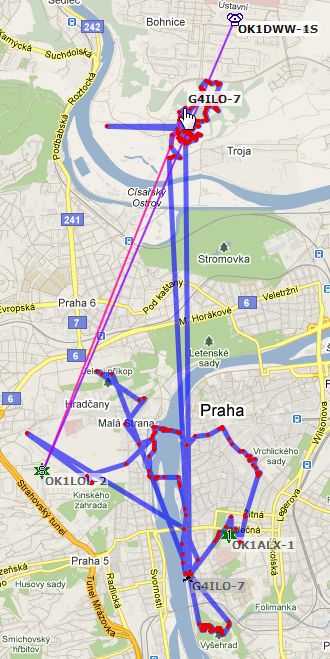 The map on the right shows the tracks of some of our outings in the seven days before our return, tracked using the VX-8GR. Although aprs.fi reportedly stores position reports for a year, it doesn’t appear to be possible to display tracks for specific periods retrospectively, and as I didn’t have a computer with me (this was supposed to be a holiday) I couldn’t capture my tracks at the time. But you can see at the top one day’s walk in the Botanical Gardens, at the bottom a walk around Vysehrad, and in the middle a circular walk we made into the city centre and back along the river one evening.
Tracking an outing from start to finish wasn’t very convenient, or even possible, because the GPS wouldn’t pick up a fix inside the apartment and I couldn’t be bothered to stand around for 3 or 4 minutes on the street outside waiting for it to get a fix before we started. Hence the big jumps from where we were staying to where we started walking.
We were on foot or using public transport and you would lose a fix whenever you got on the metro or a tram or went inside a building, and then have to wait to regain a fix when you came out. It was too much hassle. But when we were planning to just walk, it was interesting to see where my beacons were picked up, both from higher ground and from street level within the city.
I didn’t use the Windows Mobile client for tracking much at all (apart for one short evening stroll along by the river) because using the GPS reduced the phone’s battery life to an unacceptable couple of hours. However I was impressed by the battery endurance of the VX-8GR. After reducing the beacon frequency to no more than one every two minutes and using the 2.5W power setting, it lasted all day with enough power left for a couple of hours receiving in the evening. This is particularly noteworthy considering that the power saver was disabled (as it needs to be for APRS usage) and the receiver was constantly receiving and displaying APRS data. If only the GPS was quicker at finding its position after switch-on it would be just about perfect.
 Like most hams, I guess, I always keep an eye open for antennas wherever I’m travelling. Antenna-spotting in Prague is quite difficult as every building has comprehensive lightning protection consisting of tall lightning conductors looking like VHF collinears, usually connected together along the ridge of the roof. I have never seen this anywhere else.
Close to where we were staying, in a street called Vysehradska, I noticed a shop window displaying a few old radios, some vacuum tubes, what looked like a tube tester and some other electronic bits and pieces. On the roof of the building next door I spotted an MFJ multiband HF vertical antenna. I was sure that the owner of the shop must be a ham, so we decided to go in and introduce ourselves.
Inside, the place looked more like somebody’s untidy workshop than a shop. There were three elderly gentlemen, one of whom was presumably the owner. Another was leafing through a dog-eared book while the third was inspecting a vintage broadcast radio he had taken down from a shelf. They looked at us expectantly. I said “ham radio?”, anticipating that someone would understand at least that English phrase, but was met with blank stares and something we couldn’t understand in Czech.
Older people in the Czech Republic speak Russian, a legacy of the Russian occupation, so Olga then explained in Russian that I was a ham radio enthusiast and was interested in what they had in the shop. No-one introduced themselves as a licensed amateur, however. Instead, they told us that it was not a ham radio shop, but that there was one a few blocks away. Unfortunately Czech street names are confusing to non-native speakers, even to Olga. We didn’t find it. Perhaps we will on our next visit.

Julian Moss, G4ILO, is a regular contributor to AmateurRadio.com and writes from Cumbria, England. Contact him at [email protected].
 Ham Radio Deluxe |
 W5SWL Electronics |
 Ham Radio Prep |
 KB3IFH QSL Cards  Hip Ham Shirts  HamRadioAuctions HamRadioAuctions Reliance Antennas Reliance Antennas Enigma Shop Enigma Shop |  morseDX  Ni4L Antennas  R&L Electronics R&L Electronics antennas.us antennas.us QRV QRV |
- Matt W1MST, Managing Editor
