 |
 Duh: Learning Curve #2
 1 September 2010 | by
 Sunday I got the itch to get online. That means backyard portable when you live in an antenna restricted condo. So I put a card table up in the back porch and my 20 ft Jackite and 20m End Fed Half Wave in between the buildings.
Doggone noise and weak band conditions ruined the day so I decided to experiment with the new C Pole antenna that Neil W0VLZ had suggested. To get rid of a hunk of fiberglass gel inside the barrel of one of the Black Widow Crappie poles I used my cheapo Harbor Freight rotary tool which is a lame imitation of a Dremel tool but gets the job done. A few minutes of fitting and I was good to go.
I’m pretty impressed with it though conditions did not allow for any QSO’s yet. I cut the wire a bit longer than Niel’s directions but it tuned up 1:1 at 13.889 on my MFJ 207 Analyzer. At 14.060 it was a bit over 1.4:1 which is plenty usable. Next time out I’ll do a bit of trimming and be right on the money! Compared to the EFHW in a 20 ft L configuration, it did seem a bit noisier but with condx so difficult it would be hard to tell without some instrumentation.
LESSON: The C Pole is a pretty fine design. I need to work on the physical setup to improve the way the antenna hangs. The crappie poles I used were a bit too flimsy on the top section and leaned inward from the weight of the wire. A better tippy top support system is needed.
LESSON: Niel’s C Pole base design and specs worked very well. Lacking an empty plastic coffee can, I used a quart diet soda bottle of the same dimension and it worked very well for the balun section. With winds of approximately 15 mph and gusts to 20+ the antenna was stable and I did not use the spikes for the outriggers that I had prepared. Great work Niel. The weight of the base makes it a good choice for backyard or campground use.
LESSON: The C Pole would be a fantastic portable antenna sans the earth side supports. Chuck Carpenter W5USJ has posted a picture of this configuration. Take a look. One point hanger and spreaders at the top and bottom and simple stake to the ground for anchoring it and you are good to go. I will be testing this next time out by the lake. Winner!
LESSON: The off center fed dipole folded like this and deployed vertically is a good compact option for antenna restricted hams. I bit more work on the frame and support system may pay good dividends in stability and efficiency.
Hope to fly this new antenna in its tree configuration this weekend. I’ll update my results then.
72,
Kelly K4UPG PB #173
Kelly McClelland, K4UPG, is a regular contributor to AmateurRadio.com and writes from Florida, USA. Contact him at [email protected].
LHS Episode #047: OLF 2010
 In a rare promotional episode of Linux in the Ham Shack, we talk to four folks from the upcoming Ohio Linux Fest. Bear, Rob, Moose and Beth Lynn give our listeners the low down on everything that’s going to happen at this year’s event. Make no mistake, this time around it sounds like it’s going to be a lot of fun, even more fun than last year. Linux in the Ham Shack is going to be there, too, with new equipment, new demos and a lot more to make it worth stopping by. So if you’re going to be around Columbus, Ohio on September 10-12 or you have some free time and a little bit of extra cash, make sure to come by the show. It’s going to be KILLA.
73 de The LHS Guys
Russ Woodman, K5TUX, co-hosts the Linux in the Ham Shack podcast which is available for download in both MP3 and OGG audio format. Contact him at [email protected].
Creating APRS objects for repeaters using OpenAPRS.Net
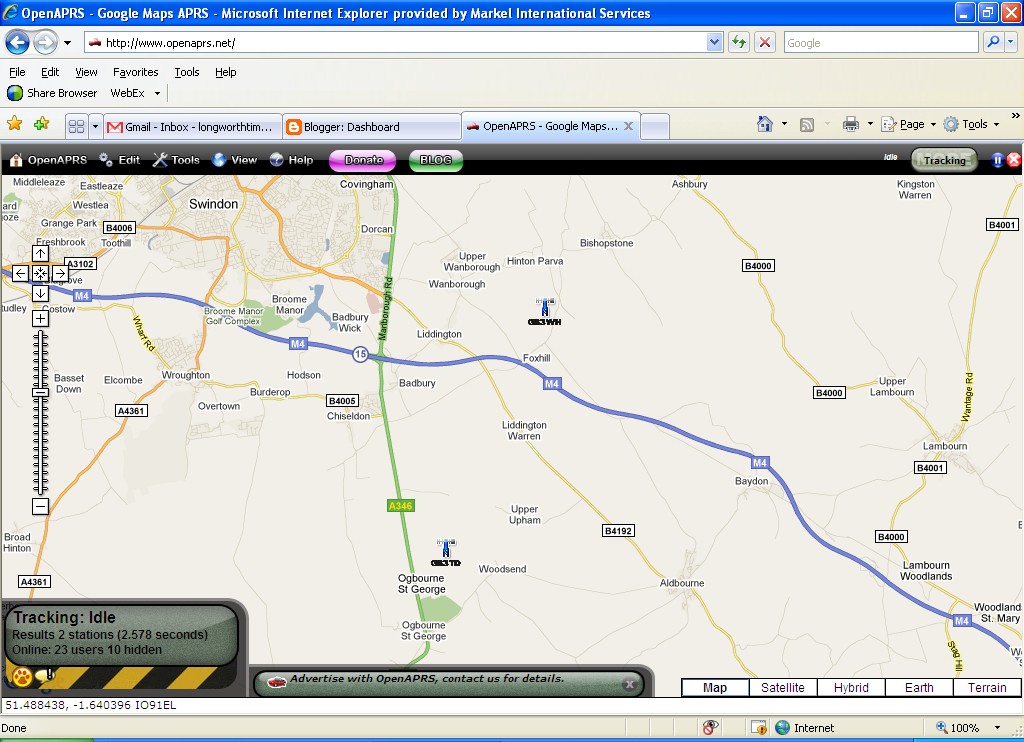
I’d wanted to create an APRS object for the Ridgeway Repeater Group‘s two voice repeaters, GB3TD and GB3WH for a while. In practice, this just means making sure that they show up on the map in the right place, when someone goes to http://aprs.fi and looks at the area.
I wanted to display an icon for them, showing the approximate position and their callsign, and some detail available, if someone clicks on the icon. I’d looked at various ways of doing it, but found OpenAPRS the best method.
I’d looked at doing this a few months ago, but had stalled, because OpenAPRS required me to verify my account using an ‘RF APRS client’ which I didn’t have – all my APRS interfacing is done through the Internet. Without verifying my account, I couldn’t create objects on the APRS map.
When I was looking at OpenAPRS the other day, I noticed that they were offering another method of verifying accounts, using Paypal and a small (dollar or so) donation. I was happy to pay this and sure enough the account was verified very speedily.
Having done this, it was straightforward to create an object for each of the repeaters using Tools/Create Objects and then clicking on the map in the appropriate place and entering the information. In some ways, rather than clicking on the map, I’d have preferred to manually enter the latitude and longitude, but this didn’t seem to be possible.
Either way, GB3TD and GB3WH are now represented on the APRS map. I like this – and it provides some useful information to people about where they may find activity in particular localities.

Tim Kirby, G4VXE, is a regular contributor to AmateurRadio.com and writes from Oxfordshire, England. Contact him at [email protected].
Ham Forums Becoming Passé?

Ham Forums Becoming Passé?
While we're waiting for better bands, enjoy this video:
Hmmmm. Maybe Youtube has something to do with this lack of activity....

Anthony Good, K3NG, is a regular contributor to AmateurRadio.com and writes from Pennsylvania, USA. Contact him at [email protected].
2010 SCC RTTY Contest
It seems that I’ve been doing more RTTY contesting lately, and on Saturday, I spent about 8 1/2 hours participating in the SCC (Slovenia Contest Club) RTTY Championship contest. This was a 24 hour contest, running from 8AM Saturday to 8AM Sunday (local time), and it’s one of the contests where anybody can work anybody. I like those, because even if propagation isn’t cooperating, I can usually work someone in the US. This is a good thing, because propagation wasn’t all that great, and as it turns out, just about 50% of my contacts were with US stations.
There are some interesting scoring rules in this contest that I haven’t seen before. In many DX contests, you get more points for working DX which favors certain parts of the world where there are literally dozens of countries in an area the size of the US. However, for this contest the rules are set up so that within “big” counties (like the US, Canada, Australia, Japan, Argentina, and others) you get extra points for working stations within that country but who are in different call areas, provinces, or oblasts. I wish that some of the other DX contests would use this system which seems to level the playing field a bit. One other scoring rule that is fun is that the multipliers are the year that you were first licensed. I worked a few stations who were first licensed in 2010 (all of which were, I believe, specially issued callsigns), but it was fun working stations who were licensed in the 1940s and even in the 1930s. I worked a couple of stations who were licensed in the 40s, but both of them turned out to be using club callsigns, which of course were issued when the club was originally founded. (Still quite impressive to be sure). The oldest non-club call that I worked was Charles, W0HW, who was first licensed in 1937. According to the information on qrz.com, he was born in 1922, so Charles, who is now 88 (and obviously still active on the air) got his first license at age 15. I’m sure he’s got a lot of interesting stories to tell.
As with a lot of my contesting, I tend to fit it into the “space available” on a weekend. For this contest, I didn’t get started until around 3:30PM (local time), at which point I configured my contest logging program for this contest and got on the air. I listened briefly on 15m but since I only heard one very weak signal, I decided to start off on 20m. For about the first half hour, I ran in Search & Pounce (S&P) mode, working just under 20 stations. As I was tuning, I found an open frequency right at the lower end of the 20m RTTY sub-band (14.084Mhz), and I figured that I’d try to see if I could switch to Run mode. As I’ve mentioned previously, being able to run stations really improves you rate and it’s also a lot more fun. It’s usually difficult for a low-power station like mine to hold a run frequency for long (because usually a higher-power station will just sort of take over, despite the fact that it’s poor operating practice, at best, so do so; it’s arguably illegal as well), but I was thrilled to be able to stay on that same frequency for around 4 hours. I can’t say that I had huge numbers of stations calling me the entire time, but there were periods where I was working about 2 stations per minute continuously for several minutes. For this contest, it seems that 2 per minute was about the maximum achievable because the rate of information exchanged is fixed (a characteristic of RTTY), and the amount of information that had to be exchanged was of a certain length. Unlike a CW or Phone contest, you simply can’t go much faster. (Yes, there are some shortcuts, but they don’t make that much difference, especially when you don’t have a continuous pileup.) I was very pleased to be able to continue my run for that amount of time.
I took a break and went out to dinner with Sharon (who, as usual, was being very understanding about the contest), and got back to the radio at around 9:30PM, worked a few stations on 20m, then moved down to 40m. The conditions on 40m seemed to be surprisingly good, and I was able to work a good number of European stations first running S&P and then later when I had a run frequency. (That run wasn’t nearly as good as the 20m run, but it was still quite productive). After a while, I seemed to have run out of stations on 40m, so I moved down to 80m to see what I could find. During the summer, 80m isn’t great for DX because it’s noisy due to the thunderstorms that are common during that time of the year. After a while, including a period where I had a rather unsuccessful attempt and running station (plenty of frequencies were available, but apparently nobody could hear me), I moved back to 40m again. Somewhat to my surprise, the propagation had improved, and by that time, some of the early-risers in Europe were awake to work the night-owls in North America. (It was around 1AM at that point.) I continued to work stations on 40m, but at 2AM, I finally threw in the towel and finished up with 207 (non-duplicate) QSOs in the log. As it turns out, I was up for over an hour after that acting as the family “IT guy”, fixing a problem with Sharon’s BlackBerry. Needless to say, I didn’t get up early enough to put a few more QSOs in the log the next morning, so that was my final total.
Here’s my detailed score summary for the contest:
Band QSOs Pts Sec
3.5 29 57 25
7 67 168 42
14 111 268 50Total 207 493 117
Score : 57,681
This was my first effort in this contest, so I don’t have anything to compare it to, but I was very happy with the results.

David Kozinn, K2DBK, is a regular contributor to AmateurRadio.com and writes from New Jersey, USA. Contact him at [email protected].
What Happened?
Back in 1964 as a novice, it seemed like the strongest signals I heard in Central Indiana were the Florida stations. Man, seemed like they were always there, louder than anything else. As a new ham and teenager, I always thought how cool it would be to live in Florida, the land of fantastic propagation.

Memory Lane…The First Rig
Sure been disappointing lately… the bands are noisy, the thunderstorms consistent and sometimes it seems like no one else is on the air. What happened to my Florida ham radio paradise dream?
Are the bands working elsewhere? Boy, we have had some poor conditions lately. How about you?
On a high note (pun intended) it was pretty cool to watch QRPSPOTS.COM yesterday as lots of hams helped give signal reports to the Iowa High Altitude Balloon launched by W0OTM team! Congrats on creating some excitement and interesting reports. Now, if I can just get my antenna up to 30,000 feet or more, maybe my FL QTH will be ham radio paradise after all.
72,
Kelly K4UPG PB #173
Kelly McClelland, K4UPG, is a regular contributor to AmateurRadio.com and writes from Florida, USA. Contact him at [email protected].
 Ham Radio Deluxe |
 W5SWL Electronics |
 Ham Radio Prep |
 KB3IFH QSL Cards  Hip Ham Shirts  HamRadioAuctions HamRadioAuctions Reliance Antennas Reliance Antennas Enigma Shop Enigma Shop |  morseDX  Ni4L Antennas  R&L Electronics R&L Electronics antennas.us antennas.us QRV QRV |
- Matt W1MST, Managing Editor
