 |
 APRS Chat
 3 September 2010 | by
 It has been a while since I wrote about the new APRS client for Windows and Windows Mobile being developed by Lynn, KJ4ERJ and known as APRSISCE/32 but it has been coming on apace with new versions being released almost every day. Many of the improvements probably won’t mean much to anyone who doesn’t know anything about APRS. But one of the more recent and quite revolutionary developments has been the chat window, which allows you to carry out a two-way text chat conversation with another APRS user.
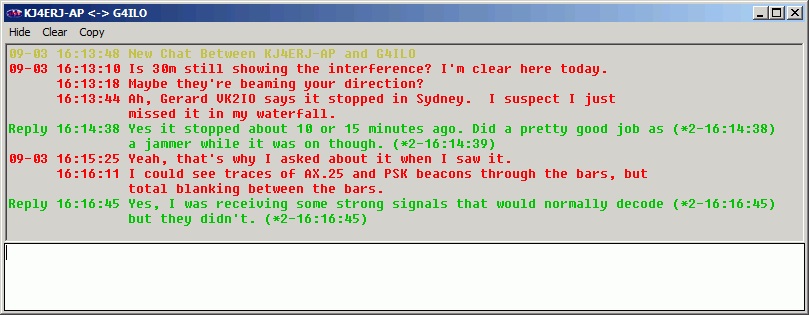
Instead of the primitive edit box found in most APRS clients in which you would have to type your messages in 64-character chunks due to the limitations of APRS messaging you can now type just what you want and APRSISCE/32 will split it up and send it as separate messages transparently. It also takes care of ensuring the parts are displayed in the right order at the other end. You can also view the entire conversation in its own window – useful if you are having conversations with two or more people when you are tired late at night and lose track of what you are saying to whom!
You can chat with anyone, anywhere in the world. True, at the moment most of these conversations are being conveyed over the internet not RF, which will inevitably incur the complaints that “it’s not ham radio.” But they could just as easily use RF. The only problem is that for most of us an adequate APRS RF infrastructure to support worldwide messaging doesn’t exist. But the more people are attracted to the mode – and even the hobby – by cool developments like this, the more likely it is that an effective infrastructure will be built. In many parts of the world you could certainly link up across town on VHF like this.
Regular digital modes are fun. But is there any reason why the only way to have a contact is for two people to have sole occupancy of a frequency and one sends to the other, then the other replies back, repeat until finished, the way contacts have been made ever since Marconi first picked up a morse key?

Julian Moss, G4ILO, is a regular contributor to AmateurRadio.com and writes from Cumbria, England. Contact him at [email protected].
Interference on 30m
I was in the shack making a few adjustments to the Echolink software configuration. The K3 was on 30m APRS with the speaker volume turned down to almost inaudible. Suddenly, at about 1410 UTC, I heard a buzzing type of interference. I looked at the TrueTTY waterfall and saw there were interference bars every 50Hz right across the screen, strong enough to prevent anything from being decoded.

50Hz is the mains frequency here in the UK. With a sinking feeling my immediate thought was that one of the neighbours had discovered a new way to make the HF bands unusable. Then I remembered that Lynn, KJ4ERJ had posted a screenshot of similar interference only the day before in an APRS forum. I checked back, and sure enough the interference Lynn had seen in Florida was exactly the same.
I don’t know what it is, but I don’t think even my neighbours are capable of generating interference that could be heard across the Atlantic. It’s still going strong 30 minutes later. I haven’t seen an HF band wiped out like this since the Woodpecker fell silent back in the ’80s. Well, at least I’ve got Echolink!

Julian Moss, G4ILO, is a regular contributor to AmateurRadio.com and writes from Cumbria, England. Contact him at [email protected].
NS Ladder (3 September 2010)
Definitely unprepared this week and the score has gone down appropriately. I’ve been slowly working to combat RF gremlins in the station. 80 and 40 are now 100% clean for SO2R, but I still have problems on 20 and 40 (both ways). I think the 20-meter feedline is picking up (radiating) garbage. I had a number of SO2R QLF moments. The QRN was pretty nasty here (probably on account of the approach of Hurricane Earl) and I had to work hard to concentrate on the main radio. I ended up just going to one radio after I went for three minutes without a QSO.
For next week’s NS and the NA Sprint, I plan to be QRV from a different QTH. More on this when it happens.
NCCC Sprint Ladder - Sep 3

Call: K8GU
Operator(s): K8GU
Station: K8GU

Class: Single Op LP
QTH: MD
Operating Time (hrs): 0.5
Radios: SO2R

Summary:
 Band  QSOs  Mults
-------------------
  160:   0      0
   80:   8      5
   40:  12      9
   20:  10      6
   15:
   10:
-------------------
Total:  30     21  Total Score = 630

Club: Potomac Valley Radio Club
Ethan Miller, K8GU, is a regular contributor to AmateurRadio.com and writes from Maryland, USA. Contact him at [email protected].
The mystery of the failing filters
A couple of months ago I acquired a Kenwood TM-D710 dual band FM transceiver with APRS as it was the best solution to the problem of how to operate an APRS gateway without losing the ability to monitor for voice contacts on 2m when you do not have the space for two widely separated antennas. I have been quite pleased with the radio but rather alarmed at the number of reports of loss of sensitivity due to the failure of one or more of the IF filters. I asked on the Kenwood Yahoo group whether this was just a faulty batch of filters affecting radios of a certain age or a generic problem that was likely to affect any TM-D710 eventually and was directed to this explanation in the blog of Tasos, SV8YM.
It has been a long time since I read such a well written explanation of a technical phenomenon and I’m sure you’ll find it interesting, especially if you own a VHF radio with 455kHz IF filters. In fact I’m sure many of you will find other articles of interest in this blog. I’ve added it to my regular reading list.

Julian Moss, G4ILO, is a regular contributor to AmateurRadio.com and writes from Cumbria, England. Contact him at [email protected].
Win a Wouxun KG-UVD2 Dual-Band HT
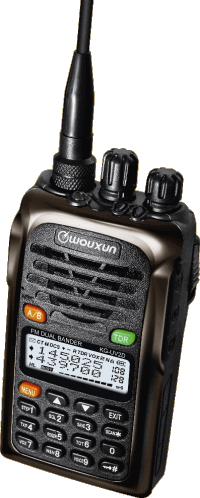
AmateurRadio.com is offering a free prize drawing!
With the help of our generous sponsor, Wouxun.us,
we’re holding a drawing for a
Wouxun KG-UVD2 Dual-Band HT
(KG-UV2D 144/440 version)
This is a US$107 value.
Enter now to win!
Matt Thomas, W1MST, is the managing editor of AmateurRadio.com. Contact him at [email protected].
On why not all mag mounts are created equal…
I use a magnetic mount to attach my relatively small VHF/UHF antennas onto the car for my daily activity on the commute to and from the station. I tend to need a new magmount every 12-15 months as repeated opening and closing of the hatchback eventually takes its toll on the coax!
The last but one magmount I had worked really well for the usual period on all the VHF/UHF bands I use from the car. It finally gave up and I replaced it, with one from the same retailer, with ostensibly the same spec. It certainly worked, but particularly on 70cms, the performance was considerably worse. Not catastrophically worse, more like ‘conditions aren’t very good today’ worse – so I just put up with it.
I had the opportunity this morning to try a different magmount – a slightly more expensive model (the original one I was using retail at around £16 and the newer one at about £25). On 433MHz the difference was enormous! GB3TD which had become unusable at the far end of my commute near Didcot, was just fine! I don’t think it was just conditions. but it will be interesting to see how the new mount affects the other bands.
So now I’m wondering what was ‘wrong’ with the old magmount. It’s not as if it really didn’t work, but perhaps it was just very lossy. Either way, I’m glad I tried the different mount. Your mileage may vary, but you may be well advised to spend slightly more on your next magmount!

Tim Kirby, G4VXE, is a regular contributor to AmateurRadio.com and writes from Oxfordshire, England. Contact him at [email protected].
The death of VHF
Olga and I have returned from a long weekend in London. I took my VX-8GR along, hoping to see some APRS activity or even make some contacts. But I heard absolutely nothing, nada, zilch, not a braap on the APRS frequency nor any signs of life on the simplex or repeater frequencies.
Twenty years ago I lived in London, in Charlton SE7 and I seem to recall that in those days there were four London repeaters on 2m and plenty of activity. I also seem to recall that some of the repeaters were plagued with abuse. Last weeked even a kerchunker or a pirate playing music would have been a welcome sign that someone was using the amateur frequencies.
I took a laptop with me – the small Eee PC running Ubuntu Linux, with APRSIS32 under wine – to monitor activity and see if my RF beacons were heard. I received a greeting from G5YC via the APRS-IS internet network and that was that. What a contrast to Prague, where I was a month ago, where the APRS activity just didn’t stop.
Tim, G4VXE, posted yesterday about creating APRS objects for repeaters using OpenAPRS.net. I commented that it was all very well, but these internet created objects are never transmitted on RF so they never fulfil the intended purpose of the mode which is to inform visiting mobiles of the local repeater frequencies. Unfortunately with the lack of radio activity here in the UK one cannot deny that APRS works much better as an internet application than it does over RF. Anyone who has a computer can call up aprs.fi and see the local picture – if anyone has taken the trouble to create the objects. If they were transmitted on RF, would anyone hear them?
I could say much the same about 2m FM. If I’d had an iPhone I could have made some contacts using the newly released Echolink app, which again is more than I was able to do using my Yaesu. What has happened to ham radio that one can’t find any activity even in the UK’s biggest city? It seems to me that we have all decided that cellphones are a much better tool for contacting our ham buddies. If we lost the use of the VHF and UHF bands would anyone actually notice?

Julian Moss, G4ILO, is a regular contributor to AmateurRadio.com and writes from Cumbria, England. Contact him at [email protected].
 Ham Radio Deluxe |
 W5SWL Electronics |
 Ham Radio Prep |
 KB3IFH QSL Cards  Hip Ham Shirts  HamRadioAuctions HamRadioAuctions Reliance Antennas Reliance Antennas Enigma Shop Enigma Shop |  morseDX  Ni4L Antennas  R&L Electronics R&L Electronics antennas.us antennas.us QRV QRV |
- Matt W1MST, Managing Editor
