 |
 The DX Code Of Conduct
 18 September 2010 | by
 It’s been several years (about 2 1/2) since I last editorialized about DX behavior in this blog. I try not to get on my soapbox too often, but I think I can write again on that same subject now that some time has passed.
Actually, I’ll let someone else do most of the work for me this time, after a bit of an introduction. In response to the increasingly poor standard of operating practice being heard on the bands, particularly when working DX, the First Class CW Operators Club formulated a draft DX Code of Conduct that they are trying to publicize. You can follow the links on their website, but they’ve also created a website at http://dx-code.org/ that has a number of useful resources (as well as the code itself, of course). I recommend that you visit their website and click around to learn more.
- I will listen, and listen, and then listen again before calling.
- I will only call if I can copy the DX station properly.
- I will not trust the cluster and will be sure of the DX station’s call sign before calling.
- I will not interfere with the DX station nor anyone calling and will never tune up on the DX frequency or in the QSX slot.
- I will wait for the DX station to end a contact before I call.
- I will always send my full call sign.
- I will call and then listen for a reasonable interval. I will not call continuously.
- I will not transmit when the DX operator calls another call sign, not mine.
- I will not transmit when the DX operator queries a call sign not like mine.
- I will not transmit when the DX station calls other geographic areas than mine.
- When the DX operator calls me, I will not repeat my call sign unless I think he has copied it incorrectly.
- I will be thankful if and when I do make a contact.
- I will respect my fellow hams and conduct myself so as to earn their respect.

David Kozinn, K2DBK, is a regular contributor to AmateurRadio.com and writes from New Jersey, USA. Contact him at [email protected].
EEVblog entertains nerds!
I enjoy Dave Jones’ Electrical Engineering Video Blog, or EEVblog. He recently submitted this video to a competition. It is a 90 second compilation showing the entertaining side of what he shares with followers and makes a great commercial for the EEVblog, so I include it here in case you have never watched one of his videos. Warning, best not to watch this with the kids or grandma in earshot!

Don’t go thinking that Dave just fools around on his videos. There is some pretty good information in the posts, so give his site a try if you like electronics.


Alan Steele, VA3STL, is a regular contributor to AmateurRadio.com and writes from Ottawa, Ontario. Contact him at [email protected].
VHF/UHF firepower
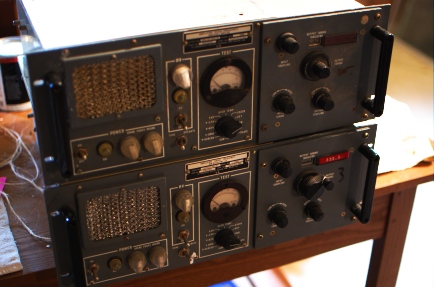
As if I don’t have enough projects already, I recently obtained these two surplus FAA AM-6155 amplifiers on, as usual, very attractive terms. I don’t have the equipment to properly test them at this point. But, that is coming. The FAA specified these to do 50 watts continuous duty AM. With modification, they will do about 300-400 clean watts with 10 watts of drive on 144, 222, and 432 MHz. Once I get the first two working (on 222 and 432), I plan to find two more of them and use them on 50 and 144 MHz. For 50 MHz, I plan to remove the VHF/UHF cavity and components and install an RF deck using the same Amperex DX393 or Eimac 8930 tube. Comments and ideas welcome. They’re a lot cheaper than bricks! One of my units appears to be at least partially converted already, but I’ve only had it open for a few minutes with my brother Seth, who got all of the mechanical aptitude in the family.
Note: Thanks to WY3X for catching my error on the tube type. He also notes that 300 watts would be a conservative maximum on 432. I plan to run the amps with very low drive after tuning so I can compete in the ARRL’s low power category at 100 watts on 222 and 432.
Ethan Miller, K8GU, is a regular contributor to AmateurRadio.com and writes from Maryland, USA. Contact him at [email protected].
QRL for Sprint and September VHF
As I mentioned previously, I was planning to make the NCJ North American Sprint and the ARRL September VHF contests my kick-off to the Fall/Winter contest season. When a work trip was scheduled for that weekend, I assembled my portable station. But, Sarah convinced me not to take it since carrying the ham gear always complicates travel a little bit. Since the work trip was radio-related, I thought I’d share a couple of pictures and stories.
One of the projects in which I participate is the middle-latitude expansion of SuperDARN (Super Dual Auroral Radar Network). SuperDARN is a global HF radar network that is used to monitor plasma processes in the polar ionosphere/magnetosphere. It was recently highlighted on QRZ.com. Last year, we built a pair of radars near Hays, KS. This year, two radars are under construction in central Oregon. I went out to assist with the initial phases of the build.
The radars are installed on an old HF over-the-horizon-backscatter (OTH-B) radar transmitting site in Christmas Valley, OR.
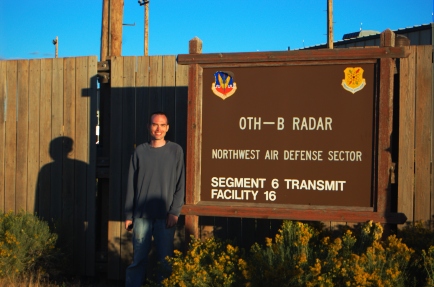
Two of these radars were constructed for the U.S. Air Force as an early-warning system for aircraft, one in Maine and one in Oregon/California. The western portion of the radar was only turned on briefly for testing before being relegated to “warm storage” and then decommissioning. Typical. None of the antennas or transmitters are still on site and a lot of the copper wiring has been looted. Everything left inside the building, including the backup generator, was in essentially mint condition. As an aside, the transmitters from the Maine site were recently installed at Arecibo Observatory. I have no idea what happened to the transmitters from this site. Despite the fact that the antennas and transmitters were missing, there were a number of interesting things to see.
This OTH-B radar was a megawatt class (output, not ERP) system split into three segments/sectors, facing NW, W, and SW, each fed by four transmitters. Each sector had a separate, dedicated 3-phase power line that came from a substation some 50 miles away—I found it on the way home. You could follow the poles straight to it if you knew what you were looking for. Each of the transmitting arrays was surrounded by a fence, for obvious reasons. The fence was made entirely of wood. Furthermore, almost all of the washers were a fiber material, not galvanized steel like the bolts.
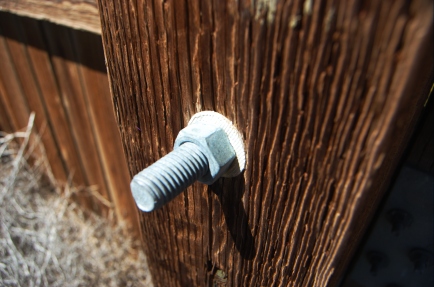
At first, I thought that the washers might have been an electromagnetic consideration, like the wooden fence, which might have distorted the antenna pattern in the best of cases or simply melted in the worst. But, I suspect now that it was a mechanical consideration to deal with dramatic changes in temperature and humidity in central Orgeon’s Great Sandy Desert.
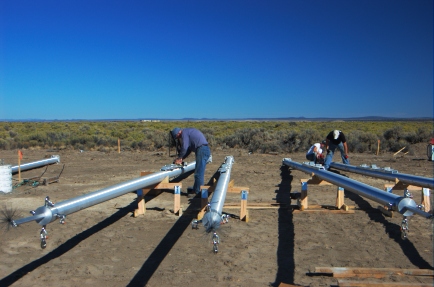
The actual construction of the SuperDARN radar is not that exciting at this point, but here are some of the 72 aluminum poles we dressed with cables for the two radars. Each radar has a 16-element phased-array of folded dipoles mounted in a corner reflector. I installed a lot of N connectors on LMR-600 and a lot of Preformed end-grips on Phillystran, in addition to some more cerebral tasks.
The site has good optical conditions, too. So, I’m looking forward to trying some of my optical instruments out there. Here’s a quick star-trail exposure I took with the camera propped up on a picnic table in the motel parking lot.

So, that’s what I was doing instead of Sprinting and grid hunting! I should be QRV in the NS Ladder tonight.
Ethan Miller, K8GU, is a regular contributor to AmateurRadio.com and writes from Maryland, USA. Contact him at [email protected].
Duh: Learning Curve #4 Oops I did it again!
Ever see one of those tie bars or pins that say, “IYKDWYBDYKGWYBG” My dad had one back in the days when men wore ties. The thing used to bug me cause he didn’t tell us what it meant right away. We tried guessing for a few days before he got tired of 7 kids all ganging up on him.
It is the famous “If You Keep Doing What You’ve Been Doing, You’ll Keep Getting What You’ve Been Getting!” Not sure who gets the credit for that one, but it sure stuck with me all these years. Of course, I’ve heard my bosses recite it a few times along the way too.

It only hurts when I laugh, or think, or move, or…use a new antenna in a contest!
That’s what this series of posts is about. Not repeating mistakes I’ve made. Maybe you can learn from my mistakes and save a bit of time. Or maybe you’ll just get a laugh and some relief from knowing someone else made the same mistake you’ve made. HA!
Well, last night, I did not follow my own advice. I put together a new antenna a few hours before the NAQCC Sprint and set it up. LESSON: As previously mentioned, don’t try to use a brand new antenna in a contest.
Ooops I did it again. Strike TWO! It was a disappointing night and too late to try to get another antenna up before the 2 hour sprint was over. So no contacts for me, I’m still scratching my head. Was it the antenna, me, or the band conditions? BUT… I don’t think I’ll pull that one again. Unless I have a hole in my head…
72,
Kelly K4UPG
p.s. Don’t forget to take the poll on my blog for the best ham radio QTH in the USA! It is on the left side column.
Kelly McClelland, K4UPG, is a regular contributor to AmateurRadio.com and writes from Florida, USA. Contact him at [email protected].
Terminator

Ethan Miller, K8GU, is a regular contributor to AmateurRadio.com and writes from Maryland, USA. Contact him at [email protected].
Handiham World for 09 September 2010
Welcome to Handiham World!
Back at work!
The Handiham World weekly is finally back at work after a couple weeks of rest & relaxation. While the e-letter went on holiday, I also took my vacation at exactly the same time. What a coincidence!

In the accompanying photo, I am posing in front of something that would make a perfect ham radio antenna support – the Eiffel Tower. My XYL and I made the trip to celebrate our anniversary, and she was a saint to put up with my obsession with ham radio and antennas. According to Wikipedia, “The tower stands 324 meters (1,063 ft) tall, about the same height as an 81-storey building.” Just imagine the signal you could get out with a multielement Yagi antenna on top, right?
As nice as it is to travel, it’s always great to be back. Today will be mostly filled with member contacts like phone calls and emails, because I have quite a backlog. I hope to get our audio magazine digest updated either later today or perhaps tomorrow if I run out of time today, but rest assured I will eventually catch up – in the meantime, I am coping with the jet lag by draining out the entire coffee pot.
One of the most fun things was checking in to the PICONET on 3.925 MHz via the Handiham remote base from France and Italy. This is certainly proof that a remote base station can be useful when setting up antennas or traveling with lots of radio gear is simply not practical. I also enjoyed making some Echolink contacts, including a check in on the daily Handiham net. These days, one does not need to give up regular operating just because you are staying in a hotel. These new ways to use technology enhance our options to use ham radio, and I’m sure thankful to all of our volunteers and supporters who make it possible. The best thing about ham radio for me has always been staying in touch with my community of friends. In order to get through all of the calls today, this edition will be a bit shorter than usual, but hopefully still worth a few minutes of your time.
73,
Patrick Tice, WA0TDA
Handiham Manager
[email protected]

Pat Tice, WA0TDA, is the manager of HANDI-HAM and a regular contributor to AmateurRadio.com. Contact him at [email protected].
 Ham Radio Deluxe |
 W5SWL Electronics |
 Ham Radio Prep |
 KB3IFH QSL Cards  Hip Ham Shirts  HamRadioAuctions HamRadioAuctions Reliance Antennas Reliance Antennas Enigma Shop Enigma Shop |  morseDX  Ni4L Antennas  R&L Electronics R&L Electronics antennas.us antennas.us QRV QRV |
- Matt W1MST, Managing Editor
