 |
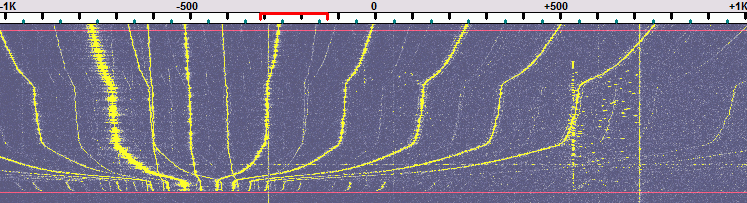
 Interference on 14.077MHz
 24 September 2010 | by
 Anyone else seeing this diabolical interference on 20m?

Julian Moss, G4ILO, is a regular contributor to AmateurRadio.com and writes from Cumbria, England. Contact him at [email protected].
Flash in the pan
I’m not exactly a fan of Flash in websites but I think you’ll agree that that this example from the home page of the Dutch store HEMA is very amusing. When the page opens, don’t click on anything, just wait…

Julian Moss, G4ILO, is a regular contributor to AmateurRadio.com and writes from Cumbria, England. Contact him at [email protected].
Codec2 Open Source Vocoder Project
David Rowe, VK5DGR, is working on Codec2, an open source low rate speech codec that is intended to replace the proprietary AMBE vocoder in D-STAR. Bruce Perens, K6BP, discusses the Codec2 project here, and further information from VK5DGR is here.
If you missed it, I discussed the issues with proprietary technology and D-STAR here, here, and here.
If you believe open source technologies are crucial to amateur radio, please donate to the Codec 2 project. Paypal donations are accepted.


Codec2 Open Source Vocoder Project
If you missed it, I discussed the issues with proprietary technology and D-STAR here, here, and here.
If you believe open source technologies are crucial to amateur radio, please donate to the Codec 2 project. Paypal donations are accepted.

Anthony Good, K3NG, is a regular contributor to AmateurRadio.com and writes from Pennsylvania, USA. Contact him at [email protected].
JT65 and HF
Julian G4ILO has an interesting post about using W6CQZ’s JT65-HF software.
“One of the features of JT65-HF is that it automatically links in to the PSK Reporter network so you can see all the stations you heard on a map and, even more interestingly, all those that heard you.”
In 20 minutes on 20m at 5W he managed to be heard twice on the west coast of N America under S9 noise condx. Julian says he can understand “why the mode is so popular, even addictive”.
More info on JT65 from HFLINK. “JT65A is a weak signal digital QSO mode.
JT65A is normally used on HF and 6 meter bands.” Also not to be missed are The Complete Bozo’s Guide to HF JT65A (a work in progress) by Andy K3UK and the ‘smart person’s guide’ to the mother mode WSJT.
Stephen Rapley, VK2RH, is a regular contributor to AmateurRadio.com and writes from New South Wales, Australia. Contact him at [email protected].
IK1ZYW Labs & FT817 remote
Interesting update on IK1ZYW Labs on project to achieve remote control of the FT817. Also a pointer to an interesting page on FT817 Accessories, the external keypad project (circuit, manual & firmware available as well as various configurations of components including reprogrammed and tested chip ATtiny2313-20PU, xtal and 4×4 keypad) and the remote display project (pages under construction).
From the external keyboard info:
“…are you tired of hunting needed functions through F+Sel+A/B/C combinations? Do you want to improve your on-the-air proficiency? You can’t help but always press more keys at a time? Or always retouch the frequency when pushing the F button? An external keypad will let you re-discover the joy of QRPing with the FT-817(ND).
The IK1ZYW Keypad for FT-817(ND) is a wired partial remote control for the little Yaesu transceiver. It was conceived during a 6-hour field session at 2700 m.a.s.l. for a VHF contest in August 2008…”
Stephen Rapley, VK2RH, is a regular contributor to AmateurRadio.com and writes from New South Wales, Australia. Contact him at [email protected].
JT65 on HF
Several of my blogging compadres have written recently about using the JT65-HF software by W6CQZ so I thought I would give it another try to see if I could understand what all the fuss is about. This is not the first time I have tried the program. I tried it at the beginning of the year. In fact, it was the main reason for upgrading my shack computer because the old one could not decode the received signals quickly enough to give me time to reply to calls. But having got the new PC I found the mode rather uninvolving as contacts are made just by clicking buttons to send computer-determined reports and you can’t even tell which of the signals you can hear is the one you are replying to.
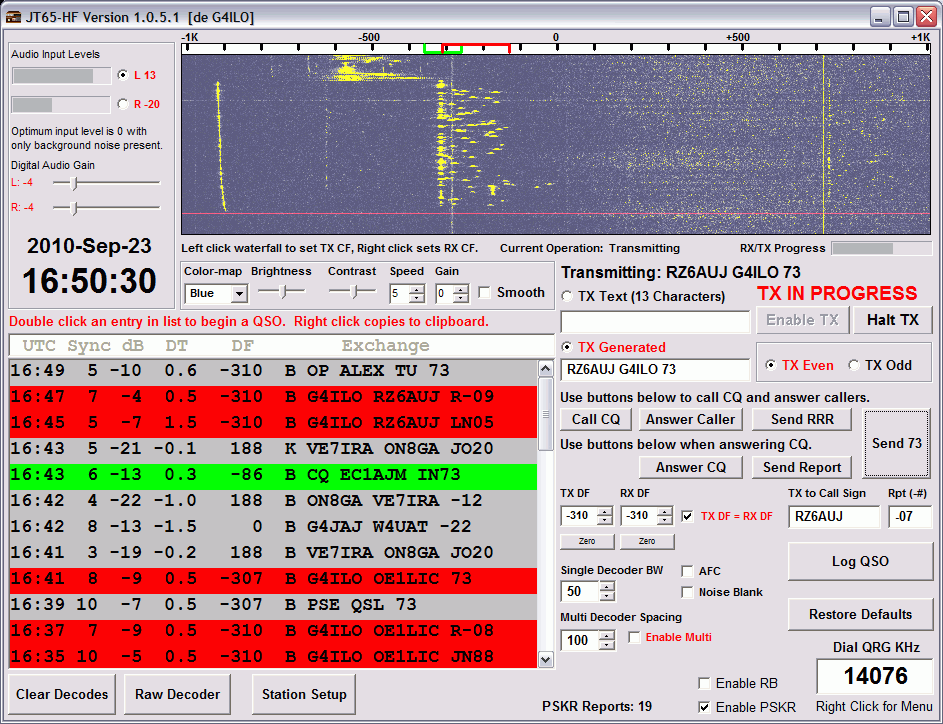
I decided to run the K3 at 5W into the dipole because the K2 was doing 30m APRS gateway duty on the magnetic loop and the two antennas are only a few feet apart. But there was no interference. I’m not sure how much power people normally use on this mode but I might try more next time. My new shack computer coped easily, decoding the received JT65A signals in a second or so despite the fact that it was simultaneously running two APRS gateways one of which was using TrueTTY and a USB sound card to decode the packet data.
I found a free spot on the waterfall, sent a CQ and two people immediately came back to me at the same time. I didn’t decode anything! I called again and this time three people replied! I sent CQ once more and this time the first two must have decided I was either deaf or an idiot which left just one signal on my frequency: OE1LIC, for my first contact of the day. My second CQ raised RZ6AUJ, Alex for another contact and that was all I had time for before dinner.

One of the features of JT65-HF is that it automatically links in to the PSK Reporter network so you can see all the stations you heard on a map and, even more interestingly, all those that heard you. I remembered this and popped up to the shack after dinner to grab a screen shot. As you can see, my 5W to an attic dipole was heard by two stations on the west coast of the USA, and I was only on the air for about 20 minutes! The small blob on the west coast is VE7IRA who was heard by me despite the appalling S9 interference I get on this band, which was reduced to about an S3 by the MFJ-1026 noise canceller using a PA0RDT mini-whip for a noise antenna.
I still find using JT65A on HF feels a bit odd but I can understand why it has become so popular, even addictive. It takes up little band space and doesn’t interfere with other band users unlike a certain R** digital mode. I said this before and didn’t end up doing it but I think I will spend a bit more time using JT65-HF to see what I can work and whether I can join the crowd of enthusiasts for this unusual digital mode.

Julian Moss, G4ILO, is a regular contributor to AmateurRadio.com and writes from Cumbria, England. Contact him at [email protected].
 Ham Radio Deluxe |
 W5SWL Electronics |
 Ham Radio Prep |
 KB3IFH QSL Cards  Hip Ham Shirts  HamRadioAuctions HamRadioAuctions Reliance Antennas Reliance Antennas Enigma Shop Enigma Shop |  morseDX  Ni4L Antennas  R&L Electronics R&L Electronics antennas.us antennas.us QRV QRV |
- Matt W1MST, Managing Editor
