 |
 ICQ Podcast Series Three Episode Twenty – Microwaving (26 September 2010)
 26 September 2010 | by
 Series Three Episode Twenty of the ICQ Amateur / Ham Radio Podcast. News Stories include:
- Earth dodges another sun bullet
- Goodbye to Sunspots?
- Historic Chain Home Tower back on the air
- Take your hand-held to work day
- WSJT 9.0 released
- Frequency change for Scotland Morse Enthusiasts Group
- Digital radio switchover 'far too early'
- New type of antenna - Sea Water Antenna
- Ham Radio high-altitude balloon launch team opportunity
- Online radio course from DoC
- GB7MM back on the air
- Home electricity wiring antenna
Your feedback, upcoming events, and Martin (M1MRB) visits a Microwave Group.
Colin Butler, M6BOY, is the host of the ICQ Podcast, a weekly radio show about Amateur Radio. Contact him at [email protected].
GB7ML/GB7AU update – nodes off air
I hadn’t been on D-STAR for a few days, but popped on for a quick chat this morning. I was particularly sorry to hear that GB7ML from Tring, as well as GB7AU are now QRT. I’m not entirely sure what has happened, although someone mentioned ‘politics’, but the current expectation is that the nodes will not return.
What a shame – GB7ML in particular had such fabulous coverage.

Tim Kirby, G4VXE, is a regular contributor to AmateurRadio.com and writes from Oxfordshire, England. Contact him at [email protected].
Serial addition
I installed a four port RS-232 serial card in my shack PC today. When I bought the computer earlier in the year I purchased and installed a two port serial card, thinking that would be enough. But it wasn’t. You can never have enough serial ports if you want to interface with radios. With four, I can now have CAT control of both the K2 and the K3, the TNC connection to the Kenwood TM-D710 and one more which is currently controlling the PTT of the FT-817 for the EchoLink node but could be used for the control port of the Kenwood if I ever decided to use that for EchoLink. No more hassles with USB to serial adapters, and all my USB ports are free for things like sound cards. I don’t know why people use laptops for shack computers, they provide far fewer options.
Needless to say, things did not go as smoothly as they could have done. I thought I could have COM2 for the K2, COM3 for the K3 which would be easy to remember. But Windows gave the ports the designators COM3, 4, 10 and 11. There’s an option to reassign the port numbers but Windows claimed that everything from COM2 to COM9 was in use. By what, was my unanswered question.
In the end I decided to name the ports COM2 through COM5 as I wanted regardless of Windows’ protestations. They did work, but finding out which port was which was a matter of attaching a radio to one socket, loading a program and trying all possible COM port numbers until it worked, as there was no logical correspondence between the numbering and the sockets on the back of the computer. Who said it was meant to be easy anyway?
Despite all this I managed to make a few contacts using JT65A on 20m including DU1GM, N0OB and K1CF, using 25W to the dipole.
Although I now have computer control of the K2 I don’t have a sound card interface as I have cracked open the plastic case of the USB audio dongle and superglued the bottom half containing the PCB to the stripboard on which I will be building my homebrew SignaLink clone. Of course, now I have a serial cable connection between the computer and the K2 I don’t need a VOX controlled interface, never mind an isolated one because the serial cable will bypass the isolation anyway!

Julian Moss, G4ILO, is a regular contributor to AmateurRadio.com and writes from Cumbria, England. Contact him at [email protected].
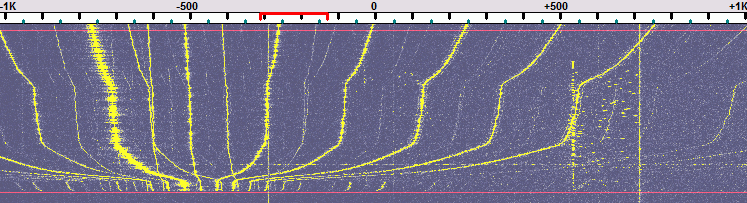
Interference on 14.077MHz
Anyone else seeing this diabolical interference on 20m?

Julian Moss, G4ILO, is a regular contributor to AmateurRadio.com and writes from Cumbria, England. Contact him at [email protected].
Flash in the pan
I’m not exactly a fan of Flash in websites but I think you’ll agree that that this example from the home page of the Dutch store HEMA is very amusing. When the page opens, don’t click on anything, just wait…

Julian Moss, G4ILO, is a regular contributor to AmateurRadio.com and writes from Cumbria, England. Contact him at [email protected].
Codec2 Open Source Vocoder Project
David Rowe, VK5DGR, is working on Codec2, an open source low rate speech codec that is intended to replace the proprietary AMBE vocoder in D-STAR. Bruce Perens, K6BP, discusses the Codec2 project here, and further information from VK5DGR is here.
If you missed it, I discussed the issues with proprietary technology and D-STAR here, here, and here.
If you believe open source technologies are crucial to amateur radio, please donate to the Codec 2 project. Paypal donations are accepted.


Codec2 Open Source Vocoder Project
If you missed it, I discussed the issues with proprietary technology and D-STAR here, here, and here.
If you believe open source technologies are crucial to amateur radio, please donate to the Codec 2 project. Paypal donations are accepted.

Anthony Good, K3NG, is a regular contributor to AmateurRadio.com and writes from Pennsylvania, USA. Contact him at [email protected].
 Ham Radio Deluxe |
 W5SWL Electronics |
 Ham Radio Prep |
 KB3IFH QSL Cards  Hip Ham Shirts  HamRadioAuctions HamRadioAuctions Reliance Antennas Reliance Antennas Enigma Shop Enigma Shop |  morseDX  Ni4L Antennas  R&L Electronics R&L Electronics antennas.us antennas.us QRV QRV |
- Matt W1MST, Managing Editor
