 |
 Plenty of new DX entities coming
 1 October 2010 | by
 Because of the dissolution of the Netherlands Antilles as single political entity effective 10/10/10 (one of those dates that you don’t have to worry about whether that is in “American” or “rest of the world” format), the status of some existing DXCC entities will change. The details of this have been discussed elsewhere and the ARRL has said that there will be new entities formed for DXCC award purposes. All of those locations are in the Caribbean, and all are easy to work from the US, particularly from the east coast where I’m located. Because of the way that the DXCC program works, anyone who wants to keep their DXCC totals up will need to work all the “new” entities in order for them to count for award credit. To help out all those who will be interested in contacting these new entities (and there will be a lot of us), DXpeditions have been planned to activate all of those islands starting on the 10/10/10 date. I hope that everyone keeps in mind the DX Code of Conduct that I wrote about last week. It’s going to be tempting for everyone to try to force their way into the pileups, but it’s important to realize that: A) The operators working the DXpeditions are experienced and in all likelyhood they will work you and B) Even if you aren’t able to work those DXpeditions, all the islands have regular activity and they’ll be on the air again soon.
The different DXpedtions agreed on a bandplan to minimize the interference between themselves. My recommendation is that you print out a copy of this document (PDF file) and keep it at your operating location. By following the bandplan, you’ll have a much better chance of working the station that you think you’re working.
Be patient, you’ll work them, these are not difficult islands to get to and it’s not worth getting into an on-air fight in an attempt to work them. Be courteous and you should have a good shot. Good luck.

David Kozinn, K2DBK, is a regular contributor to AmateurRadio.com and writes from New Jersey, USA. Contact him at [email protected].
Radio recording software Vox Recorder for Windows
 I, on occasion, have the need to have recordings of activities on our local repeaters. Being the local area DEC, recordings do come in handy when running training sessions in the future. Sometimes, it’s nice to have a recording of an on air event as well. When I’m operating in my capacity as a control operator, it comes in handy to have recordings of repeater traffic.
Having a VOX actuated recorder comes in handy. Especially for recording repeater activity. I stumbled on Vox Recorder for Windows by Nino Porcino, IZ8BLY. Wrote a handy little app that will not only record the files, but also name them as well.
Caveat: I have only run this on a 32 bit OS. If you have experience running this in any of the 64 bit versions of windows, please comment below and let us know.
You can find VOX Recorder for Windows at:
http://xoomer.virgilio.it/aporcino/VoxRecorder/
Jonathan Hardy, KB1KIX, is a regular contributor to AmateurRadio.com and writes from Connecticut, USA. Contact him at [email protected].
LHS Episode #048: Better Late Than Never
 Linux in the Ham Shack took a bit of an unintended hiatus over the last month. We’re in the process of trying to catch back up to where we’re supposed to be. The current episode recording schedule has been posted and is accurate. We’re going to do a couple of broadcasts two weeks in a row and then the next three releases will be coming out in rapid succession so we’re back on track.
After the Dayton Hamvention, Southeast Linux Fest, Joplin ARC Hamfest and Ohio Linux Fest, things have slowed down a bit on the event front, but we’re just starting up again when it comes to the show. So please stay tuned, tell your friends about us, and make sure to pick up a shirt or a ball cap. These are high quality items, and the only way you can get them is online or when we’re at an event close to you. Also, check out the new BADGER WEAR! You can find a link to all of our merchandise at the top of this Web site. Have a good week, everyone, and thanks for listening!
73 de The LHS Guys
Russ Woodman, K5TUX, co-hosts the Linux in the Ham Shack podcast which is available for download in both MP3 and OGG audio format. Contact him at [email protected].
Handiham World for 29 September 2010
Welcome to Handiham World!
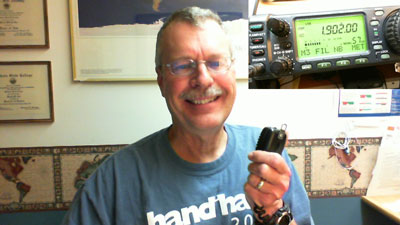
At this time of year I am always taken by surprise at how quickly the daylight hours fade every day here in the northern hemisphere. That means more hours of darkness and more HF radio fun in the evenings, as we mentioned last week when we extolled the virtues of 160, 80, and 40 m for long-distance communications. Things are also looking up in the daytime communications department, because my Windows sidebar gadget, “Full Sun 2.1” by John Stephen, shows me the face of the sun becoming more regularly dotted with sunspots. More sunspot activity means that the shorter wavelength HF bands like 10 and 15 meters will soon become much more reliable for very long distance daytime contacts.
If you have a Technician Class license, now is the time to consider an upgrade to General Class so that you can really use and appreciate all of these HF bands at a time when conditions favor some really great operating.
What makes me think about this upgrade business today of all days, when I am busy with your weekly E-letter and podcast is that tonight I will be teaching a two hour General Class course on rules and regulations. The course is open to anyone, but of course Technician Class license holders would probably be the most interested since they have already completed their first license and are familiar with ham radio terminology and operations, at least on the VHF and UHF bands. While some HF frequencies are open to Technician Class licensees, pretty much everyone realizes that an upgrade to General is a necessity if one is really going to enjoy shortwave operation.
One advantage that I feel that I have in teaching rules and regulations is that those who have passed the Technician are already familiar with the fact that we are regulated by the Federal Communications Commission and that the section of the rules governing the Amateur Radio Service are called Part 97. Anyone with a license should already know about frequency charts and about how the various levels of license allow for operation in different band segments. Everyone is already familiar with the fact that transmit power levels are regulated and that examinations are given by a VE team. Starting with this foundation of basic knowledge makes the General Class study regimen that much easier. I always start out the course by assuring my students that the examination for General Class will be 35 multiple-choice questions without any Morse code testing. Yes, I know that the code requirement has been gone for quite awhile now, but I still encounter students who either don’t quite believe it or simply haven’t gotten the news. One thing I have learned over years and years of teaching is that one cannot assume that the students know all of these basics on the first day of class!
Although I am very familiar with teaching into a microphone for our blind Handiham students, these courses taught in front of a class of students from the general public will only occasionally have a blind participant. This is going to sound a little bit odd, but I have to remind myself that I will now be expected to provide some visual learning cues as I speak and answer questions. For a traditional teacher of amateur radio at a typical radio club course the situation is reversed and that teacher may have considerable difficulty working with blind students. It all serves to remind me that the first time I meet my students I am going to have to assess them to find out how they learn and be flexible enough to adapt my teaching style accordingly. In teaching amateur radio courses, flexibility is the key. Your students will help guide you if you are open-minded enough to listen to them – just as we always tell new operators to listen on the bands before transmitting.
When I see a classroom full of students who are interested in amateur radio, I know that they are motivated to learn. After all, amateur radio classes are completely voluntary and these people could be doing something else instead of sitting in a ham radio class. This is a tremendous advantage and opportunity for me – and you – as teachers in amateur radio. Our students want to learn. We need to make sure that we are prepared to teach by having our teaching materials and any audiovisual equipment ready to go at the beginning of class so that we can move right into the topic at hand and make sure that we use the time as efficiently as possible.
Today we have the Internet and all of its amateur radio resources as study aids for post-class reinforcement of each week’s classroom topic. Since I am teaching rules and regulations and the radio club has chosen the ARRL General Class License Manual as the official study guide, I will be referring my students to the section of the ARRL website that provides further information about that particular book, including extra study material, any corrections that might need to be made in the text, and – most importantly – a question pool organized to follow the book. Not everyone knows about this special question pool, so I never assume that my students have discovered it on their own. Believe me, it makes quite a difference to be able to follow the question pool in the same order as the chapters in your textbook. I also freely recommend other amateur radio websites that might help with either studying or practice examinations.
One disadvantage of having to teach the chapter about rules and regulations is that it is not considered a “fun” topic. When one thinks about rules and regulations, it brings to mind memorizing really dull legal-sounding rules and lots of frequency limits. I won’t deny that there is some of that, but your job as an instructor is to help the students learn how to learn. That might mean pulling out the US Amateur Radio Bands frequency chart and helping the students to make sense of a page full of data that might otherwise seem overwhelming. One trick is to divide the frequency bands into the ones where there are no special General Class subsections and those that do have subsections. Breaking the frequency chart down in this manner can help your students remember which bands they may get questions on regarding frequency limits. Of course there is going to be some memory work no matter what you do in the classroom to help the students organize their thinking. I tell my students in no uncertain terms that they will have to sit down and do some memorization and that they will do it as homework. My volunteer instructors at Handiham Radio Camp have told me for years that studying at home is vital to ultimately passing the examination during the VE session at camp. Fortunately most radio club classes meet weekly for 8 to 10 weeks, giving your students much more time to study at home. Just be sure that they understand what to study and help them develop good study habits.
My classes are always interactive. I don’t prefer to lecture from a podium for an hour and then have a question-and-answer session. Most people learn best if their questions are answered the instant they pop into their heads. If you wait to have a question and answer session you will find that many of your students have forgotten questions that might’ve come up during the lecture. A better way to conduct the class will be as a discussion that can be interrupted to answer questions. Time will be a factor, so a good teacher learns to manage this kind of interactive classroom experience in order to keep the class moving along while still allowing the students to participate actively during the entire class period.
Since my class is going to be in a two hour time frame, I am going to plan for a mid-class break. Your students will be more alert if they can attend to personal needs and walk around a bit instead of having to sit for an extended period of time.
Finally, when you are wrapping up your class, your students may feel overwhelmed with all of the material that you have managed to cram into the evening’s session. Once they return home and think about what they have learned, which may even take the rest of the week, they may have other questions that they wish they had asked during the class. That’s why I always provide my e-mail address and invite my students to ask questions whenever they think of them. My radio club teaches classes in Technician and General, offering the first license in the spring of the year in conjunction with an emergency weather spotter course. The upgrade class to General is offered in the autumn. All of the classes are taught by a team of volunteer instructors so that no one instructor will be tasked with many classes to prepare for over the course of 8 to 10 weeks.
I hope your radio club is offering classes as well. Over the years I have received the sad news from time to time that a radio club is dissolving and distributing its assets to worthy causes like the Handiham System. While I am always glad to receive support for our program, I really hate to see an amateur radio club closing its doors. I suspect that one of the biggest factors in the demise of these clubs was the absence of an education program to teach amateur radio classes. A club without an educational program is a club that is not building a base of new amateur radio operators in their community. This is a recipe for an aging club membership that will eventually diminish to a few members and eventually the plug will be pulled on the club. Don’t let that happen to your club. Volunteer to help with an education program. If you have never been an amateur radio instructor, you may want to sit in on a class taught by one of your other club members or even a neighboring radio club’s class. The idea is to learn how to teach and then get out there and do it. Rest assured that your efforts will be rewarded by the new members you will bring into the amateur radio community. You will have more members in your club, and these new members will have new ideas. Eventually they will become instructors themselves and they will also serve in leadership positions and provide new club programs. They will be the ones who will take up the mantle of “Elmers” who will be able to keep amateur radio healthy and growing into the future.
I always feel honored when I am asked to teach one of our classes. I hope you will feel that way, too.
I hope to hear you on the air soon.
73,
Patrick Tice, WA0TDA
Handiham Manager
[email protected]

A dip in the pool
No one told you there was going to be a quiz, right? I thought it would be fun to pick a question out of the question pool and see how many of us can remember the right answer. Ready? Here we go:
G1A01 [97.301(d)]
On which of the following bands is a General Class license holder granted all amateur
frequency privileges?
A. 20, 17, and 12 meters
B. 160, 80, 40, and 10 meters
C. 160, 30, 17, 12, and 10 meters
D. 160, 30, 17, 15, 12, and 10 meters
Do see how sneaky I can be? In my opening remarks I specifically referred to teaching my students about dividing the frequency chart into bands where General Class licensees have full privileges and bands that have frequency restrictions. Think about which one of these is the correct answer and we will provide it at the end of this newsletter and podcast.

Pat Tice, WA0TDA, is the manager of HANDI-HAM and a regular contributor to AmateurRadio.com. Contact him at [email protected].
Too many distractions
 |
| My bureau-workshop |
I have sometimes seen comments to this blog that are disparaging towards the idea of stealth operation. I don’t for a moment accept that stealth antennas are worse than the modest wire antennas many hams in the UK who don’t have deep pockets, large gardens and amazingly tolerant neighbours use. RF doesn’t care whether an antenna is visible or not, it’s what you do to make the antenna invisible that might compromise performance and with the small gardens without trees that so many of us in the UK have, most of us have to live with compromise.
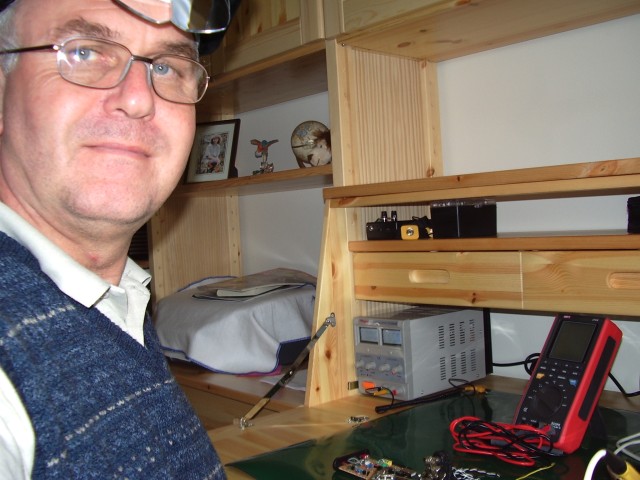
But the real test of a ham radio station is whether it allows you to pursue enough activities to maintain interest in the hobby. And based on that criterion I think G4ILO does very well. One of the best additions to the shack was to make a dedicated work area for construction in a bureau unit whose door drops down to make a work surface and which can be closed when I have done enough without having to put everything away. I have a greater interest in building stuff now that I have somewhere to do it.
In fact there are more things I would like to do, radio-wise, than I have time to do. Last weekend, for example, I would like to have tried making some contacts in the worldwide RTTY contest but of all the radio things I did that weekend, giving away some contest points was something I didn’t get around to.
Today I was trying to finish up my homebrew SignaLink USB clone, but I made the mistake of turning the K3 on and leaving JT65-HF running and I kept on being distracted by seeing CQ calls from DX stations. In between work on the interface I made contacts with YV6BFE, N8ABY, AA1CZ and KD0AGX plus a couple of Europeans, all using 25W to the attic dipole. My signals were spotted in Japan and far eastern Russia, though I didn’t hear anyone that far east. DU1GM, whom I worked a few days ago, was calling for most of the afternoon with no takers.
The SignaLink USB clone is just about finished and does work. After I made up an interface cable between it and the FT-817ND I made one solid PSK31 contact with F5TTI on 30m with it on the test bench. So now it just has to be put into its case and it will be completed.

Julian Moss, G4ILO, is a regular contributor to AmateurRadio.com and writes from Cumbria, England. Contact him at [email protected].
Ham kits business models
Recent posts on this blog mentioning the Chinese DIY scene and the explosion of offerings have prompted a very interesting exchange of views and reflections on how best to nurture this business and make it accessible to the global ham market.
Most recently Sivan Toledo has posted thoughtful comments drawing possible inspiration for the emergent Chinese DIY industry from successful amateur kit operations like Tony Parks’ Softrock. And the secret appears to be finding the right balance between the great product and crowdsourcing the support and handholding that is as much part of the product and building experience as the device itself.
Elecraft clearly enjoy the best in solid detailed step-by-step documentation (reminiscent of Heathkit) and they have the added advantage of an amazing online community dedicated to solving any problems, assisted by the designers and principals of the company. Part of the success of their online presence is a well moderated space and volunteer heroes like Don Wilhelm W3FPR who don’t appear to need sleep!
Doug Hendricks’ QRP Kits shows you can fill a niche and still keep your day job. While many of Doug’s star attractions are designed by Steve Weber KD1JV, Steve has his own website which I visit frequently to see whether a new batch of ATS-4 Miniature 5 band CW / digital mode HF transceivers are available or not, knowing they’ll probably sell out in a matter of hours. Users of this and its predecessors rave about them. Steve WG0AT took an ATS3 on his latest adventure with Rooster and Peanut.
Dave Benson, K1SWL’s Small Wonder Labs also offers quality kits at really good prices and a very efficient service. (My SW-40+ arrived in Sydney in record time.) Hunt around his site for a minute and you’ll discover how how the SWLabs fit into his lifestyle on 4+ acres near Newport “(we get a lot of winter here)” NH.
K1SWL’s approach to support includes email – “If you run into trouble during alignment and test, I’ll guide you through the troubleshoot process as far as we can get by e-mail. If that doesn’t do the trick, my repair person offers prompt and reasonably-priced service- he’ll troubleshoot and repair the unit and let you know what he found.” And you have a fair sense of what Dave means by ‘reasonable’.
It’s not unlike the successful formula for a restaurant or café – to offer the number of dishes it can do consistently well rather than attempt to cater to everyone’s tastes.
Tony Parks KB9YIG seems to have achieved production numbers of SoftRock kits that would appeal to any business backer, even if they are only made available in batches of 20 or so depending on availability of components and time. The very reasonable prices charged – including international shipping – play a part in this success by attracting a broad base of committed supporters keen to share experiences and grow the platform and everyone’s skills.
And today I noticed Julian G4ILO wrote about a range of kits from Fox Delta Amateur Radio Projects and Kits in India. They have the advantage over Chinese offerings of the English language and they accept PayPal. The range of kits on offer is impressive. Julian had ordered a APRS Tracker Module.
And of course Australia has its own GenesisRadio with its amazing line of SDR Kits such as the G59.
What an amazingly exciting time to be involved in ham radio!
Speaking of global reach, a prominent link currently on eHam.net has helped boost traffic to this site as well! (Welcome to all new visitors to the blog! I hope you find something interesting here.)
Stephen Rapley, VK2RH, is a regular contributor to AmateurRadio.com and writes from New South Wales, Australia. Contact him at [email protected].
FT8900R returned to service
I was pleased to get my Yaesu FT8900 back from its service visit yesterday. You might remember that I’d had my suspicion that the 50MHz receiver had gone very deaf over the summer. It was odd, because the receiver was still working, but it seemed well down on gain.
It was well worth sending it away, because the receiver is now much more sensitive and it was good to be able to listen through the GB3FX, Farnham 50MHz repeater on the way to the station this morning.
Looking forward to getting back on 50MHz FM again! GB3FX works well around home and GB3ZY in Bristol works well when I travel towards the west. I noticed today, looking at the repeater maps for 50MHz, that GB3VI in the Birmingham area might be useable. I shall have to listen!

Tim Kirby, G4VXE, is a regular contributor to AmateurRadio.com and writes from Oxfordshire, England. Contact him at [email protected].
 Ham Radio Deluxe |
 W5SWL Electronics |
 Ham Radio Prep |
 KB3IFH QSL Cards  Hip Ham Shirts  HamRadioAuctions HamRadioAuctions Reliance Antennas Reliance Antennas Enigma Shop Enigma Shop |  morseDX  Ni4L Antennas  R&L Electronics R&L Electronics antennas.us antennas.us QRV QRV |
- Matt W1MST, Managing Editor
