 |
 WOTA day
 20 November 2010 | by
 What a day it has been for activity in the Lake District fells! Although the day isn’t over the light is beginning to fade as I write this and I’m guessing there won’t be any more activations today. But a quick count of the spots on the Wainwrights On The Air website shows there have been a total of 22 different fells activated by 6 different people which is probably a Wainwrights record.

At times the spots were coming so thick and fast that there was a danger of missing someone because you spent too long calling another station. And the fell-top stations had a hard job finding a clear frequency. Many had to QSY two or three times from their original chosen frequency because they landed on top of someone else’s contact. Perhaps we need to consider moving to 70cm for WOTA?
I myself made 16 contacts and added 7 new summits to my chaser total. I wish I could have been out on the fells myself to gain a bit of elevation and work some of the more distant ones. But this has still been my most productive day of WOTA chasing. Thanks to Phil G4OBK, Geoff GM4WHA, Phil M0AYB, Richard G1JTD and Colin G4UXH for the contacts. Visit Phil G4OBK’s Wainwrights blog where he will no doubt be posting an account of today’s activity with pictures shortly.

Julian Moss, G4ILO, is a regular contributor to AmateurRadio.com and writes from Cumbria, England. Contact him at [email protected].
W1GHZ 1296 MHz RX working!
I spent about two hours last night assembling the W1GHZ 1296RSU and 1152LO boards from his paper “Multiband Microwave Transverters for the Rover—Simple and Cheap.” Once again, I trekked over to W3APL beacon site at lunch and put the pair through their paces on RX with the IC-290H as the IF radio. It worked! Here’s a clip:
One of the interesting things about the 1296-MHz beacon is that it’s FSK, not CW. You’ll notice this after about 15 seconds when it starts sending its callsign. The higher pitch tone is “keyed” and the lower is “unkeyed.” Brian, ND3F, was at the beacon site with us last week to check out a problem (turned out to be a dead power supply fan). He told us that it’s common for microwave beacons to operate in FSK mode so you always have a carrier to tune across (and swing your antenna across). Who knew?!
Anyhow, it’s time to start building the other trappings, including enclosures, sequencers, filters, PAs, and T/R switches! Apart from the PA parts and some connectors, the other components are on-hand and ready.
Ethan Miller, K8GU, is a regular contributor to AmateurRadio.com and writes from Maryland, USA. Contact him at [email protected].
A little RF goes a long way
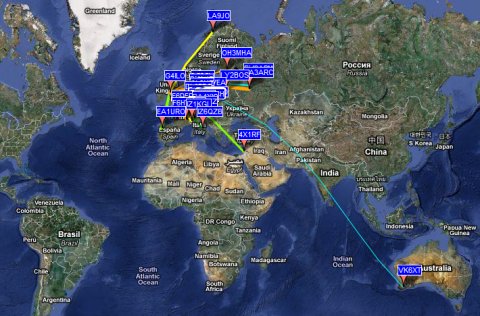
In this case, 5W of WSPR on 40m to a bent attic dipole. Not, perhaps, as impressive as M0XPD’s results with 50mW on 30m. But it’s still nice to be heard on the other side of the planet.

Julian Moss, G4ILO, is a regular contributor to AmateurRadio.com and writes from Cumbria, England. Contact him at [email protected].
Raytracing
Today we have a little bit of fun ham-related tinkering from work. This is two different frequencies transmitted from the same site.
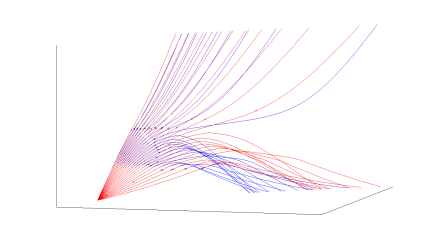
There are lots of neat details in a ray-trace: skip focusing, Pedersen rays, mode-splitting, … One thing that’s fun about writing your own models is that you can modify (intentionally or not) the model physics to do unphysical things…
The second run shows X and O modes for a single frequency and a failed attempt at modeling an MF signal into an E-F region duct. (The ducting, by the way, has nothing to do with my actual work. I was simulating it for ham purposes, although it helped me uncover a problem.) The signals do get to the duct, but they bend the wrong way. This has been fixed in the code, but it serves to remind that modelers have complete control. The background ionosphere is relatively unphysical in this one as well…
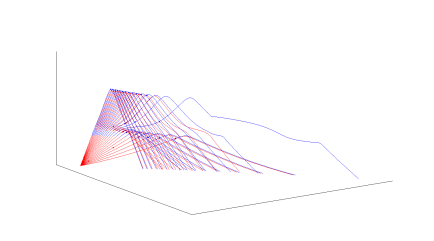
The raytrace code used above is small, simple, and written in MATLAB. I doubt that it will ever be released publicly, but if so I will note it here on the blog.
Ethan Miller, K8GU, is a regular contributor to AmateurRadio.com and writes from Maryland, USA. Contact him at [email protected].
A Follow-up to “New QSL card”
This is a follow-up to a post from Sunday.
On Wednesday night, Sarah handed me an envelope from the day’s mail that had the appearance of a QSL card. I took out my knife and opened it. It had a some sample QSL cards, along with a brochure inside. I scratched my head for a moment and concluded that I had just received my first QSL card for a blog post.
This curious turn of events brings me around to a couple of points. For those of you who don’t know, this blog is aggregated by AmateurRadio.com (and it is syndicated on my Facebook profile). My agreement with the owner of AmateurRadio.com is that he provides me with visibility in return for select content from my blog. The QSL printer who sent me the samples is one of his advertisers. Thanks, by the way! The cards were very beautiful and of high quality and I will consider him to print photo cards for my next DX operation. In full-disclosure, I received nothing from the printer who printed my cards in return for mentioning them. But, I should clarify that the blog is something I do for fun and I’m not really in the business of product endorsements.
A final point of clarification is that my beef with the available QSL cards was not so much the quality available, but amount of semi-relevant stuff hams try to cram onto the card. I guess if 10 meters ever opened up again regularly, we might start getting asked for our “Ten-Ten” numbers again. After listening to the V31BB clip about the secret decoder ring, I’m sort of ashamed to admit that I have one. Strike that from the card! The long and the short of the original post was that I wanted an uncluttered, distinctive card. And, I think I found it.
Ethan Miller, K8GU, is a regular contributor to AmateurRadio.com and writes from Maryland, USA. Contact him at [email protected].
Visitors Book Spam
I received two emails this morning from people who had received spam from someone who claimed to have got their profile from my website G4ILO’s Shack. I don’t have user profiles on my site. The only place the spammer could have got the email address is from the visitors’ book, and sure enough when I checked both these people had made entries in it.
The visitors book uses the common trick to obfuscate the email address of encrypting it and using a Javascript function to display it in the user’s browser. This worked on the assumption that spammers email harvesting bots simply grabbed the raw HTML pages and didn’t use an actual browser so the Javascript didn’t run and the email addresses remained hidden from the spammer.
I guess it was only a matter of time, given that computers are now much faster, before spammers started using embedded web browsers to load web pages before scanning them for email addresses. That is the only explanation I have for this. I have removed the display of the email address from the visitors book comments entirely, which should prevent this happening in future.
Some visitors ask questions or mention something interesting in their comments and I thought it would be useful for those who read them to be able to reply if they wish. But I doubt that many people take advantage of this so removing the email address is probably no great loss.

Julian Moss, G4ILO, is a regular contributor to AmateurRadio.com and writes from Cumbria, England. Contact him at [email protected].
Handiham World for 17 November 2010
Dr. Tom Linde, KZ0T, Silent Key

Dr. Tom Linde, KZ0T, long time Handiham member and volunteer, became a silent key on Monday 15 November 2010 at 1:30 AM. Tom died peacefully in his sleep at home with family members at his side.
As you might expect, Tom and I met each other through amateur radio. I’m not sure when Tom was first licensed, but his accomplishments in amateur radio were pretty amazing and included working all states on 6 meters, something I haven’t done and many of us will never do in our entire amateur radio careers. Yet Tom, whose speech was compromised by his disability, managed to train himself to speak the necessary amateur radio jargon and call signs clearly so that he could accomplish this feat. He made use of Morse code and always enjoyed the competitive and also the social aspects of amateur radio. When I started with the Handiham staff at Courage Center in 1992, it wasn’t long before Sister Alverna O’Laughlin, WA0SGJ, told me about “Dr. Tom”. He had been in Handihams since the late 1970s, and had made a name for himself on the amateur radio bands.
When I first met Dr. Tom, I had to listen up when he spoke. His CP made it difficult for him to form the words clearly, but he was never offended if I asked him to repeat something or say it in a different way so that I would understand. His accomplishments outside amateur radio included earning his PhD in psychology and having a full working life as a professional psychologist. Family was always important to Tom, and he raised his family in the heartland of Iowa with his wife Ann, who preceded him in death nine years ago.
I quickly learned from Tom that he was interested in helping others through the Handiham program. As a volunteer, he assisted at our radio camp sessions, teaching in operating skills so that he could share his experience with other Handiham members who had disabilities. He was also pretty darned good at inspiring those Handiham members who had trouble dealing with their disabilities. After all, as a psychologist he had heard every excuse in the book why the glass was half empty instead of half full, and he knew better from his own life experience. It was hard to complain that you couldn’t do something when Dr. Tom showed you by example that it could indeed be done and that even a severe disability would not stop you from reaching your goals.
Dr. Tom taught at a number of radio camps in both California and Minnesota. He joined the Stillwater Amateur Radio Association where he made many friends, and was active on the air, even trying new things like wheelchair mobile HF operation.
One of the most interesting things I have ever seen was not actually part of amateur radio at all. It was when Dr. Tom conducted the Minnesota Symphony Orchestra. Lyle Koehler, K0LR, built a robotic conducting system so that the members of the orchestra could see and follow flashing lights as Dr. Tom directed them. Tom was truly a renaissance man who loved music and art and would frequently catch you off guard with his wry and cerebral sense of humor. He published a book about his life that will carry on inspiring others to overcome their disabilities and accomplish their goals. “I Am Not What I Am: A Psychologist’s Memoir: Notes On Controlling and Managing Personal Misfortune” is available through Amazon.com in print and in spoken word audio from the Handiham system for our blind members. The ISBN-13 designation is: 978-1420867633. I strongly recommend this inspiring book.
His son Peter, N0EDI, in a touching tribute, remembers his father in his 80 years of life as all of these things:
A Son,
A Brother,
A Husband,
A Father,
A Grandfather,
A Student,
An Extra Class Ham Radio Operator,
A Ph.D. Psychologist,
A Published Author,
An Artist,
A Music Lover,
A Guest Conductor of the Minnesota Symphony Orchestra,
A Traveler,
A Teacher,
A man who pushed the boundaries of CP farther than anyone thought possible,
Ultimately, he was My Dad, without whom I would not be the person I am today.
Memorial services are currently being planned for Rapid City, SD and Sheboygan, WI. Tom, a generous spirit giving even in death, requested that his body be donated to help medical science. There will be a headstone in Knoxville, IA, next to his Wife (Ann) and youngest son (Matt), who preceded him in death.
We will miss the kind wisdom and positive outlook that KZ0T brought to Handihams and to the airwaves. I count myself privileged to have been his friend.
Patrick Tice, WA0TDA
Handiham System Manager

Pat Tice, WA0TDA, is the manager of HANDI-HAM and a regular contributor to AmateurRadio.com. Contact him at [email protected].
 Ham Radio Deluxe |
 W5SWL Electronics |
 Ham Radio Prep |
 KB3IFH QSL Cards  Hip Ham Shirts  HamRadioAuctions HamRadioAuctions Reliance Antennas Reliance Antennas Enigma Shop Enigma Shop |  morseDX  Ni4L Antennas  R&L Electronics R&L Electronics antennas.us antennas.us QRV QRV |
- Matt W1MST, Managing Editor
