 |
 FUNcube Dongle on eBay: Going, going…
 30 March 2011 | by
Are you trying to get your hands on one of those coveted FUNcube Dongle SDRs? Well, it looks like a healthy used market is already emerging on eBay. This seller started the bidding off at $175 — just about what he (or she) paid for it. But with only about 8 5 3 1 hour left to go, there are 4 7 9 10 bids and it’s already up to $217.58 $228.75 $255.51 $270.55! How high will it go? I’d argue that it’s still a terrific value even if it were priced higher.
A tidy little profit and surely a sign that demand for these little gems exceeds supply. There is big opportunity here. Hopefully Howard G6LVB and the good folks at FUNcube will be able to ramp up to meet this demand soon.
What about a US-based distributor? Would the dongle have to be type-accepted to be sold/marketed in the US? Maybe someone with more experience with these this could chime in….
Matt Thomas, W1MST, is the managing editor of AmateurRadio.com. Contact him at [email protected].
Chirp, chirp
I discovered some free radio memory management software this morning. Called CHIRP, which is presumably an acronym that ends with “Radio Programming”, it is a free, cross-platform, cross-radio programming tool that is being developed by Dan Smith, KK7DS. CHIRP works on Windows and Linux (and MacOSX with a little work, according to Dan). It supports a whole list of radios from manufacturers such as Alinco, Icom, Kenwood, Yaesu and Wouxun.
As the VX-8R is listed, I thought I’d give it a try with my VX-8GR. Unlike the excellent but non-free FTBVX8 software from G4HFQ, CHIRP doesn’t prompt you with the steps you need to perform on the radio. If you just connect the radio, load the software and start the download nothing will happen. With the VX-8R you must begin with the radio turned off, then after starting the download press and hold the F/W button on the side while turning the radio on. When CLONE appears on the display, press BAND. The download will then start and the program will display its progress. With other radios different steps will no doubt be needed. Hopefully at some point prompts will be incorporated into the software.
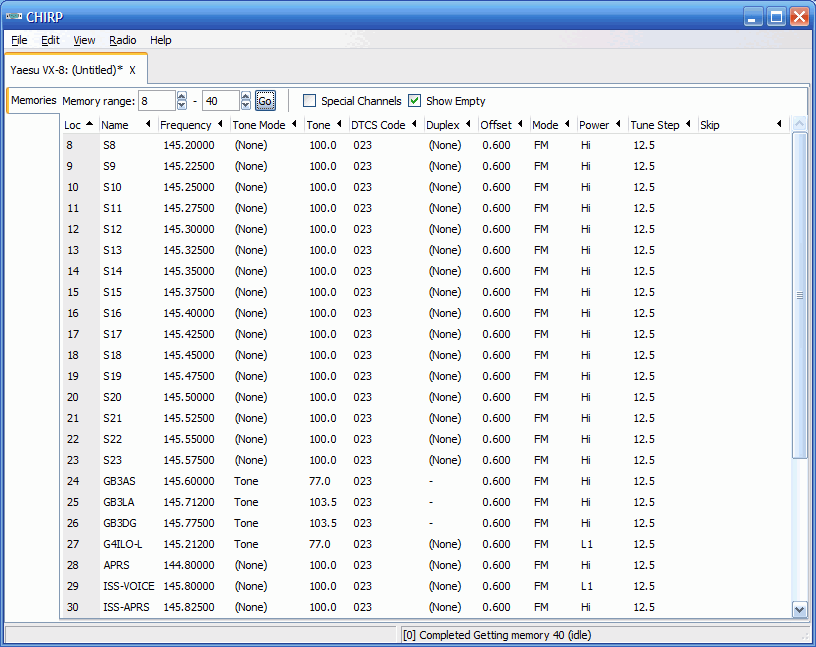
My first download attempt did not complete. Instead an error message appeared near the end. But I tried again. This time the memories were downloaded successfully and displayed in the program as you can see. The “cross-radio” part of the specification means, presumably, that memories are saved in a unified format so you can download them from one radio and upload them to a different one.
I didn’t try uploading to the radio. I have heard of people bricking radios by using software that wrote unexpected stuff and I’d already seen one error message. Besides, I have the FTBVX8 software and I didn’t have any changes I wanted to make anyway. But if you don’t want to pay for memory management software, you want to maintain one memory file and upload it to multiple different radios or you want a program that will run on Linux or Mac OS, CHIRP is a development that’s worth keeping an eye on.

Julian Moss, G4ILO, is a regular contributor to AmateurRadio.com and writes from Cumbria, England. Contact him at [email protected].
The RSGB
Details are yet to emerge about the nature of the misconduct that led to the dismissal of the RSGB’s General Manager Peter Kirby. However in one or two blogs and forums it is already being suggested that this should be an opportunity for root and branch change at the RSGB, a chance to get rid of the “old school tie brigade.” I don’t agree.
I may be an old fart now, but when I first joined the RSGB back in 1973 I was 20 years old and it was an even more traditional organization than than it is today. Most of the officers held two-letter calls that indicated they had been licensed since before the war. Radio Communication (it was years until it became the more trendy RadCom) had more of the air of a professional electronics journal. But did I feel that the RSGB was an old boys’ club that should be run by more know-nothing-but-think-they-know-it-all youngsters like me? Did I write letters asking for Radio Communication to be dumbed down to make it more understandable to newcomers? No I didn’t. The RSGB did have a bit of an air of being an elite group, but I was proud that it now included me. And instead of grumbling that the contents of Radio Communication were over my head I aspired to understand what was then a mystery. Unlike other radio services ham radio is a hobby with a long tradition and that is one of the things that is reflected by the RSGB.
I never attended an RSGB annual general meeting. But when these were held they were usually followed by a “black tie” dinner. I’ve seen Big Issue sellers more smartly attired than the average radio rally attendee and I have often wondered if these formal dinners were part of the same hobby. But the fact that I had no desire to attend such functions did not mean I felt they should not occur, or that the people who attended them could not possibly represent the interests of people like me.
I think the RSGB has done quite a good job so far, especially considering the differing and often conflicting demands of its members. Britain was one of the first countries to drop the Morse proficiency requirement and to introduce a licensing scheme that made it easy for the very young and those with limited technical knowledge to enter the hobby. These are hardly the actions of an RSGB dedicated to maintaining the status quo, to resisting change, to keeping ham radio an elite club of people who know code and understand circuit diagrams.
I don’t think the misdemeanours of one salaried officer should be allowed to overshadow that achievement. One bad apple doesn’t mean you must cut down the entire tree. We live in an egalitarian age where everyone’s opinion counts and it seems that many want an RSGB run by people like them. I just wonder where that would lead. If you look at history, the times when Britain was great was when it was run by leaders who were in their 60s and 70s. Now the country is run by political careerists in their 40s and 50s and look at the mess we’re in. We need an RSGB that can shape the future of the hobby but still respect the the past.

Julian Moss, G4ILO, is a regular contributor to AmateurRadio.com and writes from Cumbria, England. Contact him at [email protected].
LHS Episode #059: Orca and Outtakes
 Welcome to Episode #059 of Linux in the Ham Shack. On this edition, we talk with Jonathan Nadeau of Frostbite Systems about Linux for the sight impaired. Jonathan, being a blind Linux user, has overcome many challenges when it comes to using his favorite operating system and he shares with us the ins and outs of accessibility on Linux systems. There is a Linux distribution dedicated to blind users called Vinux, along with an accessible version of Arch called Talking Arch. Even newer versions of Slackware are jumping on the bandwagon with a Speakup enabled installation kernel.
This is also the first episode of LHS with a blooper reel left in at the end. Listen all the way to the last so you don’t miss out on any of the fun. Many thanks to Jonathan for his time and expertise, and many thanks to our listeners for making our show so fun to do.
73 de The LHS Guys
Russ Woodman, K5TUX, co-hosts the Linux in the Ham Shack podcast which is available for download in both MP3 and OGG audio format. Contact him at [email protected].
How To Save VHF and UHF Bands in the New World of Wireless
Here in the US, proposed legislation HR 607 recently made headlines as the latest amateur radio band threat, with a bid to reallocate the 70 cm band in the next ten years. ARRL is opposing the legislation on the basis that it would reallocate currently non-commercial spectrum to commercial interests.
On the surface ARRL’s claim is valid. But eventually this approach is going to fall on deaf ears at the FCC and in Congress. Commercial interests holding bands is not inherently evil. But in this current “pro-business” climate, the value of resources are increasing being judged more by revenue potential than benefits to a subset of citizens. Sadly, the “bang-to-buck” ratio that the FCC is getting by continuing to allow amateur radio to use this prime real estate band is abysmal. While the 70 cm band does have numerous repeaters across the US, it seems that in many areas the band is just dead or serves as a life support system for 2m repeater links or cross band repeaters that would otherwise be dead if it weren’t for 2 meters. Even worse, the 2 meter repeaters being linked are often dead as well, other than weekly ARES/RACES nets and the occasional kerchunker.
Since amateur radio can’t generate revenue from spectrum, the default benefit of amateur radio having the spectrum is public service. But when public service is used as a justification for keeping a band allocated to amateur radio, that argument can be easily turned around against amateur radio in the situation of 440 and HR 607. If the band is used for true public service in amateur radio perhaps only one or two times per year per one hundred square miles, and a competing use such as a mobile network in which the general public and public safety agencies can use it continually and use every last hertz, the amateur radio public service argument falls apart. The public overwhelming gets more service from the band in the hands of mobile wireless carriers than amateur radio.
What’s the solution? While mobile wireless networks are spectrum hogs, such technologies today can squeeze 2 or 3 bits per spectrum hertz of data transmission with complex modulation techniques, extensive frequency reuse, and “smart” antennas. Amateur radio needs to upgrade its technology to squeeze more information into the spectrum and use it to transmit information of value. Amateur radio needs to give up on classic single-carrier FM analog repeaters as a mainstay of VHF and UHF communications and migrate to wideband spread-spectrum digital modes and repeaters that carry both voice and data. To some extent this needs to mimic mobile wireless networks, but in an affordable lower tech and “open software” manner. Initially D-STAR comes to mind, but it’s like climbing a tree to get to the moon. It’s still a narrowband mode that can carry only a meager amount of data and lacks the complexity needed in its protocol for technological growth.
The new technology needs to be paired with a decentralized and open messaging system that connects with the Internet and is inter-operable directly with existing messaging standards. This would enable the creation of a true resilient 21st century messaging network, one that would come closer to having the capacity and speed necessary to provide public service benefits in the event of a disaster that would cripple mobile wireless and landline networks.
ARRL and other organizations worldwide need to develop a plan for such a technology and network, get support from manufacturers for low cost hardware, and build a development community around it. There needs to be a road map to show regulatory agencies where we’re going, not where we have been. This is what will save our valuable bands in the new world of wireless.
Stealth operation
One of the problems with operating in the evening is that on most HF bands even a few watts of RF is enough to turn on the neighbours’ security lights. So there is an extra incentive to work QRP. This evening I tried JT65A at 2W on 30m, then moved to 20m with 5W. This map shows where my QRP signals were received.
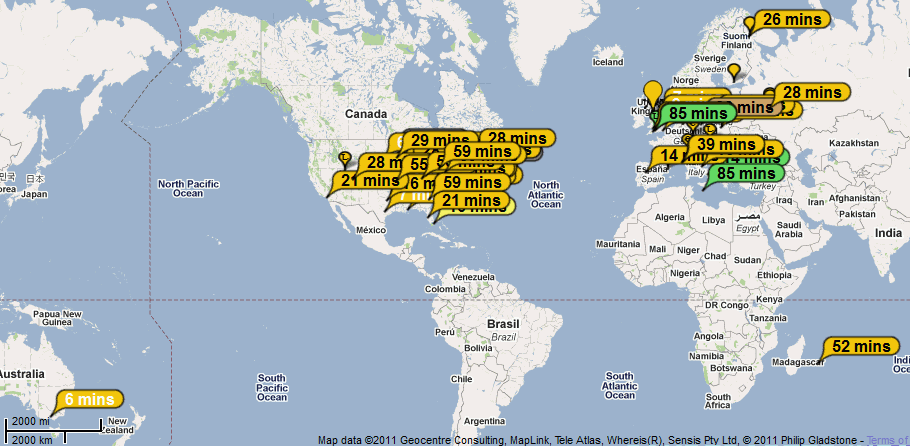
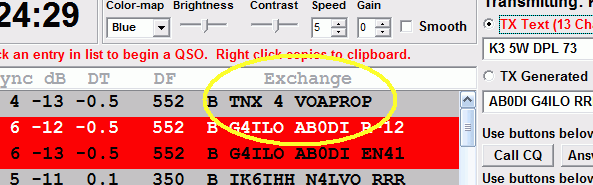
The antenna on 20m was the multiband attic dipole. Stations worked included K3AXR (FM28), KF4NX (EM83), AB0DI (EN41), VA3WLD (FN03) and KD2A (FN13). By the way, whoever said JT65A is not a chat mode!

Julian Moss, G4ILO, is a regular contributor to AmateurRadio.com and writes from Cumbria, England. Contact him at [email protected].
RSGB news
The Board of the RSGB has today released the following announcement:
Peter Kirby, RSGB General Manager, has left the Society’s employment after the discovery of financial irregularities on his part.
For the time being, RSGB Director Don Beattie, G3BJ, will act as General Manager.
At this difficult time for the Society can I ask that everyone supports Don in his role. He may be contacted at Don.Beattie at rsgb.org.uk or 01234 832 701/07802 922 219.
Dave Wilson
President
28 March 2011
Further comment from me would be inappropriate until we know the nature of the financial irregularities. But to say the news comes as a shock would be an understatement. I have been an RSGB member for nearly 40 years, barring a few years in the 1990s when I was inactive in the hobby. The Society will never please everybody and it has done a few things I don’t agree with but I think all things considered it does a pretty good job. I hope it will survive this crisis.

Julian Moss, G4ILO, is a regular contributor to AmateurRadio.com and writes from Cumbria, England. Contact him at [email protected].
 Ham Radio Deluxe |
 W5SWL Electronics |
 Ham Radio Prep |
 KB3IFH QSL Cards  Hip Ham Shirts  HamRadioAuctions HamRadioAuctions Reliance Antennas Reliance Antennas Enigma Shop Enigma Shop |  morseDX  Ni4L Antennas  R&L Electronics R&L Electronics antennas.us antennas.us QRV QRV |
- Matt W1MST, Managing Editor
