 |
 Handiham World for 30 March 2011
 30 March 2011 | by
 Welcome to Handiham World!
Troubleshooting 101 continued: “My antenna is generating electricity and giving me shocks!”
Recap: Last week we presented the following scenario and invited comments:
We are going back in time to when I worked at an antenna company, a job that often involved talking directly to customers on the phone. I would answer questions and make suggestions about installation and troubleshooting. One fine day we got a call from a fellow who had installed one of our vertical antennas. He had ground mounted it, carefully following the instructions in the manual. This antenna came with an aluminum mounting post that was dug into the ground and usually secured with a bag of do-it-yourself concrete mix. A fiberglass dowel in the exposed end of the mounting post served as an insulator and supported the vertical element of the antenna. The center conductor of an included length of a matching section of 75 Ohm coaxial cable was connected with a stainless steel bolt to the main radiating element and the braid was connected to another stainless bolt on the grounded mounting post as well as to a ground rod within inches of the antenna base. The customer had to supply the remaining run of 50 Ohm coax from the ham shack out to the antenna and connect it to the already installed matching section with a barrel connector. When the customer called us, he complained that his antenna was generating electricity and giving him shocks. He noticed this as he was trying to connect the two pieces of coax together.
Can you guess what was wrong and suggest what questions I might have asked the customer to verify my theory? For bonus points, what did I have to tell him to resolve the problem?
I got some good comments back from you, so it’s time to share your brilliance in troubleshooting with our readers and listeners:
| From Tom, WA6IVG: Unless he’d driven the antenna’s mounting rod into a buried power cable, (unlikely) the problem just about has to be bad station ground. Ask exactly what the coax run is connected to, and how said equipment is grounded. If the station isn’t closely connected, with heavy wire or braid, to the electrical service ground, or better yet to a separate ground rod and said service ground, then that’s what to do. Also check that power main connections are two standard 3 prong grounded outlet boxes. In a totally desperate situation, of 2 prong power, maybe reversing 2 prong cords could provide a temporary, unorthodox solution but bad idea. If all is claimed to be as it should be, then his station and antenna must be on 2 different continents. | |
| From Mike, KJ6CBW: The customer was getting shocked when connecting the long run of coax to the 75-ohm run from the ground-mounted vertical that has its coax braid connected to ground rods. The two coax cables are at different ground potentials. I think the most likely cause is that the station is not grounded because the power line isn’t grounded or a 2-wire plug is being used where a 3-wire plug is appropriate. Another possibility it that the ground rods at the antenna intercepted a buried telephone line or cable-company cable, which make the antenna ground different from that of the long coax. Please don’t shoot me, I’m new at this. ..! | |
| And fasten your seatbelt for this one from Kevin, [formerly: N1PKE ]: I have been pondering your *Troubleshooting 101, query, supra, and have attempted to extrapolate a scenario that would lead to such a conclusion as that of getting poked with an electrical current while I was hooking-up my antenna feed-line connections; wherein initially, I would cast basic common-sense to the literal wind, and just to make sure that things were to be a little more interesting, I would wait until the middle of the frigid winter season, for a night when there was very little light and there was then, e.g., currently, a frozen sleet / snow storm with full-gale winds occurring; just to make sure that Mr. Murphy would have all of the available advantages to be had, at his disposal; oh, and I would purposely plug-in and turn-on, e.g., charge my electrical circuitry with an electrical current, just to make sure that if anything went horribly wrong, that it would be the last time that I would ever have to address such a problematic situation. After all, why would I want to abrasively clean-up & ‘tin’ any of my integral and important electrical connections? I simply would refuse to apply any dielectric dope-grease and/or silicon caulk to any of my in-line electrical components and/or fixtures; and, as a matter of establishing a ground, I would first, have several-hundred yards of my fertile, composted soil removed, and then replaced with several hundred yards of coarse beach sand, just to make sure that I had an earthen environment that promoted instability of antenna constructive support and near zero ohms of conductivity. In this way, I would have assured myself, of having an almost completely isolated radiating antenna element, that I could then have used to have my soaked, limpid corpse hung-up on, as an object lesson for folks whom mistakenly believed that incessant adherence to safety considerations were foolhardy ruminations to be utilized by keenly sensitive brainiacs, wherein, I would think that I would in the future, be included in a list of: “DO NOT TRY THIS AT HOME or ANYWHERE ELSE Listings”, those listed, right next and/or near to, my newspaper obituary listing! I think I got it right? |
Wow, those are all great comments. Of course the antenna didn’t “generate” electricity. Our wise readers and listeners know that the difference in potential exists when all pieces of equipment in the station and out at the antenna are not at the same ground potential. One of the first questions I asked the customer (knowing about the possibility of that ground potential problem) was whether he had unplugged the station equipment in the ham shack from the AC power mains. He had not, and because the station was not properly grounded, there was a potentially dangerous voltage difference between the plugged-in radio and the grounded antenna. I felt that he was lucky not to have been electrocuted! Kevin’s “Do not try this at home” applies here for sure. Always disconnect equipment from the AC mains before doing any service on your antennas and feedlines. This is especially important to remember as we get warmer weather and our thoughts turn toward doing some of that antenna work we have been putting off during the cold winter months. And I mustn’t forget: Although I do ground my station equipment, I never trust the ground to protect me. I always disconnect the power before working on the antenna system, because I know that a grounding system might fail. There is no sense taking unnecessary risks when you are working around any kind of electrical equipment.
Another thought that was brought up is the possibility of a ground rod hitting a buried power cable. The way to avoid that problem is to be sure that your antenna site is clear of underground utilities. Find out from your utility company what number to call to set up a free inspection and marking of your property so that you will know where underground lines are buried. Here in my area we have a single number to call and they send out a worker to mark underground lines like gas and electric with spray paint right on the ground over the lines. “Gopher State One Call” is our system, but you will have a similar service in your area. Be aware, though, that such services will not let you know about things like the location of underground lawn sprinkling systems that are not part of the utility system.
Since the antenna in question was a vertical, one has to be especially careful assembling it on the ground and then swinging it up into place on the mounting post. You have yourself a 26 foot long aluminum stick and you are holding it with both hands, so you most definitely do not want to swing it up into a power line! Since my caller was in fact alive to call and tell me that his antenna was “generating electricity”, I pretty much assumed that he didn’t make that particular mistake. Direct contact with even a household power line in such a situation is often deadly because the current will flow from power line to antenna through the victim’s arms and through the chest cavity, where it will likely cause the heart to stop or go into arrhythmia.
Anyway, when you are answering customer complaints like this one, the most likely cause usually turns out to be the right one. He had indeed left the rig plugged into the AC mains and was getting a shock because of some fault in his equipment or station ground.
Stay safe and out of the obituaries!

Pat Tice, WA0TDA, is the manager of HANDI-HAM and a regular contributor to AmateurRadio.com. Contact him at [email protected].
Handiham World for 30 March 2011
Welcome to Handiham World!
Troubleshooting 101 continued: “My antenna is generating electricity and giving me shocks!”
Recap: Last week we presented the following scenario and invited comments:
We are going back in time to when I worked at an antenna company, a job that often involved talking directly to customers on the phone. I would answer questions and make suggestions about installation and troubleshooting. One fine day we got a call from a fellow who had installed one of our vertical antennas. He had ground mounted it, carefully following the instructions in the manual. This antenna came with an aluminum mounting post that was dug into the ground and usually secured with a bag of do-it-yourself concrete mix. A fiberglass dowel in the exposed end of the mounting post served as an insulator and supported the vertical element of the antenna. The center conductor of an included length of a matching section of 75 Ohm coaxial cable was connected with a stainless steel bolt to the main radiating element and the braid was connected to another stainless bolt on the grounded mounting post as well as to a ground rod within inches of the antenna base. The customer had to supply the remaining run of 50 Ohm coax from the ham shack out to the antenna and connect it to the already installed matching section with a barrel connector. When the customer called us, he complained that his antenna was generating electricity and giving him shocks. He noticed this as he was trying to connect the two pieces of coax together.
Can you guess what was wrong and suggest what questions I might have asked the customer to verify my theory? For bonus points, what did I have to tell him to resolve the problem?
I got some good comments back from you, so it’s time to share your brilliance in troubleshooting with our readers and listeners:
| From Tom, WA6IVG: Unless he’d driven the antenna’s mounting rod into a buried power cable, (unlikely) the problem just about has to be bad station ground. Ask exactly what the coax run is connected to, and how said equipment is grounded. If the station isn’t closely connected, with heavy wire or braid, to the electrical service ground, or better yet to a separate ground rod and said service ground, then that’s what to do. Also check that power main connections are two standard 3 prong grounded outlet boxes. In a totally desperate situation, of 2 prong power, maybe reversing 2 prong cords could provide a temporary, unorthodox solution but bad idea. If all is claimed to be as it should be, then his station and antenna must be on 2 different continents. | |
| From Mike, KJ6CBW: The customer was getting shocked when connecting the long run of coax to the 75-ohm run from the ground-mounted vertical that has its coax braid connected to ground rods. The two coax cables are at different ground potentials. I think the most likely cause is that the station is not grounded because the power line isn’t grounded or a 2-wire plug is being used where a 3-wire plug is appropriate. Another possibility it that the ground rods at the antenna intercepted a buried telephone line or cable-company cable, which make the antenna ground different from that of the long coax. Please don’t shoot me, I’m new at this. ..! | |
| And fasten your seatbelt for this one from Kevin, [formerly: N1PKE ]: I have been pondering your *Troubleshooting 101, query, supra, and have attempted to extrapolate a scenario that would lead to such a conclusion as that of getting poked with an electrical current while I was hooking-up my antenna feed-line connections; wherein initially, I would cast basic common-sense to the literal wind, and just to make sure that things were to be a little more interesting, I would wait until the middle of the frigid winter season, for a night when there was very little light and there was then, e.g., currently, a frozen sleet / snow storm with full-gale winds occurring; just to make sure that Mr. Murphy would have all of the available advantages to be had, at his disposal; oh, and I would purposely plug-in and turn-on, e.g., charge my electrical circuitry with an electrical current, just to make sure that if anything went horribly wrong, that it would be the last time that I would ever have to address such a problematic situation. After all, why would I want to abrasively clean-up & ‘tin’ any of my integral and important electrical connections? I simply would refuse to apply any dielectric dope-grease and/or silicon caulk to any of my in-line electrical components and/or fixtures; and, as a matter of establishing a ground, I would first, have several-hundred yards of my fertile, composted soil removed, and then replaced with several hundred yards of coarse beach sand, just to make sure that I had an earthen environment that promoted instability of antenna constructive support and near zero ohms of conductivity. In this way, I would have assured myself, of having an almost completely isolated radiating antenna element, that I could then have used to have my soaked, limpid corpse hung-up on, as an object lesson for folks whom mistakenly believed that incessant adherence to safety considerations were foolhardy ruminations to be utilized by keenly sensitive brainiacs, wherein, I would think that I would in the future, be included in a list of: “DO NOT TRY THIS AT HOME or ANYWHERE ELSE Listings”, those listed, right next and/or near to, my newspaper obituary listing! I think I got it right? |
Wow, those are all great comments. Of course the antenna didn’t “generate” electricity. Our wise readers and listeners know that the difference in potential exists when all pieces of equipment in the station and out at the antenna are not at the same ground potential. One of the first questions I asked the customer (knowing about the possibility of that ground potential problem) was whether he had unplugged the station equipment in the ham shack from the AC power mains. He had not, and because the station was not properly grounded, there was a potentially dangerous voltage difference between the plugged-in radio and the grounded antenna. I felt that he was lucky not to have been electrocuted! Kevin’s “Do not try this at home” applies here for sure. Always disconnect equipment from the AC mains before doing any service on your antennas and feedlines. This is especially important to remember as we get warmer weather and our thoughts turn toward doing some of that antenna work we have been putting off during the cold winter months. And I mustn’t forget: Although I do ground my station equipment, I never trust the ground to protect me. I always disconnect the power before working on the antenna system, because I know that a grounding system might fail. There is no sense taking unnecessary risks when you are working around any kind of electrical equipment.
Another thought that was brought up is the possibility of a ground rod hitting a buried power cable. The way to avoid that problem is to be sure that your antenna site is clear of underground utilities. Find out from your utility company what number to call to set up a free inspection and marking of your property so that you will know where underground lines are buried. Here in my area we have a single number to call and they send out a worker to mark underground lines like gas and electric with spray paint right on the ground over the lines. “Gopher State One Call” is our system, but you will have a similar service in your area. Be aware, though, that such services will not let you know about things like the location of underground lawn sprinkling systems that are not part of the utility system.
Since the antenna in question was a vertical, one has to be especially careful assembling it on the ground and then swinging it up into place on the mounting post. You have yourself a 26 foot long aluminum stick and you are holding it with both hands, so you most definitely do not want to swing it up into a power line! Since my caller was in fact alive to call and tell me that his antenna was “generating electricity”, I pretty much assumed that he didn’t make that particular mistake. Direct contact with even a household power line in such a situation is often deadly because the current will flow from power line to antenna through the victim’s arms and through the chest cavity, where it will likely cause the heart to stop or go into arrhythmia.
Anyway, when you are answering customer complaints like this one, the most likely cause usually turns out to be the right one. He had indeed left the rig plugged into the AC mains and was getting a shock because of some fault in his equipment or station ground.
Stay safe and out of the obituaries!
Pat Tice, WA0TDA, is the manager of HANDI-HAM and a regular contributor to AmateurRadio.com. Contact him at [email protected].
LHS Show Notes #059
Introduction:
- Apologies for the delays in releasing new episodes.
- This episode is an interview with Jonathan Nadeau of Frostbite Systems and a user of the Linux screen-reading program, Orca.
Interview:
- Orca is a screen reading program integrated with the Gnome desktop. It’s available for most Linux distributions.
- Russ and Jonathan discuss how a sight-impaired individual might install Linux. There are a couple of Linux distributions that have screen-reader support during the installation: Talking Arch Linux and Vinux.
- Speakup is another accessibility tool, but one that speaks the command line.
- Vinux is an Ubuntu-based Linux distribution with Orca built-in, allowing a sight-impaired individual to install it from the CD. Vinux is the distribtion Frostbite Systems normally installs for it’s sight-impaired customers.
- Slackware has a Speakup kernel, and more distributions are including the Speakup module as well. Several distributions can be installed using Speakup. Some instructions are available at the Speakup site.
- Russ mentioned the Quick Learning Techies Show (QLTS) that also occasionally discusses accessibility issues.
- Jonathan discusses the pros and cons of Vinux, as well as his concerns about it being Ubuntu-based.
- Richard asks Jonathan for more details about how Vinux talks a new user through the install.
- If the application is GTK-based, it will likely work with Orca; if it’s QT-based, it probably won’t work with Orca.
- Ted’s software (WA0EIR), including PSK31LX, works via ssh, so the programs are controllable from the command line and would work with the Speakup module.
- Meanwhile, Russ attempts to install Orca during the show.
- Jonathan mentions another podcast he does, This Week in Fedora, and says there is an amateur radio Fedora spin. (I could not find a link to a specific spin of Fedora for amateur radio, but there is a Special Interest Group. -Ed.)
- Frostbite Systems sells desktops and laptops with Linux pre-installed. Customers can choose from Debian, Fedora, Linux Mint, OpenSuse, Ubuntu and Vinux. A portion of each sale is donated back to the distribution chosen.
- Russ asks Jonathan about the hardware he uses in Frostbite systems. All of the laptops/notebooks have all-Intel hardware, while some desktops have nVidia video cards. All are completely Linux-compatible.
- Russ then examines the specifications of some of the Frostbite computers.
- Jonathan also produces several podcasts through Frostbite Media:
- Frostcast: interviews with project leaders of various GNU/Linux and Free/Open Source projects.
- This week in Fedora: interviews with people involved with the Fedora project.
- This week in Debian: interviews with people within the Debian community.
- Orcacast is on hiatus, but should resume in the not too distant future.
Contact Info:
- Contact Richard at [email protected], Russ at [email protected], or both at the same time at [email protected].
- Listen to the live stream every other Tuesday at 8:00pm Central time. Check the LHS web site for dates.
- Leave us a voice mail at 417-200-4811, or record an introduction to the podcast.
- Sign up for the LHS mailing list.
- Sign up for the MAGNetcon mailing list.
- LHS merchandise is available at the SHOP! link on Web site. Check out the Badgerwear or buy one of the other LHS-branded items at PrintFection.com/lhs or Cafe Press. Thanks!
- Thanks to Dave from Gamma Leonis for the theme music.
Outtakes:
Russ Woodman, K5TUX, co-hosts the Linux in the Ham Shack podcast which is available for download in both MP3 and OGG audio format. Contact him at [email protected].
FUNcube Dongle on eBay: Going, going…

Are you trying to get your hands on one of those coveted FUNcube Dongle SDRs? Well, it looks like a healthy used market is already emerging on eBay. This seller started the bidding off at $175 — just about what he (or she) paid for it. But with only about 8 5 3 1 hour left to go, there are 4 7 9 10 bids and it’s already up to $217.58 $228.75 $255.51 $270.55! How high will it go? I’d argue that it’s still a terrific value even if it were priced higher.
A tidy little profit and surely a sign that demand for these little gems exceeds supply. There is big opportunity here. Hopefully Howard G6LVB and the good folks at FUNcube will be able to ramp up to meet this demand soon.
What about a US-based distributor? Would the dongle have to be type-accepted to be sold/marketed in the US? Maybe someone with more experience with these this could chime in….
Matt Thomas, W1MST, is the managing editor of AmateurRadio.com. Contact him at [email protected].
Chirp, chirp
I discovered some free radio memory management software this morning. Called CHIRP, which is presumably an acronym that ends with “Radio Programming”, it is a free, cross-platform, cross-radio programming tool that is being developed by Dan Smith, KK7DS. CHIRP works on Windows and Linux (and MacOSX with a little work, according to Dan). It supports a whole list of radios from manufacturers such as Alinco, Icom, Kenwood, Yaesu and Wouxun.
As the VX-8R is listed, I thought I’d give it a try with my VX-8GR. Unlike the excellent but non-free FTBVX8 software from G4HFQ, CHIRP doesn’t prompt you with the steps you need to perform on the radio. If you just connect the radio, load the software and start the download nothing will happen. With the VX-8R you must begin with the radio turned off, then after starting the download press and hold the F/W button on the side while turning the radio on. When CLONE appears on the display, press BAND. The download will then start and the program will display its progress. With other radios different steps will no doubt be needed. Hopefully at some point prompts will be incorporated into the software.
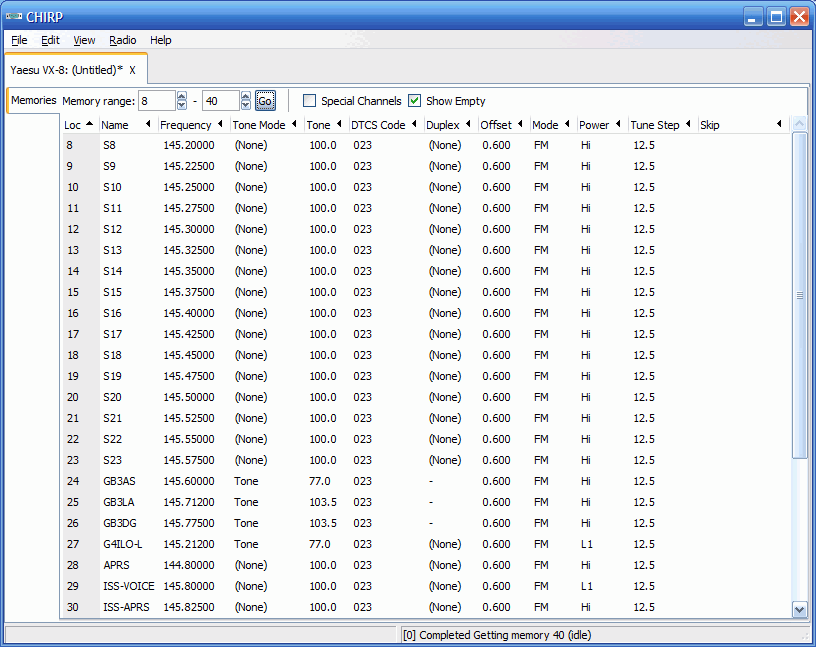
My first download attempt did not complete. Instead an error message appeared near the end. But I tried again. This time the memories were downloaded successfully and displayed in the program as you can see. The “cross-radio” part of the specification means, presumably, that memories are saved in a unified format so you can download them from one radio and upload them to a different one.
I didn’t try uploading to the radio. I have heard of people bricking radios by using software that wrote unexpected stuff and I’d already seen one error message. Besides, I have the FTBVX8 software and I didn’t have any changes I wanted to make anyway. But if you don’t want to pay for memory management software, you want to maintain one memory file and upload it to multiple different radios or you want a program that will run on Linux or Mac OS, CHIRP is a development that’s worth keeping an eye on.

Julian Moss, G4ILO, is a regular contributor to AmateurRadio.com and writes from Cumbria, England. Contact him at [email protected].
The RSGB
Details are yet to emerge about the nature of the misconduct that led to the dismissal of the RSGB’s General Manager Peter Kirby. However in one or two blogs and forums it is already being suggested that this should be an opportunity for root and branch change at the RSGB, a chance to get rid of the “old school tie brigade.” I don’t agree.
I may be an old fart now, but when I first joined the RSGB back in 1973 I was 20 years old and it was an even more traditional organization than than it is today. Most of the officers held two-letter calls that indicated they had been licensed since before the war. Radio Communication (it was years until it became the more trendy RadCom) had more of the air of a professional electronics journal. But did I feel that the RSGB was an old boys’ club that should be run by more know-nothing-but-think-they-know-it-all youngsters like me? Did I write letters asking for Radio Communication to be dumbed down to make it more understandable to newcomers? No I didn’t. The RSGB did have a bit of an air of being an elite group, but I was proud that it now included me. And instead of grumbling that the contents of Radio Communication were over my head I aspired to understand what was then a mystery. Unlike other radio services ham radio is a hobby with a long tradition and that is one of the things that is reflected by the RSGB.
I never attended an RSGB annual general meeting. But when these were held they were usually followed by a “black tie” dinner. I’ve seen Big Issue sellers more smartly attired than the average radio rally attendee and I have often wondered if these formal dinners were part of the same hobby. But the fact that I had no desire to attend such functions did not mean I felt they should not occur, or that the people who attended them could not possibly represent the interests of people like me.
I think the RSGB has done quite a good job so far, especially considering the differing and often conflicting demands of its members. Britain was one of the first countries to drop the Morse proficiency requirement and to introduce a licensing scheme that made it easy for the very young and those with limited technical knowledge to enter the hobby. These are hardly the actions of an RSGB dedicated to maintaining the status quo, to resisting change, to keeping ham radio an elite club of people who know code and understand circuit diagrams.
I don’t think the misdemeanours of one salaried officer should be allowed to overshadow that achievement. One bad apple doesn’t mean you must cut down the entire tree. We live in an egalitarian age where everyone’s opinion counts and it seems that many want an RSGB run by people like them. I just wonder where that would lead. If you look at history, the times when Britain was great was when it was run by leaders who were in their 60s and 70s. Now the country is run by political careerists in their 40s and 50s and look at the mess we’re in. We need an RSGB that can shape the future of the hobby but still respect the the past.

Julian Moss, G4ILO, is a regular contributor to AmateurRadio.com and writes from Cumbria, England. Contact him at [email protected].
LHS Episode #059: Orca and Outtakes
 Welcome to Episode #059 of Linux in the Ham Shack. On this edition, we talk with Jonathan Nadeau of Frostbite Systems about Linux for the sight impaired. Jonathan, being a blind Linux user, has overcome many challenges when it comes to using his favorite operating system and he shares with us the ins and outs of accessibility on Linux systems. There is a Linux distribution dedicated to blind users called Vinux, along with an accessible version of Arch called Talking Arch. Even newer versions of Slackware are jumping on the bandwagon with a Speakup enabled installation kernel.
This is also the first episode of LHS with a blooper reel left in at the end. Listen all the way to the last so you don’t miss out on any of the fun. Many thanks to Jonathan for his time and expertise, and many thanks to our listeners for making our show so fun to do.
73 de The LHS Guys
Russ Woodman, K5TUX, co-hosts the Linux in the Ham Shack podcast which is available for download in both MP3 and OGG audio format. Contact him at [email protected].
 Ham Radio Deluxe |
 W5SWL Electronics |
 Ham Radio Prep |
 KB3IFH QSL Cards  Hip Ham Shirts  HamRadioAuctions HamRadioAuctions Reliance Antennas Reliance Antennas Enigma Shop Enigma Shop |  morseDX  Ni4L Antennas  R&L Electronics R&L Electronics antennas.us antennas.us QRV QRV |
- Matt W1MST, Managing Editor
