 |
 The 435 Machine
 18 April 2011 | by
 Los Angeles, California USA
Contains adult language and adult themes
(Press play button to listen)
I was looking through the online scanner feeds available on RadioReference.com and found a list of the Top 50 Audio Feeds. Most of the large police departments can have quite a few listeners at one time, sometimes approaching a couple hundred listeners.
The single Amateur Radio repeater on the list caught my eye: the KE6RRI 147.435MHz repeater located near Los Angeles. The feed had 120 listeners which is pretty amazing for a ham repeater (for comparison, Chicago Fire Dept. had 40 and Las Vegas PD had 39 at the time). There was obviously something going on here that was attracting attention. So, of course, I tuned in.
Well, it’s quite the experience. Let’s just say that the conversations are colorful.
 I remember as a newly licensed teenager that I was super-paranoid about following the rules. I’d stay well clear of the band edges for fear my signal might bleed over due to some malfunction. If the FCC said that I had to identify every ten minutes, I’d make sure to do it every five. Like Christian Slater’s character in the pirate radio movie Pump Up The Volume — I imagined those yellow vans conspicuously marked “F.C.C.” circling the neighborhood just waiting for the most minor of infractions as their signal to move in. Apparently, after spending a little time listening to the 435 repeater online, the folks on this machine don’t seem to worry too much about that.
There are two interesting interview segments worth listening to on The RAIN Report where Hap Holly, KC9RP, interviews Christina Holzschuh, KE6RRI, the current owner of the repeater: Part 1 Part 1 (14 min.) Part 2 Part 2 (14 min.)
Matt Thomas, W1MST, is the managing editor of AmateurRadio.com. Contact him at [email protected].
Another Blog
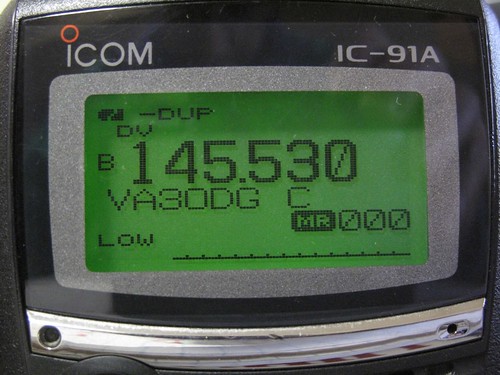
Recently, I have created a second blog for D-STAR radio, particularly in the Ottawa area.
You can find it at http://dstarottawa.wordpress.com/ The focus is on D-STAR operations in the National Capital Region and activities of the Ottawa Amateur Radio Digital Group.
My personal blog here continues to be my main blog.


Alan Steele, VA3STL, is a regular contributor to AmateurRadio.com and writes from Ottawa, Ontario. Contact him at [email protected].
SOTA Activation Attempt #2

Trail up to the site

One of the two towers near the site. This is an old firetower now used by Carbon County, PA. The cabin at the top was removed.

The other tower at the site owned by State of Pennsylvania. Well built, though a bit bland by radio artisan standards.

A neat spot on a rocky peak about a mile away from the SOTA summit


Time to ditch Dimension 4
Digital modes such as WSPR and JT65A are time-synchronous and require the computer clock to be accurate to within a second. New users frequently don’t realize this and find that they aren’t decoding any signals. When they go to a forum for advice they are inevitably advised by well-meaning helpers to run a bit of software called Dimension 4.
Once upon a time there may have been a good reason for using this program but today it is not a good idea at all. I have seen several forum threads where people have installed Dimension 4 and believed that their PC clock was now accurate, but were still not decoding signals. I suspect that this is because newer versions of Windows have tightened the security controlling whether programs are allowed to do things like change the system clock. Dimension 4, being last updated in 2004 according to its website, knows nothing of this.
There may or may not be ways to make Dimension 4 work under Windows 7 or Vista but there is no reason to bother with them. Instead, just install Meinberg NTP for Windows. Not only is this every bit as free as Dimension 4, it is also the official Network Time Protocol client software. Nothing is ever going to keep your computer clock more accurate than this, and if installed using the default settings it will “just work” even on the latest versions of Windows.
So please, computer Elmers, stop telling people who need to get their clocks synchronized to install an old and unsupported program.

Julian Moss, G4ILO, is a regular contributor to AmateurRadio.com and writes from Cumbria, England. Contact him at [email protected].
“Drive-in” antenna hookup? That’s cool!
 The Green Valley Amateur Radio Club located in Green Valley, Arizona has one of the coolest antenna setups around.
Located at the site of a former Titan missile base, this 80-foot discone antenna was built by the Collins Radio Company in the early 1960s for the Air Force. Adjacent to the Titan Missile Museum in Sahuarita, Arizona, the discone antenna is enclosed by a barbed wire fence but conveniently has a junction box with a roll of RG8U and attached PL-259, all readily accessible by vehicle.
 According to both the museum’s and GVARC’s websites, hams are welcome to use it provided that they check in with the visitor’s center and exercise good manners (roll the coax back up when they’re done). By the way, according to GVARC, the discone has a SWR of 2:1 over the entire 6-30MHz range.
Can you say “plug and play?” If you visit the missile museum while you’re there, please don’t press any of the big red buttons…. Enjoy the video below featuring the museum.
Matt Thomas, W1MST, is the managing editor of AmateurRadio.com. Contact him at [email protected].
Follow-up from Brian, KP2HC
Last night, Brian, KP2HC, left a comment on my original post about the passing of his wife Ann, KP2YL. Because many of you might not see it otherwise, I wanted to provide a direct link to that original post where you can now read Brian’s remarks: Ann, KP2YL, SK. I was very touched that Brian posted such a wonderful message about Ann, and I wanted to make sure that as many people saw it as possible. Please spread the word so that others might see it.

Follow-up from Brian, KP2HC
Last night, Brian, KP2HC, left a comment on my original post about the passing of his wife Ann, KP2YL. Because many of you might not see it otherwise, I wanted to provide a direct link to that original post where you can now read Brian’s remarks: Ann, KP2YL, SK. I was very touched that Brian posted such a wonderful message about Ann, and I wanted to make sure that as many people saw it as possible. Please spread the word so that others might see it.
David Kozinn, K2DBK, is a regular contributor to AmateurRadio.com and writes from New Jersey, USA. Contact him at [email protected].
 Ham Radio Deluxe |
 W5SWL Electronics |
 Ham Radio Prep |
 KB3IFH QSL Cards  Hip Ham Shirts  HamRadioAuctions HamRadioAuctions Reliance Antennas Reliance Antennas Enigma Shop Enigma Shop |  morseDX  Ni4L Antennas  R&L Electronics R&L Electronics antennas.us antennas.us QRV QRV |
- Matt W1MST, Managing Editor
