 |
 Celebrating the Royal Wedding as GR4VXE
 1 May 2011 | by
 I think I mentioned a few weeks ago that OFCOM had offered us the chance to use a special prefix to celebrate the wedding of Prince William and Kate Middleton (have you noticed how she’s become Catherine recently!). The special call can be used from the date of their wedding, 29th April for 11 days.On the day of the wedding my QSOs were all on 70MHz – but it was nice to catch up with some of the locals as I was using the special call. I was out and about a little from the mobile on both 144MHz and 433MHz too, so fun to use the call there too. Tried a few CQs on 29.600MHz FM, but no luck!Today, I caught a little sporadic E on 50MHz this morning, so worked I0JX and I0WTD from the Rome area. Once again, tried a CQ on 70.200MHz but no luck. Also had a really nice DSTAR QSO with Gordon, G8PNN from Northumberland who I’d not spoken to for years. It was really good to catch up and hear about some of the interesting QSOs that he’s been having recently – including optical ones!This afternoon, after some pleasant 70MHz FM QSOs, I biked over to Windmill Hill taking the FT817 and whip as well as the Icom IC-E92. 28MHz was quite interesting and I was pleased to hear some African DX coming through; ZS1AX, ZS1ACH and a 5R7 (I think) all on phone. Heard a I3 working into Brazil (PP5) on CW and A61Q on 24MHz CW before switching over to VHF/UHF.I called through GB3UK on Cleeve Hill and worked Mike, G4UXC a friend from a long way back. We were licenced around the same sort of time and it was good to work him with the special call. Last but not least, before pedalling back to Longworth was a QSO with John, G4SRE/M in Swindon. John’s a great 70MHz FM enthusiast so we swapped news about the band. John’s a native of South Wales and I’m hoping that I’ll be able to work him on 70MHz FM from a mountain top in Wales at some point! Ought to be able to do it from here…And this evening, I was pleased to work the Camb-Hams expedition to the Isle of Arran, GS3PYE/P on 7MHz – probably my first 7MHz SSB QSO in a couple of years!

Tim Kirby, G4VXE, is a regular contributor to AmateurRadio.com and writes from Oxfordshire, England. Contact him at [email protected].
Celebrating the Royal Wedding as GR4VXE
I think I mentioned a few weeks ago that OFCOM had offered us the chance to use a special prefix to celebrate the wedding of Prince William and Kate Middleton (have you noticed how she’s become Catherine recently!). The special call can be used from the date of their wedding, 29th April for 11 days.On the day of the wedding my QSOs were all on 70MHz – but it was nice to catch up with some of the locals as I was using the special call. I was out and about a little from the mobile on both 144MHz and 433MHz too, so fun to use the call there too. Tried a few CQs on 29.600MHz FM, but no luck!Today, I caught a little sporadic E on 50MHz this morning, so worked I0JX and I0WTD from the Rome area. Once again, tried a CQ on 70.200MHz but no luck. Also had a really nice DSTAR QSO with Gordon, G8PNN from Northumberland who I’d not spoken to for years. It was really good to catch up and hear about some of the interesting QSOs that he’s been having recently – including optical ones!This afternoon, after some pleasant 70MHz FM QSOs, I biked over to Windmill Hill taking the FT817 and whip as well as the Icom IC-E92. 28MHz was quite interesting and I was pleased to hear some African DX coming through; ZS1AX, ZS1ACH and a 5R7 (I think) all on phone. Heard a I3 working into Brazil (PP5) on CW and A61Q on 24MHz CW before switching over to VHF/UHF.I called through GB3UK on Cleeve Hill and worked Mike, G4UXC a friend from a long way back. We were licenced around the same sort of time and it was good to work him with the special call. Last but not least, before pedalling back to Longworth was a QSO with John, G4SRE/M in Swindon. John’s a great 70MHz FM enthusiast so we swapped news about the band. John’s a native of South Wales and I’m hoping that I’ll be able to work him on 70MHz FM from a mountain top in Wales at some point! Ought to be able to do it from here…And this evening, I was pleased to work the Camb-Hams expedition to the Isle of Arran, GS3PYE/P on 7MHz – probably my first 7MHz SSB QSO in a couple of years!
Tim Kirby, G4VXE, is a regular contributor to AmateurRadio.com and writes from Oxfordshire, England. Contact him at [email protected].
Life on 6m
The 6 metre band is showing signs of life, as this map of WSPR activity from this afternoon shows.
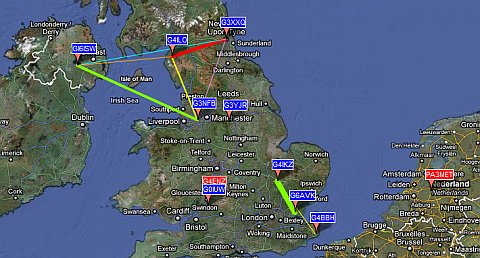
However, some of the traces on the WSPR application screen look a bit odd.

I don’t claim to be an expert but I think what I am seeing is the result of doppler shift on the signals being reflected by fast-moving Sporadic-E clouds. In several cases what seems to be a trace has not been decoded.
I’ve said this before, but I wonder if WSPR mode with its 110 second transmit periods and tiny frequency shift encoding is really suitable for detecting Sporadic-E propagation. But no-one has ever commented on this, leaving me to wonder whether they think I’m an idiot who doesn’t know what he is talking about or whether nobody knows.
The digital mode most people seem to use on 6m is JT6M, however this entails using the WSJT program which I find rather confusing. I’m interested in trying JT65A but I’m not sure if it is any more suitable than WSPR for this type of work.
In the absence of any expert advice I’m going to try JT65A using a dial frequency of 50.276MHz. With the JT-Alert accessory to tell me when anyone replies I can leave the rig calling CQ whilst I am otherwise occupied. It will be interesting to see what we can work on 6m with the JT65A mode.

Julian Moss, G4ILO, is a regular contributor to AmateurRadio.com and writes from Cumbria, England. Contact him at [email protected].
Life on 6m
The 6 metre band is showing signs of life, as this map of WSPR activity from this afternoon shows.
However, some of the traces on the WSPR application screen look a bit odd.
I don’t claim to be an expert but I think what I am seeing is the result of doppler shift on the signals being reflected by fast-moving Sporadic-E clouds. In several cases what seems to be a trace has not been decoded.
I’ve said this before, but I wonder if WSPR mode with its 110 second transmit periods and tiny frequency shift encoding is really suitable for detecting Sporadic-E propagation. But no-one has ever commented on this, leaving me to wonder whether they think I’m an idiot who doesn’t know what he is talking about or whether nobody knows.
The digital mode most people seem to use on 6m is JT6M, however this entails using the WSJT program which I find rather confusing. I’m interested in trying JT65A but I’m not sure if it is any more suitable than WSPR for this type of work.
In the absence of any expert advice I’m going to try JT65A using a dial frequency of 50.276MHz. With the JT-Alert accessory to tell me when anyone replies I can leave the rig calling CQ whilst I am otherwise occupied. It will be interesting to see what we can work on 6m with the JT65A mode.
Julian Moss, G4ILO, is a regular contributor to AmateurRadio.com and writes from Cumbria, England. Contact him at [email protected].
High Pike [LDW-107] and Carrock Fell [LDW-105]
Sometimes conditions on the fell-tops are not what you expect when you leave home. Yesterday, having no desire to watch the big event in London, I decided to have a big event of my own, namely to activate two of the Northern Fells for Wainwrights On The Air (WOTA). Although the weather was a little hazy there had been several sunny days and I anticipated two leisurely activations lazing in the grass and basking in the sun beside my guyed WOTA Pole, perhaps even some DX due to atmospheric conditions. I did notice a chilly breeze as I went out to the car, so I went back and got an extra fleece. That turned out to be a good move.

It was about 45 minutes drive to the parking spot at Caldbeck Common. I set off on a circuitous but easy climb up to High Pike, the first summit, working Jimmy on Blencathra who was using a special Wedding call MR3EYP/P on the way. No getting away completely from thoughts of the big event in London.
Half way up I noticed the wind was getting stronger and chillier. The extra fleece was quickly donned, and I worked another activator with a Royal call, MR1EYO/P on Red Screes. By the time I reached the summit I felt conditions were such that I didn’t want to stay long up there. After a contact with Bill G4WSB/P on Grasmoor whose voice was at times unintelligible due to wind getting into the mic of his Quansheng, I walked down from the summit in search of a slightly less windy spot to eat my packed lunch.
Whilst eating my lunch I weakly heard Derek 2E0MIX/P on Maiden Moor but I didn’t dare nip up to the top to make a contact in case my rucksack and other things blew away. When I did return to the summit I found the wind was blowing icy rain into my face. I didn’t have any enthusiasm for putting the WOTA Pole up as I didn’t intend staying there long enough for the effort to be worthwhile. I also didn’t want to get the non-waterproof Kenwood TH-D72 – which I’d taken after realizing the limitations of the receiver of the VX-8R – wet. So I sat on the stone bench near the wind break on the summit and using the 8in. helical rubber duck rapidly worked 7 of the ‘usual suspects’, contest-style, then stuffed the Kenwood in the rucksack and set off on my way to the next summit.
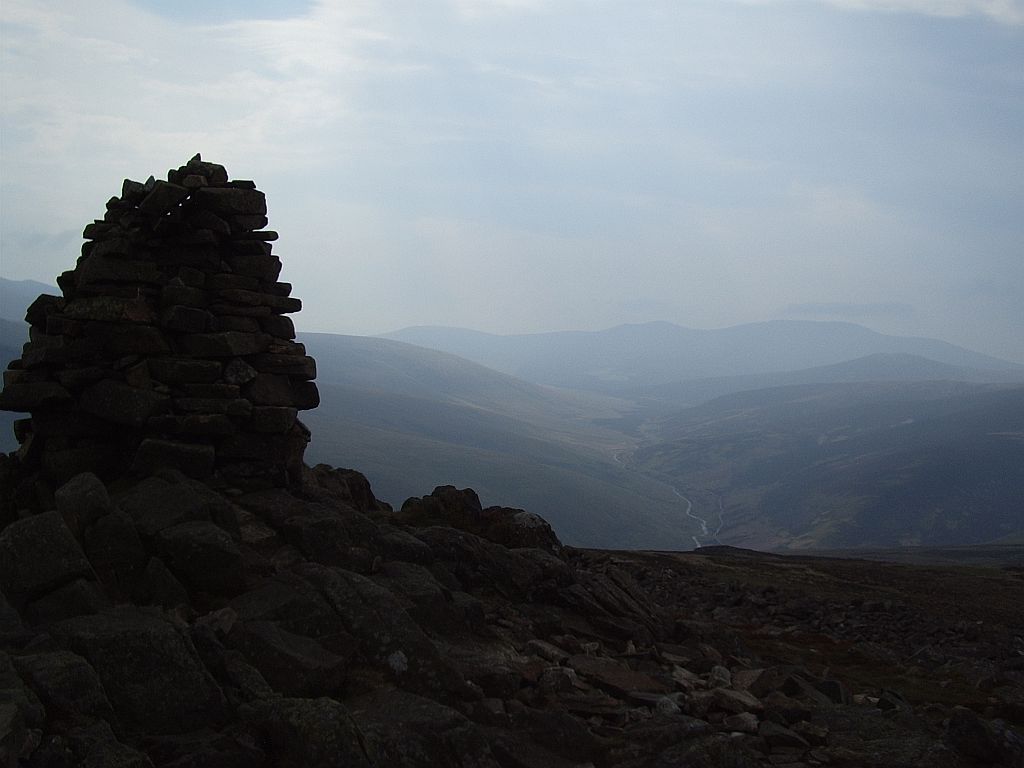
Carrock Fell is is a rocky summit with a big cairn, overlooking a valley. By the time I got there the rain had stopped and the wind had dropped a bit and seemed less cold. There were numerous large rocks scattered about making inviting seats. I decided to put up the WOTA Pole. First, I had a fight untangling the guys, which had knotted themselves together. Then, while pulling up the antenna using the third guy, doing my trick of using my walking stick as a bottom section for extra height, there was a crack and the antenna fell back on the ground. The jointing piece between the lower two sections of plastic tube had cracked. Arrgh!
So I was forced once again to do the activation using the 8in. helical rubber duck. However one piece of equipment favourably surprised me. Well, two, really. I began to get used to the Kenwood TH-D72 and felt that perhaps it is a viable alternative to the VX-8GR to use on activations. I received several APRS messages while I was up in the hills and found it easy to read and reply to them. Before I set off I used ?APRSO to load APRS objects for the two summits into the radio which I used to help navigation and check proximity. Very useful, though having to page forward a couple of times is less convenient than the VX-8’s all in one view.
I’m still not convinced that the Kenwood’s snazzy metallic grey paint and plasticky casing isn’t going to start showing marks from the rough and tumble of use up in the mountains. And the radio does sometimes do things I don’t understand, like beep and do nothing when I press the PTT, or beep and mute the audio of the station I’m listening to until I press the PTT again. I think this may be something to do with the APRS functions but it confuses me. The battery endurance doesn’t seem to be as good as the Yaesu either. But I’m learning to love it.
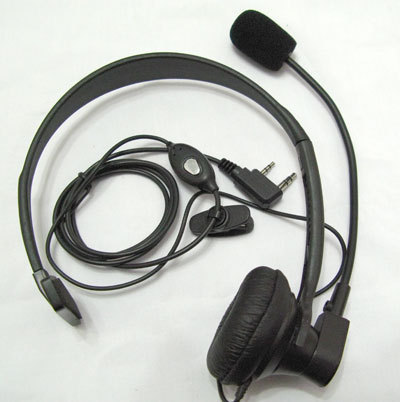
This was also the first time I could try out a headset for the Kenwood that I’d bought for £3.99 on eBay. The price, which included shipping from Hong Kong, was so low I doubted that it could be any good. But it was also cheap enough to be worth a gamble. It turned out to be the ideal accessory for operating from windy hilltops. The microphone has a foam muffler and even with my head turned so that wind was blowing on to the mic stations reported that there was only very slight wind noise, not enough to interfere with copy. With my head turned away there was no wind noise at all. Experienced activators will know just how hard it is, when it is windy, to find a position that keeps the wind out of the mic on the front of the radio.
Despite the unexpectedly nasty weather I had a nice walk and two successful activations. I may have one last try with the WOTA Pole. I will superglue the cracked jointing piece and then try reinforcing them with nylon cable ties. If that doesn’t help then I must give up the idea or accept that it will only work with longer tubes and only one joining section.

Julian Moss, G4ILO, is a regular contributor to AmateurRadio.com and writes from Cumbria, England. Contact him at [email protected].
High Pike [LDW-107] and Carrock Fell [LDW-105]
Sometimes conditions on the fell-tops are not what you expect when you leave home. Yesterday, having no desire to watch the big event in London, I decided to have a big event of my own, namely to activate two of the Northern Fells for Wainwrights On The Air (WOTA). Although the weather was a little hazy there had been several sunny days and I anticipated two leisurely activations lazing in the grass and basking in the sun beside my guyed WOTA Pole, perhaps even some DX due to atmospheric conditions. I did notice a chilly breeze as I went out to the car, so I went back and got an extra fleece. That turned out to be a good move.
It was about 45 minutes drive to the parking spot at Caldbeck Common. I set off on a circuitous but easy climb up to High Pike, the first summit, working Jimmy on Blencathra who was using a special Wedding call MR3EYP/P on the way. No getting away completely from thoughts of the big event in London.
Half way up I noticed the wind was getting stronger and chillier. The extra fleece was quickly donned, and I worked another activator with a Royal call, MR1EYO/P on Red Screes. By the time I reached the summit I felt conditions were such that I didn’t want to stay long up there. After a contact with Bill G4WSB/P on Grasmoor whose voice was at times unintelligible due to wind getting into the mic of his Quansheng, I walked down from the summit in search of a slightly less windy spot to eat my packed lunch.
Whilst eating my lunch I weakly heard Derek 2E0MIX/P on Maiden Moor but I didn’t dare nip up to the top to make a contact in case my rucksack and other things blew away. When I did return to the summit I found the wind was blowing icy rain into my face. I didn’t have any enthusiasm for putting the WOTA Pole up as I didn’t intend staying there long enough for the effort to be worthwhile. I also didn’t want to get the non-waterproof Kenwood TH-D72 – which I’d taken after realizing the limitations of the receiver of the VX-8R – wet. So I sat on the stone bench near the wind break on the summit and using the 8in. helical rubber duck rapidly worked 7 of the ‘usual suspects’, contest-style, then stuffed the Kenwood in the rucksack and set off on my way to the next summit.
Carrock Fell is is a rocky summit with a big cairn, overlooking a valley. By the time I got there the rain had stopped and the wind had dropped a bit and seemed less cold. There were numerous large rocks scattered about making inviting seats. I decided to put up the WOTA Pole. First, I had a fight untangling the guys, which had knotted themselves together. Then, while pulling up the antenna using the third guy, doing my trick of using my walking stick as a bottom section for extra height, there was a crack and the antenna fell back on the ground. The jointing piece between the lower two sections of plastic tube had cracked. Arrgh!
So I was forced once again to do the activation using the 8in. helical rubber duck. However one piece of equipment favourably surprised me. Well, two, really. I began to get used to the Kenwood TH-D72 and felt that perhaps it is a viable alternative to the VX-8GR to use on activations. I received several APRS messages while I was up in the hills and found it easy to read and reply to them. Before I set off I used ?APRSO to load APRS objects for the two summits into the radio which I used to help navigation and check proximity. Very useful, though having to page forward a couple of times is less convenient than the VX-8’s all in one view.
I’m still not convinced that the Kenwood’s snazzy metallic grey paint and plasticky casing isn’t going to start showing marks from the rough and tumble of use up in the mountains. And the radio does sometimes do things I don’t understand, like beep and do nothing when I press the PTT, or beep and mute the audio of the station I’m listening to until I press the PTT again. I think this may be something to do with the APRS functions but it confuses me. The battery endurance doesn’t seem to be as good as the Yaesu either. But I’m learning to love it.
This was also the first time I could try out a headset for the Kenwood that I’d bought for £3.99 on eBay. The price, which included shipping from Hong Kong, was so low I doubted that it could be any good. But it was also cheap enough to be worth a gamble. It turned out to be the ideal accessory for operating from windy hilltops. The microphone has a foam muffler and even with my head turned so that wind was blowing on to the mic stations reported that there was only very slight wind noise, not enough to interfere with copy. With my head turned away there was no wind noise at all. Experienced activators will know just how hard it is, when it is windy, to find a position that keeps the wind out of the mic on the front of the radio.
Despite the unexpectedly nasty weather I had a nice walk and two successful activations. I may have one last try with the WOTA Pole. I will superglue the cracked jointing piece and then try reinforcing them with nylon cable ties. If that doesn’t help then I must give up the idea or accept that it will only work with longer tubes and only one joining section.
Julian Moss, G4ILO, is a regular contributor to AmateurRadio.com and writes from Cumbria, England. Contact him at [email protected].
QRP at Bamarang
Last weekend I had a great time playing radio. Along with half a dozen other families and all our kids we went to spend the Easter weekend at the “mud brick mansion” at Bamarang on the Shoalhaven River, a few km west of Nowra on the south coast of New South Wales. Courtesy of the pod on my car I was able to take quite a few radio bits and pieces along.
We enjoyed perfect autumn weather while it rained back home in Sydney!
I even managed to build the neat little EFHW (End Fed Half Wave) Tuner designed by Stu, KI6J on a shady verandah. The kit had arrived a few days earlier and I made sure I had everything I needed to build it away from my attic/shack/workshop. In fact the weekend became a sort of trial for field day and a great way to identify the essentials. If there’s a lot of gear on hand an awful amount of time can be wasted deciding which bits to use and how.
I was inspired by reports about the EFHW tuner and the appeal of not having to worry about ground radials. What clinched it for me was a photo I saw on one of the (far too many) qrp email groups I try to follow showing a ham on a mountain side beneath his arching squid pole with the little tuner matching the hi-Z of the half-wave antenna to the 50 ohms expectations of the tiny transceiver which was probably an ATS3b.
So that was my mission for the weekend.
The tuner kit went together in a very short time. Before accepting my order Stu, KI6J sent me a powerpoint of the assembly instructions so I was sure I could handle the construction. The fiddliest bit was the tiny binocular ferrite core transformer for the bridge. Fortunately he provided enough wire in the kit for me to botch it the first time round and do it perfectly the second!
After a couple of leisurely hours mostly taken up with drilling holes in a tiny plastic box it was working on the test lash-up. The polyvaricon is delightfully sharp. You tune by dimming the LED – and then switch out the bridge to transmit.

The KI6J EFHW Tuner kit almost complete with the 5k ohms test load in place. The builder provides the enclosure and connectors. (Photo sourced from instructions)
I had a 10m (almost 33 feet) squid pole (aka Jackite or crappie pole) with a tiny pulley from a boating store attached to the top with cable ties. I used the guy ropes from my Buddipole setup to hold the pole up straight. It stayed up all weekend.
The half wavelength formula in feet is 477/freq in MHz, or just on 68 feet (20.7m) for the code end of 40m. The far end of this was held up – via a plastic button insulator – by a fishing line launched up into a tree using a half-filled plastic drink bottle. All too easy! The near end of the antenna simply terminates in a banana plug that connects to the little tuner. I also connected a short 5-6 foot counterpoise, which was essential.
I had a great time playing with the tuner and my new SDR-Cube pumping out a whole watt of RF, as well as the trusty little FT-817.
Now I have a clear idea of what’s required for an effective little kit of gear to take up a hill for relatively speedy SOTA style deployment. And maybe I’ll fill the water bottle for those trips.
If you’re interested in getting hold of one of these nifty little EFHW Tuner kits you should contact Stu KI6J at [email protected]. US$27 included shipping across the Pacific Ocean! Fast and very fair!

My blissed-out second operator in the field at Bamarang, near Nowra NSW. He helped me retain my QRP calm.
During a trip into the township to replenish supplies I found a fishing tackle shop with an Easter sale on, and bought a couple of handy Plano tackle boxes and some inexpensive 10m lengths of nylon coated stainless steel ‘leader line’ wire which I’m sure can be used for a handy weatherproof dipole. As long I don’t have to solder the stuff.
Stephen Rapley, VK2RH, is a regular contributor to AmateurRadio.com and writes from New South Wales, Australia. Contact him at [email protected].
 Ham Radio Deluxe |
 W5SWL Electronics |
 Ham Radio Prep |
 KB3IFH QSL Cards  Hip Ham Shirts  HamRadioAuctions HamRadioAuctions Reliance Antennas Reliance Antennas Enigma Shop Enigma Shop |  morseDX  Ni4L Antennas  R&L Electronics R&L Electronics antennas.us antennas.us QRV QRV |
- Matt W1MST, Managing Editor
