 |
 PLT a threat to British intelligence gathering?
 17 May 2011 | by
 A report produced for the British intelligence gathering organization GCHQ claims that noise from power line networking devices is causing a detectable increase in interference at its monitoring stations and could adversely affect its operations. The report, which can be found on the website Ban PLT, was originally released by GCHQ’s Director of Engineering and Technology but has since been disowned by GCHQ which now claims it contained “inaccuracies.” The government organization also forced the online tech news journal The Register, which published an article containing details of the report, to remove the author’s identity from the article using measures designed, ironically, to suppress information that could be considered a threat to national security. So much for freedom of speech.
Ofcom meanwhile continues to deny that PLT devices cause a problem, stating that there have been “only” 272 complaints of interference (all from radio amateurs) and that of 233 cases referred to BT all but one have been resolved so there is nothing to worry about. Has pressure been brought from on high to force GCHQ to disown the report which is embarrassing to BT which has a couple of million of the Comtrend PLT devices installed nationwide? It is blatantly obvious that Ofcom couldn’t give a damn about the possible effects on a few hobbyists who don’t even pay a license for the spectrum they use. But a threat to the country’s ability to monitor the short waves to gather intelligence about potential security threats is something they would have had to take seriously.

Julian Moss, G4ILO, is a regular contributor to AmateurRadio.com and writes from Cumbria, England. Contact him at [email protected].
PLT a threat to British intelligence gathering?
A report produced for the British intelligence gathering organization GCHQ claims that noise from power line networking devices is causing a detectable increase in interference at its monitoring stations and could adversely affect its operations. The report, which can be found on the website Ban PLT, was originally released by GCHQ’s Director of Engineering and Technology but has since been disowned by GCHQ which now claims it contained “inaccuracies.” The government organization also forced the online tech news journal The Register, which published an article containing details of the report, to remove the author’s identity from the article using measures designed, ironically, to suppress information that could be considered a threat to national security. So much for freedom of speech.
Ofcom meanwhile continues to deny that PLT devices cause a problem, stating that there have been “only” 272 complaints of interference (all from radio amateurs) and that of 233 cases referred to BT all but one have been resolved so there is nothing to worry about. Has pressure been brought from on high to force GCHQ to disown the report which is embarrassing to BT which has a couple of million of the Comtrend PLT devices installed nationwide? It is blatantly obvious that Ofcom couldn’t give a damn about the possible effects on a few hobbyists who don’t even pay a license for the spectrum they use. But a threat to the country’s ability to monitor the short waves to gather intelligence about potential security threats is something they would have had to take seriously.
Julian Moss, G4ILO, is a regular contributor to AmateurRadio.com and writes from Cumbria, England. Contact him at [email protected].
Opening the case on an Ascom SE-550
I was talking to Rob, G4XUT yesterday about getting the case of an Ascom SE-550 open – in order to make some adjustments to the internal squelch pot.Rob very kindly put together a list of instructions on how to get the rig apart which I thought someone else might find of use. Thanks Rob!To get into the Ascom:-Assuming that the mobile bracket has already been removed.Disconnect the rear connector by loosening the retaining screw.Remove the Mic plug connector.Unplug the code plug which is above the mic connector.Remove the screw behind code plug.Detach the front panel with is hinged on the L/H side.Remove the 4 screws at the front and 4 screws at the rear.Carefully pull apart the two main boards from the main housing.Carefully re-assemble the two boards.Replace the front panel, code plug and the mic plug.Power up and adjust sq or whatever as required. Simples!!

Tim Kirby, G4VXE, is a regular contributor to AmateurRadio.com and writes from Oxfordshire, England. Contact him at [email protected].
Opening the case on an Ascom SE-550
I was talking to Rob, G4XUT yesterday about getting the case of an Ascom SE-550 open – in order to make some adjustments to the internal squelch pot.Rob very kindly put together a list of instructions on how to get the rig apart which I thought someone else might find of use. Thanks Rob!To get into the Ascom:-Assuming that the mobile bracket has already been removed.Disconnect the rear connector by loosening the retaining screw.Remove the Mic plug connector.Unplug the code plug which is above the mic connector.Remove the screw behind code plug.Detach the front panel with is hinged on the L/H side.Remove the 4 screws at the front and 4 screws at the rear.Carefully pull apart the two main boards from the main housing.Carefully re-assemble the two boards.Replace the front panel, code plug and the mic plug.Power up and adjust sq or whatever as required. Simples!!
Tim Kirby, G4VXE, is a regular contributor to AmateurRadio.com and writes from Oxfordshire, England. Contact him at [email protected].
LHS Episode #060: apt-get install make-pr0n-work
 Hello, faithful listeners and newcomers alike. A couple of big events are coming up. The first is the Dayton Hamvention, this weekend from May 20th through the 22nd. The other is the Southeast Linux Fest, from June 10th through the 12th. Linux in the Ham Shack will have a presence at both events and we hope to see everyone there. We will be having raffles for “quite good” prizes so you don’t want to miss that either.
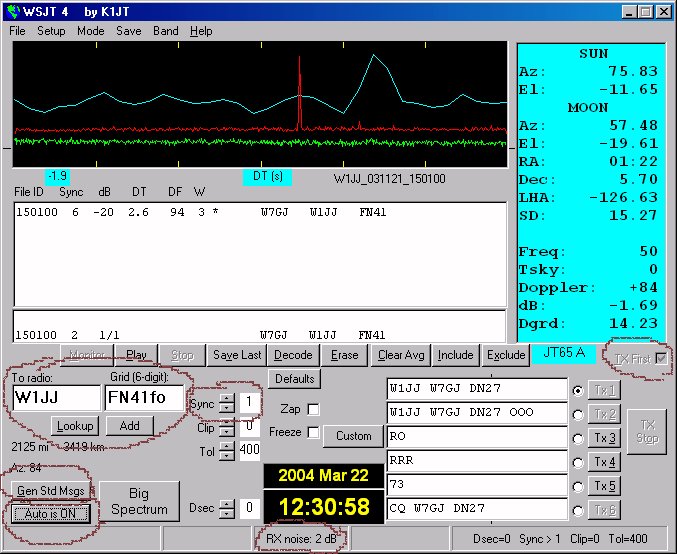
In this episode of our show, we catch up on almost all of our (very old) feedback and even manage to discuss a couple of items which may interest ham radio and Linux enthusiasts alike: JT65, a weak-signal digital mode, and codec2, a new audio codec designed for low bandwidth, telephone quality, error correction and to be free of patents or encumbrances of any kind. Enjoy.
Russ Woodman, K5TUX, co-hosts the Linux in the Ham Shack podcast which is available for download in both MP3 and OGG audio format. Contact him at [email protected].
The Defense of 440
Lately there’s been more saber-rattling and calls to arms over HR 607 here in the US. This is the bill that places several UHF bands on the auction block for commercial wireless service and public safety. The item of concern to amateur radio is the listing of the 440 band which amateur radio has a secondary allocation.
There are some “inconvenient truths” about 440 and its potential reallocation:
1. Amateur radio usage of the 440 band is abysmal. (Dead repeaters don’t count as usage.)
2. What usage there is of 440 is inefficient when compared with 3G and 4G technologies that could use the band.
3. Millions could benefit for 440 rather than a few thousand who use it today.
4. Amateur radio’s 440 band is a secondary allocation, not primary.
BPL was a major threat to amateur radio and I adamantly opposed it. Millions could have benefited from BPL as well so opposition of BPL may seem hypocritical, but there is key difference. BPL didn’t actually use the spectrum, it polluted it. If BPL would have made actual use of the spectrum for transmission of data, we may have seen a de facto reallocation of amateur radio HF spectrum. But ultimately physics and market forces killed BPL.
When it comes to the reallocation of 440, I’m neutral about it and almost leaning towards letting the chips fall where they may. However, I feel like I’m selling out amateur radio. It’s been ingrained in our minds that we have to reflexively defend amateur radio against any and all threats.
The comments I see from amateurs regarding HR 607 seem to reflect a lack of understanding of the real world today, technology, and amateur radio’s place in the world. Perhaps I’m reading and hearing the wrong comments, undoubtedly from venues that cater to those who speak before thinking. But I digress.
Amateur radio has little to no political pull today. Any semblance of political power is merely momentary photo opportunity politics. We lack the numbers to give politicians appreciable benefits from sticking their necks out for us. The post 9/11 homeland security “importance bump” we received is winding down and arguably so will the war on terrorism. The next war is going to be a war of limited resources and debt, areas where amateur radio is politically irrelevant and potentially a roadblock.
We can’t expect to hold on to valuable spectrum forever with 1960s technology when faced with 21st century technology that can make use of a limited resource that would result in a benefit several orders of magnitude greater than what amateur radio is doing today. In recent years in American society it’s become common for vocal citizens to complain about entitlements, programs, and hand outs under the guise of reigning in the national debt, thinly veiled in patriotism, protecting the American Way and all that is good. But when it comes to cutting entitlements, programs, and hand outs from which they receive benefits, the conversation abruptly ends and out come the protest signs and 16th century costumes. It’s much the same with amateur radio bands. Our wise and aging licensees are deathly afraid of the coming debtpocalypse, but “you can pry my barely used UHF spectrum from my cold, dead fingers.” I see retorts to HR 607 like “why do they need more spectrum; public safety/cellular has X MHz” or “why don’t they reallocate FRS/TV/WIFI/Cellular!?!” I just have to do a face-palm. It’s painful to read.
Ultimately I doubt 440 will be reallocated as a result of HR 607. Amateur radio is a secondary allocation, the primary being the military. All the boilerplate letter mailing campaigns and phone calls to poor overworked congressional staffers won’t have an effect. If the military throws in the towel on the 440 band, the amateur radio 440 allocation is going down for the count, regardless. Much like the situation with BPL, it’s mostly out of our control.
Rather than just totally blocking the reallocation of this band, “we’re the radio guys who will save the world, end-of-story”, we need come up with some reasonable compromise options that gives something to the public and justifies what spectrum we hold on to for decades to come. Perhaps this means offering up 10 or 20 Mhz and keeping the remain part for satellites and data modes. As I mentioned in a previous article, we need to develop a digital protocol and network to utilize this spectrum at a respectable level with applications beyond ragchewing and exchanging grid squares. We certainly can’t forever defend holding on to this band with analog repeaters and point-to-point links linking vegetating two meter repeaters.
Inside the UV-3R
Many people have been buying the cheap little dual band Baofeng UV-3R handheld radios from China. Some people have been pulling them apart, such as Fabrice, F4AVI, who has discovered that it is really quite a state of the art radio.

Fabrice found that the VHF/UHF transceiver functionality is provided by an RDA Microelectronics RDA1846 chip. This is a single chip fully DSP based transceiver capable of covering 134-174, 200-250 and 400-500MHz and supports CTCSS, CDCSS and DTMF with an 8dBm on-board PA. The Band 2 broadcast FM receiver uses an RDA5802E chip, also from RDA Microelectronics, which is a single chip broadcast FM stereo tuner. The UV-3R doesn’t cover the US 220MHz band, of course, nor is the FM broadcast audio in stereo. But future models might well do.
Some buyers of the Boafeng have experienced minor issues with their radios that suggest the quality control is not all it could be. Still, it is interesting to see innovative designs coming out of China. One can only wonder what next?

Julian Moss, G4ILO, is a regular contributor to AmateurRadio.com and writes from Cumbria, England. Contact him at [email protected].
 Ham Radio Deluxe |
 W5SWL Electronics |
 Ham Radio Prep |
 KB3IFH QSL Cards  Hip Ham Shirts  HamRadioAuctions HamRadioAuctions Reliance Antennas Reliance Antennas Enigma Shop Enigma Shop |  morseDX  Ni4L Antennas  R&L Electronics R&L Electronics antennas.us antennas.us QRV QRV |
- Matt W1MST, Managing Editor
