 |
 HAM Nation: Interview with Bob Heil K9EID
 24 May 2011 | by
  Bob Heil, K9EID, is a very busy guy (especially today as he gets ready to debut his new show on Leo Laporte’s TWiT network called HAM Nation), but I had the opportunity to catch up with him to find out more about his plans:
Bob, when Leo Laporte, “The Tech Guy,” offered you the opportunity to host a show about ham radio on his amazing TWiT Network, what was your first reaction?
I was very thrilled and extremely honored to have Leo recognize the importance of the ham radio community.
Talk some about the equipment you’ll be using to record the show. Will you be broadcasting live?
The show will be done live from my station lab where I develop all of our amateur radio as well as professional series products. I use a P.C. based computer fed with an Alesis Mix 8 USB mixer. Using one of our PR 40 into the mixer, it gives me great flexibility with tailoring the audio right where we need it. For camera, I am using what most of the TWIT hosts are using, the new Logitech C 910 HD camera. Very small but extremely high quality for the size and cost.
You’re going to have a massive technically-oriented audience that may not have much familiarity with Amateur Radio. What are some of the goals you’re hoping to achieve with the show?
It is amazing how many hams are in that TWiT audience. It was one of the leading factors that led Leo to invite our industry onto his network. As Leo, I will let the chat room guide us to the subjects they want to know more about but I already have guests lined up to do all types of technical things – kit building, antennas, types of transceivers, digital communications, D Star, emergency communications, Field Day activities, etc. . . any ideas? Please pass them on. We, the amateur radio community now has a platform on Tuesday night where we can share with the world.
What are some of your personal interests as a ham? What equipment do you run in your shack?
If it were not for my interest in ham radio back in the mid 50’s as a high school teenager, I would never have been able to accomplish anything close to what has happened. The basis of everything I do was learned from great mentors I met on the air. I spent 17 years as a technician exploring SERIOUS VHF work. Since 1976 when I upgraded, I have been all over the map but I STILL revert to much of my original gear that I have had over the years including my 1956 Harvey wells, 1958 CE 20A, 1962 HT 37. I love all of the vintage gear and you can find me on AM several nights a week. Because my station is my lab for my company, I have many late model transceivers to keep up with the technology and what needs to be done to make then sound good.
Tune in Tuesday nights, starting tonight, 6pm Pacific/9pm Eastern at http://live.twit.tv. You’ll also be able to watch the show via the embedded video below. Good luck, Bob!
Matt Thomas, W1MST, is the managing editor of AmateurRadio.com. Contact him at [email protected].
Don Keith: You might be a real ham radio operator if…
 Recent comments on some of the amateur radio web forums have attempted to posit the point that someone is not a “REAL HAM” unless he or she meets certain arbitrary criteria. Those include such requirements as passing a code test to get licensed, using equipment with tubes in it, or being able to build a transceiver from scratch, using only a pie tin, a set of shoe laces, and a handful of grab-bag parts from a swap meet.
With apologizes to a certain comedian who has made a gazillion dollars with his “You might be a redneck if…” shtick, here goes my feeble attempt at a similar definition of a “REAL HAM:”
- If you have a ham band antenna on all four fenders of your car, the roof, in the trunk lip, and another one clamped to the trailer hitch with an alligator clip and duct tape…you might be a “REAL HAM!”
- If your wife…sorry, “XYL”…asks you to help bring in the groceries while you are chasing a rare one and you yell back, “QRX! QRX!”…you might be a “REAL HAM!”
- If you can recite the numbers of every driver, modulator, and final amplifier tube in every Heathkit, Drake or Collins transmitter or amplifier ever made, and name the best idling grid current for 90% of them…you might be a “REAL HAM!”
- If when you were a teenager, you tore open the cases of your little brother’s “Flash Gordon” walkie-talkies just to see if you could modify them to work on 10 meters or used the pans from your sister’s Easy-Bake oven to breadboard a code-practice oscillator…you might be a “REAL HAM!”
- If you have ever tried to ker-chunk the repeater while riding in a funeral procession…you might be a “REAL HAM!”
- If your kids…sorry, “harmonics”…know your call sign, your grid square, and your 10-10 number, but not your middle name…you might be a “REAL HAM!”
- If you have at least a half-dozen different sets of hilarious (at least to you and the guys on your 75-meter roundtable) phonetics for your call letters…you might be a “REAL HAM!”
- If you have more countries confirmed than you have dollars in your 401-K and more bucks invested in your tower, rotor and tri-bander than you have in your retirement annuity…you might be a “REAL HAM!”
- If you have ever taken an HT to church or a scanner to the courthouse while on jury duty…you might be a “REAL HAM!”
- If you painted the walls of the new playroom downstairs in the colors of the resistor color code…you might be a “REAL HAM!”
- If you ever chopped up your wife’s…sorry, XYL’s…patio furniture to build a Yagi for 15…you might be a “REAL HAM!”
- If you have ever attempted to use a gutter downspout, the hubcap from a ’93 Buick, your dog’s food dish, your neighbor’s rose trellis, the vent hose from a clothes dryer, a wicket from your mom’s croquet set, or a one-quart metal Thermos bottle (with or without coffee) as an antenna…you might be a “REAL HAM!”
- If you read the ARRL “Repeater Directory” or the latest catalog from one of the big “candy stores” while taking your daily “constitutional” …you might be a “REAL HAM!”
- If you know the formulae for Ohm’s Law and Kirchoff’s Law and can read a Smith Chart from 100 feet but have no idea who Paris Hilton is…you might be a “REAL HAM!”
- If you typically go to hamfests wearing your “Hams do it with frequency” tee-shirt, a “KNOW CODE” belt buckle, at least two HTs clipped to your belt and an earpiece for each in each ear, a pith helmet with a 440 ground plane sticking out the top, and a blinking-LED button with your callsign on it…you might be a “REAL HAM!”
- If you know the prefixes for every DXCC entity as well as their beam headings but you don’t know your oldest kid’s…sorry, “first harmonic’s”…birthday…you might be a “REAL HAM!”
- If you ever flagged down a local utility bucket truck and tried to bribe the guy to hang some ropes and pulleys in the trees in the backyard…you might be a “REAL HAM!”
- If you ever tried to convince your fiancé that Dayton, Ohio, has replaced Niagara Falls as the Honeymoon Capitol of the World and that the first part of May is absolutely the best time for a wedding…you might be a “REAL HAM!”
- Of course, if you MET your fiancé in the flea market at Dayton when she tried to jaw you down on the price of a Hallicrafters HT-37 with a bad power transformer…you might be a “REAL HAM!”
Finally, if you call beers “807s,” money “green stamps,” your house your “home QTH,” your car your “moe-byle,” your base station your “shack,” the FCC “the friendly candy company,” anything a salesman tells you “Bravo Sierra,” the big brouhaha at the last club meeting “a Charlie Foxtrot,” your wife your “XYL,” and your kids “harmonics” …you might be a “REAL HAM!”
Ain’t it fun?
Don Keith, N4KC, is a regular contributor to AmateurRadio.com and writes from Alabama, USA. Contact him at [email protected].
Off-air frequency standard
This is an unbuilt kit for an Off-Air Frequency Standard from Spectrum Communications. It is a crystal calibrator phase locked to BBC Radio 4 on 198kHz with an output of 2V peak to peak at 10MHz.
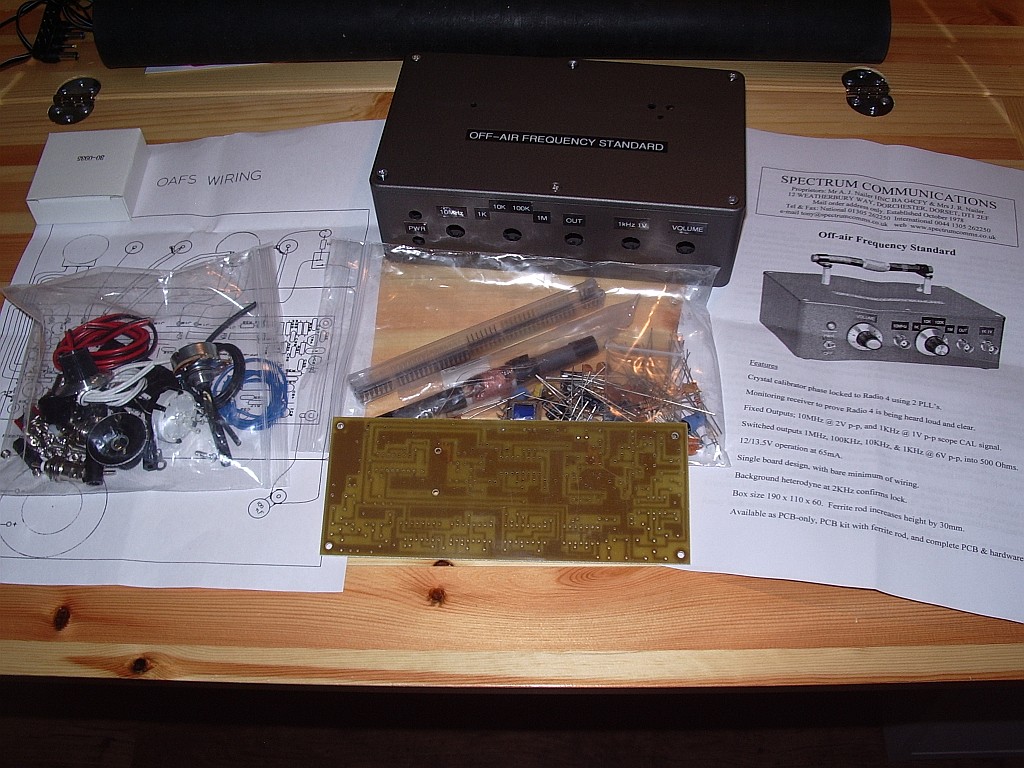
I got this with the intention of using it to frequency lock my Elecraft K3 using the KREF3 module. Regular readers may remember that last year I purchased a surplus Efratom LPRO-101 rubidium frequency standard to calibrate my radios. But a rubidium frequency standard has a finite life which will be used up very quickly if it is turned on all day to use as a real-time frequency reference. My intention is that the off-air frequency standard will run all day and keep my K3 as accurate as I need it to be.
I ordered the full kit from Spectrum. I was disappointed to find that what looked like a die cast box in the picture is actually a plastic box with a grey metallic finish. If I had realized it was not a die cast box I would probably have opted for the cheaper PCB kit and ordered one of the nice extruded aluminium alloy Hammond cases for the project. I hope it will be RF-proof enough to work in my shack environment where up to 100W may be used into indoor antennas.
The other disappointment was the rather home made looking PCB which does not have a silk screened component overlay. There is a printed layout in the instruction sheet but relating the component positions to the holes on the PCB is easier said than done. My initial thought was that I am not going to be able to build this. What I will have to do is draw the component overlay on to the PCB itself prior to construction. But it isn’t easy with my diminishing eyesight and need to use different strength lenses which makes switching between things at different distances a real trial. Having a silk screened PCB would just have made things a bit easier. I think my days of kit building are definitely numbered.

Julian Moss, G4ILO, is a regular contributor to AmateurRadio.com and writes from Cumbria, England. Contact him at [email protected].
Off-air frequency standard
This is an unbuilt kit for an Off-Air Frequency Standard from Spectrum Communications. It is a crystal calibrator phase locked to BBC Radio 4 on 198kHz with an output of 2V peak to peak at 10MHz.
I got this with the intention of using it to frequency lock my Elecraft K3 using the KREF3 module. Regular readers may remember that last year I purchased a surplus Efratom LPRO-101 rubidium frequency standard to calibrate my radios. But a rubidium frequency standard has a finite life which will be used up very quickly if it is turned on all day to use as a real-time frequency reference. My intention is that the off-air frequency standard will run all day and keep my K3 as accurate as I need it to be.
I ordered the full kit from Spectrum. I was disappointed to find that what looked like a die cast box in the picture is actually a plastic box with a grey metallic finish. If I had realized it was not a die cast box I would probably have opted for the cheaper PCB kit and ordered one of the nice extruded aluminium alloy Hammond cases for the project. I hope it will be RF-proof enough to work in my shack environment where up to 100W may be used into indoor antennas.
The other disappointment was the rather home made looking PCB which does not have a silk screened component overlay. There is a printed layout in the instruction sheet but relating the component positions to the holes on the PCB is easier said than done. My initial thought was that I am not going to be able to build this. What I will have to do is draw the component overlay on to the PCB itself prior to construction. But it isn’t easy with my diminishing eyesight and need to use different strength lenses which makes switching between things at different distances a real trial. Having a silk screened PCB would just have made things a bit easier. I think my days of kit building are definitely numbered.
Julian Moss, G4ILO, is a regular contributor to AmateurRadio.com and writes from Cumbria, England. Contact him at [email protected].
Kenwood TM-D710 firmware update
According to Bob Bruninga WB4APR, Kenwood announced an update to the TM-D710 firmware at Dayton. The changes are:
– INTERRUPT ALWAYS: always displays information about every packet received on screen for a few seconds, not just packets from new stations.
– INFINITE: extends the above to retain the information about the last heard packet on screen.
– MY PACKET: now displays the actual digi path used when your own packet is digipeated so you don’t just see that it was digipeated you can see which digipeater.
– TOP button: LIST display inserts new entries at the top so no need to scroll down.
– HEADING/UP: you can toggle the compass rose to North-UP or Heading
UP.
– PREVIEW of PHRASES: When selecting phrases you can see a preview of
first 9 bytes.
– READ/REPLY keys come up when a message is flashed on the front panel
– OVERLAYS: You can now select overlay characters on any symbol
– TOTAL hops can be set as low as 0 instead of 1.
– Auto-Powerup-Time set (if GPS is connected and is locked)
The update also contains some bug fixes. It does not include support for item-in-message or any other previously unsupported APRS features. 🙁
At this time the update is not yet available for download from Kenwood’s website.

Julian Moss, G4ILO, is a regular contributor to AmateurRadio.com and writes from Cumbria, England. Contact him at [email protected].
Kenwood TM-D710 firmware update
According to Bob Bruninga WB4APR, Kenwood announced an update to the TM-D710 firmware at Dayton. The changes are:
– INTERRUPT ALWAYS: always displays information about every packet received on screen for a few seconds, not just packets from new stations.
– INFINITE: extends the above to retain the information about the last heard packet on screen.
– MY PACKET: now displays the actual digi path used when your own packet is digipeated so you don’t just see that it was digipeated you can see which digipeater.
– TOP button: LIST display inserts new entries at the top so no need to scroll down.
– HEADING/UP: you can toggle the compass rose to North-UP or Heading
UP.
– PREVIEW of PHRASES: When selecting phrases you can see a preview of
first 9 bytes.
– READ/REPLY keys come up when a message is flashed on the front panel
– OVERLAYS: You can now select overlay characters on any symbol
– TOTAL hops can be set as low as 0 instead of 1.
– Auto-Powerup-Time set (if GPS is connected and is locked)
The update also contains some bug fixes. It does not include support for item-in-message or any other previously unsupported APRS features. 🙁
At this time the update is not yet available for download from Kenwood’s website.
Julian Moss, G4ILO, is a regular contributor to AmateurRadio.com and writes from Cumbria, England. Contact him at [email protected].
Congratulations John Sluymer VE3EJ!
I was delighted to read that John, VE3EJ had been ‘inducted’ into the CQ Contest Hall of Hame this weekend at the Dayton Hamvention.Here’s what the citation had to say:”The 2011 inductee to the CQ Contest Hall of Fame is John Sluymer, VE3EJ. Sluymer has been an active contester and DXer since 1973 and is a founding member and current President of Contest Club Ontario, which has grown from 16 to 250 members in less than a decade. He also holds numerous Canadian domestic and DX contest records, was named the 2006 Radio Amateur of the Year by the Radio Amateurs of Canada (RAC). A frequent host for single- and multi-op contest operations from his station, Sluymer is a longtime member of the CQ WW Contest Committee and a frequent speaker at hamfest forums and club meetings”Congratulations, John! I had the genuine pleasure of getting to know John when I worked in Toronto, Canada during the late 1990s. John is everything it says there, but lots more too. He’s a genuinely warm and great guy. He and his wife, Hazel have welcomed me to their house on many occasions – radio related and non radio-related! Though I’ve not seen John in a few years now, we run across each other on the bands from time to time and it’s always great to hear from him.Well done John !

Tim Kirby, G4VXE, is a regular contributor to AmateurRadio.com and writes from Oxfordshire, England. Contact him at [email protected].
 Ham Radio Deluxe |
 W5SWL Electronics |
 Ham Radio Prep |
 KB3IFH QSL Cards  Hip Ham Shirts  HamRadioAuctions HamRadioAuctions Reliance Antennas Reliance Antennas Enigma Shop Enigma Shop |  morseDX  Ni4L Antennas  R&L Electronics R&L Electronics antennas.us antennas.us QRV QRV |
- Matt W1MST, Managing Editor
