 |
 Handiham World for 08 June 2011
 8 June 2011 | by
 Welcome to Handiham World!
Troubleshooting 101: Your toolkit
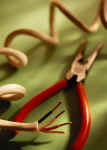
Having the right tool for the repair at hand is important. Life being what it is, you never know what you might be called upon to fix, and being an amateur radio operator most definitely opens up possibilities that the average homeowner will not encounter! While a typical household toolkit will include hand tools like a few sets of pliers, a hammer, perhaps a wood saw and a hacksaw, screwdrivers and some wrenches among other simple tools, the ham’s toolkit will add a few tools related to electronics.
When I was growing up, my dad made a living by selling and repairing office machines, particularly typewriters. That work was mostly dealing with mechanical devices, and dad had plenty of tools specific to the job. There were lots of screwdrivers, specialty pliers and other hand tools designed to get at small parts in tight places. Typewriters of the day were both mechanical and electric. Mechanical calculators were such an amazing conglomeration of cogs and tiny moving parts that I still stand in amazement when I think of how the clattering devices could come up with solutions to math problems! Anyway, dad had collected and organized all of his tools and his workspaces to complete diagnoses and repairs on these machines as efficiently as possible.
It takes time and experience to build a workshop and collect the right tools for an activity like amateur radio. I started decades ago with some of my own hand tools, like wrenches, which I needed to do antenna work. I didn’t want to have to borrow my dad’s tools. Not having much to spend as a teenager, I bought a set of “Globemaster” wrenches. They were stamped “Made in India” and I still have some of them today. I couldn’t even begin to guess how many miles they have on them just going up and down towers! Of course I acquired a multimeter from Radio Shack when I felt that I could really afford to splurge. A cheap SWR bridge of the type used with CB radios worked for my antenna needs, and dad helped me choose a soldering pencil and showed me how to correctly heat and flow the solder over a clean joint to make a solid connection. Dad used a propane torch for some of his parts soldering, so I learned how to use that to make outdoor connections, soldering my antenna wires.
Over the years I have collected lots of tools. I have a frequency counter, an oscilloscope, a transistor tester, several multimeters – both analog and digital, SWR meters, a logic probe, a frequency generator with selectable waveforms, lots of hand and power tools, and those old Globemaster wrenches. It’s worth noting that most of these tools really are not what I call “core” tools. Using an oscilloscope is a rare thing for me, but the small hand tools like side cutters and screwdrivers get used all the time. That’s partly because they have to do service in the repair of typical household items. You can get started building your tool collection logically by getting a good set of screwdrivers, nut drivers, and pliers, including needle nose pliers. You will need a couple of side cutters, probably a miniature pair and a larger pair for cutting and stripping wires. A multimeter is a definite plus as an early purchase, because you will use it for household repairs as well as for radio work. Many of them include an audible continuity tester, something that really comes in handy when checking coaxial cables for shorts and open circuits. Good quality electrical tape, such as that made by 3M, is a useful item to have in your toolbox. And speaking of a toolbox, you might want to have several of those as well. I like the smaller plastic ones with a couple of trays to help keep things sorted out. A bigger metal one may be the best bet for tools like hammers, saws, and plumbing tools.
One thing you will learn by experience is which tools to put in a small toolbox to take along on most of your projects. When you get good at doing simple repairs, you likely have gotten the hang of grabbing the right tools before setting out for the garage or back yard, or the Field Day site. If you have ever been working on a Field Day antenna and needed a wrench that you forgot to bring, you know how frustrating a poorly-stocked toolbox can be. Going to Field Day? Why not start a checklist so that you are sure you’ll have all the tools you need?
Don’t forget about safety! Whether you are working on projects around the house or yard or at the Field Day site, you will still sometimes need gloves or eye protection – and yes, even if you are blind you do need eye protection. Some basic safety gear to consider as you build your tool collection might be:
 | Safety glasses or goggles – use for lots of stuff around the house, and for antenna work or during soldering.
|
| Gloves – great for hand protection while gardening or installing masts!
|
| Extension cords with third wire for ground – help to prevent electric shock when using power tools.
|
| Hearing protection – perfect for saving your hearing while vacuuming the carpets or while using power tools.
|
| Hard hat – protects your noggin while trimming trees or while working on a tower project when someone drops a wrench from 30 feet up.
|
| Ground fault interrupters – excellent shock protection!
|
Proceed logically with your tool collecting. Acquire the usual household tools and safety gear first, then add the meters and other less often used gear later on. If your capabilities in tool use are limited, start simple and learn what works for you and what doesn’t. Asking for help through your local radio club is usually an option, and actually makes a lot of sense for anyone, because there will be times when you only need some esoteric and expensive tool once, so why not ask a fellow club member who owns one to help you out? Everyone should have at least one pair of hearing protectors around the house, but it is perfectly understandable if you don’t care to own a chain saw or an oscilloscope.
Know your limitations. If you cannot see to use some power tools safely, you can concentrate on building a collection of hand tools that you can use independently. If you are unable to lift and climb, you are not going to need a climbing harness. This is not rocket science, but it does bear mentioning because we don’t always know our own limitations without trying something first. This is a very individual thing, so I recommend keeping an open mind and trying new things – but with someone experienced in operating that new power tool or doing soldering. Having a spotter available during a project like using a table saw or climbing a tower is essential. I recall one of my ham radio friends who severed his fingers with a power saw. Thankfully there was help nearby! Using tools when you are tired or not feeing well, or – heaven forbid – when you have been drinking alcohol, is a prescription for disaster.
Having a good, basic set of tools that you are comfortable using should be your goal. Now, let’s get out there and fix something!
Send your ideas about troubleshooting for possible inclusion in this column to:
Patrick Tice [email protected] Handiham Manager
Letters

Looking for a TS-480SAT? Here’s your chance!

Tom Behler, KB8TYJ, writes:
I think I’m just about ready here to take the plunge and order a Kenwood TS-590S HF transceiver. Before doing so, however, I am going to have to sell one of my TS480’s. You know: It’s the old “radio in, radio out” principle.
So, here’s what I’ve got, and what I’m proposing:
TS-480 SAT, which includes the mobile mounting bracket and all original accessories plus the VGS1 voice guide, and a 500 HZ CW filter. I also have a number of Braille and electronic documentation files on the radio, including the manual, a key-chart, menu list, and other assorted goodies. I bought this TS480 slightly used back in the Spring of 2008, and it has served me well. It is in good working order, and I’ve never had a problem with it.
I’m asking $900 for the entire package, and that will include shipping within the USA. If the VGS1 is not needed, I’ll take it out of the unit, and drop the price down to $850. I would prefer payment in the form of either a postal money order, or certified cashier’s check. I have advertised the rig in other places, but really would prefer it to go to a fellow blind ham, or other Handiham member who could take full advantage of its great accessibility. If you have questions, or want more specifics, please e-mail me personally at: [email protected]
Blind users: Call for assistance with Elecraft K3 screenreader project

The Elecraft K3 has earned a reputation as an excellent, high-performance 160 through 6 meter rig. Wouldn’t it be great if there was a software program to collect data from the radio and return it in a blind-accessible format? Well, listen to what Mike, NF4L, says:
Dear Handihams,
I’m Mike Reublin NF4L. I have written a program that collects the responses that an Elecraft K3 can return, and puts it on the computer screen, so a user’s screen reader can say it. I’m in late testing, and it was suggested that some of the Handiham members might be interested in helping me test. And to use it when it’s released.
If this is of interest to you, how can I make the request to the sight impaired community?
This has the backing of Elecraft, and it’s free.
73, Mike NF4L
Can you help Mike with this project? If so, he would like to hear from you. Contact him via email at nf4l at nf4l dot com.
Please feel free to share this story with the blind ham community. Let’s get the word out to as many potential beta testers as we can!

Pat Tice, WA0TDA, is the manager of HANDI-HAM and a regular contributor to AmateurRadio.com. Contact him at [email protected].
2010 ARRL June VHF QSO Party (yes, 2010)
When I came home today, I found a large envelope from the ARRL waiting for me in the mail, and opened it up to find this:

It turns out that I won the 6m category for the 2010 ARRL June VHF contest and I didn’t even know it! It may be a little difficult to read, but the fine print towards the center left says “Winner 50 MHz”. That was definitely a nice surprise.
The 2011 ARRL June VHF QSO Party (link goes to the rules for the contest) is coming up this weekend, the 11th – 13th of June. I have some family coming in from out of town and some other commitments so I probably won’t be spending as much time on the air as I did last year, but I will try to get on the air and operate as much as I can.
ICQ Podcast S04 E12 – BHI Noise Cancellation (05 June 2011)
Series Four Episode Twelve of the ICQ Podcast has been released. News Stories include :-
- Radio Show about Amateur / Ham Radio
- Is USA 420-440 MHz safe?
- National Amateur / Ham Radio Club of the Year winners
- London Olympic 70cm tests
- 6C8G Amateur / Ham Radio valves (tubes) wanted
- Out-of-this-world communications for Children and the Pope
- P3-E and P5 Amateur Radio satellites update
- No more morse in Japan test
- Australian top Amateur / Ham Radio DXCC’rs
- Radio Nord Revival back on 603 kHz
- 2011 70 MHz Sporadic-E season has opened
- Sun becomes more active again
- RSGB to sell Luso radio tower
- Long-distance ham radio bicyclist rides from Alaska to Texas
Your feedback and Graham Somerville (M3ZGS) joins us to discuss BHI Noise Cancellation products.
Colin Butler, M6BOY, is the host of the ICQ Podcast, a weekly radio show about Amateur Radio. Contact him at [email protected].
ICQ Podcast S04 E12 – BHI Noise Cancellation (05 June 2011)
Series Four Episode Twelve of the ICQ Podcast has been released. News Stories include :-
- Radio Show about Amateur / Ham Radio
- Is USA 420-440 MHz safe?
- National Amateur / Ham Radio Club of the Year winners
- London Olympic 70cm tests
- 6C8G Amateur / Ham Radio valves (tubes) wanted
- Out-of-this-world communications for Children and the Pope
- P3-E and P5 Amateur Radio satellites update
- No more morse in Japan test
- Australian top Amateur / Ham Radio DXCC’rs
- Radio Nord Revival back on 603 kHz
- 2011 70 MHz Sporadic-E season has opened
- Sun becomes more active again
- RSGB to sell Luso radio tower
- Long-distance ham radio bicyclist rides from Alaska to Texas
Your feedback and Graham Somerville (M3ZGS) joins us to discuss BHI Noise Cancellation products.
Colin Butler, M6BOY, is the host of the ICQ Podcast, a weekly radio show about Amateur Radio. Contact him at [email protected].
Recycling LMR crimp connectors
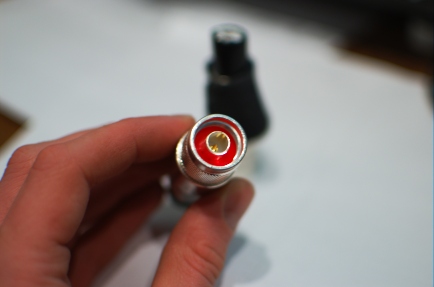
A while back, I came upon about two dozen Times Microwave Systems TC-600-NM connectors that had been improperly installed and cut off. Knowing that LMR-600 type cable is commonly available, I stashed them for later use. These connectors cost between $8 and $15 each, so the ability to recycle could offer a substantial savings. I endeavored to see just what it would take to do so.
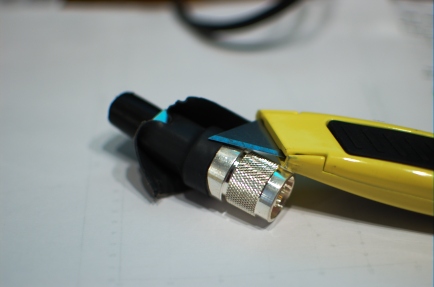
The first step is to remove the heatshrink tubing (if installed). These connectors employed a relatively easy-to-remove heatshrink, which I was able to get off with a sharp knife. (That probably means that they would have filled with water if they had been used.)
Twist off the old crimp ring with two pair of Channel-Lock-type pliers.
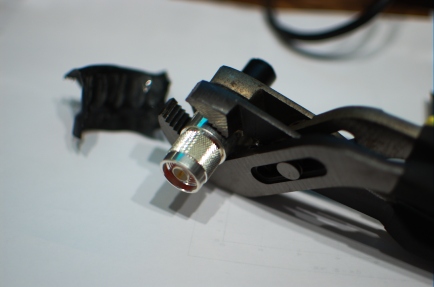
Presto! (Be sure to do this in a work area where it is easy to vacuum up the small strands of braid that will invariably fall everywhere.)
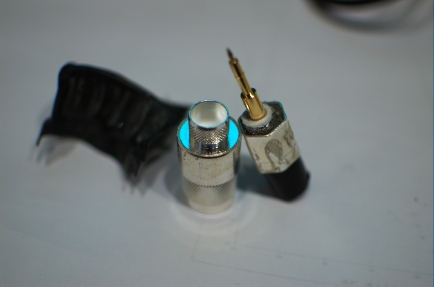
A butane torch gets the pin off in no time.
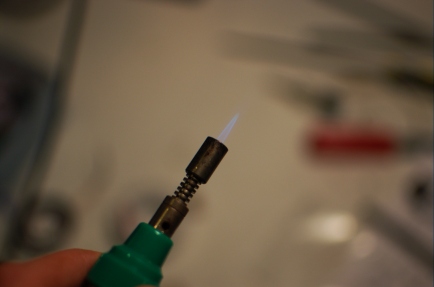
Unfortunately, I did not have enough hands to take a photograph and demonstrate the proper technique. Place the tip of the flame on the widest (diameter) part of the pin and rotate the cut-off coax with the pin hanging down. The solder will melt and the pin will drop. Reinstallation can be performed in the exact opposite sequence with the pin sitting on top of the coax.
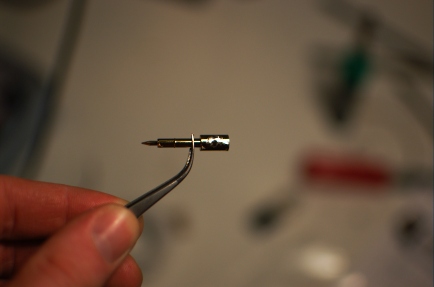
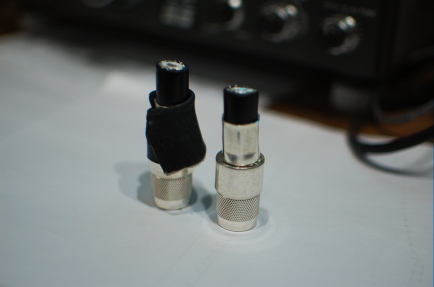
The secret to this whole operation is the replacement crimp rings. I originally was going to make them but since I did not know the dimensions, I was searching around the Web. And, I discovered that Times Microwave offers them individually (part #CR-600). So, I contacted Joel at The RF Connection and he sold me a bunch of them (second from right below) at an attractive price.
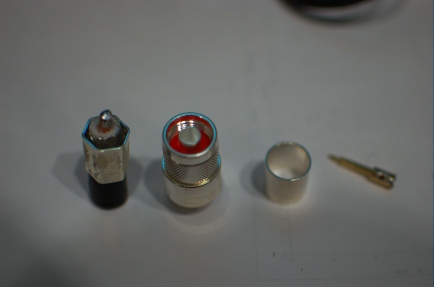
The three rightmost components—connector body, crimp ring, and solder pin, form a complete connector. You just need to add heatshrink, which is also available from the RF Connection and many other vendors. The trick to getting a correct installation on the connectors is to be sure that the pin seats (clicks) into the body before crimping the ring. The whole process of disassembly takes about as long as assembly (minus the stripping step)—just a few minutes.
I recently obtained about 250 ft (80 m) of LMR-600 pieces from various places for about what it costs to fill the gas tank in my Escort. So, this should be a relatively attractive cable for use at K8GU.
Ethan Miller, K8GU, is a regular contributor to AmateurRadio.com and writes from Maryland, USA. Contact him at [email protected].
Possible operation from Costa Rica
In July, I’ll be heading to the Guanacaste area of Costa Rica along with a group of friends (some of them the same as those who I was with when I operated from Grand Cayman as ZF2DK). This is primarily a vacation, and when I initially investigated whether I would be able to operate from there I ran into a few logistical issues and pretty much gave up. However, recently, a couple of those issues were removed, and now it’s looking a lot more possible than I’ll be operating as TI7/K2DBK. I will post updates here with additional information as things progress, but this will most likely be phone-only and while I’ll pick the bands based on conditions while I’m there, most likely I’ll be on 15, 17, and 20. I plan to bring my Buddistick that I’ve used in Cayman and from IOTA NA-034 because it’s small and very easy to travel with, my trusty Icom 706MKIIG, and a fairly lightweight switcher power supply. While the place we’re staying isn’t right on the water, it’s got a pretty decent elevation above it and a nice balcony outside my room that I can use to attach the antenna. I believe my best shot for DX will be towards the northeast US, Europe, and Africa, but I think that I’ll be able to work towards Asia as well.
As with my previous trip to Grand Cayman, this will be holiday-style operation, meaning that I’ll get on when I have free time, probably a few hours a day, most likely in the late afternoon.
I’ll be posting more once the plans are a little more firm, but I wanted to give a tentative heads-up.
Incidentally, I’m planning to just take my iPad instead of a laptop for the trip, and I’d like to hear from anyone who has used any logging software (there don’t seem to be a lot of choices, but I’d still rather get a personal recommendation) for the iPad. I expect most of my contacts to be DXpedition style, so I’m not looking for any fancy integration, just ease of use. Please either leave a comment or email me if you’ve got any recommendation.
You’ve Been Warned
I met KE9V at the Dayton Hamvention a few days ago and told him this story. Jeff invited me to share it with you in the interest of public safety…
I was licensed in 1959 having been bitten by the radio bug when I was a just a wisp of a boy. I spent every possible spare moment building gear, antennas, and learning the ways of radio. At some point fairly early in my journey, I fell in with a bunch of 4’s who met on 75 meter phone almost every night for long-winded late night bull sessions. We all lived within a five-hundred mile circle except for one fellow who told us his name was “LG” – just letters, no name – and when asked, he would swear on his mother’s grave that they weren’t his initials, it was just his ‘name’.
That caused a few of us to privately wonder about the character of a man without a real name but LG was a nice enough fellow except that on most nights would ask everyone in the roundtable to open their icebox and look carefully at our bottles of milk.
He wanted us to report back on the color of the cap and the type of milk. I couldn’t see much sense in it though LG was insistent. He was working on a theory that enemy spies were signaling each other about big events by changing certain colors. For instance, if 2-percent milk usually had a green cap, but was suddenly switched to blue then that meant that something bad was soon to happen.
“Stuff and nonsense” was the usual reply though we were all more than a little shook when shortly after the skim milk cap colors were changed from red to blue a DC-10 crashed on takeoff from Chicago killing everyone onboard. “Could have been an inside job”, LG said and who were we to protest having been eyewitnesses to the change in milk cap colors just a week before the tragedy?
Having known about the milk caps and yet not alerting the local authorities weighed heavy on me like a man condemned. So much so that before long I dropped out of the roundtable.
I didn’t want the responsibility that comes with such great power and foreknowledge.
Besides, I needed a bigger challenge and somehow got it in my head that I would become a world-class CW operator. That was just the sort of thing I needed to challenge me and to hold my interest. Though I had passed the Morse test years earlier to get my ticket, I thought of the code mostly as an annoyance, a barrier to keep dimwits out of the fraternity.
But after a year or so of constant practice, on the air, in contests, and off the air with a CPO, I couldn’t get comfortable above about 18 words per minute. I was blocked and becoming obsessed with a growing desperation to break through that barrier.
And it was at about that time that I attended a hamfest in Texas and happened to bump into old “LG” from the 75 meter net while I was there. We sat down with a few frosty 807s and he spoke at length about the milk caps and the way they were facilitating chatter among the spies that had infiltrated the USA…
Wanting to change the subject, I confided in LG the challenge I had laid out for myself – to become a world-class CW operator – and I admitted that I was falling seriously short of that goal. That’s when he looked at me for a long moment, leaned a little closer and said, “follow me and don’t say a word”.
Not wanting to be rude, and admittedly a little curious as to what he might be up to, I followed him to the RV lot where his motorhome was parked and we went inside. The unit was clean, though very small with a rack of radio equipment on one side. He said that he was now living full-time in this rig and was enjoying his retirement by traveling all over the country “wherever he wanted to go”.
We sat down in the only two seats available and after looking out all the windows, I guess to make certain we had some privacy, he began to speak in a hushed voice.
“I spent thirty-years in the military. Special ops. At the end of WWII we spent a lot of time critiquing the war effort – what worked, what didn’t. Truman was impressed with what the Brits had done at Bletchley and he wanted us to do the same. One of the weaknesses of that time was that most of the radio communication being passed by spooks was coded messages sent by humans using Morse.”
“Teaching agents the code wasn’t difficult – but like you, most of them would top out at about 20 words a minute. Since shorter transmissions were less likely to be traced, high value was placed on field ops who could send and receive Morse at much higher rates…”
“And so the nation’s top scientists were given a challenge – give us a way to take an average ‘Joe’ and make him a high speed CW operator in a month or less – Project Celeritas became one of the first top-secret, high-tech projects of the Cold War era.”
“What they came up with was a drug. First, you learn the code at a rudimentary level, then you take one of these pills and your ability to send and receive Morse grows exponentially. It’s a miracle – though not without a few side effects. I have a small supply and would share them with you for – $500 – which would be enough to get this gas guzzling rig back home – you interested?”
It sounds crazy, I know, but I was desperate. And it just so happened that I was flush with cash having planned to blow a small fortune at the hamfest. I pulled out my wallet and had $550. It must have been fate. LG took my money then told me to turn around and close my eyes while he collected the pills from a secret stash.
He handed me a bottle with 100 tiny pills inside. “Don’t take more than one a week and don’t show off your new found skills too openly. Uncle Sam thinks that these are long gone and if you draw much attention to yourself it will be trouble. You understand?”
I told him that I did and wandered off anxious to see if I had just wasted $500 or not…
Back in my own shack I took one of the pills and began to tune the bands. I didn’t notice an immediate improvement and was beginning to think that I had been ripped off by a nut with a milk bottle cap obsession but then, wait … what was that? I was reading the mail on the lower end of 20 – in my head. I listened carefully and decided these guys were running about 35wpm. Eureka!
Over the next month I faithfully took a pill once each week and found myself easily copying high speed code in my head while cleaning the house, working on a crossword puzzle, and once I even answered the door to talk to some disciple inviting me to his church – and I never missed a single bit of the conversation that was whirring along in the background from my receiver on 20 meters.
I could detect no side effects. In fact, the biggest problem with the drug was that I could find no one fast enough to really challenge me. I retrofitted paddles with high speed bearings but was beginning to run up on the physical limits of sending because the hardware couldn’t keep up with my burgeoning ability. A fact I found horribly frustrating.
Six months later I heard about an annual high-speed Morse code contest in North Carolina and decided to enter the fray. Before long I was seated at a table with a dozen other ops all with cans clamped to our heads copying code messages limping along at just 60wpm. When the speed reached 90 words per minute there was just me and one other guy left and he bowed out at 100wpm.
Amazed, they kept cranking the code speed up – it was being sent by a machine capable of sending at 160wpm and I easily copied paragraph after paragraph of random text, right up to the limit of the machine and was all the while taunting them to “go faster”.
I took home the trophy and $1000 prize without realizing that the results of the event would be published in the local newspaper. That story was picked up a day later by the wire services and within 48 hours there was a knock on my door. Two G-men escorted me to a local office where they asked me a lot of questions about how I was able to copy code at such speeds.
I hadn’t heeded LG’s warning not to show off the results of the drug and now there would be hell to pay.
After being transported to a dank office in Langley, Virginia I was interrogated but there was no need for them to go to extremes. I coughed up the details in a heartbeat figuring that now wasn’t the time to be coy. I had 43 pills left and told the Feds exactly where to find them in my home. And I told them everything I knew about LG … and the milk bottle caps. After two days of incarceration and hours of high-speed Morse tests they took me home.
The remaining pills were gone – taken by the government I assume.
Withdrawal from the drug began driving me crazy. I heard Morse when there was none to hear. Every sound in the house, from rain dripping off the roof to the popping of the water heater sounded like code to me and it only became worse. When I heard people talking my brain was trying to convert their words into code and that distracted me from having even a brief conversation with anyone. It kept getting worse until I could no longer work for a living or enjoy ham radio.
I sold my house and all my gear and moved to a solitary cabin in Michigan’s UP where even the chirping of birds sounds like a message that my brain strains to decode, but there’s nothing there to be decoded. I think I may be going completely mad.
I’m telling you this story because the Feds contacted me a year after all this went down for some additional information. It seems they never found “LG” and for all I know, he’s still out there dealing that magic drug to some unsuspecting radio ham who just wants to improve his code speed a little. After all, what ham doesn’t want that?
You’ve been warned…
Jeff Davis, KE9V, is a regular contributor to AmateurRadio.com and writes from Indiana, USA.
 Ham Radio Deluxe |
 W5SWL Electronics |
 Ham Radio Prep |
 KB3IFH QSL Cards  Hip Ham Shirts  HamRadioAuctions HamRadioAuctions Reliance Antennas Reliance Antennas Enigma Shop Enigma Shop |  morseDX  Ni4L Antennas  R&L Electronics R&L Electronics antennas.us antennas.us QRV QRV |
- Matt W1MST, Managing Editor
