 |
 28MHz musings
 17 June 2011 | by
  I’ve been quite tempted by one of the Anytone AT5555 10m transceivers. Quite clearly its heritage is a CB radio, but there’s an appeal in the simplicity of it. A few watts of SSB on 28MHz can go a long way as we know by now, and FM can be fun at times. Partly I’d thought about having one for the car – as long as I could find a 10m mobile antenna that will fit under the barrier at the station! Reading around on the web, reviews are fairly favourable. Still haven’t quite convinced myself to push ‘buy’ on the website! Anyone reading this that’s tried one?Either way – the musings have convinced me to reroute the coax from the Butternut vertical to the shack (it was previously routed to the lounge…) so that I can listen on 28MHz a bit more on one of the rigs I’ve got around. If I get a chance this weekend I’ll work on that.

Tim Kirby, G4VXE, is a regular contributor to AmateurRadio.com and writes from Oxfordshire, England. Contact him at [email protected].
Pick me up an HT on the way home!
It’s a rainy lunchtime in London and I just popped over to the City branch of Maplin to pick up a few connectors for something I want to do at the weekend. Whilst I was in there I had a look around.
To my surprise, under the communication section was a 144MHz handheld for about £90. It’s badged Moonraker, but I’m guessing it is one of the many radios finding their way to our market from China. Doubtless the quality isn’t going to be quite as good as one as one that you’d pay two or three times the price for, but at that price it would be worth trying.
What excites me about seeing equipment available so readily and as cheaply is that it has the potential to tempt people to take their first steps in amateur radio – or even to return to the hobby.
I’ve worked quite a number of people who had dropped out of the hobby over the years, but had seen the budget priced transceivers and been tempted to pick one up and try it out.
If you’ve got a ham licence, but no transceiver – why not give one a go! Amateur radio is much more than an HT – but every journey has to start somewhere!

Tim Kirby, G4VXE, is a regular contributor to AmateurRadio.com and writes from Oxfordshire, England. Contact him at [email protected].
Our little sliver of time
All the news sources–I saw it on Yahoo!, of all places–are churning out stories today about the current state of the surface of the sun. Three different “experts” have issued dire predictions about the sleepy sun and what it means for mankind…and not just us hams, who enjoy bouncing signals off an ionized atmosphere.
You know as well as I do that simply saying this cycle is slow to develop is not going to attract much reader interest. But if you say there is the possibility that the dormancy of Ole Sol portends historic implications, that it could reverse the effects of that evil, man-made global warming (or make it even more dire), that there could be unknown but potentially catastrophic weather events as a result…heck, even that we are on the verge of another Maunder Minimum, when the sun went to sleep for 300 years and we entered a “mini-Ice Age!”…then you will get some attention. Attention to your columns, your websites, your blogs, your books, your speeches.
I know it is human nature to see things from a very narrow perspective. Understanding things like climate change that usually take eons to be obvious and drawing conclusions about variations in sunspot minima and maxima that only occur in eleven-year cycles are difficult for us mortals to do. Geologic time and cosmologic time and distance are impossible for us to comprehend in our simple little seven- or eight-decade life spans. That’s why all the junk about rapid climate change (which I consider normal weather variation and based on decidedly short-term data) has found so many who are willing to swallow it, hook, line and sinker.
I admit I know little about sunspots or solar weather, beyond the fact that more spots equal better propagation on the high-frequency radio bands and pretty displays of the Northern Lights. And I appreciate data and scientific observation. But seems to me that it is far too early to say the sun is going to be dozing for the next three centuries simply because cycle 24 is a tad bit slow to get moving. After all, many of these same “experts” were touting what an active cycle this was going to be…and they were doing it only a year or so ago.
Reminds me of the high-tech “weather rock” my wife has in her flower garden. “If this rock is wet, it is raining. If it is dry, it is sunny. If it is white, it is snowing.”
I’m still hoping for an active solar cycle. I have somehow managed to be inactive in my amateur radio activities during each of the past two cycle maxima, and I had high hopes for that “arm-chair” ragchew with the Far East on 10 meters in the middle of the day. But if it doesn’t measure up, so be it. I talked to plenty of guys all over the world at the yawning chasm between the peaks, after all.
But most of all, I’d like to see everyone calm down a bit and not be so myopic. We see only a tiny slice of time in our own existence. Even so-called scientific observations are looking at a pitifully narrow slab of time and only a tiny bit of reliable data.
Put it into perspective before you panic and sell all your ham gear. Or before you stop gazing northward for a glimpse of the aurora borealis.
By the way, I checked. There is nothing we can do about the state of the sun’s surface anyway, so why worry?
Don N4KC
www.n4kc.com
www.donkeith.com
Don Keith, N4KC, is a regular contributor to AmateurRadio.com and writes from Alabama, USA. Contact him at [email protected].
Handiham World for 15 June 2011
Welcome to Handiham World!

Wondering about this photo of me getting grabbed by a giant alligator? I’ve used it many times before on a variety of occasions, but this time it’s especially apropos because time is flying by and there are some important dates that are approaching a little bit too fast for some of us!
Here we are halfway through the month of June already. That means we definitely have to pay attention to two important ham radio events, ARRL Field Day and the transition to the new The General Class question pool for all examinations after June 30. Field Day happens on the weekend of June 25 – 26. You still have time to volunteer with your local amateur radio club to help with planning, set up, and operation. I have operated many Field Day stations over the years and have had lots of fun. As I have mentioned in past years, what you want to do is find a club or group of other amateur radio operators who share your goals for the contest. If you are highly competitive and want to be in it for the points, you will want to pick a group with a no-nonsense approach to efficient operating. If you are like me and just want to have fun and really don’t care about your score all that much, you are going to be pretty unhappy if you are pressed to work lots of stations instead of having fun socializing or perhaps helping to run the GOTA (get on the air) station. So if you don’t care to rack up the points, be sure to make that clear to your other group members so that you are creating reasonable expectations when Field Day rolls around. The thing about Field Day is that it has always been part contest, part social get together, part emergency communications practice, and often times a good excuse for a family picnic. Since points are also given for getting a story about your Field Day operations in the media, the event also serves as an excellent way to showcase amateur radio to the general public. My own local club, the Stillwater Amateur Radio Association, has decided to locate its Field Day event in a local park and nature preserve. It offers the advantage of easy access and parking for the participants and general public, and it is also in an excellent, air-conditioned wheelchair-accessible building that will allow anyone to get right up to the stations and find out what is going on. Yes, it is true that we are not going to be using emergency power nor are we going to be setting up in an actual field. But our vision of Field Day includes getting as many people as possible to participate and to make it easy for the general public to stop by and see what we are doing. Some of our field locations in the past have been pretty rugged and visits by the general public were few and far between. Of course in those locations we were able to use portable power sources like generators and put up long wire antennas and even towers with beams. The thing about Field Day is that it is such a flexible event that you can pretty much make it what you want to be. So whether you are in it for the points or in it for the fun of just making an occasional contact and showcasing amateur radio, you can plan on having a great weekend of ham radio fun. Following shortly on the heels of Field Day is July 1, the first day on which the new General Class question pool is in effect. If you have been studying for your General Class license, now, and I mean today, is when you have to start looking for a VE session so that you can take your exam under the old question pool. Although it is not a disaster if you miss this deadline and have to test under the new pool, there are new questions in the upcoming pool for which you haven’t studied. It is far better to get the test out of the way ASAP so that you can start looking around for an HF radio and planning your new HF antenna system. If you have put off studying and are not sure whether to attempt the test or not, I suggest that you head for one of the online testing sites such as AA9PW.com and take some practice exams. I would say that if you pass two out of three times, you may be ready to take a chance on the real thing. If you are failing the tests by many points, forget it; you have to hit the books and take the test under the new question pool after you have had sufficient time to prepare. There is one other thing happening on July 1 that probably only affects us here in Minnesota, and that is the prospect of a State government shutdown. We have a divided government here in Minnesota, and the legislature and governor have not been able to agree on a budget. This must be done by June 30, or at least part of the State government will have to shut down. Because our parent organization, Courage Center, provides services for people with disabilities, there will be a definite effect on us as an organization as there will be on other healthcare organizations and nursing homes here in the State of Minnesota. While the Handiham program does not depend on government funding, significant parts of other Courage Center programs do. In the upcoming weeks Courage Center is planning what to do in the event of a government shutdown and loss of funding for a portion of our clients. If you think about it, it makes sense to plan for the worst-case scenario while hoping for the best. It is already quite late and much planning has already taken place, but the fact of the matter is that no one knows exactly what will happen in a State government shutdown. We will keep you posted on anything that affects the Handiham program. Radio Camp will continue as planned, because our Handiham services are not government-funded.
Patrick Tice [email protected] Handiham Manager

Letters

Anne, K1STM, writes about her sudden exit from last night’s TIPSnet session:
In case you’re wondering what happened, a very good friend’s daughter called telling me her mother and guide dog were hit by a car while out for a walk. My friend, Nancy, is fine. Her dog, Simon, broke the bones in his foot and has a tender stomach. He is in the animal hospital, Nancy is home. They were at the end of a driveway near their home when a car suddenly started and backed up fast and hit them, throwing Nancy down and Simon under it. Nancy didn’t have time to finish crossing the driveway and the driver apparently didn’t look. We think Simon saved Nancy’s life. What a night!
Anne, K1STM TIPSnet Manager
Editor’s note: We are sure happy to hear that your friend Nancy and her dog Simon are going to be okay. In some ways, even with the awareness of good pedestrian safety practices and better driver training, pedestrians and wheelchair users are at more risk than ever. There are a lot of distracted drivers out there, busy talking on cell phones or fiddling with the radio. If you drive, make operating your vehicle your first priority. If you are walking or using a wheelchair remember that even though you may have the right of way not all drivers are responsible and careful.
Troubleshooting 101: The junk box – is it obsolete?
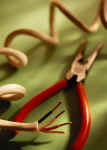
In the course of a conversation I had with a Handiham member recently, the topic of spare electronic parts came up. That got me to thinking how the Handiham shop has changed over the years and how the traditional ham radio operator’s junk box has changed right along with it. 20 years ago, when I started with the Handiham program, we had a very well stocked collection of vacuum tubes and discrete electronic components in our electronic repair shop. We had a cadre of around a half dozen dedicated volunteers led by chief volunteer Rex Kiser, W0GLU, and the repair shop was staffed several days a week. Back in those days, donated electronic equipment was usually tube-type and was generally considered to be “repairable” unless it had been dropped from a 10 story building or run over by a truck. Most of the components were discrete, meaning that if a capacitor went bad it was possible to trace it and replace it. The same went for vacuum tubes, a common source of failures in equipment of that vintage. Naturally it was practical and necessary to maintain a well-stocked collection of electronic parts and repair manuals for a variety of common and not so common pieces of amateur radio equipment. The shop volunteers had pretty much “seen it all” and were familiar with all of the common problems in the amateur radio equipment of that era. Some of the donated gear that came into the shop had been modified by its previous owner, but the shop volunteers were pretty much able to figure out just about anything and make it right. The old shop was in the basement of the Courage Center in Golden Valley, Minnesota. Golden Valley is adjacent to Minneapolis and thus was a relatively convenient location for volunteers to get to so that they could work in the shop. I don’t remember exactly how many square feet of space was devoted to the shop, but I can tell you that there was a significant amount of both working space with large, well-let workbenches and another separate area with many shelves to store donated equipment, gear that was in the process of being repaired but waiting for something or other, and equipment that was ready to be sent out in the equipment loan program of the day.
Everything is so much different today. Most of our volunteers, including Rex, have become silent keys. It has been so very hard to lose so many good friends over the past two decades. In some ways, their passing reminds me of my father’s working life and what has transpired since he passed away in the 1980s. Dad was a typewriter repair man, and in the last quarter century since he died, so has the typewriter, at least in any form in which he would recognize it. Technology has changed amateur radio just as radically as it has the typewriter business.
The amateur radio equipment of today is often not considered to be user-serviceable. Tiny integrated circuits and surface mount components are packed onto dual-surface circuit boards. It has become very, very difficult to trace and diagnose problems in this new equipment. When repairs are necessary, one simply packs the equipment up and sends it back to a service center for repair or replacement. Even at authorized service centers repairs usually consist of replacing entire sections of the radio because it is often times not practical to trace problems down to a single bad component. On the plus side, this new equipment with its solid-state surface mount technology is far more reliable than the old equipment and as a result will likely never need repairs.
So the Handiham repair shop has pretty much ceased to exist. About all that can be done these days is to diagnose at a very basic level, and that means simply giving a piece of donated equipment a “thumbs up” if it is working or a “thumbs down” if it is not. It would be impossible to maintain a supply of discrete parts or even modules for all of these new radios. Furthermore, the test equipment available to us is simply too basic to be used in any practical sense to repair serious problems. Since all of this change has happened to the Handiham shop, I think it is reasonable to expect that similar changes have taken place in your own workshop in the basement or the garage! You may have quite a collection of vacuum tubes, radio hardware, and discrete electronic components. I have some of that stuff myself, but I am hard-pressed to think of the last time I made use of any of it. When something needs fixing, it had better be something pretty basic like a dipole antenna or a manual antenna tuner if I am going to actually attempt any repairs myself. I don’t own a single radio with a vacuum tube in it anymore and the radios that I do own have been extraordinarily reliable because of the solid-state design and good engineering decades of improvement have brought to the amateur radio manufacturers. So maybe it is time to take a look at my own ham radio junk box and try to decide what to save and what to get rid of. This, as you might expect, is not going to be an easy task. For one thing, some of the old parts and frankly “junk” that I have collected over the years will simply never be any good to anyone in any practical sense. That means disposing of it, but because we are more aware of environmental consequences these days, one may have to dispose of old electronic parts through an electronics recycler. The days of simply pitching everything into the trashcan are gone forever. Where I live, my local county government has a recycling center that will take electronic parts, so at least I know that if I do a little sorting I can dispose of them without too much hassle.
The hard part is really the sorting. How do you decide what to get rid of and what to keep? If there is one thing I have observed over the years about the typical ham radio operator, it is that most of us think that there will be a use for every single item in our junk box collection at some time in the future. This is where you have to think things through before you start and develop a strategy for the kind of repairs you intend to do in the future. For example, since I no longer own any vacuum tube gear, I am going to get rid of any vacuum tubes that I find in my collection. I probably only have one or two left, so that shouldn’t be any problem. I have several tubs of unsorted oddball hardware. Yes, I could take a week off of work and burn some vacation time sorting through that junk, but why? Like as not, if I have a need for a particular piece of hardware, such as replacement stainless steel nuts and bolts for an antenna project, I am probably going to make a trip to the hardware store anyway rather than spending hours sorting through my tubs of hardware junk. Wire, if it is in actual usable lengths and properly rolled up and stored, can come in useful. You never know when you might want to put up another antenna or use the wire to add ground radials or to repair a dipole system. Coaxial cable deteriorates in the weather, so it never hurts to save a partially-used spool in your collection. That is the sort of practical stuff that one can save without feeling guilty about being a junk collector. On the other hand, those old carcasses of broken radios and military-surplus chassis that you had cannibalized for parts in 1975 really don’t need to be in your parts collection anymore, do they? If you haven’t used something in the last few years, you are probably never going to use it and you should think about getting rid of it. Yes, getting a table at a hamfest is one option, but I have never really understood the practicality of dragging 500 pounds of old junk to the high school gym, putting it on a table for people who don’t need it anymore than you do to look at, and then stuffing it all back into the trunk of the car and hauling it all home again that afternoon. It’s probably better to do some simple networking at your ham radio club meeting to see if anyone wants something from your collection and is willing to take it off your hands. I’ve always felt that it is better to repurpose than throw away, but sometimes the only practical thing to do is to simply make the decision to clean up the junk box and the workshop and be done with it!
What should the workshop and parts collection of the 21st century ham look like?
Well, it’s going to be pretty lean and mean, that’s for sure. You are going to have a good tool collection and some basic test instrumentation, just as you have had in the past. You are not going to have boxes and boxes of assorted electronic junk and hardware that you are never going to use. It is okay to have a few basic components that are actually useful, such as connectors, fuses, and common hardware. Think about it: if you are really going to build one of those projects you see in one of the amateur radio publications, you are going to go to a company like Digi- Key and simply order the parts you need online or by calling on the phone. In fact, that is probably what you have to do already even if you have shelves and shelves and boxes and boxes of old hardware and electronic parts already in your collection, because none of that old junk is going to do you any good in the new project anyway. Furthermore, having lots of old unnecessary junk around can actually get in the way of enjoying building a new project. It is simply a fact that modern technology is going to require fewer repairs than old technology and the repairs that must be done will probably have to be done in a factory service center anyway. Of course there are exceptions to every rule. If you are one of those amateur radio hobbyists who are interested in vintage equipment, it may be practical and necessary to maintain a stock of vacuum tubes. Most of us have newer equipment and, if you are like me, too much old junk lying around that you will never use. I have been an amateur radio operator for over four decades, so I have had plenty of time to collect a sizable junk box. Since at one time I did own vacuum tube equipment and user-repairable radios, it made sense to have a collection of parts. Today those radios are long gone and replaced with modern equipment, but the junk box still has those old parts. I know that I am not alone in having this kind of collection in my workshop. Over the years in my work with the Handiham System I have run into some mind-boggling collections that have taken up entire basements and then some. Some people are just collectors, I guess! I prefer the lean and mean approach to the modern ham radio workshop. That’s why I’ve been paring down my junk collection and concentrating on keeping just what I need to do regular maintenance on my antenna systems and to do simple repairs. If I’m going to build the project I’m going to order new parts and get on with it. That is the practical, modern approach to the ham radio workshop.
Send your ideas about troubleshooting for possible inclusion in this column to:

Pat Tice, WA0TDA, is the manager of HANDI-HAM and a regular contributor to AmateurRadio.com. Contact him at [email protected].
A bit of a headache
A couple of people have commented on the lack of new postings on this blog. I’m grateful that you noticed. Here are a few words of explanation.
Three weeks ago I was doing some work on the computer when I had what I thought was a bad migraine attack. My vision became blurred and I felt nauseous. I switched off the PC and lay down in a darkened room to recover.
Normally a migraine leaves you feeling a bit shaky and after a couple of days you are right as rain again. but the feeling of shakiness never really went away.
After the attack I noticed a few symptoms that were a bit scary because they were really odd. For example I had trouble telling the time. I could see the hands of the watch but couldn’t seem to make sense of it. I also had trouble finding the pointer on the computer screen, even when I knew where it should be. These symptoms did start to wear off, but I still felt that something wasn’t quite right.
For example, if I was trying to pick something (like a Wainwright summit name) from an alphabetically sorted list on a web page I couldn’t find it. If my radio was on 145.450 and someone said they were QSYing to 145.525 I had trouble finding the channel.
I also had – indeed if you could watch me typing this you would find I still have – a lot of trouble using the keyboard. It became so frustrating that I lost most of the desire to post to the blog.
I was in denial that anything was wrong. Plus, to be honest, I didn’t have much faith that the system here would do much to help me. I hoped that if I just carried on trying to do normal things one day I would find that everything was back to normal again.
Last weekend I went for a walk to the top of Binsey, one of the local Wainwright summits. I made it to the top OK but after I finished making contacts and went to leave I felt strangely disorientated and had to search for the way down. On the drive home I almost went off the edge of the road because I had trouble judging the distance on the left hand side.
Walking around town several times I knocked into lamp posts and other obstructions on the left hand side, as if I didn’t notice them.
Eventually, yesterday, I decided finally that I should see my GP. He listened carefully as I described all the symptoms I have mentioned and did a few tests on my reflexes and co-ordination. Unfortunately it seems my pessimism about the system was not misplaced. The doctor told me that the specialist he would like to refer me to, a neurologist, is not available here.
He said – these are more or less his exact words – that the NHS is very good in an emergency, such as if you have a heart attack, but in the case of ongoing problems it doesn’t work very well. His role is just to help me get the best out of it. So he has arranged for me to have an appointment at the hospital in Whitehaven for a CT scan. which given the speed things normally move here could be several days. In the meantime I have been advised not to drive, which is obviously understandable but a major hassle in an place where public transport is very limited and it is a couple of hours by bus just to reach the hospital.
So I don’t know exactly what is the matter with me. I just have to wait for the results of the scan and hope for the best. In the meantime I can still talk to people on the radio but it is unlikely that I shall be posting to the blog or answering emails very much.

Julian Moss, G4ILO, is a regular contributor to AmateurRadio.com and writes from Cumbria, England. Contact him at [email protected].
My Collins Radio Equipment Is For Sale
I’ve finally decided to sell my Collins S-line station. Trust me, it’s not a decision I’ve made lightly!
I absolutely love this equipment. In fact, it’s my dream rig. I just don’t have the time to devote to working HF and I don’t see that situation improving anytime soon. I know that someone will be able to make very good use of it.
If you are interested, or know of someone who is, please pass this along!

Collins 32S-3A Ham Radio Transmitter
http://cgi.ebay.com/ws/eBayISAPI.dll?ViewItem&item=120737000467

Collins 75S-3C Ham Radio Receiver
http://cgi.ebay.com/ws/eBayISAPI.dll?ViewItem&item=120737004368

Collins 30L-1 Ham Radio Linear Amplifier
http://cgi.ebay.com/ws/eBayISAPI.dll?ViewItem&item=120737009082

Collins DL-1 Ham Radio Dummy Load
http://cgi.ebay.com/ws/eBayISAPI.dll?ViewItem&item=120737012242

Collins 312B-4 Ham Radio Station Control
http://cgi.ebay.com/ws/eBayISAPI.dll?ViewItem&item=120737015978

Collins 516F-2 Ham Radio AC Power Supply
http://cgi.ebay.com/ws/eBayISAPI.dll?ViewItem&item=120737020097
(Update: I’m sorry to report that all the equipment has now sold. Thanks for your interest!)
Matt Thomas, W1MST, is the managing editor of AmateurRadio.com. Contact him at [email protected].
6m digital DX
Conditions were again great on 6 metres yesterday afternoon and evening, with the Sporadic E favouring Scandinavia and the Baltic countries. After making a few contacts on SSB – it’s always gratifying when using an attic dipole to have stations come right back to your call and give you a 59 report – I was tuning up the band and heard the unmistakable sound of PSK31 activity.
I worked LA8OKA and OH2NAF using PSK31 and SM7OYP using PSK63. I thought these may have been my first PSK contacts on 6m but my log tells me I worked Spain using the digimode during June last year.
Signals were strong and steady and most people were using their regular macros and brag files and exchanging greetings rather than sending quick report and locator overs as you might expect for sporadic propagation.
Some bloggers have been advocating using the weak signal digital modes like WSPR or JT65A on 6m but when propagation is this strong I’d rather use a digital mode that allows me to have a proper QSO and exchange names and other details with the stations I’m working.

Julian Moss, G4ILO, is a regular contributor to AmateurRadio.com and writes from Cumbria, England. Contact him at [email protected].
 Ham Radio Deluxe |
 W5SWL Electronics |
 Ham Radio Prep |
 KB3IFH QSL Cards  Hip Ham Shirts  HamRadioAuctions HamRadioAuctions Reliance Antennas Reliance Antennas Enigma Shop Enigma Shop |  morseDX  Ni4L Antennas  R&L Electronics R&L Electronics antennas.us antennas.us QRV QRV |
- Matt W1MST, Managing Editor
