 |
 TI7/K2DBK Post-event wrapup, part 2
 31 July 2011 | by
 This is part 2 of the series, click here to read part 1
It’s been another crazy week at work and at home and I’d hoped to have another entry or two posted by now, but I just haven’t had the time. I’ve finally found a few minutes, so I’d like to focus on things from a DX perspective and talk a bit about QSLing.
As I’ve previously noted, the weather kept the total number of contacts far lower than I’d hoped, with the total number of contacts ending up at 87 for the week (including one duplicate who I helped out with an antenna check). It looks like I worked 22 different countries though I believe that one of those will be a busted call: I logged a caller with a “DX” prefix which would correspond to the Philippines but at the time I was working into Europe and I suspect that it’s actually a “DL” call. In terms of “best DX”, I worked into European Russia (UA) and Ukraine (UT) a few times, with the majority of the countries being in central Europe such as Spain, Italy, France, Belgium, Germany, Hungary, and others in that area. I worked relatively few US states, though I don’t have good statistics on the because I didn’t get the state from all the operators that I worked. Most of the stateside contacts tended to be in the US Southwest although I did work up into Virginia and farther up the US East Coast for a few contacts.
As I mentioned in my last post, I did manage to get a full-blown pileup going a few times, and I can really understand how addicting this can be. I’d love to be able to operate from a “real” DXpedition, or even from a “primarily radio” vacation somewhere, but for now my vacation time is limited so I tend to squeeze in radio when I can. I hope that at some point over the next year or two I can get creative and find time away for a “radio” vacation.
Regarding QSLing, I got a question this week from a station asking me about whether the contacts would be uploaded to Logbook of The World. As regular readers of this blog know, I’m a big fan of LoTW, and would love to make the contacts available there. However, I’m having some issues getting a LoTW certificate issued and it’s not clear when (or if) that issue will be resolved. (This only applies to my operating from TI7.) In the meantime, if you need a card, please QSL via my home call the “old fashioned” way with a paper card. Because of the relatively few contacts made, I’m not going to have a bunch of card commercially printed but I will design and print a card specifically for this operation. My QSL information is always kept up to date at my entry on qrz.com.
If you want to check to see if you’re in my TI7 log, I’ve uploaded that to the Clublog website which you can search here. If you think you worked me and you can’t find your entry in the online log, please drop me a note and I’ll check for you as it’s entirely possible that I busted a call or two.
VHF simplex QSOs
When I’m out and about mobile, I generally have at least one VFO scanning about 40 channels on 2m and 70cm. The 2m FM calling frequency (145.500) is one. But generally, I seem to end up making QSOs via the repeaters. This works well and I have lots of fun and interesting contacts.
This weekend I decided to leave one of the VFOs on 145.500 and make lots of CQ calls! It yielded a couple of decent contacts. Yesterday, from one of the lanes around the village, I worked a SOTA station M0TUB/P on the summit of Cleeve Hill near Cheltenham. And today, when I was driving back from Mum’s near Cheltenham, I had an excellent QSO with Giles G0NXA across the town and up and over the Cotswold escarpment. I wonder if a few CQs on 145.500 on the daily commute will bear any fruit?

Tim Kirby, G4VXE, is a regular contributor to AmateurRadio.com and writes from Oxfordshire, England. Contact him at [email protected].
Reflections on the Es season so far
The VHF Es season seemed to kick off early this year in mid April. So here we are at the end of July and it seems to have been going for a while. Sadly, it generally starts to tail off a bit now – normally.
The new V2000 aerial has proved a great success for single hop Es on 50MHz and I have two to three hundred QSOs in the log. 70MHz has been more sparse. I think I have probably spent too much time on 50MHz at the expense of 70MHz. And for me, 144MHZ has been a wipeout, with nothing heard or worked. But that’s just a case of not being there at the right time.
The Anytone AT-5555 has proved a lot of fun on 28MHz with a good number of low power QSOs around Europe on Es. With the exception of very low power WSPR operation, this has been my most rewarding HF operation in a couple of years!

Tim Kirby, G4VXE, is a regular contributor to AmateurRadio.com and writes from Oxfordshire, England. Contact him at [email protected].
ICQ Podcast S04 E16 – Cyprus Ham Radio Uncovered (31 July 2011)
Series Four Episode Sixteen of the ICQ Podcast has been released. News Stories include :-
- New Zealand's first radio station ZLW 100 years old
- RSGB Amateur Radio survey results
- Ofcom licensing error
- Codar radar on 24 MHz
- Amateur Radio exams falling
- 2 metre simplex frequencies loss imminent in Texas
- Radio ham killed in tower accident
- Ham radio saves man’s life
- SJ22S World Scout Jamboree
- The Republic of South Sudan now a DXCC Entity
- 5 MHz in Slovakia
- 500 kHz and 70 MHz in the Netherlands
- Brazil's first Amateur Radio satellite
Your feedback and Martin (M1MRB) and Colin (M6BOY) interview Richard (5B4AJG / M1EAR) and Baz (5B4AHO / M5BAZ) about being Amateur / Ham Radio operators in Cyprus.
Colin Butler, M6BOY, is the host of the ICQ Podcast, a weekly radio show about Amateur Radio. Contact him at [email protected].
ICQ Podcast S04 E16 – Cyprus Ham Radio Uncovered (31 July 2011)
Series Four Episode Sixteen of the ICQ Podcast has been released. News Stories include :-
- New Zealand's first radio station ZLW 100 years old
- RSGB Amateur Radio survey results
- Ofcom licensing error
- Codar radar on 24 MHz
- Amateur Radio exams falling
- 2 metre simplex frequencies loss imminent in Texas
- Radio ham killed in tower accident
- Ham radio saves man’s life
- SJ22S World Scout Jamboree
- The Republic of South Sudan now a DXCC Entity
- 5 MHz in Slovakia
- 500 kHz and 70 MHz in the Netherlands
- Brazil's first Amateur Radio satellite
Your feedback and Martin (M1MRB) and Colin (M6BOY) interview Richard (5B4AJG / M1EAR) and Baz (5B4AHO / M5BAZ) about being Amateur / Ham Radio operators in Cyprus.
Colin Butler, M6BOY, is the host of the ICQ Podcast, a weekly radio show about Amateur Radio. Contact him at [email protected].
Riverside portable with KX1
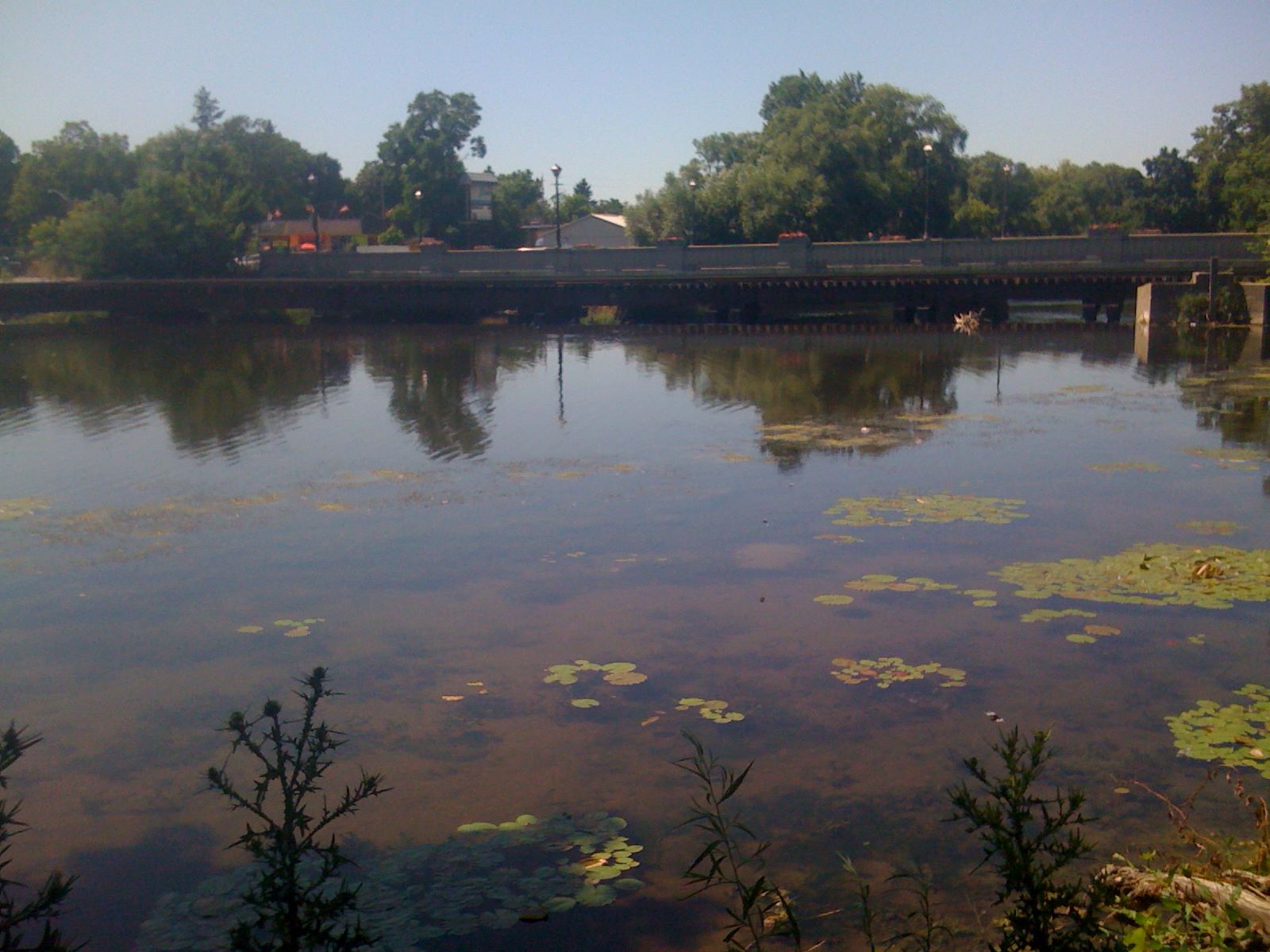
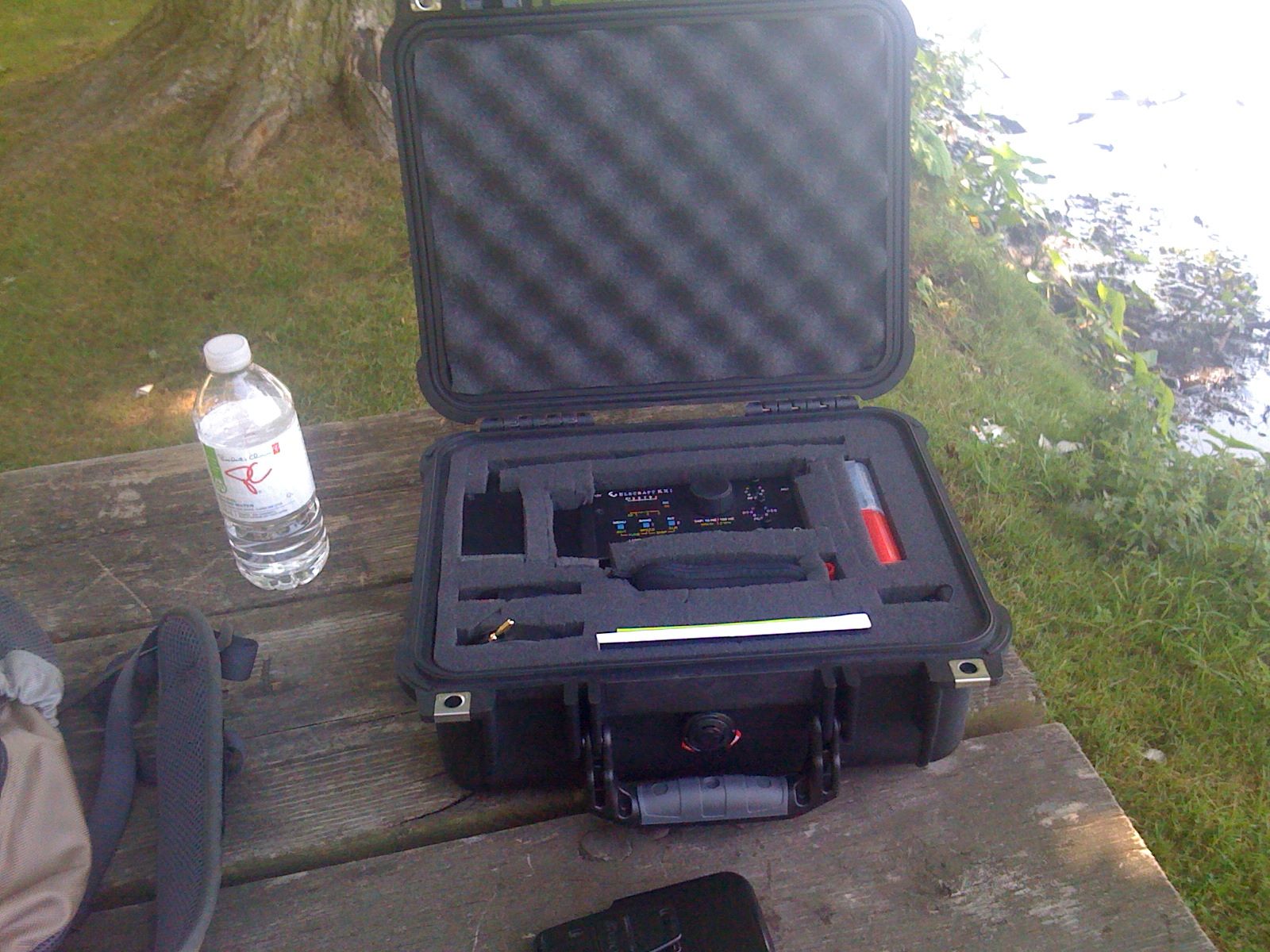
sure all was packed (Murphy decided to participate in those plans). It was off to Starbuck to have a coffee and get the laptop out (Starbucks has free wifi) and look up the contests that are on and get the exchange's they are using. I was going to be a "point giver" in as many contests as I could. So once at Starbucks Murphy kicked in.....I had all I needed for my portable operation but forgot my laptop!!!! Well the Iphone came to the rescue and I was able to get the contest info from there. So it was off to the park and I did find the perfect spot to setup at around 10 am. It was still cool but just to make sure this spot was under a large tree with
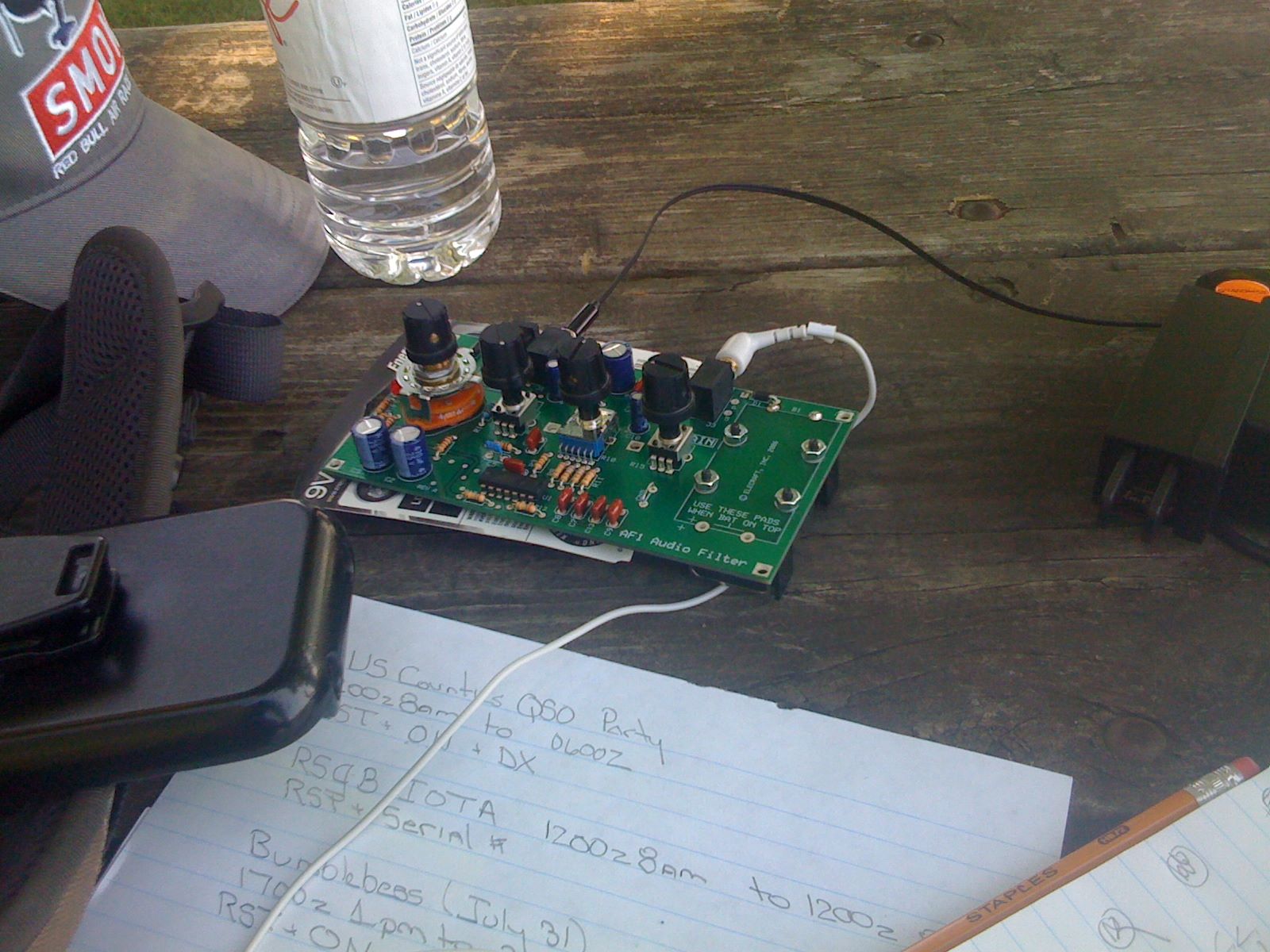 |
| Elecraft AF1 |
lots of shade right beside the river. It was time to take a picture of the setup. Got the camera out and it just would not take a picture...I charged the battery last night....hmmm...upon further investigation I forgot to put a memory card for the camera.....another Murphy moment....Well the Iphone came to the rescue once again so the pic's in this post are done with my Iphone. I camped out on 20 meters and it seemed to be more alive with the IOTA contest than the QSO party contest. The noise level was amazing at almost "0" . So how did the AF1 work out...I found the connecting cable between the KX1 and AF1 being not shielded was picking up the RF from the
 |
| The park patrol |
 N4LN 14.082mhz 400 miles with 1 watt.
Mike Weir, VE9KK, is a regular contributor to AmateurRadio.com and writes from New Brunswick, Canada. Contact him at [email protected].
HamAuction.com Up For Grabs

A little birdie let me know that an interesting web address is up for auction today. The Internet domain name, hamauction.com, is at a little over $300 at the moment. For those looking to set up a ham radio-related site, not a bad name!
For those who are interested, it’s being offered up for auction by the domain registrar. Apparently the former owner didn’t pay the renewal fee, so now it goes to auction to the highest bidder. There’s a good lesson here — if you own your own web address, don’t forget to keep your e-mail address current so that you get the renewal notices. Even better, pay a few years ahead so that you don’t wake up one morning and your domain name is gone!
Anyway, here’s the link.
Matt Thomas, W1MST, is the managing editor of AmateurRadio.com. Contact him at [email protected].
 Ham Radio Deluxe |
 W5SWL Electronics |
 Ham Radio Prep |
 KB3IFH QSL Cards  Hip Ham Shirts  HamRadioAuctions HamRadioAuctions Reliance Antennas Reliance Antennas Enigma Shop Enigma Shop |  morseDX  Ni4L Antennas  R&L Electronics R&L Electronics antennas.us antennas.us QRV QRV |
- Matt W1MST, Managing Editor
