 |
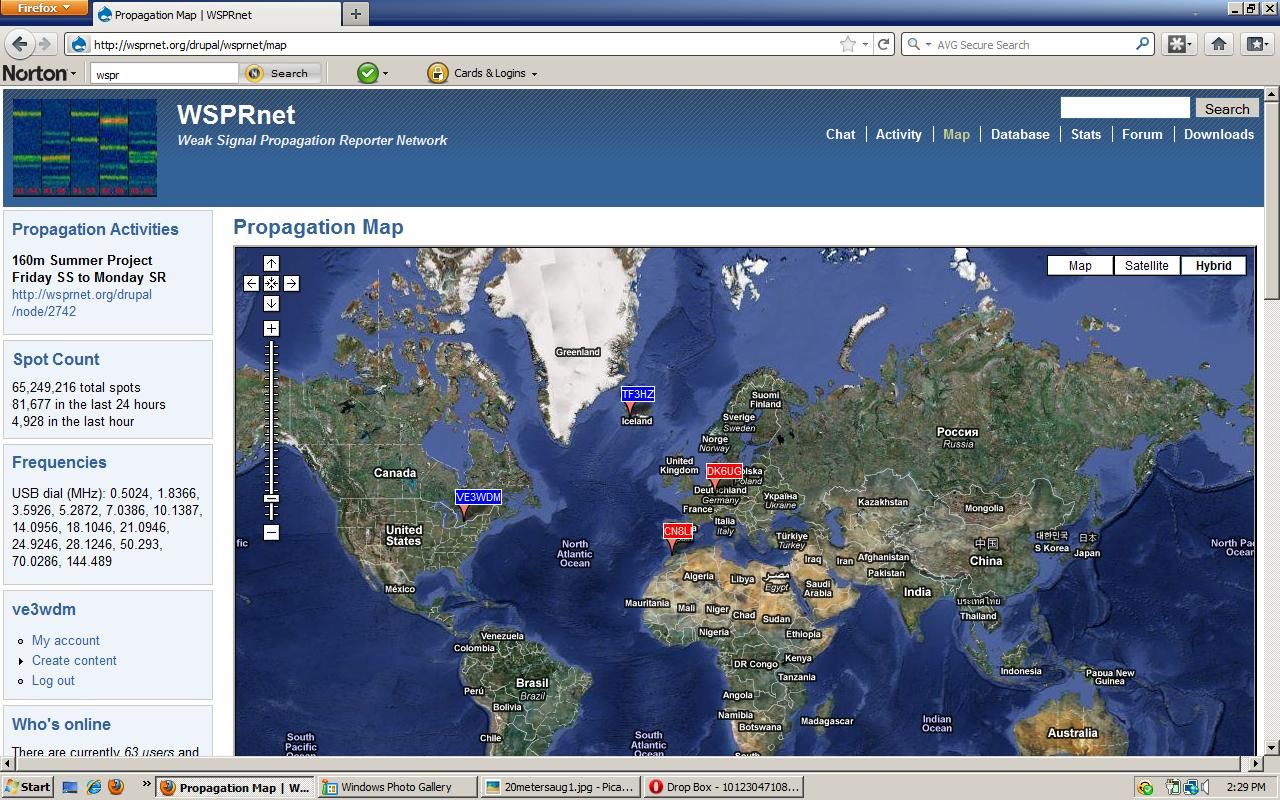
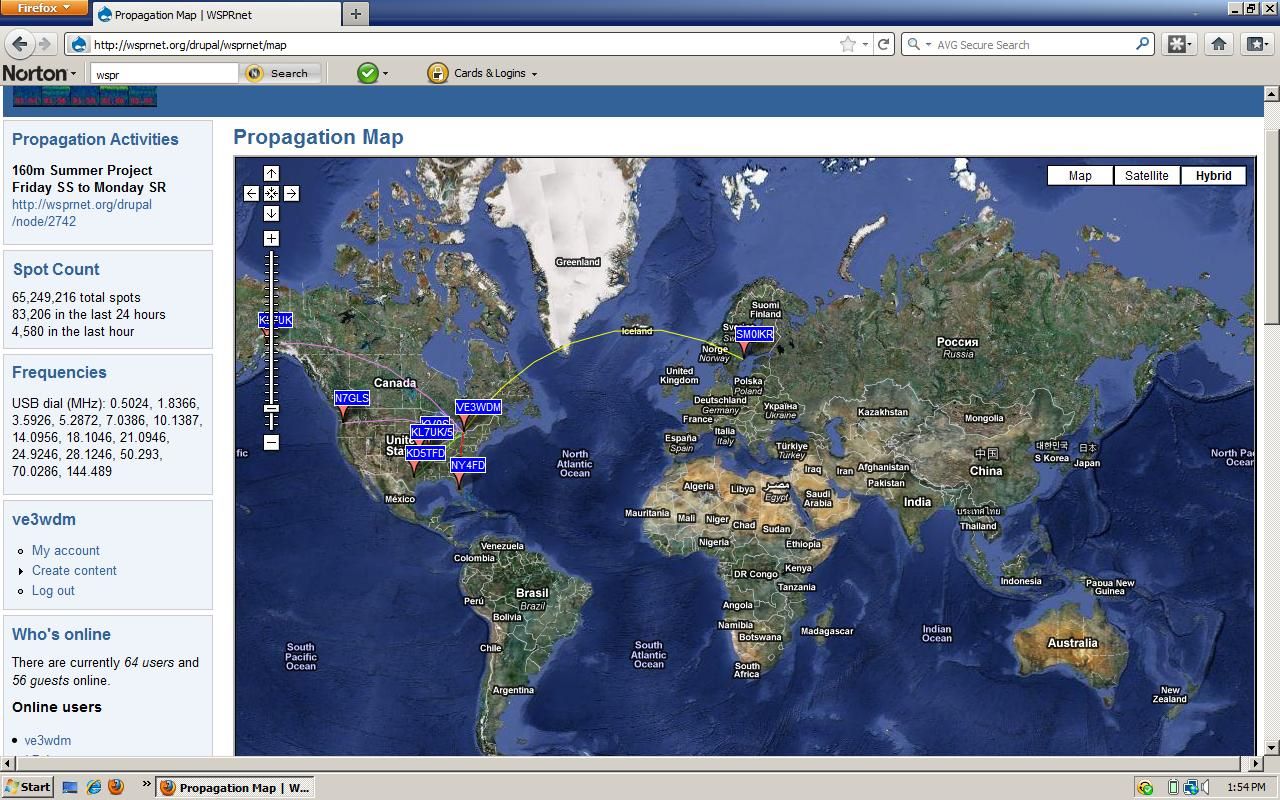
 You can count on WSPR
 1 August 2011 | by
  |
| 10 meters |
 |
| 15 meters |
 |
| 20 meters |

Mike Weir, VE9KK, is a regular contributor to AmateurRadio.com and writes from New Brunswick, Canada. Contact him at [email protected].
QRP and DXing
I rarely post on the Elecraft reflector these days but I do check Nabble from time to time to see what’s going on and today I saw one thread that got me annoyed. Someone who had just built a new base version K2 posted that until he had done so he hadn’t realized that it was possible to work DX using 15 watts. Someone then piped up that QRP DX claims are pretty meaningless unless the antennas used are also mentioned – a point with which I’d agree. But then someone had to add the hoary old argument “They also don’t report how the guy they worked had to struggle to pull them out or what his equipment was.”
This argument gets my goat every time. Whilst many people use QRP through choice, when it comes down to antennas many people don’t have a choice. If you live in an apartment, or like me in a tiny house on a postage stamp sized plot, or if you have HOA restrictions, or again like me have an awkward neighbour who likes to make your life difficult just because he can, then having a tower and a beam, or even a decent long wire antenna high and in the clear simply isn’t an option.
What these people seem to be saying is: “If you can’t run high power and a beam like me then don’t waste my time.” Now, excluding a lot of people from the hobby just because they aren’t fortunate enough to be able to put together a top class station doesn’t seem to me like a good thing for the future of the hobby.
It is surprising what you can work using low power, even with modest antennas. And what the naysayers who have probably never even tried using low power and simple antennas don’t realize is that it is also surprising how many contacts don’t have to struggle to pull the QRP station out of the noise. In fact they have probably worked many low power stations themselves without realizing it because the other guy never mentioned he was using QRP. The attitude that “life’s too short for QRP” is just bullshit.
But when making contacts with low power and limited antennas is a struggle there are always other things you can do. Personally, ticking countries off a list has always seemed to me to be an exercise in frustration, especially since the advent of the DX Cluster which means that you’ll almost never come across a DX station that isn’t on the end of a pileup. And whilst it’s nice to have a chat uisng the radio, these days it’s so much easier to have a discussion about the hobby online using forums, blogs and so on.
For many of the QRP persuasion, ham radio is a lot to do with seeing how far a little radio signal can go. And there are so many ways you can do that – with QRSS beacons, WSPR and weak signal digital QSO modes like JT65A. Today I saw a Google Groups post from Joe W6CQZ/4, the author of the JT65-HF program, who is using the mode to make contacts running 500mW to a 20m Hamstick mounted on the metal roof of his shed. This sort of thing is much more satisfying than working DX using a superstation. Let’s fact it, anyone could do that if they had deep enough pockets and enough real estate. Where’s the challenge in it?
So if you can’t run a superstation don’t be discouraged by the braggers with their QRO gear and big antennas. There’s a heck of a lot of fun to be had in this hobby using low power and simple gear. And I’ll bet a whole lot less frustration, expense and envy as well.

Julian Moss, G4ILO, is a regular contributor to AmateurRadio.com and writes from Cumbria, England. Contact him at [email protected].
AM Fone -Where the Heavy Iron Meet
For some time, I have admired and loved AM radio. I worked at an AM broadcast station for 12 years. So I fell in love with that full sound. It has always appealed to me. And there are other out there who enjoy that too. And if you have ever wanted to be a part of that world, you can be. There is even a website for people who love AM as well as home brewing radios.

Screen Shot of AMFone.net
I have been a lurker on AMFone.net for a while. I originally found it through the AM Window website. It has articles and files on how to get a top notch AM station on the air and sounding good. You can also have a look at the classifieds on the website to find equipment to supplement your existing AM station to to find that right receiver or transmitter to get your station started. There is even an area for restoration of old radios as well.
And not to leave out the folks who like new radios, there is also a section for modern rigs. Tips and modifications to get that modern solid state radio to be top notch on AM. And if you’re like me and want to just learn more in general about Ham Radio from a more technical side, this is an awesome site to do it from as well. Reading and asking questions is how to learn. And one of the things I have found on this site is a lack of old farts telling you “How it should be done”. Instead, I have found helpful people willing to share their knowledge.
Definitely check out this website if AM has been a mode you have been curious about. It’s well worth the look and you’ll be happy you did.
73.
Rich also writes a Tech blog and posts stories every Tuesday and Thursday on Q103, The Rock of Albany’s website, as well as Amateur Radio stories every Monday thru Friday here on AmiZed Studios.
[amazon_enhanced asin=”B000P0O12I” /]
Rich Gattie, KB2MOB, is a regular contributor to AmateurRadio.com and writes from New York, USA. Contact him at [email protected].
IKEA and ham radio
Just a few days ago the IKEA store opened here in the local Denver area. We’ve been hearing about IKEA coming to Colorado for the past 4-5 years. Just a little over a year ago, IKEA broke ground on their new site just south of my QTH in Centennial, Colorado. The grand opening certainly wasn’t without fanfare and my wife was looking forward to visiting the new store.
The local news sources (TV, radio and newspaper) had all been talking about the number of people lining up and even camping out for several days before the official opening. I avoid most crowded situations like the plague and this was certainly no exception.
Since the grand opening was Wednesday, I really figured the weekend crowd (Saturday and Sunday) would also be busy, so we decided to go on Friday and make an evening of it. Our IKEA has a restaurant specializing in Swedish meatballs. Yum Yum
Anyway, I gladly accepted my role of driver and bag carrier. We arrived just after 6 PM and the city/county officials had done a great job with traffic management. Once on the IKEA property we were directed to the underground parking garage and found a parking spot with ease. A few minutes later we were riding up the escalators to the upper level of the store.
While my wife had a few items on her shopping list, I really went with no expectations I would find anything I wanted, much less needed. But I enthusiastically walked around looking interested in all the stuff IKEA sells. Now before you get the wrong impression, I do enjoy shopping and it’s made even better when my best friend, my wife is with me. Yes, I’ll be the first to admit I know where all the “man chairs” are located in the mall shops, but I do enjoy shopping.
We covered the two levels of IKEA and I had not really found anything that interested me personally. I looked at the office chairs but my wonderful wife had purchased me a great chair last year and it still looks as good as new. We passed by some of those white, cardboard magazine boxes. I did grab a pack of 5 for about 3 bucks I think. I need something to better organize QST, CQ and RADCOM magazines.
A few minutes later I found something that caught my eye. It was a LED table lamp on an adjustable arm. It puts out practically no heat and I can bend the light around and focus it just where I need it. The wife saw me looking at them and she said “for the soldering projects”? I said yes and then some.
The light has a heavy base (around 2lbs) and comes with a 6 foot cord. This lamp will work great with my “soldering projects”, but also with other things where I just need to get more light onto the subject. The light cost me $12.99 and can be found here on the IKEA website.

It didn’t take me long to put it to good use. Here you can see it being used on an old radio project I’ve been working off and on (mostly off). I’m currently re-stringing the dial cord on an old Belmont AM radio my wife gave me for Christmas a few years ago. The radio needed a new dial cover, dial string and dial light. I have all the parts and just getting it all assembled again.
But yes, the IKEA light will also come in handy for soldering projects and other things around the shack. I often dim the lights when operating (especially at night) and this will be great just to the side of my shack desk.
So I guess even a radio ham can find things of interest in IKEA. It’ll probably be a few weeks before we venture into IKEA again. I will probably pickup another of these lights and I already need some more magazine boxes. Who knows, maybe I’ll find a few other things I can’t live without next time.
Until next time…
73 de KD0BIK
Jerry Taylor, KD0BIK, is a regular contributor to AmateurRadio.com and writes from Colorado, USA. He is the host of the Practical Amateur Radio Podcast. Contact him at [email protected].
Sorry for the long absence
Hello fellow amateurs,
Sorry for the long delay between blog postings. The last update was a Merry Christmas message and before that it was Happy Thanksgiving. I’ve had some recent ham radio activity and plan to get the blog going again with those activities in the next few days. So for now I’m just using this posting to test the RSS feeds, knock the cobwebs down from the site and say hello to all my fellow ham friends.
73,
Jerry
KD0BIK
Jerry Taylor, KD0BIK, is a regular contributor to AmateurRadio.com and writes from Colorado, USA. He is the host of the Practical Amateur Radio Podcast. Contact him at [email protected].
TI7/K2DBK Post-event wrapup, part 2
This is part 2 of the series, click here to read part 1
It’s been another crazy week at work and at home and I’d hoped to have another entry or two posted by now, but I just haven’t had the time. I’ve finally found a few minutes, so I’d like to focus on things from a DX perspective and talk a bit about QSLing.
As I’ve previously noted, the weather kept the total number of contacts far lower than I’d hoped, with the total number of contacts ending up at 87 for the week (including one duplicate who I helped out with an antenna check). It looks like I worked 22 different countries though I believe that one of those will be a busted call: I logged a caller with a “DX” prefix which would correspond to the Philippines but at the time I was working into Europe and I suspect that it’s actually a “DL” call. In terms of “best DX”, I worked into European Russia (UA) and Ukraine (UT) a few times, with the majority of the countries being in central Europe such as Spain, Italy, France, Belgium, Germany, Hungary, and others in that area. I worked relatively few US states, though I don’t have good statistics on the because I didn’t get the state from all the operators that I worked. Most of the stateside contacts tended to be in the US Southwest although I did work up into Virginia and farther up the US East Coast for a few contacts.
As I mentioned in my last post, I did manage to get a full-blown pileup going a few times, and I can really understand how addicting this can be. I’d love to be able to operate from a “real” DXpedition, or even from a “primarily radio” vacation somewhere, but for now my vacation time is limited so I tend to squeeze in radio when I can. I hope that at some point over the next year or two I can get creative and find time away for a “radio” vacation.
Regarding QSLing, I got a question this week from a station asking me about whether the contacts would be uploaded to Logbook of The World. As regular readers of this blog know, I’m a big fan of LoTW, and would love to make the contacts available there. However, I’m having some issues getting a LoTW certificate issued and it’s not clear when (or if) that issue will be resolved. (This only applies to my operating from TI7.) In the meantime, if you need a card, please QSL via my home call the “old fashioned” way with a paper card. Because of the relatively few contacts made, I’m not going to have a bunch of card commercially printed but I will design and print a card specifically for this operation. My QSL information is always kept up to date at my entry on qrz.com.
If you want to check to see if you’re in my TI7 log, I’ve uploaded that to the Clublog website which you can search here. If you think you worked me and you can’t find your entry in the online log, please drop me a note and I’ll check for you as it’s entirely possible that I busted a call or two.
VHF simplex QSOs
When I’m out and about mobile, I generally have at least one VFO scanning about 40 channels on 2m and 70cm. The 2m FM calling frequency (145.500) is one. But generally, I seem to end up making QSOs via the repeaters. This works well and I have lots of fun and interesting contacts.
This weekend I decided to leave one of the VFOs on 145.500 and make lots of CQ calls! It yielded a couple of decent contacts. Yesterday, from one of the lanes around the village, I worked a SOTA station M0TUB/P on the summit of Cleeve Hill near Cheltenham. And today, when I was driving back from Mum’s near Cheltenham, I had an excellent QSO with Giles G0NXA across the town and up and over the Cotswold escarpment. I wonder if a few CQs on 145.500 on the daily commute will bear any fruit?

Tim Kirby, G4VXE, is a regular contributor to AmateurRadio.com and writes from Oxfordshire, England. Contact him at [email protected].
 Ham Radio Deluxe |
 W5SWL Electronics |
 Ham Radio Prep |
 KB3IFH QSL Cards  Hip Ham Shirts  HamRadioAuctions HamRadioAuctions Reliance Antennas Reliance Antennas Enigma Shop Enigma Shop |  morseDX  Ni4L Antennas  R&L Electronics R&L Electronics antennas.us antennas.us QRV QRV |
- Matt W1MST, Managing Editor
