 |
 Luddite…or just a traditionalist
 1 October 2011 | by
 There is quite a debate raging over on eHam.net about a service provided to amateur radio operators by the ARRL. With the Internet and computer being an integral part of most of our shacks, the ARRL created Logbook of the World, an electronic way to do confirmations of QSOs, a function previously done by QSL cards through the mail. Some say they went overboard on the security aspect of their system. It does require a security certificate with an applicant’s call sign and location verified through the Federal Communications Commission before it is granted to the user. Many hams have had difficulties setting up the system on their computers or moving it to a different machine when necessary and are having a fit about having to jump through such hoops for what they see as no real good reason.
The thrust of the eHam comments–and those with a negative view tend to dominate this discussion just as they do any Internet forum–is that LoTW is too complex, that it threatens the traditional printed, post office-delivered QSL card, and even that it threatens the “privacy” of anyone who uses the system since the League could sell that info or it could be subpoenaed by some nefarious government agency.
This type of debate seems to be quite common these days anytime there is a new-fangled way to do anything in our society. I suspect a big part of it is simple resistance to technological change. People still have a choice in most things technical. You don’t have to use a smart phone, join Facebook, have an email address, or use an online QSO confirmation service. But I understand why anyone with an aversion to change or a distrust–however well placed or dismally unfounded it might be–of all this technology is reluctant to accept it.
I enjoy getting a QSL card from a new country in Africa or one that bears a picture of a ham’s antenna farm in rural Belgium. I hope we never lose that personal touch. But I also enjoy the convenience and cost savings of being able to confirm contacts electronically. Stamps to mail to some parts of the world are expensive. It can take years to send and receive back a card. Stations in rare locations get tons of requests for confirmations and that can run into big expense for them, too. Some even ask for “green stamps”to offset their expenses, but putting cash into an envelope is risky, especially in some spots where an envelope bound for a ham radio operator is routinely opened because everyone knows there are bucks in there.
But the real reason I endorse LoTW and similar services is that it allows me to easily and inexpensively extend the courtesy of a confirmation to anyone and everyone who wants it for whatever reason. I still get paper cards and I display them on the wall in my office/”shack.” I enjoy looking at them. I hope they never stop coming. But I also recognize that there is a way that is better in most aspects and that allows me to benefit from the service. And I believe there are enough people like me who still like the card that they will probably not go away.
And isn’t that what new technology is supposed to do? I love the fact that I can download a book on my Nook, but I also still enjoy the traditional book. I also think both methods will still be around for a long, long time.
But I also understand that all this change is scaring the bejesus out of some folks.
Don Keith, N4KC, is a regular contributor to AmateurRadio.com and writes from Alabama, USA. Contact him at [email protected].
HRO launches new auction site

I was perusing HRO’s website this morning and noticed that they’ve apparently launched an auction page. It looks like they’ve gone to an auction model to move damaged box and scratch’n’dent merchandise. You’ll have to watch closely, however, as you can’t see the price that previous items sold for. It also doesn’t look like it will notify you if someone outbids you. Will be interesting to see if there are any deals to be had.
Matt Thomas, W1MST, is the managing editor of AmateurRadio.com. Contact him at [email protected].
LHS Episode #067: The Left Hand of ARES
 And we are back. In this installment, Richard tells us all about his renewed interest in emergency communications and his dealings with ARES in the Texas county where he now lives. On the Linux side of things, Russ talks about some security issues: the hacking of kernel.org, emacs violates the GPL and how to get cheap certificates for your Web sites. Throw in a dash of humor, some general screwing around and you have the formula for pretty much every episode of Linux in the Ham Shack. Thanks for sticking it out with us, everyone. We love each and every one of you.
73 de The LHS Guys
Russ Woodman, K5TUX, co-hosts the Linux in the Ham Shack podcast which is available for download in both MP3 and OGG audio format. Contact him at [email protected].
Coffee Talk for Amatuer Radio
So, for a month or so now, my posts have been syndicating on AmateurRadio.com and a couple of my articles have gotten some response. 1 that I would like to review and still get some info on is my ‘Who’s Using 6 Meters?‘ post. (AmateurRadio.com post)I’m still very curious what the deal is with 6 meters.

Photo Rich Lawrence
I guess I just can’t get my head around it. So I think I need to do something locally to get 6 meter activity going. Maybe setup that net I was talking about in the article. That would be a good way to go I think. Make it an informal thing, and invite as many local people to be a part of it as I could. The question would be, when to do it? Weekends? Weeknights? I don’t want to make anyone miss Football or The Big Bang Theory.
The only other thing I want to get comments on from people, are the dual posting of stories on AmateurRadio.com. None of the other writers and I really co-ordinate what we are all working on or anything. I just find a story and post it with my own style. And I usually don’t go to the site on a regular basis because of my work schedule and when I write my stories. So I’m curious how people feel about that. I guess you can get multiple views on the stories, but doesn’t that get kind of frustrating?So I would love to know what others think about it.
Please comment below. Thanks, and Make Mine Marvel!! (Peter Parker will ALWAYS be Spider-Man!)
73.
Rich also writes a Tech blog and posts stories every Tuesday and Thursday on Q103, Albany’s #1 Rock Station website, as well as Amateur Radio stories every Monday thru Friday on AmiZed Studios and hosts a podcast called The Kim & Rich Show with his fiance’ Kim Dunne.
Rich Gattie, KB2MOB, is a regular contributor to AmateurRadio.com and writes from New York, USA. Contact him at [email protected].
Ten-Tec 539: a new QRP transceiver
Through the QRP-L mailing list I have read about a new QRP HF transceiver to be made by Ten-Tec. It has the model number 539 and seems to be a 10W output rig with 80m, 40m, 30m, 20m, 17m, 15m and 10m band coverage, three filter slots, DSP and dual VFOs. Photographs and details are available at the QRPer blog. The rig looks about the size of a K2 and seems to be designed for portable operations. The front panel looks very minimalist with a few knobs and buttons, and I could not help thinking it resembled the old Lowe HF 150 in appearance. From the QRPer blog it is reported that the receiver board is the same as that used in the Eagle.
Besides the transceiver there appears to be a planned 100W amplifier to match with the 539. This is a clever combination as having both will allow a user to have a full 100W station at home with the ability to take away the 10W transceiver ‘front-end’ for portable use. No information yet on the Ten-Tec site as of the time of writing this, but there is a Yahoo group already available.
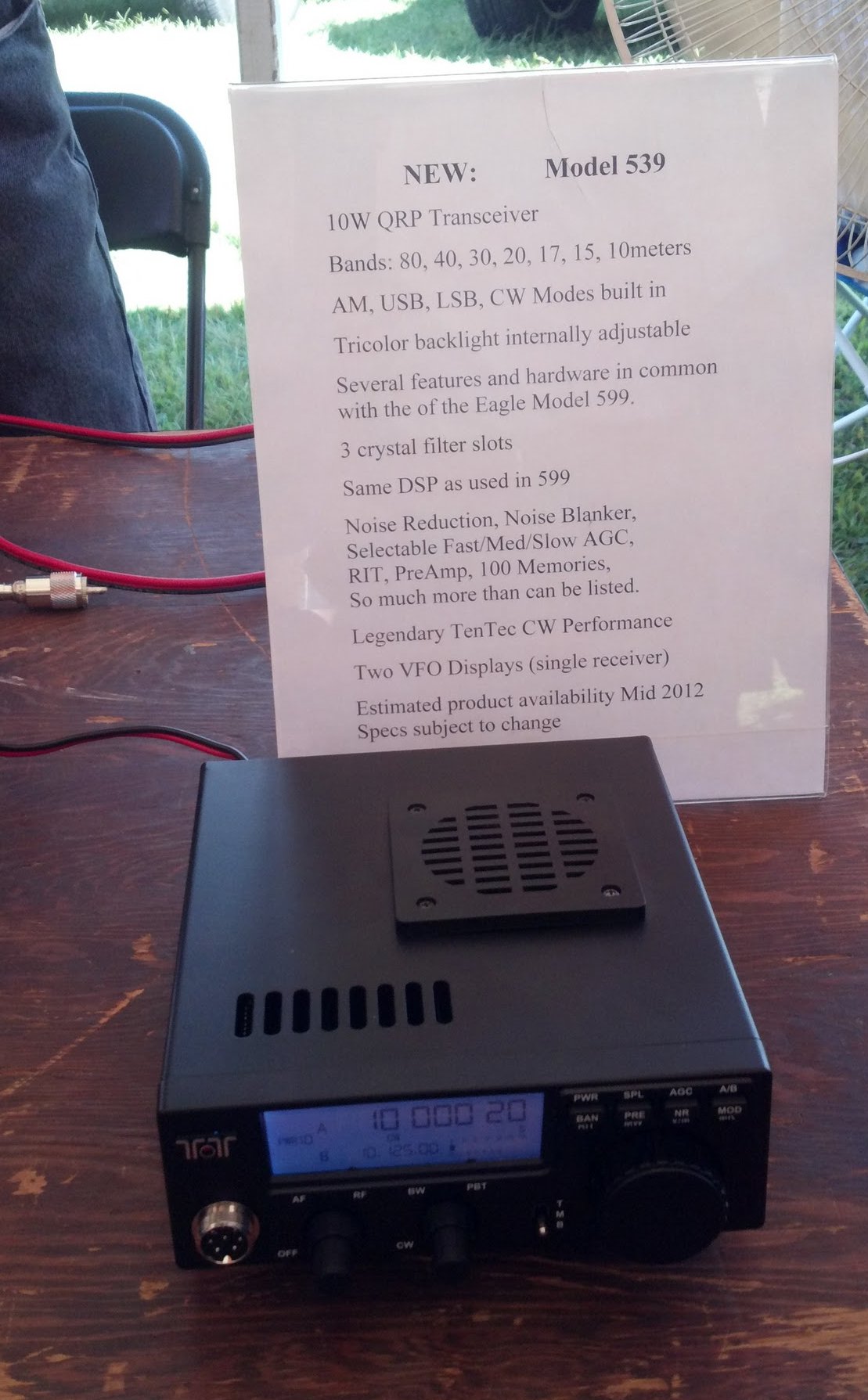
You have time to save your money, it is indicated on a display board in one photograph that it is expected to be available in mid 2012.


Alan Steele, VA3STL, is a regular contributor to AmateurRadio.com and writes from Ottawa, Ontario. Contact him at [email protected].
EchoLink or D-Star?
Over the last few days I have been running my EchoLink node #3098 connected into the IRELAND conference server. As I’ve been feeling a bit tired and lethargic recently it has been a way to pass the time listening to QSOs and making the occasional contact.
Apart from IRELAND there seems to be nowhere else on the EchoLink network where there is enough activity that you can guarantee something to listen to or that someone will reply if you call CQ. I know this is like talking of selling your soul to the Devil but would D-Star, which I have never experienced but which I gather has something called “reflectors”, be any better from the point of view of making contacts with hams around the globe using a handheld?

Julian Moss, G4ILO, is a regular contributor to AmateurRadio.com and writes from Cumbria, England. Contact him at [email protected].
CQ to Add Digital Editions to All Publications
This is something pretty cool. CQ Communications, the publisher of CQ Amateur Radio (CQ magazine), CQ VHF, Popular Communications and WorldRadio Online will begin publishing electornic versions of their magazine starting this coming October.
Richard Ross, K2MGA, made the announcement a couple days ago and Editorial Director Rich Moseson, W2VU, explained how the digital editions would be supplimental and not replace the print versions. He said they would also have added features to the digital versions as well.
“Versions will be available for a variety of online and mobile platforms and will be hosted by Zinio, one of the top names in the e-magazine hosting business. This will assure that our magazines will always be able to take advantage of new technology when it becomes available.”

Cover of CQ Communication's World Radio Magazine
Some of the added features will be links to websites, as well as audio and photo albums as well as video and software. He also added that with the continuation of the print magazines, readers will still have the tactile experience we are all familiar with.
This is a good thing in my opinion. It’s melding the two worlds and laying the ground work for the next generation to discover this magazine. In 20 years, I predict that most publications will be digital, while print slowly fades from the foreground. I’m sure they will still make printed versions, but not as much. It’s also better for the environment.
According to the article over at Southgate’s website, “The digital launch will begin in late October with the November issue of an enhanced, multi-platform, version of WorldRadio Online, which will again become a paid-subscription publication; followed by November CQ, which, appropriately, is the magazine’s first annual Technology Special. The fall issue of CQ VHF and the December issue of Popular Communications will round out the introductions. Digital editions will be available by single copy and by subscription.”
No word though on pricing for digital versions though. I would suspect, it’ll be much cheaper compared with the print version.
73.
Rich also writes a Tech blog and posts stories every Tuesday and Thursday on Q103, Albany’s #1 Rock Station website, as well as Amateur Radio stories every Monday thru Friday on AmiZed Studios and hosts a podcast called The Kim & Rich Show with his fiance’ Kim Dunne.
Rich Gattie, KB2MOB, is a regular contributor to AmateurRadio.com and writes from New York, USA. Contact him at [email protected].
 Ham Radio Deluxe |
 W5SWL Electronics |
 Ham Radio Prep |
 KB3IFH QSL Cards  Hip Ham Shirts  HamRadioAuctions HamRadioAuctions Reliance Antennas Reliance Antennas Enigma Shop Enigma Shop |  morseDX  Ni4L Antennas  R&L Electronics R&L Electronics antennas.us antennas.us QRV QRV |
- Matt W1MST, Managing Editor
