 |
 20 over 9 into Michigan
 7 October 2011 | by
 Propagation has again been excellent on 10m. I heard many US stations and other DX at good strength. I didn’t make many contacts, though. Most of the stations I was hearing were enjoying 5 or 10 minute QSOs. You can use up a lot of time listening to such contacts, especially when you make your call and the station you are hoping to work replies to someone else and not you, so you get to wait another 5 or 10 minutes for the next chance.
Not that I’m complaining. But it doesn’t help that I refuse to use bad operating tactics to get a contact. One station I waited for got angry and went QRT because other European stations were calling over the final of the station he was working. If I can only hear the DX side of the conversation I won’t call until I hear the DX call CQ or say QRZ or listening for any calls. Others do, and too often they get rewarded with a contact. It makes me angry, too.
My first contact of the day was with UT1AN Alex on 10m FM. His QTH is not far from Kharkiv, Olga’s home town. Alex gave me an S9+20dB report.

The last – so far, anyway, was on 10m SSB with W8ERN Angelo in Brighton, Michigan, pictured right. I waited a long time before my call was heard. But it was worth the wait because Angelo replied with are you the G4ILO that wrote the VOAProp software? I ‘fessed up and Angelo told me how much he liked the program.
We also talked about web pages and logging programs. Angelo’s web page is produced using a software program called CommCat Live. You can hear live streaming audio from his station and see a graphical S meter plot of the station he is receiving. He told me my signal – 100w to the attic dipole – was almost peaking 20 over 9 and sure enough when I looked at the screen it was. Perhaps my QTH is not so bad after all.
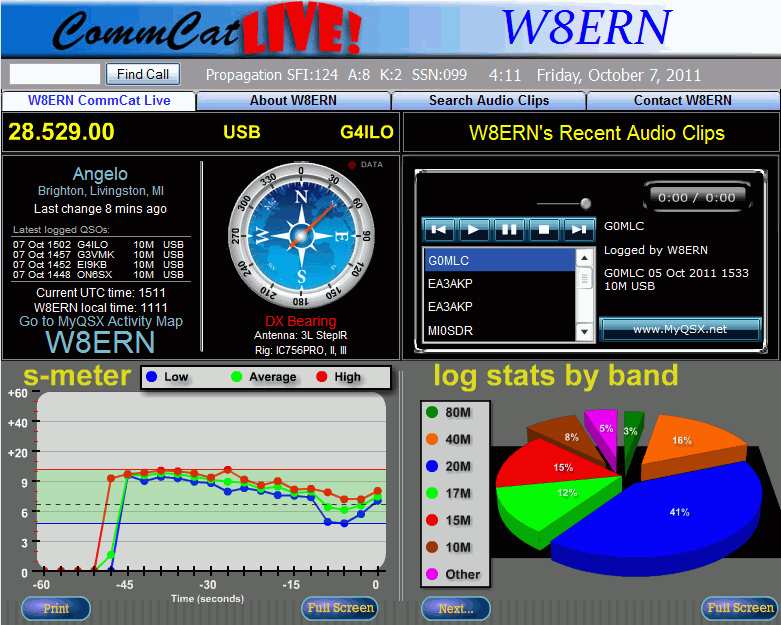
Here is the proof: W8ERN’s web page snapped while I was in QSO with him.
CommCat certainly adds interest to a ham radio web page. Unfortunately – but not surprisingly – it doesn’t support my home-written logging program KComm.

Julian Moss, G4ILO, is a regular contributor to AmateurRadio.com and writes from Cumbria, England. Contact him at [email protected].
Ham Radio….It’s really just ham
While the main purpose of this blog is to document my own activities in amateur radio, I do enjoy focusing its attention in an educational manner from time to time. This blog post will be just that…an attempt to provide a little educational value to your reading enjoyment.
If you peruse through amateur radio blogs, amateur radio websites and even amateur radio club websites, newsletters and other publications you will certainly see the term we use to identify our hobby and service written in many ways. Of course the term I’m talking about is the “ham” in ham radio.
Before I go much further (and I do intend to keep this blog posting short), we don’t know a lot about why we are called hams. There are many ideas floating around and most generally agree the true meaning as simply been lost in time. Having said that, the more common idea today is the word may have originally been used to describe a poor operator. This of course was back in those early wireless days when spark was king. This common theory goes on to assume the government, coastal or ship stations may have received interference from early amateur stations and referred to these early amateur stations as hams. It is then believed, not really knowing the word was meant as slang, early amateurs picked it up and began referring to themselves as hams. But remember, this is only a theory.
In todays technical (and not so technical) world we live in we have grown to know many things by an acronym. Just to refresh everyone’s memory. An acronym (credit to Merriam-Webster) is formed from the initial letter or letters of each of the successive parts or major parts of a compound term. An example which most will be familiar with is NATO (North Atlantic Treaty Organization) or FBI (Federal Bureau of Investigations) or how about ABC, NBC and BBC. The acronym (regardless of the number of letters/words) is written and referred to by those letters typically written in upper case.
As I stated, these acronyms are all around us. In my day job, I have to be very careful when I am presenting or teaching to not get carried away with throwing out acronyms as I shouldn’t assume everyone understands their meanings when I start speaking about FAQ, VPN, VoIP, TCP, CRM and ERP.
In the amateur radio hobby we use many acronyms to describe various components of our hobby and service. Some that come to mind are FCC, ARRL, RSGB, SSB, SSTV, PSK, RTTY, VHF, UHF, HF, CRT, LCD, LED, EME, CMOS and MOSFET. I’ll stop there as you get the idea.
The take away and educational point I’m driving home is the word “ham” in ham radio is not an acronym. Simply put, the word is just a word which follows the laws of regular sentence structure. Since it is not an acronym, it’s not necessary to capitalize each letter (e.g. HAM) it is also not necessary to place a period or dot between each letter (e.g. H.A.M.). If you are writing ham radio in a sentence it just follows all the normal rules. Ham would be capitalized if starting a sentence. If not, ham would just be written in lowercase. That really is it.
Of course, nothing bad will happen if you choose not to follow this guidance. But in my opinion, (and others agree) writing it as an acronym or going outside of the rules of normal sentence structure is not correct. This just leads to new hams becoming confused and of course teaching something which just simply isn’t true. The issue just perpetuates itself on down the road. To go back to Merriam-Webster, “perpetuates means to make something, (typically an undesirable situation or an unfounded belief) continue indefinitely.
Until next time….
73 de KD0BIK (Jerry)
Jerry Taylor, KD0BIK, is a regular contributor to AmateurRadio.com and writes from Colorado, USA. He is the host of the Practical Amateur Radio Podcast. Contact him at [email protected].
Just like in Europe
In the year that I was a ham in Europe I found that there was always a fellow radio nut available to talk with. I am not picky, so when I wanted to have a rag chew I did it in any mode available (except CW, because my keying is still painfully slow) and on any band. I found the French and Norwegians the nicest to chat with, despite the language difficulties.
Here in East Asia the bands are rather empty, especially in the day time. A simple wire dipole won’t get you far if the sunspots are non-existent; you need something better. So I do feel a little bit lonely sometimes when I scan the bands and there is no one out there. But with the old CB whip on the balcony, 15 Watts to put into it, I do need some spot on the sun to get somewhere. Tonight I did get somewhere however: 10 meters was open to Europe and I had two successful QSO’s with France and Germany in psk31. Alas, only 599 exchanges. But 17 meters was also open and I had to smile when I heard VK4BX having a QSO in SSB with a German station. After all, I am BX2ABT and my Dutch call is PA2BX. So I called him and immediately felt like I was back in Europe: steady signals, good modulation and we both wanted to chat. Of course we both commented that the combination of B and X is the best in the world, no question about it. 10 Minutes later I felt like a million dollars and the tiredness of the work-week was totally gone. What a great start of the weekend and all because of a 10 minute chat with Chris. Cheers, mate.
By the way, if you have had contact with BV100 then remember that coming Monday is the 100th birthday of the Republic of China, the reason for the special call. Over here we call it “Double-10 day” and there are a lot of celebrations planned. If you haven’t worked them yet then you have till the end of the year. Zai jian from Taiwan.
Hans "Fong" van den Boogert, BX2ABT, is a regular contributor to AmateurRadio.com and writes from Taiwan. Contact him at [email protected].
Of Pounding Ground Rods and Labeling a Field Box
My arm is tired! I pounded in a ground rod tonight, a stout 8-footer from Fleet Farm. It wouldn’t have been so bad if it had gone in on the first try, but it took me three tries before I found a spot that didn’t have some obstruction about four feet under ground! (Remember I live in Granite Falls. There’s lots of rock around here.) I’m not sure which was harder — swinging the sledge hammer until the rod got stuck, or trying to pull the crazy thing out of the ground when it did. Soaking the ground with water helped to get it out in one instance.
It’s tempting to soak the ground with water before pounding your ground rod in, to make it sink in easier, but I’ve read that you shouldn’t do that as you wind up with a poor connection after the soil dries. As with many other things, the easy way isn’t always the best way.
Anyhow, I finally got it in far enough. There’s about ten inches sticking up out of the ground still, but all I’m doing by swinging at it now is flattening out the top. Once my wife hides it with a hosta plant it will look just fine! I tried pounding in a second one, but when it got stuck and I had to work it out (by clamping vicegrips on it and prying it out with a crowbar, a few inches at a time), I called it a day.
Much easier and more satisfying was labeling the toolbox I’ve converted into a field-kit: I’m asking an awful lot of this decal, sticking it on a pebbled surface. But so far it’s sticking just fine. Randy George, N3ZK, does a great job on these, ships them fast, and the price is right! For only $4.00 (shipping included) you get three of these labels.
In the field box right now is my Heathkit HW-8 and all the accessories necessary to zip out to my picnic table and get on the air with my low-hanging, temporary OCF dipole. Pretty soon it will be too cold to do that comfortably! That’s why I’m pounding ground rods, trying to get my long-awaited New Carolina Windom up and going before the ice and snow comes.


Todd Mitchell, NØIP, is a regular contributor to AmateurRadio.com and writes from Minnesota, USA. He can be contacted at [email protected].
CB interlopers
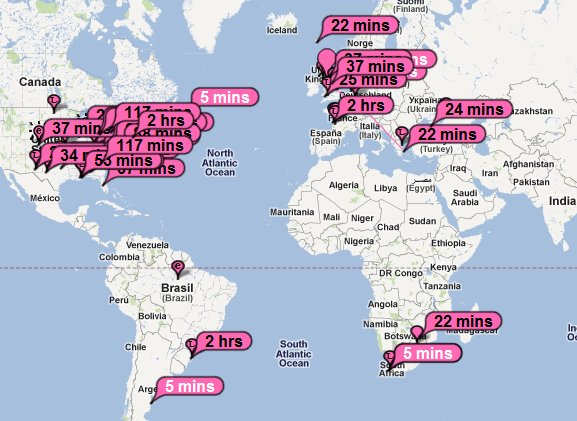
Propagation remains good on 10 metres. I left the K3 on 28.076 running JT65-HF for most of the day. I made several contacts including N3CAL, WA2CRB, PY8ELO, KE1AF, WB9OTX, WK8G and SV4FFK. The map shows where my signal was heard. I was even spotted by Joe, W6CQZ/4, the author of the excellent JT65-HF software.
JT65 is addictive. It’s also a very relaxing way to make QSOs. It’s ideal for me at the moment because my eyes tire very easily. I end up with blurred or double vision if I read or stare at the computer screen for too long so modes like PSK31 aren’t really a good idea. Thanks to the JT65-HF add-on JT-Alert an alarm sounds if a station I haven’t worked before calls CQ and another sound wakes me up if a station replies to me. This means that I can look out the window or something and only need look at the screen when I have something to do. The print in the JT65-HF program window is nice and big too.
Listening on 28.076 I heard some strange noises which I eventually realized were FM transmissions being received in SSB mode. CBers transmitting out of band I presume.
I don’t suppose many CBers read this blog but come on, guys. It’s none of my business if you choose to operate illegally but if you do, please stay below 28MHz. You may not hear our weak JT65 signals with your FM radios but we sure as hell can hear you.
Update: Just worked Joe “The Man” W6CQZ/4 in Florida. He was running 5W to what I seem to remember him posting once in the JT65-HF Google group is a Hamstick on a mag mount stuck to the roof of his shed. Thank you Joe for the contact and for the fantastic JT65-HF software!

Julian Moss, G4ILO, is a regular contributor to AmateurRadio.com and writes from Cumbria, England. Contact him at [email protected].
Steve Jobs: His Legacy
If you’re wondering why I am posting this instead of an Amateur Radio story, then please read the full article and you will understand. But for now, I am posting a clip and a link to my full article on the Q103Albany website, and it has already been picked up by the station I used to work at in Utica as well. Here is a clip:
I have been trying to write this story for hours now. It’s not hard to talk about someone like Steve Jobs and recite facts about him. Yes, he pioneered how we consume digital content and how we buy our digital music as well as how we use computers and much more. And while it could be considered corny by some for me to say this, he touched lives all over the world. Just look at Twitter and Facebook. One of those lives he touched, is mine.
To read the full article, check out my Tech Thursday story for today.
73.

Courtesy of Gawker.com
Rich Gattie, KB2MOB, is a regular contributor to AmateurRadio.com and writes from New York, USA. Contact him at [email protected].
Ham Nation 20

Hosts: Gary Pearce (KN4AQ), Gordon West (WB6NOA), and George Thomas (W5JDX)
Shelby Hamfest tour, the MFJ factory, a transmitter with one part, and more.
Download or subscribe to this show at http://twit.tv/hn.
We invite you to read, add to, and amend our show notes at wiki.twit.tv.
Thanks to Joe Walsh who wrote and plays the Ham Nation theme.
Thanks to Cachefly for the bandwidth for this show.
http://dts.podtrac.com/redirect.mp4/twit.cachefly.net/video/hn/hn0020/hn0020_h264b_864x480_500.mp4
http://dts.podtrac.com/redirect.mp4/twit.cachefly.net/video/hn/hn0020/hn0020_h264b_640x368_256.mp4
http://www.podtrac.com/pts/redirect.mp3/twit.cachefly.net/hn0020.mp3
Dr. Bob Heil, K9EID, is the founder of Heil Sound and host of TWiT.tv's Ham Nation which streams live each Tuesday at 6:00pm PT (9:00pm ET) at http://live.twit.tv. Contact him at [email protected].
 Ham Radio Deluxe |
 W5SWL Electronics |
 Ham Radio Prep |
 KB3IFH QSL Cards  Hip Ham Shirts  HamRadioAuctions HamRadioAuctions Reliance Antennas Reliance Antennas Enigma Shop Enigma Shop |  morseDX  Ni4L Antennas  R&L Electronics R&L Electronics antennas.us antennas.us QRV QRV |
- Matt W1MST, Managing Editor
