 |
 Tales of the Texas Hamfest in Oklahoma
 23 October 2011 | by
Well let me see if I can come up with enough words to get all the pictures on this post.

Well October is here and along with the State Fair of Texas in Dallas it is also time for the Texhoma Hamarama in Ardmore Oklahoma. For many years a friend of mine and organizer of this event Henry Allen W5TYD has been trying to get me to make the track to Ardmore and check it out.

So I gathered myself up at 4:30 in the morning put a spark to the B.S.S. Improbable and made my way toward the Indian territories. I had really forgotten that the middle of the night was the only time that it is not a total pain to drive through Dallas. A little over two hours later I found myself in Ardmore. As described the hamfest was very easy to find. The shiny almost new convention center was right off I-35 at exit 33. I exited made a right turn then made another right turn and I was there ( I could never be a Nascar driver ).
 The parking lot at the Ardmore Convention Center was more than ample and I was able to find a parking space very close to the front door. Not like Ham Com here locally where you have to park on the other side of town and ride a shuttle bus. Due to a mistake on the website I found myself there an hour before they opened the doors. So I spent some time talking to other Hams that had made the same mistake.
 After paying a very resonable $8.00 to get in I roamed around looking at all the wonderful items to be had. At the end of the first row I went down I ran into Jimmy (Pinky) Pinston N5WYT from the Texas Baptist Men who was debating on buying some hardline for the freshly installed commercial repeater at the Baptist Mens building in Dallas. We talked about a few things like ARES in Van Zandt county where he lives and the fact that his license expired at midnight that night. Shame on you Pinky.
 Went and sat in on the OK section ARES presentation. Then went and sat in on Andy WY5V’s amateur radio in the park presentation. Andy is king of amateur radio these days. King of ARES in Dallas. Big Chief at the VHF-FM society everything. Spent some time visiting with folks that I have known for years David Kaun N5DBK, Tim KD6FWD, and my little buddy Paul KD5TKO.
I really didn’t come home with anything except some good memories but we had a great time in Ardmore and I expect to go back many times in the future. Russ was not in attendance but you all know how he is.
73 everybody

Russ Woodman, K5TUX, co-hosts the Linux in the Ham Shack podcast which is available for download in both MP3 and OGG audio format. Contact him at [email protected].
ICQ Podcast S04 E22 – RSGB in Crisis (23 October 2011)
Series Four Episode Twenty-Two of the ICQ Podcast has been released. News Stories include :-
- Guernsey’s AM broadcasts are valued
- CEPT proposes medium wave frequency allocation
- London 2012 usage of 70cm
- G4ZU Grand Daughter gets licence
- CW SRM Nanosat decoding software
- US Amateurs Now 700,000 Strong
Your feedback and Martin (M1MRB) and Colin (M6BOY) discuss the issues facing the RSGB EGM annoucement. Ex RSGB Technical Director Leslie Butterfields (G0CIB) joins us to help to understand the proposals.
Colin Butler, M6BOY, is the host of the ICQ Podcast, a weekly radio show about Amateur Radio. Contact him at [email protected].
ICQ Podcast S04 E22 – RSGB in Crisis (23 October 2011)
Series Four Episode Twenty-Two of the ICQ Podcast has been released. News Stories include :-
- Guernsey’s AM broadcasts are valued
- CEPT proposes medium wave frequency allocation
- London 2012 usage of 70cm
- G4ZU Grand Daughter gets licence
- CW SRM Nanosat decoding software
- US Amateurs Now 700,000 Strong
Your feedback and Martin (M1MRB) and Colin (M6BOY) discuss the issues facing the RSGB EGM annoucement. Ex RSGB Technical Director Leslie Butterfields (G0CIB) joins us to help to understand the proposals.
Colin Butler, M6BOY, is the host of the ICQ Podcast, a weekly radio show about Amateur Radio. Contact him at [email protected].
Free! Excel Worksheet for Building Any 1/2 Wave Dipole (Center-Fed, OCF, Windom, New Carolina Windom)
Here is a spreadsheet I designed in Microsoft Excel for calculating the first cut and the final cut (after testing) of a 1/2 wave dipole, whether center-fed, classic off-center-fed, Windom, or New Carolina Windom. If you use it for a plain ol’ center-fed dipole, just ignore the references to “long leg” and “short leg” — the numbers will still be right. Anyhow, you’re welcome to use it, pass it around, whatever:

DipoleWorksheet.xls (Microsoft Excel)
I’d enjoy hearing from any of you who end up using this spreadsheet to build an antenna!
If you find any bugs in this spreadsheet, please let me know. Note that it is protected for your convenience, but you can unprotect it anytime you like to see the formulas in each cell (there is no password).


Todd Mitchell, NØIP, is a regular contributor to AmateurRadio.com and writes from Minnesota, USA. He can be contacted at [email protected].
What’s the Best Way to Hang an Inverted-V OCFD/Windom Antenna?
What is the best way to hang an off-center-fed dipole or windom antenna as an inverted-V? Should you hang the feedpoint at the apex, or hang the center of the antenna at the apex?
From an electrical standpoint the best way is to hang the center at the apex. That is where the current is at a maximum on the lowest resonant frequency. But that leaves all the weight of your balun, coax, and (in the case of a New Carolina Windom) RF choke unsupported by anything but the antenna-wire itself. So from a mechanical standpoint the best way is to hang the feedpoint at the apex, with all that weight hanging straight down from the hanger. Either way it’s a trade-off.

I think it makes sense to hang the feedpoint at the apex if the angle of your V is reasonably broad. The mechanical benefit outweighs the electrical cost in this case. As you can see in this diagram, you really don’t give up much height at the center of the antenna. My own 40m New Carolina Windom, with the longest leg at 74o from vertical, sacrifices only 2.3′ at the center of the antenna. Even if it were cut for 80m the sacrifice would only be 4.5′. A 160m version (I know of one fellow who plans to build one!) would give up almost 9 feet, though. You might want to hang the center at the apex in that case, unless it’s already so high that 9 feet doesn’t matter much. You can always figure out a way to support the feedpoint in some way if you need to.
This changes if you mount your V with a narrow angle. Dropping the longest leg to 45o from vertical would cost me 6′ on my 40m New Carolina Windom! In that case it would probably make more sense to hang the center at the apex.
The way to calculate this is shown in the figure above. Notice how I labeled the sides of that triangle with “H” and “A?” Now why did I do that? Glad you asked! The “H” stands for “hypotenuse” and the “A” stands for “adjacent” — adjacent to the angle of 74o in this triangle (your own angle may be different, of course). Just remember this sentence: “Oscar And Ole Have Huge Appetites.” (Up here in Minnesota we all love that name Ole, don’t ya know!) That will help you remember the way to calculate the sine, cosine, tangent, arcsine, arccosine, and arctangent of any angle. “O” stand for opposite (the length of the side opposite the angle you’re dealing with), “A” stands for adjacent, and “H” stands for hypotenuse:

Oscar And Ole Have Huge Appetites!
So to figure out the height of the apex above the center of my antenna, I figure:
A/H = cosine(74o)
A = cosine(74o)*H
A = 0.276*8.5′ = 2.3′
There you go! Of course, you’ll have to know the angle to figure this out. To see an example of that calculation, check out my previous post.


Todd Mitchell, NØIP, is a regular contributor to AmateurRadio.com and writes from Minnesota, USA. He can be contacted at [email protected].
SSTV on an iOS Device
From the “Oh, How Cool is That?!” department, is a video to round out a week’s worth of Ham Radio videos, showing an iOS device, (iPhone,iPod Touch,iPad) decoding an SSTV signal. I have seen a bunch of Ham Radio apps on the iTunes App store, but I seemed to miss this one. According to the link in the video’s description, the SSTV Decoder app is made by Black Cat Systems, who also make a few other Ham Radio programs for Macs. The webpage says “.. Just connect it to an HF radio (or even set it next to the radio’s speaker), tune in an SSTV frequency, and watch the pictures.” From the video I didn’t see a directly connected cable from the iPod Touch, so I’m guessing that they are using a 4th Generation iPod Touch with a built in microphone and have it sitting close to the radio to hear the SSTV tones. Still, it looks like it received a nice picture. But they could also have been replaying pre-recorded picture on the device too. Either way, it’s cool!
73.
Rich also writes a Tech blog and posts stories every Tuesday and Thursday on Q103, Albany’s #1 Rock Station website, as well as Amateur Radio stories every Monday thru Friday on AmiZed Studios and hosts a podcast called The Kim & Rich Show with his fiance’ Kim Dunne.
Rich Gattie, KB2MOB, is a regular contributor to AmateurRadio.com and writes from New York, USA. Contact him at [email protected].
Happy Birthday Olga!
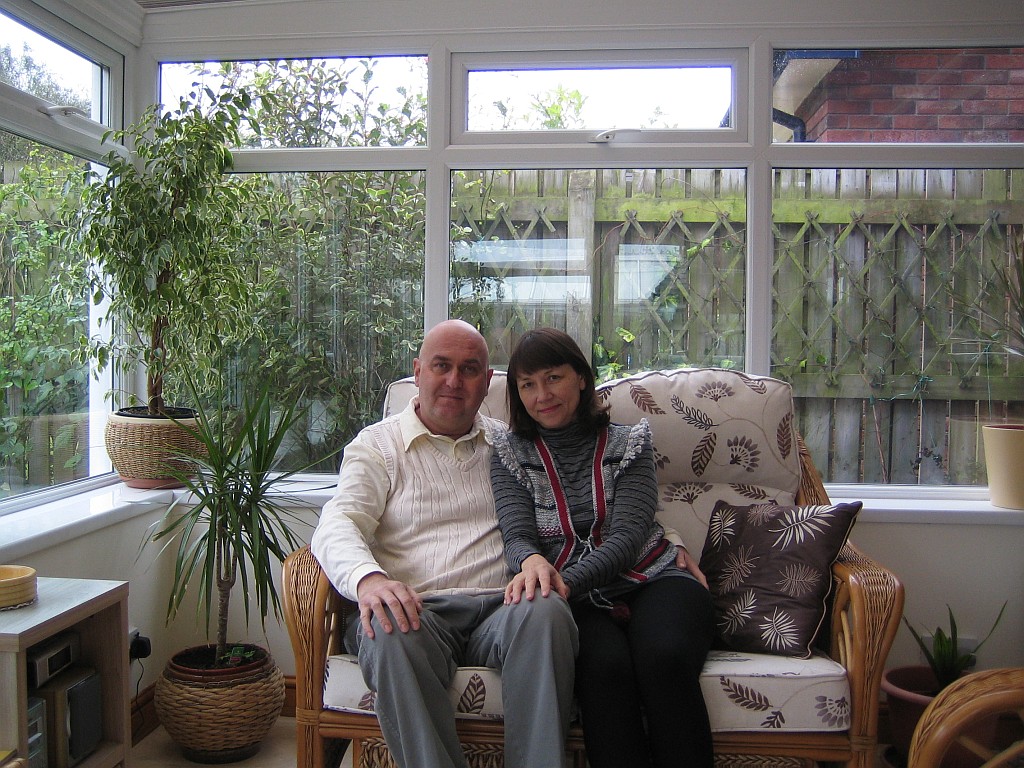
Today is my wonderful wife Olga’s 60th birthday. Without her amazing help and support I don’t know if I would have the strength to cope with this brain tumour. I keep up the fight so that I will still be here to help celebrate the next one. Happy 60th birthday, Olga!

Julian Moss, G4ILO, is a regular contributor to AmateurRadio.com and writes from Cumbria, England. Contact him at [email protected].
 Ham Radio Deluxe |
 W5SWL Electronics |
 Ham Radio Prep |
 KB3IFH QSL Cards  Hip Ham Shirts  HamRadioAuctions HamRadioAuctions Reliance Antennas Reliance Antennas Enigma Shop Enigma Shop |  morseDX  Ni4L Antennas  R&L Electronics R&L Electronics antennas.us antennas.us QRV QRV |
- Matt W1MST, Managing Editor
