 |
 The CFL is coming and Im not referring to the Canadian football league….
 12 November 2011 | by
  |
| The way of the future? |
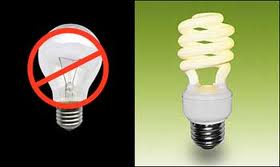
CFL thing??? Now since I have had them for some time now I do want to clear up some myths and truths about these types of lights. One of the myths is they just don't last long....well for 4 years I have not changed one CFL!!! Oh and believe me we do not live in the dark here either. I get my exercise up and down stairs turning off lights that somehow just get left on??? They do take some time to get to full illumination that is an annoying truth and if the room is cool it's even longer. There are some newer ones out there that are supposed to be "instant on" I have seen these CFL's in action and they are not at all like our friend the incandescent light were we are used to poof and there is light. Another myth....well for my home is that they cause RFI. I have not found this to be the case my rig (Elecraft K3,K2) does not show any S meter change if the lights are on or off. It's the Plasma TV here that kills me!!! Another truth is they do cast a "different" type of light from the light bulb, you do get used to it. The CFL market now offers cool white, warm white and reading lights so they have come a long way. I have not had a chance to test these as my darn CFL's wont burn out!!! Here is a myth and a truth combination, the myth is you will save on your hydro bill each month.....the truth is not until you have paid for the out of pocket cost of the CFL's!! Speaking of cost I did say in the opening paragraph that our household has "almost" gone CFL. In our bathroom we have a vanity light that is just great. It takes what is called 6 fat Albert 40 watt bulbs. I still have the incandescent ones and this past weekend replaced them all with......you guessed it with the BAD incandescent ones. Why you ask???? well for 6 it cost me 12.00 to go with CFL fat Albert's your looking at 96.00!!!! It sure would take a long time to get that money back in hydro savings.

Mike Weir, VE9KK, is a regular contributor to AmateurRadio.com and writes from New Brunswick, Canada. Contact him at [email protected].
My Introduction to SOTA

I can’t honestly say that I knew a whole heck of a lot about SOTA prior to a week or so ago. Sure I figured it had something to do with activating mountain tops and had figured out what the acronym stood for. By the way, SOTA stands for Summits On The Air. The general idea of SOTA is much of that with IOTA (Islands On The Air) or LOTA (Lighthouses On The Air). Ironically, the same weekend I worked my first SOTA station, I also worked my first lighthouse. Since there aren’t very many lighthouses in Colorado, I decided I would read up on and become more familiar with SOTA. I believe I’ll be able to find a few summits here in the Centennial State to keep me busy for a while.
My first SOTA QSO sort of came by accident. I had been tuning up and down the band looking for W3T which was the Nikola Tesla special event station operating out of New York. I had noticed W3T spotted on a few of the DX clusters, but never heard them or the stations I did hear operating on the posted frequency were clearly not W3T. I turned to Twitter to see if anyone else had either worked W3T or heard them. I was just about to send my tweet when I saw a twitter posting from K0BAM. Jim lives over in Delta, Colorado. Anyway, his Twitter posting read something like W7IMC operating QRP SOTA from Idaho 14.343. I gave the big dial on the front of my Yaesu FT-950 a spin up to 14.343 and listened for a few minutes.
The bands have been in fine shape most of the day. I had worked several US stations and even a JA on 10m just before this. The signal I was hearing from Idaho sounded like it was coming from Idaho Springs, Colorado (just up I-70 from me). I listened a few seconds more and the mountaintop station called Whiskey, Seven, India, Mike, Charlie QRZ. I quickly came back with Kilo, Delta, Zero, Bravo, India, Kilo and just like that I was in QSO with my first SOTA station.

As I previously stated, Scott’s (W7IMC shown right) 5w signal was booming into Colorado and we quickly exchanged pleasantries and he told me he was located on Regan Butte and provided the SOTA identifier of W7/SR-181. I knew Scott had others who wanted to work him and I wished him luck with his activation and said my 73 and logged the QSO in my logbook. I stayed on frequency and listened for another three or four QSO’s and picked up more information about the SOTA program. Of course, I quickly pulled up Google (Google is our friend) and soon found a couple of interesting websites.
The first website is the SOTA main home on the web. SOTA actually began over in the UK and slowly migrated throughout Europe and eventually we caught on over here. SOTA refers to each particular area as an association and there are 54 such associations around the world. Each association is managed by a volunteer called an association manager. The association which serves the Denver Front Range area is W0. W0 is managed by wG0AT, Steve Galchutt. You may know Steve from his Youtube videos featuring Rooster and Peanut his two pack goats.
Each association will have anywhere from a few qualifying summits and some have several thousands. In the case of W0, we have 1,791 qualifying summits. Enough to keep me busy for a long time. All total there are over 42,000 qualifying summits world wide.
Now we have two different ways to participate in the SOTA program. We can lace up our hiking boots, grab our portable gear and activate a qualifying summit. This is called an activator. Or we can grab a cup of coffee, head down to our comfortable shack. This is called a chaser. Obviously the success of the program requires both types of participants. Of course, an activator can work other mountain top activations.
Both activators and chasers can log their contacts into the SOTA database. Points are awarded for both categories. For what I hope is an obvious reason, those performing the activator role earn more points than those chasing. In addition, each qualifying summit may have different points earned based on degree of difficulty.
With winter coming on with a bang in the Colorado high country, I’ll spend the next few months learning more about SOTA and working other SOTA station activations as I can. Check out the SOTAwatch database for upcoming activations and current spots.

Finally, if you’re an iOS user (iPhone, iPad, iPod Touch). Check out the Pocket Sota app. It’s .99 cents in the iTunes App Store. The app provides a listing of all the associations which you can drill into to find detailed information about each of the qualifying summits including a map view.
The image to the left represents 219 qualifying summits in the Front Range region of the W0 association. While some of these are 14,000+ peaks, many are not. Those that aren’t just might be accessible even in the early winter months and I might just have to investigate a possible activation as KD0BIK/P. However, before I really get serious about this, I need to update my portable power setup.
I’m looking at the nanophosphate technology so many of our fellow amateur’s are raving about. Unlike the 12v 7.5Ah batteries I use today, which weigh in at a whopping, back breaking 5+ pounds. The 9.2Ah version is only a little over 3 pounds. Also, as I understand…the nanophosphate batteries last until the last milliamp is gone from the battery, all while holding their voltage. Yes the cost is much greater than SLA models. But I feel this could be well worth it.
Until then, I’ll be watching the SOTAwatch database for activations as well as keeping my ears open for any I happen to hear on the bands. I’ll make sure to document any such activities be it chasing or activations right here.
Until next time….
73 de KD0BIK (Jerry)
Jerry Taylor, KD0BIK, is a regular contributor to AmateurRadio.com and writes from Colorado, USA. He is the host of the Practical Amateur Radio Podcast. Contact him at [email protected].
Not so chirpy
Yesterday I attempted to have a QSO using the XBM-10-2 two transistor “Chirpy” transceiver for 10m. I asked Jim, G3XPD, who is about 8km south of G4ILO to listen out for me. Jim could hear the distinctive sound of my 100mW transmission, but I could not hear Jim, not even when he called using 100W.
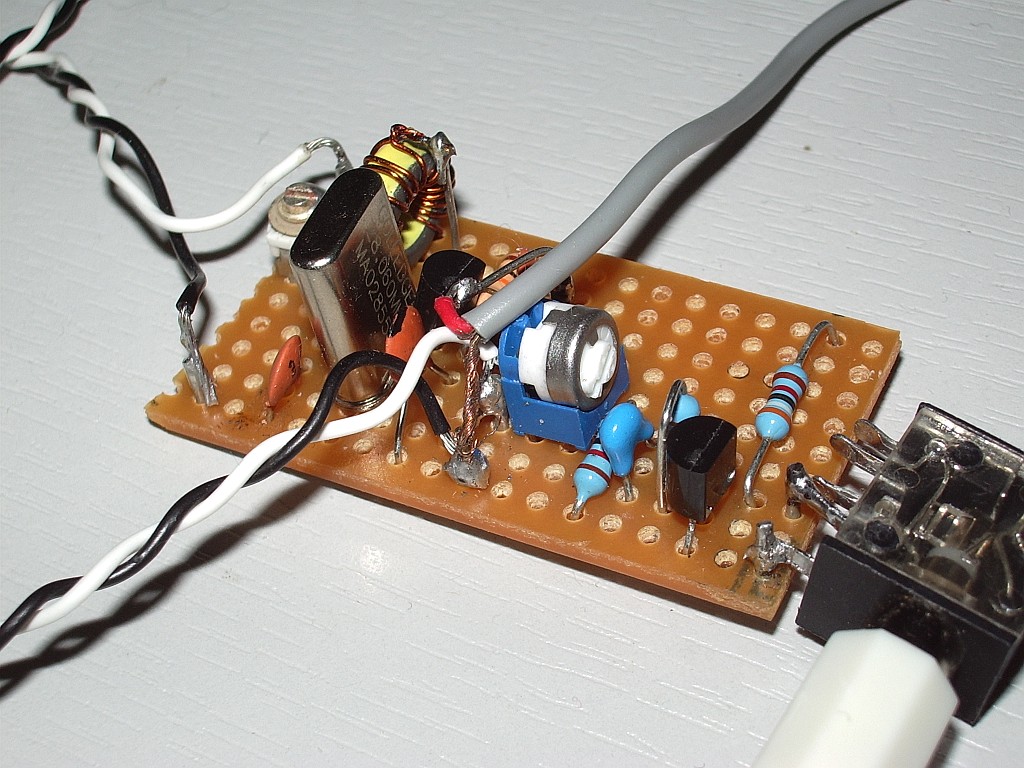
I know the Chirpy receiver works because I can receive a locally generated signal such as my antenna analyzer. But I guess even that is a big signal compared to one received off the air. I need to find a way to improve the receive sensitivity if it is to be possible to make a real two-way contact using this simple transceiver circuit.
I have tried adjusting C2 for maximum noise in the earpiece rather than maximum output when the key is down, to see if that gives some improvement. If nothing else it seems to have tamed the chirp a bit.

Julian Moss, G4ILO, is a regular contributor to AmateurRadio.com and writes from Cumbria, England. Contact him at [email protected].
In remembrance of those who gave for us


Mike Weir, VE9KK, is a regular contributor to AmateurRadio.com and writes from New Brunswick, Canada. Contact him at [email protected].
(No?) Nonsense Radio
The November 2011 issue of QST contains an Op-Ed that really left me shaking my head more than normal. The author bemoans the complexity and feature sets of newer handheld radios and pines for the days of his IC-02AT. He goes on at length about the “unnecessary” receive capabilities (NOAA weather broadcasts, AM/FM radio, etc) and how he has to search for the manual every time he wants to program a repeater offset.
Well, as someone who recently upgraded from a radio just slightly newer than the IC-02AT to a “modern” HT, he’s wrong on nearly every account (except the micro-/mini-USB port, which I would wholeheartedly support for charging purposes).
- Eliminate extraneous features. Too bad we all have different definitions of this. I think scanning is a worthless feature, but like NOAA/NWS weather broadcasts. In fact, my wife is delighted that we now have a battery-powered AM/FM+NOAA/NWS radio again that I will always be able to find and will guarantee that it works. Did you hear that, guys? My non-ham wife actually likes my HT and uses it to listen to FM radio!
- Eliminate multilevel menu trees. I’m just dying to replace my cell-phone-sized VX-3r with a knob-covered brick. I’m sure you are too. It’ll look great in my shirt pocket.
- Eliminate the proprietary programming cables. Maybe I’m not a typical ham, but I only have about ten memory channels programmed into my VHF/UHF FM radios and they took about 10 minutes to program through the front panel (my bad, menus). The mini-/micro-USB port is a good idea for charging, though.
- Allow for a battery pack that uses disposable batteries. Last time I checked, most radios have this option. Did I miss something?
- Create an inter-vendor standard for user interface. What if they standardize on Icom?!?! The last Icom VHF/UHF FM radio I used received a “grade of S, for ‘stupid’” from its owner. That was in 1993. All of the Japanese manufacturers will be put out of business by the factory owned by the Chinese military that produces their products before this happens.
He should buy another IC-02AT if he liked them so much. I bet for a Jackson or two, you could have a nice one…complete with the 6x AA battery holder. Heck, buy two or three for spare parts. I think I have the Service Manual around here somewhere if I didn’t already sell it.
On a more serious note, there are lots of no-frills radios available out there, even brand new ones with factory warranties. Until recently, at least, the money in VHF FM radios was in two-way, government, and public safety, not amateur. There are a lot of amateur rigs at the “low end” of the market that share a lot in common with their commercial counterparts. And, of course, you can always buy used Motorola gear on eBay if you desire ultimate performance and ruggedness.
Ethan Miller, K8GU, is a regular contributor to AmateurRadio.com and writes from Maryland, USA. Contact him at [email protected].
Powerline noise issue
Despite the fact that I live pretty close to some power transmission lines as well as the regular above-ground residential service, I’ve been pretty lucky in that I’ve never had much of an issue with powerline noise. Unfortunately, that changed just about a week ago. It might be coincidence, but there there were about 4 or 5 houses around a block away from here that lost power due to the October snowstorm that didn’t get it back until last Friday, which is when I started getting S7-S9 powerline noise on all the HF bands, 2m, and, to a lesser extent, 70cm. Given that there were still others in the area without any power (we were very fortunate in that we never lost power at our house), I figured I’d wait until the local power company indicated that they’d finished restoring power to everyone before calling to report it. (Powerline QRN is bad, but it doesn’t come close to not having lights or heat.) In the meantime, I put my main HF rig (Icom 756 Pro II) on a battery and turned off the main breaker to the house to eliminate any possibility that it was something in the house, but with that done, there was no change to the noise signature.
On Wednesday, the QRN was gone for a few hours in the middle of the day, and I figured that maybe they’d found and fixed the problem on their own, but it was back by the afternoon. Yesterday, the power company officially announced that all customers were back in service, so I figured that I’d give them a call today to see what they’d say.
The automated voice response system had no way to understand “RFI” so it thought I was reporting an outage, and because that’s not the case, I finally got through to a human … who seemed equally baffled. I explained that I was an amateur radio operator and that I was hearing electrical noise that I hadn’t heard until about a week ago. He put me on hold for about 10 minutes and when he came out he said they’d be dispatching a crew.
While the recommendations for a situation like this are to try to narrow it down to a small area or even a single pole, in additional to not really having the right kind of DFing equipment for this, I’m home tending to one of my kids who is recovering from minor surgery, so I didn’t want to spend the time walking or driving around. I am crossing my fingers that PSE&G (my power company) will take this seriously enough to send out a properly equipped crew and find the problem. I’ll be keeping my fingers crossed.
Here’s a short video that I took showing what the powerline noise looks like:
Thai Hams Help Save 1,000 Lives
An awesome story over on Southgate’s website shares that Ham Radio operators in Thailand, have helped to save almost 1,000 lives during the course of the floods that have been going on in this unusually heavy monsoon season. RAST, which is Thailand’s Amateur Radio society, held a gathering making this announcement.

Photo Courtesy of Wikipedia/Navy Visual News Service/Petty Officer 1st Class Jennifer Villalovos
RAST Secretary Wacharaphol, HS4DDQ, and his team working with the Public Health Ministry, setup station HS0AC and helped to coordinate rescue communications for medical emergencies. This action made it possible to save those lives. Like here in the US, many of the government agencies have been able to take advantage of the services Amateur Radio operators can offer when their communications networks failed either to overload or from interference from other agencies also trying to help during the emergency.
From the Southgate Story:
The NBTC (National Broadcasting and Telecommunications Commission) has praised the role that radio amateurs have been playing to help people cope with the disaster by providing communications support and this have been especially helpful in flooded areas where several mobile phone cell sites have failed.
During the meeting, Pranee Netrattana, E21DKD, who is a CQWW VHF Contest winner, was praised for her efforts in the disaster, as a net control operator. This is just another example of how Amateur Radio is still relevant in the 21st century. Even in the information age, there is still room for century old technology.
73.
Rich also writes a Tech blog and posts stories every Tuesday and Thursday on Q103, Albany’s #1 Rock Station website, as well as Amateur Radio stories every Monday thru Friday on AmiZed Studios and hosts a podcast called The Kim & Rich Show with his fiance’ Kim Dunne
Rich Gattie, KB2MOB, is a regular contributor to AmateurRadio.com and writes from New York, USA. Contact him at [email protected].
 Ham Radio Deluxe |
 W5SWL Electronics |
 Ham Radio Prep |
 KB3IFH QSL Cards  Hip Ham Shirts  HamRadioAuctions HamRadioAuctions Reliance Antennas Reliance Antennas Enigma Shop Enigma Shop |  morseDX  Ni4L Antennas  R&L Electronics R&L Electronics antennas.us antennas.us QRV QRV |
- Matt W1MST, Managing Editor
