 |
 Win a Wouxun KG-UV6D Dual-Band HT
 2 December 2011 | by
AmateurRadio.com is offering a free prize drawing!
With the help of our generous sponsor,
Import Communications (formerly Wouxun.us),
we’re holding a giveaway for a
Wouxun KG-UV6D Dual-Band HT
(KG-UV6D 144/440 version)
This is a US$175 value.
Enter now to win!
All licensed hams in the U.S. are eligible to enter
Matt Thomas, W1MST, is the managing editor of AmateurRadio.com. Contact him at [email protected].
Welcome to the future
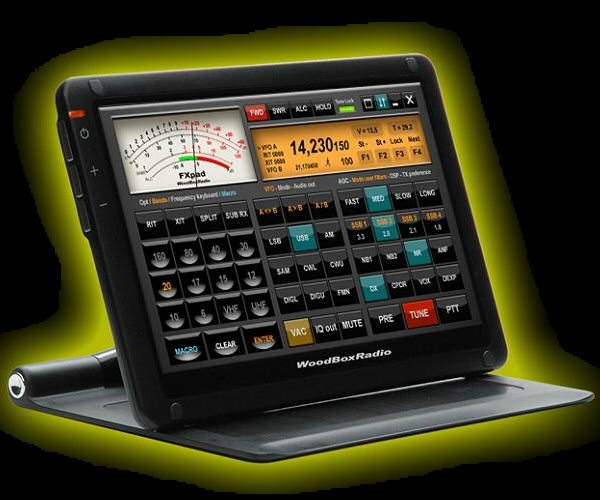
Casey TI2/NA7U recently wrote in his blog about the Elecraft KX3 which has a rather outdated look. Of course that’s just a opinion. Others will tell that it has just what they search for in a radio. But…I would rather have a flexible design were I can design my own front and knobs instead of being dependable of what the designer has in mind. With the technology of today it should not be that difficult. So, I was thinking and searching on the internet for pictures and found the site of WoodBoxRadio which already invented and sell part of my idea, the FXpad. It’s basically a Ipad for your SDR (Flexradio system) or of course any other radio. Now, you think that probabely costs a lot of money. Well just look around at that site. FXpad is just software. The pad itself only costs 179 euro, that’s not too expensive if you compare it with for example a Ipad or similair. I remind you it’s only a touchscreen, not a computer! I certainly want to have a screen like this in my new shack! Anyway, to get back to a idea for a new (QRP) radio with such a configurable touchscreen instead of knobs buttons and a display. What about a radio that is for example just as thick as a Elecraft KX3 but then with a configurable touchscreen. Software/hardware options like a internal keyer, digital modem, build in wireless LAN, progammable voiceprocessing, software updates for new features. There are endless possebilities. Just for example if you want it to look like a old Argonaut radio or just the KX3 if you like, you just change the display and it’s features to what you like. Another idea I would like is a self learning mike connection, a kind of USB plug for your mike. Just plug in any brand of mike and the radiocomputer learns the connections itself. That should be on the radio of the future….any other ideas? You’re welcome to write it as a comment on this post.
Bas, PE4BAS, is a regular contributor to AmateurRadio.com and writes from Groningen, Netherlands. Contact him at [email protected].
How To Use An Antenna Tuner
It’s always good to review the basics now and again. I know I could use some brushing upon a few things from time to time. Tyler, N7TFP, has made a video on how to tune an antenna. If your building your first station or studying for your exam, then this video is something I suggest you watch. Even if you’re a seasoned “Pro from Dover”, it’s good to watch. So here’s Tyler…
73.
Rich Gattie, KB2MOB, is a regular contributor to AmateurRadio.com and writes from New York, USA. Contact him at [email protected].
Ham Nation 27

Hosts: Gary Pearce (KN4AQ), Gordon West (WB6NOA), and George Thomas (W5JDX)
The end of youth month, ARRL’s video contest, building an electronic temperature sensor, and more.
Guests: Duncan (KU0DM), Elijah (WA6EMD), Daniel (KI6TNE), and Spencer (NG6K)
Download or subscribe to this show at http://twit.tv/hn.
We invite you to read, add to, and amend our show notes at wiki.twit.tv.
Thanks to Joe Walsh who wrote and plays the Ham Nation theme.
Thanks to Cachefly for the bandwidth for this show.
http://dts.podtrac.com/redirect.mp4/twit.cachefly.net/video/hn/hn0027/hn0027_h264b_864x480_500.mp4
http://dts.podtrac.com/redirect.mp4/twit.cachefly.net/video/hn/hn0027/hn0027_h264b_640x368_256.mp4
http://www.podtrac.com/pts/redirect.mp3/twit.cachefly.net/hn0027.mp3
Dr. Bob Heil, K9EID, is the founder of Heil Sound and host of TWiT.tv's Ham Nation which streams live each Tuesday at 6:00pm PT (9:00pm ET) at http://live.twit.tv. Contact him at [email protected].
Handiham World for 30 November 2011
Welcome to Handiham World!

 | If you own more than one vehicle, consider doing your Christmas shopping with the one that does not have the amateur radio equipment installed in it. This makes it much easier to turn that car into a “plain Jane” that will not attract any attention in the parking lot. |
| If you have accessories like transceivers or a GPS, get them out of sight. The GPS can probably fit comfortably in the glove box, but I recommend taking the transceiver out altogether and either leaving it at home or locking it securely in the trunk of the car while you are at home, not in plain sight in the parking lot of some shopping center where the bad guys can see that you are putting valuables in the trunk. I prefer using magnetic mount antennas that can quickly be pulled off the roof of the car and tossed in the trunk. |
| I have become somewhat of an expert in hiding wires under the passenger side floor mat. After taking out the radio and throwing it into the trunk, I can easily disguise the antenna feed line by simply coiling it up and placing it under the floor mat where it is completely out of sight. Any accessory plugs or wires for the GPS can also go under the floor mat or in the glove box prior to my leaving my own property. |
| Any time you purchase gifts, the time to place them in the trunk of the car is immediately upon leaving the store. Never place them on the passenger seat or anywhere else in the passenger compartment where they can be seen by anyone pretending to park their car nearby. It takes only a few seconds to break into a car and transfer these packages into an adjacent vehicle. Again, the idea is to make your car look as plain and uninviting as possible. |
| Never, ever return to the car and put packages in the trunk or anywhere else in the car and then leave the car in the same place and return to your shopping. The only time you should place packages in the car at all is when you’re getting ready to leave. Anyone can see you putting packages in the car and break into the car, including the trunk, as soon as you are out of sight. If you must unload because you have just too much to carry and it is necessary to make a stop at the car to put packages in the trunk, I recommend that you do so and then drive the car to another part of the parking lot or a different floor on the parking ramp, park it again, and return to your shopping. That lessens the possibility of someone seeing you fill the car with packages and then leave, giving them time to break in. |
| Even if you have placed your antennas out of sight, don’t be tempted to leave radios installed in the front of the car where they can be seen through the windows. Thieves may not know what they are taking, but they probably figure that whatever they get can be sold for a few bucks for drug money. You can’t simply depend on a thief not wanting an amateur radio transceiver because they don’t know what it is! |
| I have heard other amateur radio operators suggest that callsign license plates on a vehicle can attract thieves, but I have never found this to be the case. In fact, I think the general public probably thinks of them more as vanity license plates and I have even run into police officers who aren’t familiar with call letter license plates. Maybe amateur radio operators are such good drivers that they never get pulled over! |
| Generally thieves who break into cars want to be able to do so quickly without being noticed. You can improve your odds of avoiding car break-ins by locating your car in a well lighted, busy part of the parking lot. I don’t like parking next to blank walls or trucks or vans that hide the vehicle enough for someone to break in while remaining out of sight. |
| The name of the game is to avoid drawing attention to your vehicle with anything that looks expensive, flashy, or easy to steal. I can’t emphasize enough how leaving packages or expensive radio equipment in plain sight can attract thieves at this time of year. They are out there looking for easy money, so you really have to be careful to make sure that your vehicle doesn’t stand out as an easy mark. |
| Even when you park your car in your own driveway your radio equipment can be at risk. I recommend parking cars with radio equipment that you want to leave installed in a secured garage. Don’t depend on car alarms to protect your expensive radio equipment. A car parked in the driveway can be burglarized in minutes while you sleep. If you have limited parking space, the car with the radio equipment should be parked inside and the car that must be parked in the driveway should be the “plain Jane” with nothing to attract thieves left in plain sight. |
| Of course no matter how careful you are, you can fall victim to thieves. You may want to consider insurance coverage for your radio equipment. Your existing automobile insurance may provide some coverage, but supplemental insurance is always available. This is a matter to discuss with your insurance agent. Sometimes relatively inexpensive transceivers, such as 2 m only mobile units, may not be worth paying an extra insurance premium. On the other hand, if you have a truck load of expensive radios that operate on multiple bands and that are difficult to remove from the vehicle when you go Christmas shopping, you may want to consider that extra insurance coverage! |
| As they used to say on the old Hill Street Blues TV series, “Let’s be safe out there.” Timely advice for the holidays! |
[email protected]
Handiham Manager
Early Winter Reading: Becoming a Ham (Part 11)

Becoming a Ham – Part 11
By T. A. Benham (SK – formerly W3DD, a callsign which has been reassigned.)
Tom Benham, now a silent key but who most recently held callsign W3DD, was a ham radio pioneer, and being blind didn’t even slow him down! Join us now as W3DD recalls more about satellites in the early days and his experience with a Senate investigation.
The Teletype Episode
We were a very active part of NASA tracking for a couple of years and the teletype was our means of receiving messages about launchings. One night I stayed in the trailer all night because there was to be a launch about five A.M. We had fitted out the front part of the trailer with a couch, a hot-plate, coffee pot and other things for comfort. I was awakened about three in the morning by the teletypewriter coming on and typing something. Of course, I didn’t know what it had written. Perhaps the message required a reply. If so, I would have to use the phone and find out what it was. After thinking about it for a few seconds, I got up, sat down at the machine and wrote, “If what you just sent requires a reply, ring the bell three times. If no reply is required, ring the bell twice.” After a few seconds, the bell went ding ding. I went back to bed until five o’clock. A couple of days later, a man walked into my lab and said, “The office in Philadelphia sent me out here to find out what that monkey business the other night was all about.” “What monkey business?” “That business about ringing the bell three or two times.” When I explained it to him, he got a huge bang out of it saying “Gosh, wait until I get back and tell them that!” and he left. “Voices of the Satellites” got additions made to it during this period. We got the recording of Eisenhower’s Christmas message broadcast from a satellite at Christmas 1959, telemetering signals from many satellites, John Glenn’s flight in which he talked about the ice crystals, Russians talking back and forth between two space vehicles. As a matter of fact, the news people were out several times with cameras and recorders to watch and listen to the signals as we picked them up. We were not able to pick up satellite signals until they got above the horizon, so there was a delay of about two minutes after launch until the satellite was about 100 miles high before we made contact. In about 1963 we were monitoring a launch. We waited for the two minutes and then began to look for the signal. Several minutes passed with no contact so I went to the teletype machine and asked what happened. In two or three minutes the teletype machine wrote a very short message. I asked someone to read it. All it said was “splash.” One time when I thought we would be able to hear the Russian astronauts talking from one ship to another, I invited a member of the University of Pennsylvania Russian Department to come listen. He did and we got a very good signal. Unfortunately, all they talked about was trivia about temperatures in the cabins, how their food was holding out, and such like. But it was interesting to us and he seemed to get a big kick out of it. An interesting but small contribution to the Space effort was made by Ham radio back in 1959. I mentioned that President Eisenhower provided a recorded Christmas message just before December 25th that year. The story has it that the message had not arrived in time for the launch. The vehicle was closed and launch was a few minutes away. A Ham, identity not known, rushed up with a recorder and equipment and said, “Hold it! let me radio the message to the receiver in the “bird”. He set things up and sent the taped message to be stored aboard. I recorded the result when it was transmitted some time later.
The Summons
A rather amusing incident took place early in the satellite project. During the first couple of years, there was much conversation about the fact that the Russians had launched before we did. The project for launching was well under way in this country. Werner Von Braun, the German Physicist who was responsible for the development of the V1 and V2 rockets in Germany, was brought to this country at the end of the war and was making good progress organizing rocket development down in Alabama, but the red tape and time spent arguing delayed our program so that the Russians got ahead of us. There was much talk in the US Senate about why we were behind. There was an article published in one of the popular magazines telling what a good job Russia was doing. A Senate Committee was convened to investigate matters. The author of the article and I were subpoenaed to appear before the Committee. I got a small recorder and a few tapes to take with me to demonstrate what I had been recording and asked Corlies to accompany me. We were shown into the committee room and the other fellow was called first. They gave him a hard time and he did not present his information very coherently. The tenor of his remarks was that the Russians were way ahead of us, that he had been there and seen for himself.
Senator Brooks, the chairman said something like, “Well, you certainly have been given a snow job and what you have said does not seem to mean much.” Then I was called to the witness table and the chairman said in a sarcastic tone of voice, “Now, what’s your story?”
“I don’t have a story, as you put it, sir. You summoned me so I’m here. What do you want of me?”
His attitude changed immediately. He said, “We’ve heard that you have been very active in tracking satellites. We’d like to hear some of your recordings and ask a few questions. Please give us a summary of your activities.”
Things proceeded peacefully and pleasantly after that. I played a few samples of the satellite signals and explained what they meant and the information that could be derived from them, both US and Russian vehicles. They seemed to enjoy what I played and were friendly and interested.
Next week: Moonbounce.
To be continued…

Pat Tice, WA0TDA, is the manager of HANDI-HAM and a regular contributor to AmateurRadio.com. Contact him at [email protected].
W0/FR-107 (Green Mountain) 2085m / 6841ft
To say I’m hooked on SOTA might be an understatement. My second SOTA activation was completed on 27 November, just eight days after my first. Yes, I’m hooked.
As mentioned in recent blog updates, I had ordered a few items from Buddipole which didn’t arrive in time for my first activation of Mt. Herman (W0/FR-063). Let me be clear that this was no fault of Buddipole. I just simply didn’t order the items early enough for them to arrive in time.
So with my new items including the Buddipole shockcord whip, the Buddipole A123 nanophosphate battery pack and the Buddipole mini-coil and the lessons learned from activation #1, I set out for Green Mountain. Before I continue any further. I just want to say that of the list of things I just identified. The “lessons learned” were truly the most important. But new toys are always fun to have and certainly fun to play with.
As I mentioned in my activation alert blog post I chose Green Mountain due to its proximity to my home QTH and very honestly its relatively easy climb. The elevation gain is approx. 1000’ over about 1.9 miles. I was still a little sore from the Mt. Herman trip the weekend before, but couldn’t pass up the great weather which was forecasted for the area. Plus I had some turkey and dressing to work off. 

I arrived at the Green Mountain trailhead just before 8 AM (1500z). This would allow me plenty of time to hike to the summit and get everything setup to start calling CQ at 1700z. There are several trails leading to the top of Green Mountain. I had my APRS beacon on and this is how my trek looked as I hiked to the top.

The Green Mountain trail is a well maintained and an easy to follow trail. As a matter of fact, if you live in the Greater Denver area, I would highly recommend Green Mountain as a good starter SOTA summit. It’s close to Denver and the metro area and like I said it is both an easy trail to follow and not difficult either. As I stated previously, there are several trails that make up the Green Mountain Park area. All are clearly marked as shown to the right.

Like many of the foothills that dot the landscape around the Denver metro area, Green Mountain does have a transmitter site and tower. The transmitter site and tower is not the summit. But as I approached the trail that passes near the site, I saw what I thought was a little boy or girl sitting on a rock. It was still early and there was no one else around. This little boy or girl continued to just sit there on the rock. I began looking around to see if anyone else was around and once I got within about 25 yards I realized was just a rock with a pipe sticking out. Other hikers had placed a sweater, scarf, gloves and a cap. It sure fooled me.

I made it to the summit from the trailhead in just a little over 45 minutes and began setting up the Buddipole Versatee vertical. I used an older hiking staff which has a removable knob handle. Under this knob is a 1/4 stud for mounting a camera. Buddipole provides a machined brass connector which is 1/4” threads inside, with 5/8” threads outside. This allows you to stand the Buddipole Versatee on one end and easily connect it to the monopod or hiking staff. I then guyed it from just below the Versatee and used large rocks to secure it all in place. If you remember from my first activation, the wind really caused problems with the way I setup the vertical. Thanks to Steve wG0AT for this idea.

If you’re not familiar with the Buddipole versatee vertical setup, all it consists of is the Buddipole versatee adapter, Buddipole coil and either the arms and whip from the dipole kit or the new Buddipole shockcord whip. I’m using the mini-coil and the shockcord whip. The final important element to the vertical setup is a single, elevated wire counterpoise. Buddipole sells an inexpensive lightweight counterpoise kit that works great. One end of the wire counterpoise attaches to the versatee adapter and the other I keep elevated off the ground with my other hiking pole.

The other main addition to my SOTA setup is the fantastic Buddipole A123 nanophosphate battery packs. I decided to go large and I purchased the largest pack they offer. This is the 4S4P and is rated at 13.2 volts/9.2Ah and weighs just over 3 lbs. The SLA I packed up to Mt. Herman weighed over 5.5 lbs and was only 7.5Ah. This little battery pack is truly amazing and I’m 100% comfortable with the investment I made.
Weather conditions were early fall like. When I left home the temperature was around 30 F and just in the short 30 minute drive, the temperature at the trailhead was around 38 F. The sun was shining bright and summit temperatures during my two hour stay were in the 50’s with a very light breeze.
But how did it all perform? Well…I began calling CQ at just before 1700z and logged my first contact on 20m at 16:58z. I worked 21 contacts on 20m (including a summit to summit contact with wG0AT) and finished up with another 18 QSO’s on 17m for a total of 49 QSO’s in just under two hours. While band conditions weren’t as good as last weekend, I still had a lot of fun and truly look forward to activation number three.
Speaking of my next activation. It may actually be a few weeks (or longer) before I have the opportunity to do another SOTA activation. My wife and I are planning to travel to Texas in about 10 days and then the Christmas holidays are just around the corner. Also, winter weather will surely arrive at some point and bring snow covered trails and much, much colder temperatures. I’ve said several times that I don’t consider myself to only be a fair weather SOTA activator, but I also like playing it safe.
Regarding my possible next activation. The Colorado Front Range weather can be cold and snowy one day and a few days later all visible signs of snow have melted away. With that said, there are dozens of SOTA summits just in my backyard ranging in elevation from 6,800 – 9,500 feet with good, solid trails. I plan to just start at the bottom of the list and work my way up (at least during winter). This is sure to keep me busy for a while.
Until next time….
73 de KD0BIK (Jerry)
Jerry Taylor, KD0BIK, is a regular contributor to AmateurRadio.com and writes from Colorado, USA. He is the host of the Practical Amateur Radio Podcast. Contact him at [email protected].
Low-profile 2-meter mobile suggestions
A fellow blogger, Brick O’Lore, wrote me with a question that I don’t have a good answer for. Would anyone care to weigh in on this?
I’d like to add a 2M mobile rig in my wife’s car. Sounds simple enough, but the trick is that I need something that is as small as possible and will have a really neat installation. I’d prefer to have a mobile rig that I can wire in (power and an antenna) and see the display (versus cobbling together something with an HT). A detachable faceplate/remote would be fine. I want 2M to hit the repeaters – any other bands or advanced features would be a bonus, but not required. The car is a 7 year-old Audi A4 and there is very little room in the footwells. It does have a neat feature – a drawer under each of the front seats. So what’s small and installs such that it will score well on the WAF (Wife Acceptance Factor) scale?
My suspicion is that there are a lot of good choices — and none are going to be particularly “affordable.” If you have a photo of your creative radio installation that might help others, send it to me (editor at amateurradio dot com) and I’ll attach it to this post. I think that would be especially helpful. If not, your insight and tips via comments are always very much appreciated!
Matt Thomas, W1MST, is the managing editor of AmateurRadio.com. Contact him at [email protected].
 Ham Radio Deluxe |
 W5SWL Electronics |
 Ham Radio Prep |
 KB3IFH QSL Cards  Hip Ham Shirts  HamRadioAuctions HamRadioAuctions Reliance Antennas Reliance Antennas Enigma Shop Enigma Shop |  morseDX  Ni4L Antennas  R&L Electronics R&L Electronics antennas.us antennas.us QRV QRV |
- Matt W1MST, Managing Editor
