 |
 LHS Show Notes #070
 20 December 2011 | by
 Promo:
- The 2nd Annual Northeast GNU/Linuxfest will be held March 17, 2012 in Worcester, MA.
Introduction:
- Welcome to another installment of Linux in the Ham Shack.
- After the holidays, consider attending a Skywarn training class so you’ll be prepared for the next storm season.
Topics:
- Contesting software for Linux
- Ian, KM4IK, wrote that he’s now using Ubuntu 11.04 in his ham shack, but wants suggestions for a native Linux contest logging program. Good question, Ian, and we have a few suggestions. However, as neither Russ nor Richard are contesters, these may or may not be suitable for you.
- JL Logger is a Java application that supports all of the major contests.
- YFKlog and YFKtest are curses-based programs that run in a terminal session. YFKtest uses the hamlib libraries for rig control.
- TLF also runs in a terminal session and uses hamlib for rig control.
- KB is still in development. It runs in the Gnome window manager. Radio control for the Yaesu FT-1000 only.
- Fldigi has a built-in logger, and will also work with CQRLog.
- N1MM Logger has been reported to work under Wine. Others have had problems.
- Russ tried installing N1MM under Wine, and while the installer ran fine, N1MM didn’t run properly when launched. Apparently, you must have the ALSA libraries installed. Note that the N1MM website warns that you should perform the Full Install, then install the latest update. Do not run the Full Install without first installing the update. Russ also tried the JL Logger, but it crashed. After realizing that it requires that the Java Development Kit, he installed that, but it still crashed. Look for an update in a future episode.
- VLC media player
- Richard was having an issue with the VLC plugin for Firefox 7.0.1; the LHS music stream would play one song then stop. The VLC Media Player should work.
- Our hosts briefly digress into a discussion of the DEFCON system; DEFCON 1 is the most serious, while 5 is the least. Hollywood often gets it wrong.
Feedback:
- Burt, K1OIK: please contact us about recent emails we’ve received from you. It may be that your email account may have been compromised.
- Leif, KC8RWR, wrote us regarding the discussion of EchoLink clients in episode 66. He tried QTEL and it worked fine. Thanks, Leif. (Also look at SvxLink.)
- Tom, KA2D, who is on the committee for Ham Radio University in New York, asks if there are any LHS Ambassadors in the Long Island, NY area. No, Tom, so you’re it!
- Andy, KC2ZWR, of the Suffolk County Radio Club, will also be at Ham Radio University on January 8, 2012, and offers his services as ambassador for that event.
- Tony, K7ISS, wrote to say he was happy that Richard had a good time at the Texoma Hamarama. Richard blogged about his visit to the event.
- Mike S., sent a VERY generous donation to the podcast. Thank you, Mike!
- The second annual Indiana Linuxfest will be April 13-15, 2012 at the Wyndham Indianapolis West Hotel. Russ is planning to be there, and so should you.
Contact Info:
- Contact Richard at [email protected], Russ at [email protected], or both at the same time at [email protected].
- Listen to the live stream every other Tuesday at 8:00pm Central time. Check the LHS web site for dates.
- Leave us a voice mail at 1-909-LHS-SHOW (1-909-547-7469), or record an introduction to the podcast.
- Sign up for the LHS mailing list.
- Sign up for the MAGNetcon mailing list.
- LHS merchandise is available at the Merch link on Web site. Check out the Badgerwear or buy one of the other LHS-branded items at PrintFection.com/lhs or Cafe Press. Thanks!
- Thanks to Dave from Gamma Leonis for the theme music.
Music:
- To be added.
Russ Woodman, K5TUX, co-hosts the Linux in the Ham Shack podcast which is available for download in both MP3 and OGG audio format. Contact him at [email protected].
40m JT65 surprise
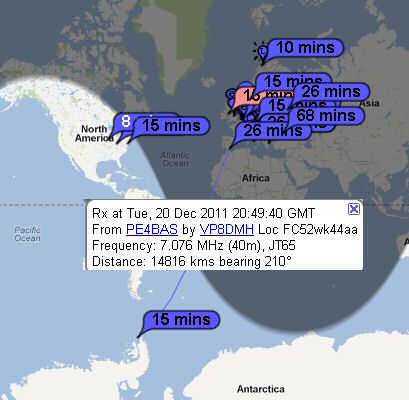
I was using JT65 this evening with 5W from my FT817 on 40m. Antenna was the 84m loop. The surprise was my signal being received by VP8DMH at the Halley Research station, Brunt Ice shelf, Antarctica. Didn’t see hime making QSOs so I guess he was just listening!
Bas, PE4BAS, is a regular contributor to AmateurRadio.com and writes from Groningen, Netherlands. Contact him at [email protected].
Building Your First Station
A few weeks ago, I posted a video from Tyler, N7FTP, who posted a “Getting Started” kind of video on how to use an antenna tuner. And I am a firm believer in getting back to basics. It’s saved my bacon a bunch of times. When I came across this video, it was a no brainer on if I should post it or not. So Tyler is back with a video and tips on building your first Amateur Radio station. He demonstrates equipment that is important to have in a first station.
73.
Rich Gattie, KB2MOB, is a regular contributor to AmateurRadio.com and writes from New York, USA. Contact him at [email protected].
Latest QSLs

A batch of QSLs just arrived from the RSGB Bureau. Here are a few of the more attractive ones. Enjoy!

Julian Moss, G4ILO, is a regular contributor to AmateurRadio.com and writes from Cumbria, England. Contact him at [email protected].
LHS Episode #070: The Stroke
 Welcome to another installment of Linux in the Ham Shack. In this episode, our mostly unprepared hosts discuss a couple of interesting topics. Yes, really, they are interesting. In the Ham Geeky™ section, Richard plows the fertile fields of contest loggers for Linux, as well as cross-platform solutions, including running your own favorites under WINE. In our Linux Geeky™ area, Russ discusses the VLC media player among other things you’ll just have to listen to find out about. Several pieces of feedback are discussed and there is the usual assortment of witty banter, mindless rambling and quasi drunkenness. No, that’s not right–I meant quasi drunkenness. So sit back, strap in, and enjoy the ride.
73 de The LHS Guys
Russ Woodman, K5TUX, co-hosts the Linux in the Ham Shack podcast which is available for download in both MP3 and OGG audio format. Contact him at [email protected].
LHS Show Notes #069
Introduction:
- Welcome back to another episode of LHS.
Topics:
- Texoma Hamarama
Richard attended Texoma Hamarama at the Ardmore Convention Center in Ardmore, OK. He had a great time and describes his adventures. He took a few pictures and wrote a blog entry for the web site. - HamQTH
HamQTH is a callsign lookup service that is free and does not require a subscription. Russ gives his review. By registering, you can edit some of your information or use the search results in your logging program. Thanks to Ted, WA0EIR, for telling us about it. - Adventures in Printing
- Richard recently installed Linux Mint on his wife’s machine as she was becoming increasingly frustrated with the speed of Windows. He did run into an issue with getting her Lexmark all-in-one printer working, which leads him to a discussion of printing in Linux.
- CUPS, Common Unix Printing System, originally developed by Apple for OS X, has become the standard printing system for Linux. You can administer CUPS by pointing your web browser to http://localhost:631
- Most distributions install the Foomatic driver database. Another source of drivers is Gutenprint.
- If your printer is not listed specifically, you may have success using a generic PCL5, PCL6 or Postscript driver.
- Also check the Linux Foundation OpenPrinting project to see how well a given printer is supported in Linux. It’s a good idea to visit this site before you buy the printer.
- Most network printers will be recognized and configured automatically by CUPS.
Contact Info:
- Contact Richard at [email protected], Russ at [email protected], or both at the same time at [email protected].
- Listen to the live stream every other Tuesday at 8:00pm Central time. Check the LHS web site for dates.
- Leave us a voice mail at 1-909-LHS-SHOW (1-909-547-7469), or record an introduction to the podcast.
- Sign up for the LHS mailing list.
- Sign up for the MAGNetcon mailing list.
- LHS merchandise is available at the Merch link on Web site. Check out the Badgerwear or buy one of the other LHS-branded items at PrintFection.com/lhs or Cafe Press. Thanks!
- Thanks to Dave from Gamma Leonis for the theme music.
Music:
- To be added.
Russ Woodman, K5TUX, co-hosts the Linux in the Ham Shack podcast which is available for download in both MP3 and OGG audio format. Contact him at [email protected].
1Hz-2MHz Function Generator Kit
 After building the “Accurate LC Meter Kit” from Electronics-DIY.com, I turned to their “1Hz – 2MHz XR2206 Function Generator Kit”. All parts necessary to complete the kit were included, though not exactly as pictured on their webpage — two of the WIMA capacitors had been replaced with substitutes and there was no IC socket. All components were through-hole; soldering the kit together went quickly and easily.
If you build one of these kits you’ll need to provide your own power source as well as your own pin-connectors (if you choose to use the pins provided). As with the LC Meter, I used a size M coaxial DC power jack to accept a plug from one of the wall-wart power supplies I have around here. I didn’t bother to install a power switch in either unit since I won’t be using them very often; I won’t leave them plugged in between uses.
The fellow at the local Radio Shack gave me some pin-connectors for free, clipping them off of some battery packs that were in a box for recycling, though he only had two-pin connectors. Since one of the pin-sets has three pins, I just soldered a piece of hookup-wire to the third pin. If I had to do it all over again, I wouldn’t bother with these pins — I’d just solder hookup wire right to the PCB. By the way, if you ever try soldering to a pin make sure you clip a heat-sink to the pin before heating it up. The plastic base of those pins melts pretty quickly!
I chose a plastic project box from Radio Shack to house this function generator. Using a Dremel tool with an engraving cutter (at the lowest speed — 5,000 RPM), I put three notches in one side of the box for the potentiometers, a notch on one end for the two switches, and ground down all four stanchions on the floor of the box since otherwise the potentiometers would have extended too high to allow the lid to fit. That Dremel tool sure is handy! A few knobs from Radio Shack finished off the project.
The two outboard switches allow you to select between three waveforms — sine, triangle, and square. I don’t have an oscilloscope so I can’t tell you how the waveforms look, but I can at least tell you that the sine wave sounded pure when I hooked my headphones up to the output with a matching pad. I am pleased to report that the signal generated by this function generator is very stable. Four DIP switches on the PCB allow you to select between four frequency-ranges, and two potentiometers allow you to tune within the selected range. One of these two potentiometers provides coarse tuning, and the other provides fine tuning. The third potentiometer controls the amplitude of the signal generated (note: amplitude decreases as you turn this potentiometer clockwise).
If you build this kit you’ll want to hook it up to a frequency counter. Two pads on the PCB are provided for this purpose. I have a piece of coax hanging out of the back of the box for connection to my own frequency counter — not that you have to use coax, but it was handy for terminating with a BNC connector. (If I were really classy I would have put this coax through its own hole in the project box, but hey, this is a piece of test equipment — I just ran it through the big hole I made for the RCA connector.) When I hooked up my frequency counter I noticed that the published ranges for each DIP switch were just rough approximations, but I was pleased to see that this frequency generator covered the entire published range and more — up to about 2.4 MHz, if I recall correctly.
Here is a slideshow of photographs I took of the completed function generator:
The source impedance of the generator is 600 ohms and the output is intended to be terminated in a 600-ohm load. In my next post, I hope to discuss the construction of a minimum-loss matching pad to hook it up to a piece of equipment that has a different input impedance.


Todd Mitchell, NØIP, is a regular contributor to AmateurRadio.com and writes from Minnesota, USA. He can be contacted at [email protected].
 Ham Radio Deluxe |
 W5SWL Electronics |
 Ham Radio Prep |
 KB3IFH QSL Cards  Hip Ham Shirts  HamRadioAuctions HamRadioAuctions Reliance Antennas Reliance Antennas Enigma Shop Enigma Shop |  morseDX  Ni4L Antennas  R&L Electronics R&L Electronics antennas.us antennas.us QRV QRV |
- Matt W1MST, Managing Editor
