 |
 My YouTube debut……
 22 January 2012 | by
has some good advantages over the way I am now......or was using.

With this configuration I am able to just push the RX ant button on the K3 and both units are inter connected. Also the way the MFJ 2026 is adjusted is a little different than I had previously adjusted the unit. I tried it and it is very easy, fast and works great!! So what are the advantages of hooking up your MFJ 1026 this way....well you never have to worry about the RF from your transmitting antenna getting into your receive antenna. With this hookup they are totally isolated. To include the MFJ 1026 it's as simple as powering up the MFJ unit and pushing the RX ant on the k3 and then some simple adjustment of the MFJ unit. Finally I decided to use my Iphone to video the results of the MFJ 1026 and the K3 and how they dealt with the Plasma TV noise. You will have to excuse the reflection of me in the Elecraft P3 and the audio may not be that great either but give it a go as it does show how the Plasma TV's interferance can be dealt with.

Mike Weir, VE9KK, is a regular contributor to AmateurRadio.com and writes from New Brunswick, Canada. Contact him at [email protected].
Propeller takes to the air
Today I have been playing around with MEPT beacon code on my Gadget Gangster Parallax Propeller board. First I wandered over to Jeff, KO7M’s blog and borrowed his WSPR beacon code.
 |
| Gadget Gangster in use as a 25mW WSPR/Opera beacon |
WSPR was the thing I originally wanted to try when I decided to get the Gadget Gangster: I hadn’t even heard of OPERA at that time. But I was unsure whether I would be able to generate the FSK frequencies WSPR uses: four tones separated by about 1.48Hz. Jeff decided to shoot as near as he could and programmed for a 2Hz separation of tones, and found that the signal was decoded by K1JT’s WSPR program. So no problem!
I measured the RF output from the Propeller board and it was somewhere in the region of 25 to 40mW, depending on which measurement method you believe. I also looked at the output using my oscilloscope.
 |
| Output waveform from Parallax Propeller on 80m |
It wasn’t a pure sine wave, there’s obviously some harmonic content there, but it was not as bad as I feared it might be. As I would be using my MFJ magnetic loop on 30m, which has a very narrow bandwidth, I decided not to bother with a low pass filter for the sake of these initial trials. I watched the seconds tick over on my shack radio-controlled clock, started the beacon and was soon rewarded by several WSPR spots!
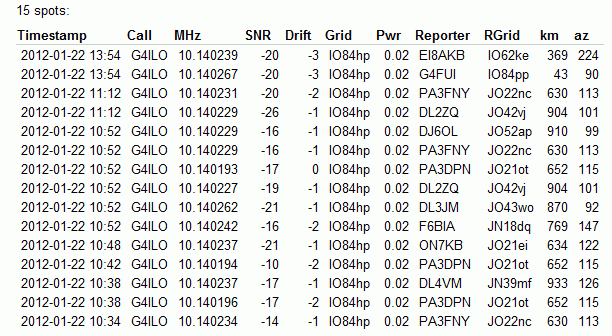 |
| WSPR spots for 25mW Propeller beacon |
Because WSPR is a time-synchronous mode I had to start the beacon when the seconds ticked over to 00. This brought to light a problem Jeff had already observed: the Propeller drifts. The drift seems to be worst during the first few minutes of operation, so leaving the beacon running so it can reach a stable temperature would appear to be the solution. However that is not so easy when you have to power it on at an exact time. I will need to look in to implementing a real-time clock for WSPR, unless I want to interface a GPS receiver to the Propeller – which is certainly possible and something else I hope to try as I’d like to have a go at making an APRS tracker.
An advantage of the OPERA mode is that it is not time synchronous so I can leave the beacon running in that mode with an arbitrary delay between transmissions. My first OPERA transmission also produced several spots, including reports from fellow bloggers PC4T and G4NKX.
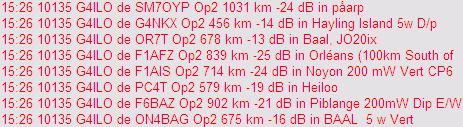 |
| OPERA spots for 25mW Propeller beacon |
I can also generate Morse and QRSS beacons using the Propeller chip. There is still a lot to do to reach my goal of a multimode, frequency-agile beacon, including adding a PA and some switchable bandpass filters. But so far this project has turned out to be easier than I thought it would.

Julian Moss, G4ILO, is a regular contributor to AmateurRadio.com and writes from Cumbria, England. Contact him at [email protected].
Happy Chinese New Year
 Yes, I am still alive. With the end of the year and the end of a semester at school there was too much going on to sit down and write something properly. But if you have followed the blog on my website you know I have been a bit busy with the hobby after all. The itch has to be scratched somehow.
Chinese New Year is upon us, which means a lot of festivities here in Asia. Expect some more activity on the bands from China and Taiwan as this is the only time of the year that people get some longer time off from work. The coming year is the year of the Dragon and I live in Longtan (meaning Dragon Lake) so my new QSL card will have to be based on a dragon as well. Stay tuned.
After a busy half year it was time to relax a bit and so we went to the southern tip of Taiwan last week. Temperatures were such that the kids could play on the beach and me and my wife could lounge on deck chairs. I didn’t take a radio with me, but still had an interesting encounter with amateur radio.
In the taxi to the National Museum of Marine Biology and Aquarium I noticed the driver had a 2m/70cm rig in his dashboard. So I asked him for his call sign. Instead he gave me his on-air handle. So I asked him again, explaining that when he applied for a licence he got himself a call sign beginning with BM (which is the prefix for the third or entry class station licence). He didn’t remember, because it was over ten years ago that he took the exam and why use a call sign anyway, everybody knew him by his handle? He only uses his rig to communicate with other drivers to warn where the police has put up speeding and alcohol checks.
And that, ladies and gentlemen, is how amateur radio works in Taiwan. Or as I saw it on a Taiwanese forum: “The third class licence is simply to legalize the ‘sausages‘ out there.” CB radio, but with a licence. Happy Chinese New Year to you all!
Hans "Fong" van den Boogert, BX2ABT, is a regular contributor to AmateurRadio.com and writes from Taiwan. Contact him at [email protected].
GB4LBC Special Event Station
It been a real pleasure to be operating the GB4LBC special event station for SOS radio week today. With just a long wire and 100w we had our own little pile up which lasted pretty much all day.
The station will be up and running again tomorrow on 40m and hopefully will be just as popular. The Workington and district club (MX0WRC) is operating 3 of the 4 stations in Cumbria
GB1LBC – Silloth
GB2LBC – Workington
GB4LBC – St Bees
GB5LBC – Barrow in Furness
GB5LBC is operated by our friends at Furness ARS and we managed to have a quick QSO during the pile up
Alex Hill, G7KSE, is a regular contributor to AmateurRadio.com and writes from Cumbria, UK. Contact him at [email protected].
LHS Episode #073: Advanced Networking Topics
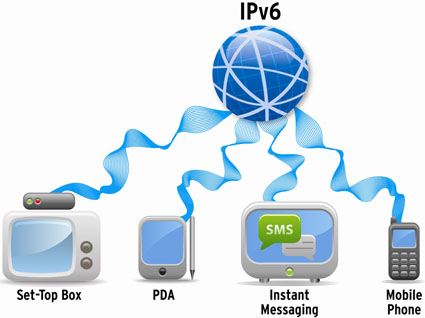 Today the guys delve deep into their geek pockets and come up with a couple of fairly advanced networking topics. One is ham radio related, the other is everything related. Don’t be scared off, however, as the discussion is a 10,000-foot overview of these technologies and how they will be important in YOUR future. Russ tackles IPv6 in a generic way, discussing using it with Linux, and gets on his soapbox about how everyone should already be using it.
Richard discusses a wireless technology called HSMM or High-Speed Multimedia. This is a networking technique that blurs the line between FCC Part 15 and FCC Part 97, but gives ham radio operators some new and exciting things to try with their off the shelf wireless gear. HSMM has some nice features and will definitely earn you your Boy Scout Geek Cred Badge if you decide to dive in.
Thanks as always to our listeners, present and future. Comments and questions, make sure to send them our way. Donations are also appreciated. If you want to promote yourself, your ideas or your projects, leave us an intro to the show at 1-909-LHS-SHOW. Stay geeky!
Russ Woodman, K5TUX, co-hosts the Linux in the Ham Shack podcast which is available for download in both MP3 and OGG audio format. Contact him at [email protected].
Four metres
There are a number of things I’d like to do radio-wise this year. One of them is to get equipped for SSB on four metres.
I have spent quite a lot over the last two or three years on 2m SSB and have very few contacts to show for it. My QTH in the Cockermouth Black Hole seems to be prevented by the Lake District mountains from receiving good signals from other English stations by normal propagation. I don’t even experience much in the way of tropo openings here. The only real 2m DX I have worked are a handful of Sporadic-E (Es) contacts into Spain and Portugal. One thing I have learned is that 144MHz Es, which is a pretty rare thing in any case, is considerably rarer the further north you get. I was ill and recovering from my brain operation during the peak of the Es season last year but as far as I can tell from DX Sherlock no Sporadic-E openings on 2m reached this far north during 2011 so I didn’t actually miss anything.
Six metres is another matter. I have made lots of contacts on the Magic Band even though my 6m antenna is just the addition of two quarter-wave wire elements to my multi-band attic dipole. Four metres won’t be open as often as Six but it should sustain Sporadic-E propagation a lot more often than Two does. And now that many European countries have granted their amateurs 4m allocations I think there could be a good chance of working some summertime DX.
The plan depends on my finding space in my attic antenna farm for a 4m antenna. One of the first home improvements Olga and I will make this year is to replace the central heating boiler and we’re advised that the most efficient types available now heat the water on demand and don’t need a header tank or pipes in the loft. I’m a bit apprehensive about letting workmen loose in the attic when I’m not sure whether I’m capable of moving around safely up there to check my antennas are OK and repair any damage. But getting rid of the tank and copper pipes will make a bit more space for the antennas and hopefully allow me to mount a 4m Moxon on the rotator where the 2m one currently is.
I will also need a radio for 4m SSB. I guess I’m looking at getting a Spectrum Communications transverter for this. Probably a ready built one as I’m not really sure I can manage to assemble that complex a kit any more. I wonder if anyone has successfully modified an Elecraft XV50 for 70MHz?

Julian Moss, G4ILO, is a regular contributor to AmateurRadio.com and writes from Cumbria, England. Contact him at [email protected].
Freedom of Expression on the Forums
Recently, I made a complaint on a well known ham forum concerning derogatory posts regarding God and Religion. I was practically told by the Administrator and Manager of the site in a PM that If I didn’t like it I could lump it! He then proceeded to insult God and Religion himself and so it became obvious that such remarks were a reflection of him and how he ran his site.
My question to hams: Should there be tighter controls over what is said on such forums?
I know blasphemy laws do not exist in the United states and are incompatible with the Constitutional provision for ‘Freedom of Expression,’ but surely forums like this are international in nature and include hams of all religious faiths.
As a journalist I believe in freedom of expression but feel this must be tempered with the protection of inalienable rights, including religious belief.
I would be interested to hear what others think?
Freddy McGavin, EI4GMB, is a special contributor to AmateurRadio.com and writes from County Cavan, Ireland. Contact him at [email protected].
 Ham Radio Deluxe |
 W5SWL Electronics |
 Ham Radio Prep |
 KB3IFH QSL Cards  Hip Ham Shirts  HamRadioAuctions HamRadioAuctions Reliance Antennas Reliance Antennas Enigma Shop Enigma Shop |  morseDX  Ni4L Antennas  R&L Electronics R&L Electronics antennas.us antennas.us QRV QRV |
- Matt W1MST, Managing Editor
