 |
 Weekend 50Mhz vertical antenna
 8 February 2012 | by
 One of the enduring aspects of amateur radio is the emphasis on ‘experimentation’ and ‘homebrew’. To many people this means designing innovative circuits for their own transceivers, amps or whatever floats their boat.
My area of interest is in collecting either bent wire, off cuts of cable and odd shaped plastic parts scavenged from just about any skip or rubbish bin I can find. Some people like to call this antenna experimentation. My XYL likes to call it ‘That junk in the garage’. I like to call it my continued education. Below is a teaser!

The latest in my armoury of ‘stuff I’ve done’ will never help anyone chase DX or bust a pile up for a little activated square or something else. But it will give me another band to work with when I’m away from home, either on top of a summit, at the mother in laws or operating portable in the summer Es season (I say summer because the top of St Bees head isn’t very welcoming in the winter as I found out whilst operating GB4LBC).
My take on the 5/8 wave 6m vertical originally published by the UKSMG by Mike, G3JVL took a little over a weekend and was made relatively cheaply from scrounged resources. I enjoyed the job so much I’ve added a little project page here which I hope you enjoy.
Feel free to try it out yourself and improve on the design path I took, let me know how you got on with the manufacturing of what should be a nice project (that can also be cheap if you’re scrounging skills are up to scratch)
Alex Hill, G7KSE, is a regular contributor to AmateurRadio.com and writes from Cumbria, UK. Contact him at [email protected].
Random thoughts.
The other night, I tried uploading some QSOs to Log of the World. I was unsuccessful as my certificate had expired. I filed for a new one, got everything working and uploaded my latest batch of QSOs without a problem. I try to do this once a month or once every couple of weeks.
Out of curiosity, I went back to the LOTW site tonight to do a little math. I have a LOTW QSL return rate of 19.8 percent. I have no idea as to whether that’s good, bad or average.
I went over to eQSL and did the same math – 19.27 percent – slightly lower. Frankly, that surprised me. I think we can all agree that eQSL has less “hoops” to jump through in order to get it working. I am not criticizing LOTW when I say that – I’m just pointing out what I think is fact. Although personally, I have not had any insurmountable LOTW problems, I have heard horror stories from other Hams who had, and gave up – running and screaming into the night. eQSL may not be as secure, I don’t know – but it does seem easier to use.
I would have thought (there goes that “conventional wisdom” again!) that being easier to use would also translate to ” greater participation and use”. I guess not.
Tonight is the 80 Meter QRP Fox hunt. Dave N0IT in Missouri is not feeling all that great, so he has swapped with John K4BAI. So the Foxes will be John in Georgia and Jim K9JWV in Utah. “Conventional wisdom” is telling me that from New Jersey on 80 Meters, I should be able to work John fairly easily and that Jim may be a stretch, if I hear him at all.
We’ll see.
72 de Larry W2LJ
QRP – When you care to send the very least!

Larry Makoski, W2LJ, is a regular contributor to AmateurRadio.com and writes from New Jersey, USA. Contact him at [email protected].
2012 Challenge–QSO a day update
I’m a few days late in getting this posted. I wanted to provide a quick update on the progress of my 2012 challenge. As I blogged about recently, I set my 2012 challenge to be a QSO a day throughout the year. I’m happy to report I successfully closed out the month of January with a QSO logged each day for a total of 205 logged QSO’s total for the month.
The breakdown is as follows:
| Mode | Number QSO’s |
| JT65 | 119 |
| RTTY | 79 |
| SSB | 7 |
I’m hoping as the year progresses to operate more SSB and also PSK. But with over 540 JT65 Q’s logged since I learned of this mode, I’m still having a lot of fun with JT65.
I’ve also recently given my main KDØBIK.com website a new look by using a WordPress theme install. While I’m keeping this blog site, as well as my SOTA blog and the Practical Amateur Radio Podcast websites all separate, the clean look of the WordPress theme just better ties everything together. Also, it allows me to essentially update the site from just about anywhere and even when on my iPad.
Finally, another plug for my podcast. I did release episode 51 back in late January. As I’ve done the past several years, the January episode is devoted to amateur radio related New Year’s resolutions. I provided several ideas in an attempt to help motivate and inspire. While we are almost to the half-way point in February, in my opinion it is never too late to set a goal. Especially if that goal allows you to have fun in the hobby of amateur radio.
Until next time,
73 de KDØBIK
Jerry Taylor, KD0BIK, is a regular contributor to AmateurRadio.com and writes from Colorado, USA. He is the host of the Practical Amateur Radio Podcast. Contact him at [email protected].
LHS Show Notes #074
Introduction:
- They barely get the introductions done, and Richard is off on a tangent about the great hobo migration in Texas. All this just proves Larry Bushey of the Going Linux podcast is right: LHS rambles. More on this in a moment.
Announcements:
- Richard and Russ discuss a disparaging comment Mitt Romney made six years ago about ham radio operators. He’s since reversed his position, at least publicly.
- Larry Bushey says LHS rambles in episode 160 of the Going Linux podcast. You know, Larry, you’re right.

Topics:
- Terminal emulation programs for Linux.
- If you’re interested in running packet radio with your Linux computer, you’ll likely need a terminal emulation program to communicate with your terminal node controller(TNC). There are several Linux tools you can use:
- setserial is a command-line program designed to set and/or report the configuration information associated with a serial port.
- microcom is a very basic terminal emulation program. Tip: pressing Control-\ will access the menu.
- minicom is a menu-driven communications program. It emulates ANSI and VT102 terminals, has a dialing directory and auto zmodem download.
- At the command line, type “minicom -s” to begin configuration. The first time you run “minicom -s”, you’ll probably want to run it as root so you have write access to the configuration file.
- The first serial port in Linux is called ttyS0.
- Most things will work at 9600 baud, 8 data bits, no parity bit, and 1 stop bit.
- Text based modem control program.
- Runs in a terminal screen
- It’s useful for other serial port tasks, too.
- Ctrl-A followed by W turns on line wrap, so you won’t have long lines truncated.
- Install on a Debian-based system by using “apt-get install minicom” or use Synaptic.
- Press Ctrl-A then X to exit.
- GTK Term is a terminal emulator written with GTK+.
- Gets added to the launch menu during installation, but with the name “Serial Port Terminal”, not “GTK Term”.
- Has a nice looking interface.
- Easy access to the serial port settings.
- CuteCom is another graphical terminal emulator, with split input and output screens.
Feedback:
- Sean, AC0VD, writes about http://www.badgerbadgerbadger.com. Thanks, Sean. That’s pretty much where the whole badger thing on LHS began. Sean also likes the howto article Installing Linux on a Dead Badger.
- Ilan Rabinovich, of the Southern California Linux Expo, SCALE, sent a voice mail asking that we play promotions for the event. Unfortunately, we’re too late with releasing the LHS episodes to promote SCALE in time. We’ll try to do better next year.
- Richard has posted an article Making Yourself Clear on the Radio, and it received a couple of comments:
- Tim liked the article and agrees that talking slower helps.
- Lief, KC8RWR, notes that codes and ciphers are only prohibited when intended to hide the meaning of a transmission.
- We received a donation from Walter J. Thank you, Walter!
- John, KF6EFG, asks what was the open source podcast mentioned in a recent episode. We don’t remember, John, but it may have been any of these:
- ICQ podcast
- Tux Radar
- Linux Outlaws
- The Linux Link Tech Show (TLLTS)
- Going Linux
- Mintcast
- To answer the second part of John’s question, neither Russ nor Richard will be at the Indiana LinuxFest. If you would like to be the LHS ambassador there, please let us know.
- The Dalton Hamfest in Dalton, Georgia, will have an LHS ambassador on duty! Look for the LHS booth on February 25th, 2012.
- If you’d like your podcast included in the Black Sparrow Media empire, send us an email!
Contact Info:
- Contact Richard at [email protected], Russ at [email protected], or both at the same time at [email protected].
- Listen to the live stream every other Tuesday at 8:00pm Central time. Check the LHS web site for dates.
- Leave us a voice mail at 1-909-LHS-SHOW (1-909-547-7469), or record an introduction to the podcast.
- Sign up for the LHS mailing list.
- Sign up for the MAGNetcon mailing list.
- LHS merchandise is available at the Merch link on Web site. Check out the Badgerwear or buy one of the other LHS-branded items at PrintFection.com/lhs or Cafe Press. Thanks!
- Thanks to Dave from Gamma Leonis for the theme music.
Music:
- To be added.
Russ Woodman, K5TUX, co-hosts the Linux in the Ham Shack podcast which is available for download in both MP3 and OGG audio format. Contact him at [email protected].
QRP Antennas
I guess in all reality, that’s a misnomer. There are antennas – period. I often get asked, “What’s the best antenna for a budding QRPer?” Without a doubt, this is:

But if you’re like the rest of us mere mortal human beings, you don’t have the real estate, money or insurance agent for one of these. But you do want to get involved in QRP on the HF bands. What should you use? Again, my friends – that’s the $64,000 dollar question; and there as many answers as there are Hams.
But the main thing to remember is this. In the end, you have to determine this for yourself, as everyone’s situation is different. Here are some questions that you can ask yourself:
1) Can you even put up an outdoor antenna?
2) How much do you want to spend?
3) How much room do you have?
4) Do heights scare the living heck out of you?
5) Are you handy?
6) What bands do you wish to operate on?
If you cannot put up an outdoor antenna, then you will have to end up with a real “compromise antenna”. That may sound really crummy, but don’t be discouraged! There are lots of folks out there who have earned Worked All States and DXCC using indoor or stealth antennas. Dipoles can be strung up in attics and be quite effective. Also, keep in mind that if your antenna is not going to be exposed to the elements, then you can lash up something quite often using lighter duty wire and components. Another antenna to investigate are the magnetic loop antennas. Use Google to invest yourself with the wealth of information on these babies. I have a friend AF2Q who lives in an apartment that is more like a Faraday Cage than anything else. He uses a magnetic loop from inside his apartment and works juicy DX all the time – even with 5 Watts. Other folks with antenna restrictions use the Buddipole and Buddistick for temporary installations and have great success. My friend Bob W3BBO just finished WAS for the umpteenth time – but this time using a Buddistick mounted to a mobile mount on his car – and he got HK0NA in his log before I got them in mine. So, there’s a lot to be said for his set up, even though it’s not considered to be “ideal”.
If you have access to the outdoors then your choices are greater; but they can still be dependent on the size of your lot. I would love to have a full sized 160 Meter loop antenna; but this postage sized New Jersey suburban lot just does not allow for it. In my case, I have two antennas – an 88′ Extended Double Zepp (EDZ) wire antenna and a Butternut HF9V antenna. With these two, I can operate anywhere from 80 to 6 Meters with no problems. The 88′ EDZ was homebrewed and the Butternut is a commercial antenna, of course. The EDZ fits nicely. I had a G5RV for 12 years and one leg had to be zigged and zagged to get it to fit within my property lines; but it worked well. The only reason I took it down was that it physically degraded between the harsh summer sun and the harsh New Jersey winters.
If you’re going to operate on just a few bands, individual resonant half wave dipoles might be your answer. If you want to operate on most, if not all the bands, then a non-resonant antenna like my EDZ and a tuner will allow you to do that. I can work all the bands on the Butternut, too. If space is at a super premium, keep in mind that a vertical will require ground radials. I have about 25 (25′) radials currently attached to the Butternut and I want to add more. It works very well; but I want to add even more.
If real estate is not a problem, the a 160 Meter full sized loop might be the way to go. Even if you’re not going to operate on 160 Meters, you can operate on all bands if you use a tuner. And loop antennas tend to be quiet and sensitive. The point is, if you have a very spacious backyard with plenty of trees, then there’s no reason to put up as much wire as you can, as high as you can. Individually tuned dipoles will eliminate the need for an antenna tuner, if that’s something you wish to avoid. The great thing about wire antennas is that they are fairly cheap, if you go the homebrew route. Again, there is a wealth of information about them on the Internet. Utilize Google to investigate dipoles, doublets, loops, long wires (Zepp antennas), W3EDP, bazookas, etc, etc, etc. While Amateur Radio gear is becoming increasingly more complex and expensive, wire antennas still provide an area for low cost experimentation.
If price is a MAJOR factor, please go to my links section and click on the link for the $4 “Special” antenna. I used one of these for years at my old East Brunswick QTH. It may not be pretty; and it may not be fancy; but it works and gets results. Ham friends would come over to my house and laugh at it, “How does THAT thing work?”- then they’d walk inside my shack and see a ton of QSL cards on the wall. Which would you rather look at – your antenna or a wall filled with QSL cards? I think you’re thinking that you’d rather look at the cards and of using the wire to get the cards. Pretty antennas are nice; but antennas were never meant to be aesthetic works of art.
If you’re deathly afraid of heights, then you’re either going to need some help getting wires up or you can use a ground mounted vertical – just keep in mind the radials deal. If you’re all thumbs, or building and experimenting is not your thing, then you’ll just have to resort to commercial antennas for all your needs. Hey, just about everything that you can possibly think of is offered commercially, it just depends on how much you’re willing to spend. If you have really deep pockets, you can always invest in a tower and a beam and have them commercially installed and maintained, but then you’re getting closer to the picture above. And if you have THAT much money, would you consider adopting me?
So in the end, after answering the necessary questions, and doing a lot of Web surfing, you’ll probably come up with a half dozen or so solutions that will work for you. Don’t be afraid to experiment, modify or change. Keep thinking outside the box!
72 de Larry W2LJ
QRP – When you care to send the very least!

Larry Makoski, W2LJ, is a regular contributor to AmateurRadio.com and writes from New Jersey, USA. Contact him at [email protected].
Things are a changing……….
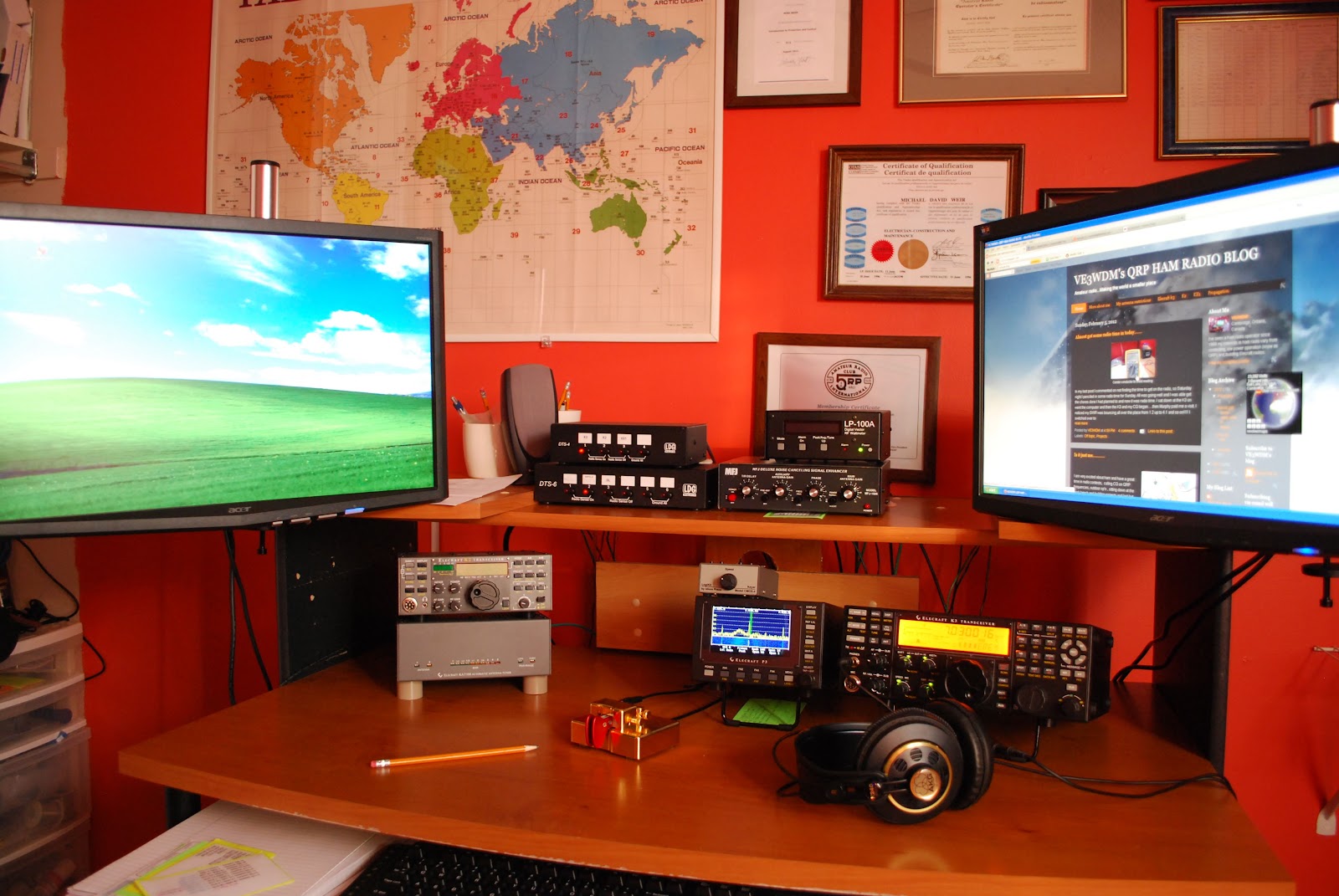 |
| Lots of changes |
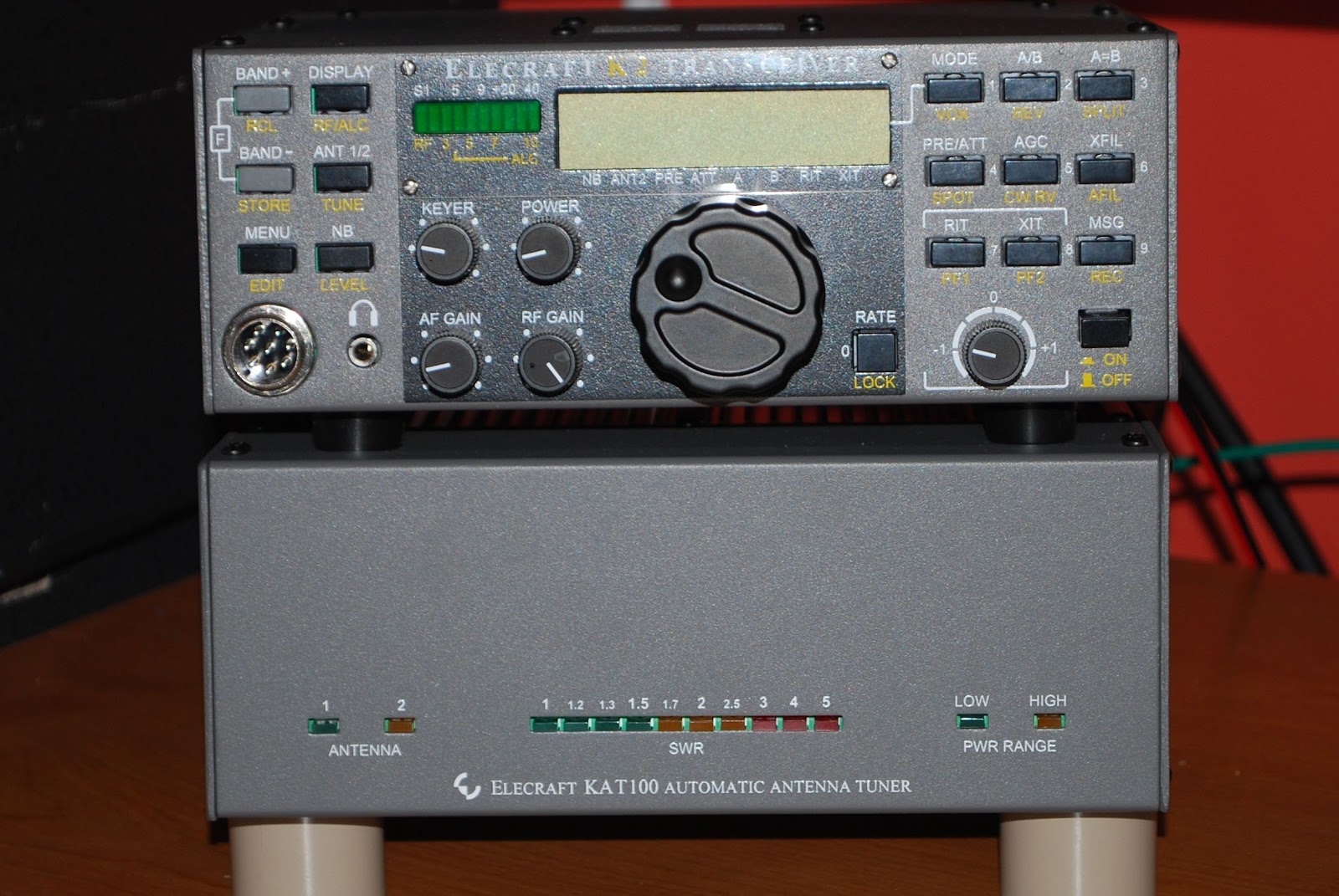 |
| The KAT100 and 100w amp enclosure |
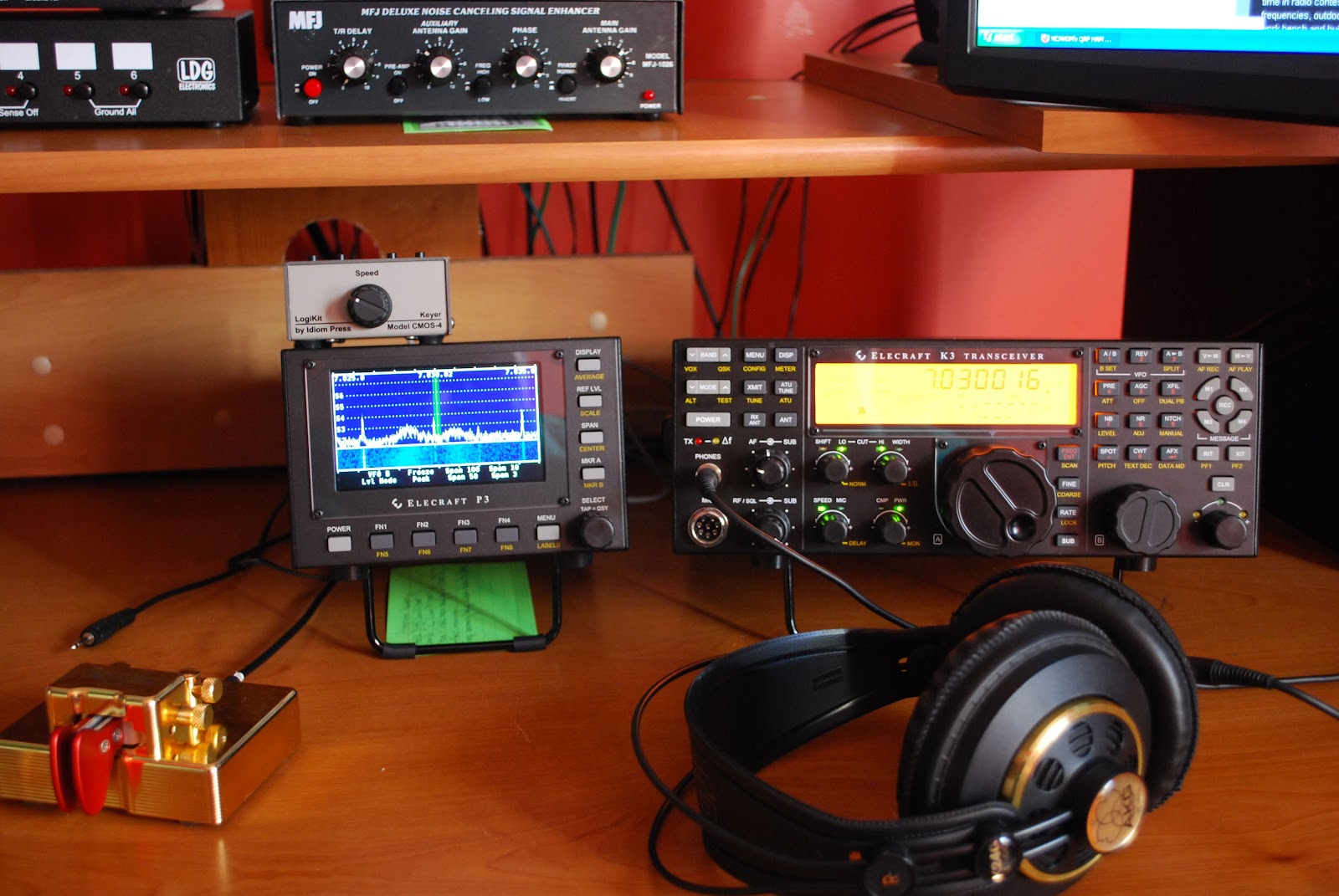 |
| P3 and AKG headphones |

Mike Weir, VE9KK, is a regular contributor to AmateurRadio.com and writes from New Brunswick, Canada. Contact him at [email protected].
Under the microscope
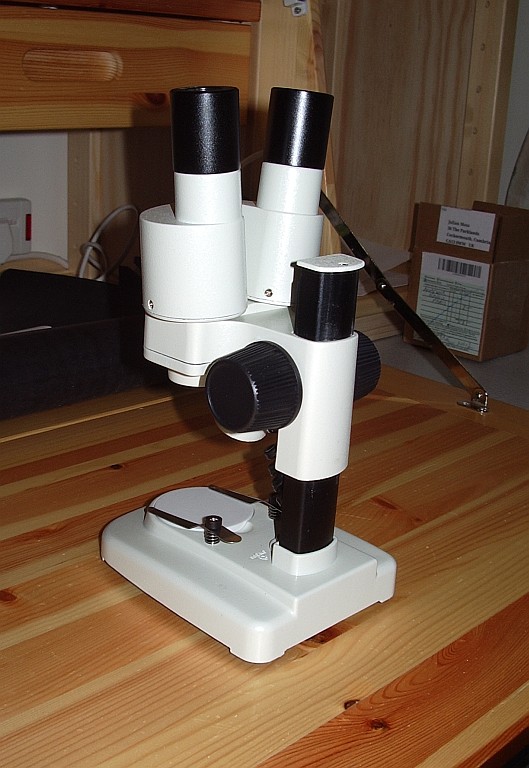 A couple of weeks ago Jeff KO7M wrote that he had acquired a binocular microscope for the workbench to enable him to work with SMT components. Although I have no particular desire to do SMT work at the moment I do have trouble with close-up work due to my eyes’ limited focal range and becoming very far-sighted. So I thought a binocular microscope would be a good addition to my workbench too.
Jeff wrote that his binocular microscope was not cheap and from the look of it I would imagine the cost ran well into three figures. The one I got was £30 from a firm that disposes of liquidated stock on eBay. I’m sure it isn’t as good as the one Jeff got but hopefully it will be useful. If not I can always start another hobby looking at plants and insects or growing bacteria!

Julian Moss, G4ILO, is a regular contributor to AmateurRadio.com and writes from Cumbria, England. Contact him at [email protected].
 Ham Radio Deluxe |
 W5SWL Electronics |
 Ham Radio Prep |
 KB3IFH QSL Cards  Hip Ham Shirts  HamRadioAuctions HamRadioAuctions Reliance Antennas Reliance Antennas Enigma Shop Enigma Shop |  morseDX  Ni4L Antennas  R&L Electronics R&L Electronics antennas.us antennas.us QRV QRV |
- Matt W1MST, Managing Editor
