 |
 My Trusty Ol’ Heathkit HW-8
 16 February 2012 | by
  Reminiscing about my early days in ham radio, one of the things that really stands out is a gift my parents gave me 32 years ago — a Heathkit HW-8, an 80/40/20/15 meter QRP CW transceiver! It was an utter surprise to me; I never had the slightest inkling that it was coming. I was 12 years old and had never built anything like that before. How wonderfully mysterious all those parts looked as I pulled them out and set them on the dinner table!
Looking back on it now, I realize how patient my mother was to let me take over that table in the dining room. As I recall, I worked nonstop to build the little rig and its power supply. Ten days later, on January 3, 1980, it was finally ready. My dad took a look at it and said it was ready for the “smoke test.” You can imagine how I held my breath as we plugged it in and turned it on. I was waiting for something on the circuit board to go up in a puff of smoke! Nothing exploded, so I was ready to take it into the shack and hook it up to an antenna and straight key. “Ready” is an understatement — I was so excited to get that rig on the air I was nearly bursting at the seams!
I picked up the phone and called Dr. Bernard “Bernie” Northrup, KAØDKN, a friend of mine across town, to see if he would get on the air and give me a signal report. Dr. Northrup (later NØCIE, now a silent key) was a professor at Central Baptist Theological Seminary of Minneapolis and a fellow member at Fourth Baptist Church, Minneapolis. Not long before, he had gotten his license after hearing me talk incessantly about ham radio at church (I’m afraid back then I was more interested in ham radio than spiritual things.). Anyhow, I called him (around suppertime, I see by my log!) and he graciously agreed to get on the air.
And sure enough, my HW-8 worked! After a half hour with Dr. Northrup on 15 meters I was ready for my first “real” QSO, as I thought of it. Tuning around the band, I heard ZL4KI. My heart started thumping as I prepared to call him. Could he really hear me even though I was sending with no more power than that of a small flashlight? My hand was shaking as I tapped out ZL4KI ZL4KI ZL4KI DE NØART NØART NØART KN and waited, flushed with excitement. I could hardly believe it when I heard my callsign as he came back to me! To think that the signal from this little radio, built with my own hands, was being heard 8,700 miles away in Invercargill, New Zealand! Amazing!
Other radios have come and gone, but that trusty ol’ HW-8 is still with me. As a boy I brought it with me to church camp and set it up in the lodge, tapping out CW while the other boys played games. Once on a trip to Louisville, KY I set it up on the second floor of my grandparents’ house — with a TV-twin-lead dipole my father had built — and worked a station in Poland. When I moved into my first apartment as a newlywed, I set it up with that same dipole in my (below-grade!) apartment. On a couple of memorable, crisp, autumn days, I brought it to a local park with a thermos of hot cocoa, sat down on a carpet of pine needles, and thrilled to the sound of soft static and CW.
And last summer, when I just couldn’t wait until I got my shack set up at my new QTH, I set it up on the picnic table in my backyard with an OCF dipole tossed into the trees. Even though that antenna was so low its feedpoint rested on the picnic table, I still worked both coasts on 20m with my trusty ol’ Heathkit HW-8! What a great little rig. Thanks, Mom and Dad, for giving me such a great gift!
(Click here to view the HW-8 Manual)


Todd Mitchell, NØIP, is a regular contributor to AmateurRadio.com and writes from Minnesota, USA. He can be contacted at [email protected].
Famous callsigns
Many friends who have been at this hobby a lot longer than I have worked some pretty famous people – King Hussein of Jordan, King Juan Carlos of Spain, Barry Goldwater.
I have never worked anyone famous per se, but I did get a chance to work the Arizona DX Association last night, which is celebrating Arizona’s Centennial this week. Their call is K7UGA – the same used by Senator Barry Goldwater (SK). So when I heard them on 40 Meters tonight, I jumped at the chance.
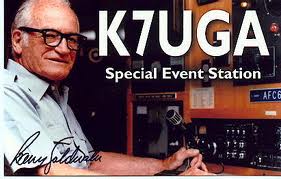
It took a while for me to break the pileup; but I was successful. 5 Watts and the HF9V yielded me a response. I got the customary “599”; but they were truly a 599 here into New Jersey. One of the loudest signals on the band.
I will definitely send for a QSL card, as this may be the closest I ever get to working a “famous” Ham.
72 de Larry W2LJ
QRP – When you care to send the very least!

Larry Makoski, W2LJ, is a regular contributor to AmateurRadio.com and writes from New Jersey, USA. Contact him at [email protected].
Johnny Cash Birthday Special Event Station
The Northeast Arkansas Radio Club is sponsoring a special event station in honor of Johnny Cash’s birthday.
All licensed amateur operators are welcome to contact N5C on Sunday, February 26, 2012 from 12:00pm CST (1800 UTC) to 8:00pm CST (0200 Feb. 27, 2012 UTC).
Stations making a confirmed contact with N5C will receive a commemorative certificate.
They are planning on operating at least one station in Johnny’s boyhood hometown of Dyess Colony, AR. Stations making contact with the Dyess Colony station will receive a special designation on their certificate.
Planned operating frequencies will be: 3.835, 7.260, 14.260 and 28.330 mHz (+/-3 kHz).
“He ‘walked the line,’ now let us ‘talk the line!'”
https://www.facebook.com/cashspecialeventstation
Matt Thomas, W1MST, is the managing editor of AmateurRadio.com. Contact him at [email protected].
Handiham World for 15 February 2012

For Handiham World, I’m…
Patrick Tice, [email protected]
Handiham Manager

Pat Tice, WA0TDA, is the manager of HANDI-HAM and a regular contributor to AmateurRadio.com. Contact him at [email protected].
Now I understand – Phase Locked Loops
Every now and then I come across great books or videos that explain a concept in such a way that it becomes immediately obvious what is going on. I’m a great believer in learning by demonstration or even better, learning by doing.
I came across another explanatory video recently that I thought was too good to keep to myself. It covers a topic that was a complete mystery to me: Phase Locked Loops. We utilize them in almost every modern transmitter and receiver yet most people I have talked to view them as a black box that, fortunately, does its job well and usually without interruption.
The video below does a good job on opening the black box and showing just what makes phase locked loops … well, lock.
Owen Morgan, KF5CZO, is a regular contributor to AmateurRadio.com and writes from Texas, USA. Contact him at [email protected].
Will Solar Cycle 24 Be 17 Years long?
Read an interesting Blog today about three Norwegian scientists who used historical solar green corona emissions data to predict that Solar Cycle 24 will be 17 years long, 4.5 years longer than Solar Cycle 23:
http://wattsupwiththat.com/2012/02/11/quantifying-the-solar-cycle-24-temperature-decline/
The Norwegian study referred to in the Blog is available for download here:
http://arxiv.org/pdf/1202.1954v1.pdf
We are currently in Cycle 24 which has, thus far, been lackluster as far as sunspots and solar flux go. I haven’t read the Norwegian study in detail, yet – I’m curious to know when the Norwegian authors think Cycle 24 will peak and at what level of solar activity and how they reached their conclusions.
My fingers are crossed for a vigorous Cycle 24 peak as it would be nice to have a bout or two (or three) of temperate latittude F2 propagation on 50-MHz before sliding down to the Cycle 24/25 trough!
73
Bill AA7XT
Bill Hein, AA7XT, is a regular contributor to AmateurRadio.com and writes from Colorado, USA. He is co-owner of Force 12 and InnovAntennas. Contact him at [email protected].
HamLog App Upgrades–WOW!!!
I’ve blogged about iOS apps before, but I can’t remember if I’ve previously mentioned anything about HamLog. I’ve owned HamLog for a few years now. I’ll honestly say for the record I don’t currently use it, but feel that will soon change.
HamLog is an iOS and Android application developed by Nick Garner, N3WG. Nick has developed over a dozen different apps. One I mentioned briefly in another blog post is his Pocket SOTA app. You can view Nick’s listing of Apps from his website.
As I mentioned, I’ve owned HamLog for a few years. I believe Nick developed and released it in 2009. I’ve watched Nick make many changes to the HamLog app over the years. While I’ve tried using it to log contacts, I found I could log via pen and paper much faster. Especially with operating SOTA, you can easily find yourself generating a large pileup. The extra time it takes to manually key in all the info was just something I wasn’t interested in for my own operational setup. Until now…
Please take a few minutes to watch this video. Nick introduces some new enhancements to the HamLog App as well as a new piece of hardware called Pigtail Air. Pigtail air will allow for true rig control through the HamLog app and of course will speed up the logging process.
I believe the Pigtail Air device, coupled with my new KX3 (when it arrives) and my iPad will make a fantastic SOTA or portable logging setup. I’ll now have an excuse to buy that Otterbox Defender iPad case.
Until next time…
73 de KD0BIK
Jerry Taylor, KD0BIK, is a regular contributor to AmateurRadio.com and writes from Colorado, USA. He is the host of the Practical Amateur Radio Podcast. Contact him at [email protected].
 Ham Radio Deluxe |
 W5SWL Electronics |
 Ham Radio Prep |
 KB3IFH QSL Cards  Hip Ham Shirts  HamRadioAuctions HamRadioAuctions Reliance Antennas Reliance Antennas Enigma Shop Enigma Shop |  morseDX  Ni4L Antennas  R&L Electronics R&L Electronics antennas.us antennas.us QRV QRV |
- Matt W1MST, Managing Editor
