 |
 G4VXE’s QRZ.COM biography updated
 10 February 2012 | by
 For ages, I’d been intending to update my QRZ.COM biography! Finally got around to doing it this week. Hopefully it may even bring a few new viewers to the blog!
See the bio here
The picture is a little out of date. The HF rig is no longer in the lounge and sadly, Bitzy the cat is no longer with us – but it is a happy picture!

Tim Kirby, G4VXE, is a regular contributor to AmateurRadio.com and writes from Oxfordshire, England. Contact him at [email protected].
Operating from Gibraltar with VA3ITA
Back in 1987 I first operated from Gibraltar as ZB2/G4VXE and then the following year, as part of the Square Bashers DXpedition group we visited again, operating this time as ZB2IQ.
It was fun. therefore, to see this video from Ed, VA3ITA of his trip to Gibraltar, some of the sights and sounds (and the apes) as well as some operating on 50MHz. It’s quite a long video, but I enjoyed it!
Good also to see Ron ZB2B featured as part of the video!

Tim Kirby, G4VXE, is a regular contributor to AmateurRadio.com and writes from Oxfordshire, England. Contact him at [email protected].
LHS Episode #075: Cinnamon Kool-Aid & WINE
 This episode we left up to the listeners because we hadn’t had enough time to prepare some content for ourselves. While waiting for some input, Richard decided to give an impromptu review of the improvements in Gnome 3 and his assessment of the technology, and where he thinks it’s going from here. You might be surprised by his analysis.
After that, we had a request to discuss WINE in a little more depth than perhaps we had touched on in previous episodes. So we take a fairly broad view of the WINE project, how to use it for your applications, what its can and can’t do, and how it can benefit you.
As a quick reminder, Hamvention in Dayton is coming up quickly, from May 18-20. As always, if you can spare a few bucks, quid, euros, drachmas, or whatever currency you currently use to help send LHS out to Ohio for the weekend, we’d love to see everyone there. Any little bit will help.
Thank you to all of our listeners, as always. We couldn’t and wouldn’t do it without you!
73 de The LHS Guys
Russ Woodman, K5TUX, co-hosts the Linux in the Ham Shack podcast which is available for download in both MP3 and OGG audio format. Contact him at [email protected].
PACC 2012 preparations
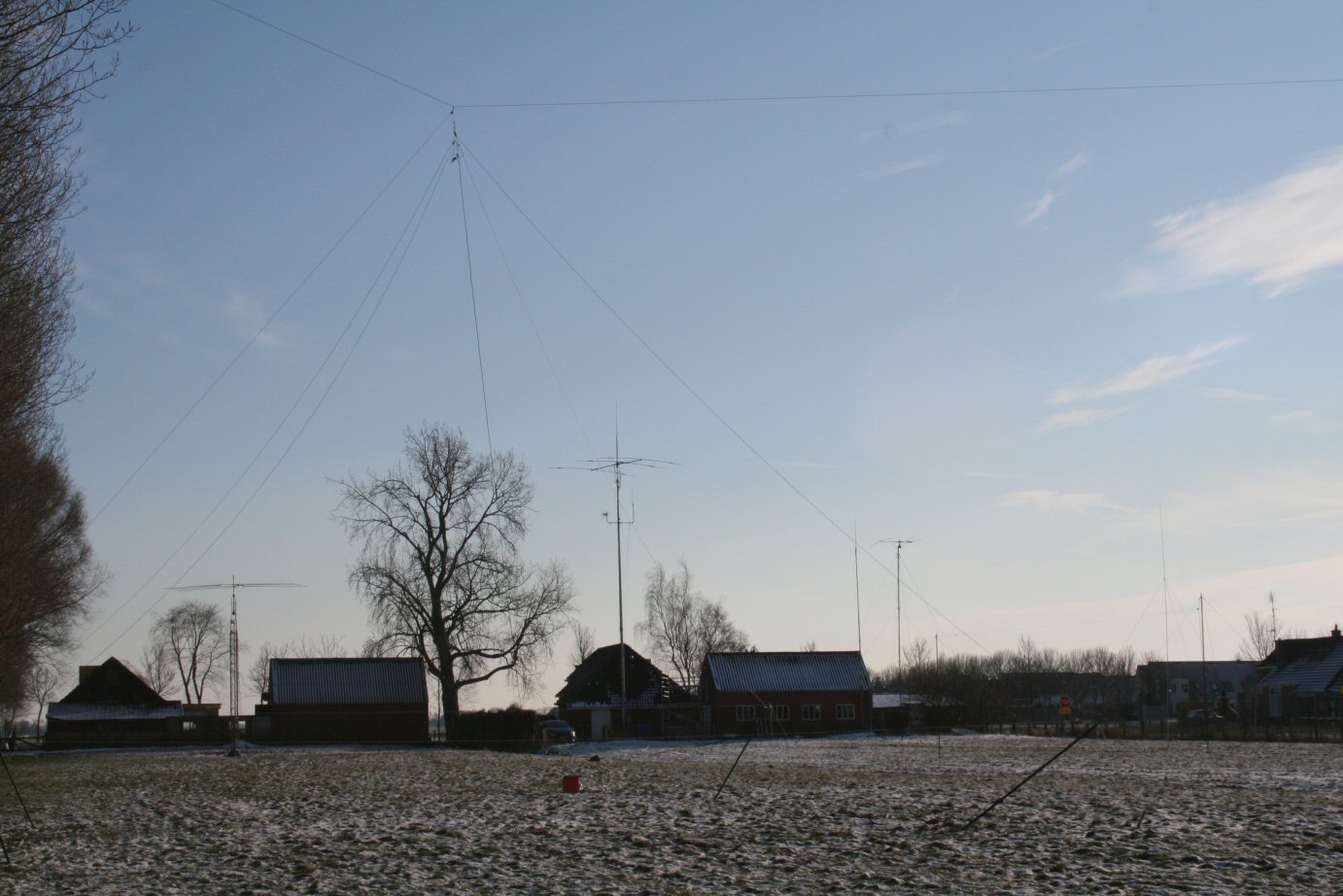 |
| PI4H contest QTH with pyramid 80m antenna on the foreground |
Well, I didn’t have much time to prepare for the PACC this year. A cold period is always a busy time at the job here. Besides that my mother-in-law had a computer that would not do what it should do. I’ve been busy with that too and it resulted in buying a new computer at the end. Probabely another case of a failing motherboard, a waste of time to fix it. I wish I had some time to work HK0NA on other bands, but it didn’t happen. I hope to check if everything is working and set-up the laptop with the latest version of N1MM at Saturday morning. Then I just go for it starting at 10m but not wasting time like last year if propagation is not good enough. I will participate in the low power single operator SSB section like last year, that’s max. 100W. The propagation doesn’t look good with low sunspots and a high A index, but it doesn’t matter as I am at my best then. I don’t have a good 10m antenna and with good propagation that would be a disadvantage. Last year most of my QSO’s were made on 40m and 80m although you need the higher bands for multipliers. Looking at my log from last year I made 552 QSOs with 122 Multipliers, that’s the score before correction. Most multipliers were made on 80m, 40m and 20m. So with bad propagation that will be the bands concentrating on. I had the opportunity to visit the PI4H contest QTH and made some pictures like last year. The guys were really enthousiastic and did made some improvement on the antennas for the contest. The only problem is that the rotor for the 10m beam doesn’t turn as it is probabely frozen. But overall I think they will improve their contest score of last year. Only 14 hours to go for the PACC start.
Bas, PE4BAS, is a regular contributor to AmateurRadio.com and writes from Groningen, Netherlands. Contact him at [email protected].
The Road Home and Other Ham Radio Novels
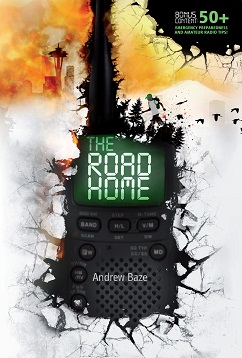

While this book is light reading, there is still some character development of the young man who is the main character of the story. Refreshingly, the boy’s father is his guide (rather than being marginalized or vilified as parents often are in teenage fiction). Not only does Mr. Baze inspire a young person to get a ham radio license, he succeeds in developing the moral imagination of his readers. The Road Home cultivates an affection for such admirable qualities as diligence, perseverance, courage, level-headedness, familial love, compassion, and a chivalric desire to avoid violence yet defend women from evil with deadly force when necessary.
You can read this book for free, if you have a Kindle and an Amazon Prime account, by borrowing it from the Kindle Owners’ Lending Library for Amazon Prime Members.
 Other novels that my children and I have enjoyed are those written by Cynthia Wall, KA7ITT: Night Signals, Hostage in the Woods, Firewatch!, Easy Target, Disappearing Act, and A Spark to the Past. These six books are a series chronicling the adventures of fictional characters Kim Stafford, KA7SJP, and her boyfriend Marc, KA7ITR. They are definitely aimed at children, but if you’re like me you’ll still read them — it’s so hard to find novels incorporating ham radio that you just can’t pass these up.
Another novel that incorporates ham radio is Cornbread Road, by Jeff Davis, KE9V. Mr. Davis released it as an audio-book in a series of podcasts in 2010-2011, and my wife and I enjoyed listening to it together. The podcast is not currently available but hopefully it will be back up soon. Cornbread Road is aimed at adults. The main character is a ham who gets involved with a secret society of ham radio operators led by a mysterious figure with a past, a ham who is an inventive genius and who is himself caught up in a web of international intrigue. While the plot may tax your ability to suspend disbelief, it is still an amusing story and throws in a little of everything in ham radio.
Do you have any ham radio novels to recommend? I dimly recall one or two that I nearly wore out as a child (back in the days when I would ride my bicycle to the local library and read my favorite books over and over), but I couldn’t tell you much about them now. If you know of any — and where to find them — please chime in with a comment!


Todd Mitchell, NØIP, is a regular contributor to AmateurRadio.com and writes from Minnesota, USA. He can be contacted at [email protected].
Kindley advise me
I’ve been thinking about buying an Amazon Kindle. But I’m not sure if it will really be useful for what I want or whether it will just end up sitting on a shelf like my Eee PC and other gadgets of the month.
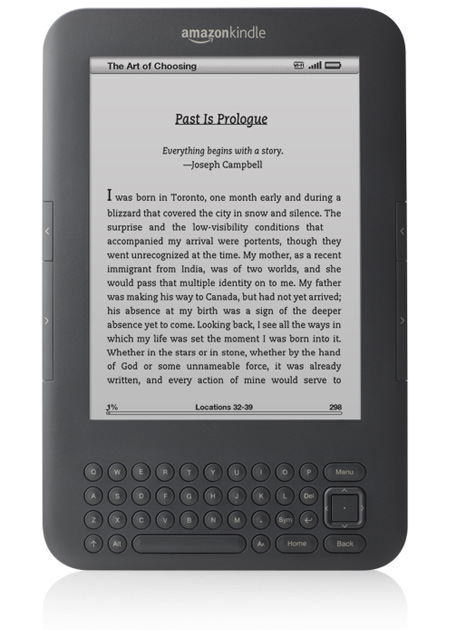
I know that the real purpose of the Kindle is for reading electronic books purchased from Amazon.com. However I don’t see myself using it for that very much. What I am interested in is reading ham radio and electronics publications that are increasingly being made available in electronic format. Are these magazines viewable on a Kindle or do they use some proprietary format only supported by a special application that needs a PC or Mac?
One of the publications I’d probably use it for is CQ, as I’m not sure it is really worth the international postage. Then there is World Radio, which is only available in electronic form, which I have never read due to the inconvenience of having to use a PC to do it. Now ARRL is bringing out an electronic version of QST. I still look forward to the printed magazine landing on the doormat but I do pay quite a premium for that.
I’d be interested to learn from Kindle users what formats the device supports. A couple of months ago the back issues of the now defunct 73 magazine and Ham Radio were put online. I downloaded the Kindle application for Windows and was disappointed with the results. The magazines were available in Kindle format but it looked as if they had been badly scanned using an OCR system and half of the content was in Greek! The PDFs were huge files and looked more like a poor quality FAX. The best format appeared to be one called Deja Vue. I downloaded a reader for it. Does the Kindle support that?
My eyes might find it easier reading on a device that lets you zoom in and enlarge the font. Does the Kindle let you do that?
How well does the Kindle support PDF files? I expect I would use it for those a lot. With a Kindle could I read PDFs I’ve downloaded and stored on a drive on our network or a memory stick? I’ve often considered, for nostalgic reasons, ordering some electronic back issues of Radio Communication (now RadCom) from the years when I first got interested in ham radio, though so far I have always changed my mind when I see the cost!
So over to my readers. Your thoughts on this, if you would be so kind!

Julian Moss, G4ILO, is a regular contributor to AmateurRadio.com and writes from Cumbria, England. Contact him at [email protected].
Should have known better!
Next week a new semester is starting. They gave me more hours to teach, which means more income, but less time to spend on fun things. So I really wanted to finish another project and this week was just the time to do it: an audio filter. In my younger years one of the few kits I build was an notch/bandpass filter. Later I bought the Datong FL-2 and FL-3 filters I always thought it was a must to have one. Ever since I became a ham I thought about building one, but surprisingly there are not many design to be found on the interwebs. Elecraft sells a kit called the AF-1 and they were nice enough to put the schematics on their site. So I gathered the parts and put quite some hours of work in building it according to my own lay-out. The result……

It worked….sort of. But not as advertised on YouTube. I should have known better, so I cleaned up my desk and started anew. Neat and tidy this time and in modules. First up, the power section. Now, how about this?

That’s the way I like it. It worked first time, delivering 12 and 6 Volts. But I’m afraid this is going to be another long term project. Stay tuned.
By the way, after only 41 days I already achieved 25% in the FISTS 25th anniversary Prefix award. The goal is to make 25 CW contacts for each prefix number. Funny to see which number is most issued and thus easiest to score. “7 is up front with 11 entries, closely followed by number 3 with a very respectable 10 entries.” I really have to start looking out for more number six stations. If you have a 6 in your prefix then don’t forget to call me, please.

Hans "Fong" van den Boogert, BX2ABT, is a regular contributor to AmateurRadio.com and writes from Taiwan. Contact him at [email protected].
 Ham Radio Deluxe |
 W5SWL Electronics |
 Ham Radio Prep |
 KB3IFH QSL Cards  Hip Ham Shirts  HamRadioAuctions HamRadioAuctions Reliance Antennas Reliance Antennas Enigma Shop Enigma Shop |  morseDX  Ni4L Antennas  R&L Electronics R&L Electronics antennas.us antennas.us QRV QRV |
- Matt W1MST, Managing Editor
