 |
 ICQ Podcast S05 E06 – 21st Century Beacon – GB3VHF (11 March 2012)
 11 March 2012 | by
 Series Five Episode Six of the ICQ Podcast has been released. News Stories include :-
- Opera Beacon takes Route 66
- Australian Kilowatt
- Ofcom on 5 MHz NoV
- Discover amateur radio at Surrey Museum
- Special Event Station - VO1AA
- ARRL publishes new Guidelines for 60 meters
- BBC - A lifetime of shortwave
- Extension of UK 501 kHz to 504 kHz NoV's
- 'Twisted' waves could boost capacity of Wi-Fi and TV
- Raspberry Pi computer now on sale
Your feedback and GB3VHF – a beacon designed for the 21st Century.
Colin Butler, M6BOY, is the host of the ICQ Podcast, a weekly radio show about Amateur Radio. Contact him at [email protected].
ICQ Podcast S05 E06 – 21st Century Beacon – GB3VHF (11 March 2012)
Series Five Episode Six of the ICQ Podcast has been released. News Stories include :-
- Opera Beacon takes Route 66
- Australian Kilowatt
- Ofcom on 5 MHz NoV
- Discover amateur radio at Surrey Museum
- Special Event Station - VO1AA
- ARRL publishes new Guidelines for 60 meters
- BBC - A lifetime of shortwave
- Extension of UK 501 kHz to 504 kHz NoV's
- 'Twisted' waves could boost capacity of Wi-Fi and TV
- Raspberry Pi computer now on sale
Your feedback and GB3VHF – a beacon designed for the 21st Century.
Colin Butler, M6BOY, is the host of the ICQ Podcast, a weekly radio show about Amateur Radio. Contact him at [email protected].
Newsflash: Not Everyone Is Going to Be an Expert
You’ve probably run into this situation…some of the more experienced radio amateurs commenting about how so many of the newer hams are incompetent. “Yeah, they’ve dumbed down the FCC exam, so now anyone can get a license. Back when I got my license, I had to copy Morse Code in my head, design a triple-feedback-loop vacuum tube amplifier and recite the Gettysburg address backwards in front of an FCC examiner.”
A while back, I wrote about the time when a newbie on an email list asked a simple electronics question and got this reply: Not to pick on you, but is there any requirement these days to have a basic knowledge of electricity and/or radios to get a ham license?
Often this shows up as an elitist attitude of If you don’t pursue the hobby my way or at my level, then you are doing it wrong.
Since amateur radio consumes most, but not all, of my hobby time, it is easy to lose perspective on this. And, yes, I am sure I have complained about clueless newbies and LID operators from time to time.
It’s interesting to put the shoe on the other foot and think about activities that I pursue with much less time and intensity. In other words, think about activities where I am not that experienced and certainly not an expert.
For example, I enjoy fishing but I am really not that skilled at it. For me, fishing is just an excuse to sit next to a stream and enjoy the scenery. If I catch fish, that is a plus (but I always throw them back in anyway). When I encounter Real Fisherpersons, they are usually friendly and helpful, passing along a few tips on what they using for bait, etc. Sometimes I will encounter That Fly Fishing Guy that looks down his nose at any form of fishing that does not meet his high standard.
I also enjoy photography. I have a decent Canon DSLR camera with a few lenses and I manage to capture some reasonably good photos that way. (This probably has more to do with the quality of the camera than the photographer.) My interest is mostly to capture experiences and events in my life and create photos that I can use in my various writing activities. But I know a number of people that are infinitely more skilled than I am. They are generally very helpful and I usually manage to learn something from them. Come to think of it, I have not encountered very many condescending photographers — most of them have been very helpful. Maybe I have just been lucky.
Although it’s a cliche, Life is Too Short. There are so many things we can choose to do with our time and, really, so little time to do it. People must make choices about how deep they get into any activity, all while balancing family time and demands at work. It shouldn’t surprise us when some people choose to be part-time hams and don’t aspire to be the expert in all things radio.
And the final point is, if you think you have something to offer to the newbies, make sure you come across as helpful and make sure it looks like you are having fun. Being the Old School Grumpus will not attract people to your favorite activity. Having fun and inviting them in will!
73, Bob K0NR
Bob Witte, KØNR, is a regular contributor to AmateurRadio.com and writes from Colorado, USA. Contact him at [email protected].
Mentoring……….who me!!!!!

are looking for in ham radio....strictly VHF/UHF, upgrade to HF and are they interested in code? The meeting to find all this out will be this weekend over coffee. In the mean time I have been on the Internet looking up what is now involved for one getting their Amateur radio license here in Canada! I found out that it sure has changed and in a very good way. It seems to me at first glance anyway that the study materials exhibit a more practical aspect of the hobby. Sure the regulations are still a part of the exam but there is more on antennas, propagation and even setting up a station. I can see for me this is going to be a learning experience as well. I will have the opportunity to brush up on my theory and who knows learn some new "stuff" about antennas, feed lines, radio equipment, the regulations and the theory! Wish me luck..........

Mike Weir, VE9KK, is a regular contributor to AmateurRadio.com and writes from New Brunswick, Canada. Contact him at [email protected].
Dreaming of the KX3
Like so many of my fellow amateurs, I ordered the new Elecraft KX3 within minutes of the order form going active on the Elecraft website. Like so many of my fellow amateurs, I also wait anxiously for word that the new KX3 is shipping. Finally, like so many of my fellow amateurs, I also look forward to seeing my credit card has been charged as that will signal the end is near. The end of the wait that is.
Back in late December, the hope was the new KX3 would begin shipping in late February. Even with the extra day added to the calendar, the month of February expired and no KX3’s are shipping. It is now Friday, 9 March and the latest shipping status as displayed on the Elecraft website states “KX3 shipments are estimated to begin Mid-March, between the 16th and 26th”.
While the excitement and anticipation is certainly very high for those who are chiseling their marks in stone waiting for that package to arrive on their doorstep, the level of patience is also just as high. There is a certain calm which proves amateur radio operators are a professional and respectable group of individuals. There is an understanding that each and ever delay experienced will just simply make a better and more reliable product in the end. I doubt we would see this same level of calm and respect in the iWhatever community.
I’m really writing this blog article in response to a few emails I’ve seen on the Elecraft Yahoo Groups reflector. The subject of cases and bags suitable for protecting our beautiful investment has been mentioned several times over the past few weeks. Wayne Burdick with the Elecraft company has suggested the LowePro Edit 140 camera bag. He stated in an email to the Yahoo reflector that he owns this bag and uses it to protect his KX3. Many other members and anxious hams have ordered this bag for their soon to be KX3.
Just like everyone else, I want a bag of some sort to protect my new KX3 but I just don’t like the look of the LowePro Edit 140. It looks like it might be a bit on the bulky side and if it were just going in the back of the SUV it would be one thing. But I want a multi-purpose bag that can go in the back of the SUV, in a carry own bag or in my backpack for SOTA activations.
A few months ago I purchased the LowePro Apex 120aw camera bag after seeing it featured in a K0MOS Youtube video. Like Matt, I currently own and use the Yaesu FT-817 for SOTA activations. I wanted a bag of some sort to protect my 817 while inside my backpack. I ordered the LowePro Apex 120aw and it works beautifully for the 817.

The LowePro Apex with my 817 and accessories protected inside.

A view inside showing the Yaesu FT-817, Yaesu microphone, Buddipole 4S4P battery pack, Doc Watson meter and power cables.
While I’ve watched every video I can find of the KX3, it is hard to judge size until you can actually hold it in your hand. Like everyone else, I also want to be ready for the day the KX3 arrives. Having a bag suitable to protect it if scheduling could allow for a SOTA activation is important. But like I said the LowePro Edit 140 looks bulky. In my mind, bulk equals weight and extra weight makes my back hurt.
But how do I know if my new Elecraft KX3 will fit inside my current LowePro Apex bag. I could measure…but how fun is that? Now if I’m reading the KX3 manual which was released just last week correctly, the KX3 measurements are 3.5 x 7.4 x 1.6 inches. If I just had something of those measurements to test with I would know for sure.
Now it wasn’t until I walked into the unfinished portion of my basement which I’ve been working on the past few weekends. You can read blog postings here about my progress along with pictures. Anyway, I had failed to clean up my mess after working for about an hour last night and just nearly tripped over my KX3….huh I mean the block of wood that is the same size of my KX3.
As we all know, a 2 x 4 is not actually 2 inches by 4 inches. The exact measurements are roughly 3.5 inches by 1.5 inches. Hmmmm, that is pretty darn close to what the KX3 manual states for the KX3 dimensions. I picked up the block of wood I had kicked away and measured the length. It was 7.5 inches. But would it fit in my bag? Perhaps another way to ask this, if it fits…will it zip?

The KD0BIK KX3 prototype. I sure hope my real KX3 receives better than this block of wood.

Yep…it zips. It’s a nice fit and still room for the large battery pack and other accessories.
Of course there is a fundamental design difference between the Elecraft KX3 and the Yaesu FT-817. The control buttons and knobs and that super large display of the KX3 is a not factored into my 2×4 KX3 prototype. However, if you review the above picture (the inside view) I will still have room and these will be protected. I will probably slip the KX3 into a felt bag just for extra protection. Where’s that Crown Royal bag I’ve been hanging onto?
Now please don’t rush out and purchase the LowePro Apex 120aw bag just because my 2×4 fits and zips. I’ll make certain to create a new blog posting once my KX3 arrives and I have a chance to model it with the bag. But if you already own this bag, it might just work out for you with the KX3.
Well this blog post and trying out my KX3 block of wood has been fun. I now must get back to work.
Until next time…
73 de KD0BIK
Jerry Taylor, KD0BIK, is a regular contributor to AmateurRadio.com and writes from Colorado, USA. He is the host of the Practical Amateur Radio Podcast. Contact him at [email protected].
Lightweight 50Mhz Yagi
Building antennas seems to be getting to be a bit of a habit for me. This time I’ve bought a kit, for evaluation purposes. No really it is.
I was trying to think of a project that I could use at MX0WRC (Workington and district amateur radio club) to help give some direction to some of the members who may never have built anything other than the kit they built for their intermediate licence. So, as I’ve been roped in to give a talk on my portable set up, which consists of what I thought were low cost antennas I thought I’d found the right direction.
Low cost is not what I came across when researching simple antennas. It seemed that I was way off the mark for commercial offerings until I found a company in Germany called Nuxcom.  They supply what look like simple yagi kits at realistic prices. By which I mean the cost of the materials isn’t prohibitive (For example from a raw material supplier 25mm box section can be bought for as little as £6-8 for a 1m length, enough for a 3 element 2m yagi and round tube for similar cost – and this isn’t cheap Chinese metal this is western European fully traceable materials! Don’t even get me started on the price of pipe clamps)
So, to placate my ever growing concern that prices are rising higher than a bankers bonuses, without any real justification I ordered one of the larger kits from Nuxcom, a 2 element lightweight 6m yagi. Purchasing was a bit drawn out as I placed an order and the ‘quote’ was returned with shipping costs added in a few hours later. But at £35 I was prepared to take a gamble, even is a third of the cost was shipping.
I’m expecting the kit before the weekend and I’ll do a little write up when it arrives. On the face of it the kit looks fairly simple in design without any bells and whistles, just what we need to add to the J pole, vertical and dipole designs that I plan on demonstrating.
What I’m really hoping for is a good value, simple lightweight antenna than doesn’t cost the earth so that the club members can learn and experiment without breaking the bank. More later.
Alex Hill, G7KSE, is a regular contributor to AmateurRadio.com and writes from Cumbria, UK. Contact him at [email protected].
This came today
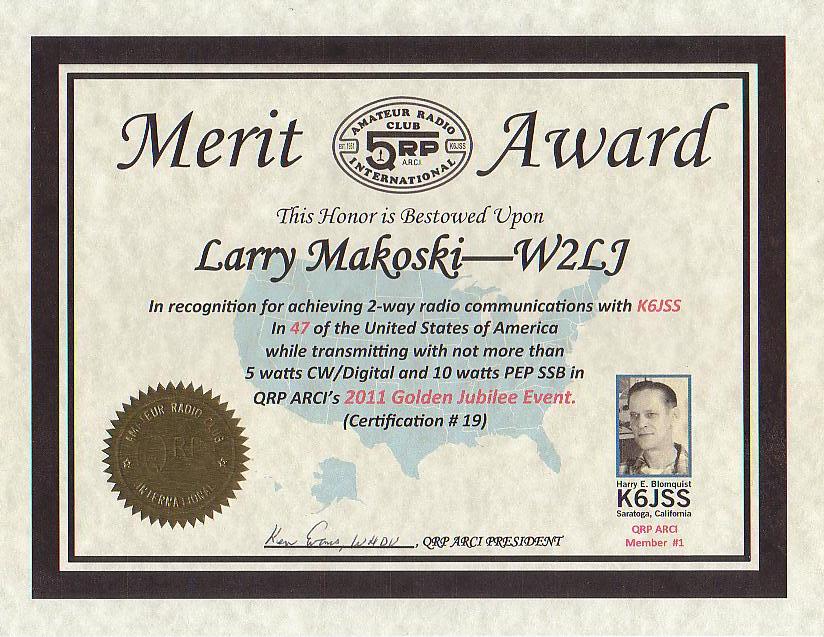

Larry Makoski, W2LJ, is a regular contributor to AmateurRadio.com and writes from New Jersey, USA. Contact him at [email protected].
 Ham Radio Deluxe |
 W5SWL Electronics |
 Ham Radio Prep |
 KB3IFH QSL Cards  Hip Ham Shirts  HamRadioAuctions HamRadioAuctions Reliance Antennas Reliance Antennas Enigma Shop Enigma Shop |  morseDX  Ni4L Antennas  R&L Electronics R&L Electronics antennas.us antennas.us QRV QRV |
- Matt W1MST, Managing Editor
