 |
 Big Week, Small Handheld
 17 March 2012 | by
Exultate Festival Choir and Orchestra Performing Handel’s Messiah at Benson Great Hall, Arden Hills, MN on 03/11/12.
What a week and a half it’s been! Last weekend we sang three performances of Handel’s Messiah. The last one, pictured here, was the best — truly out of this world.

NØIP walking near the Duluth Lift Bridge, 03/13/12.
Afterward, without even changing out of my suit, I drove to Duluth with my wife to stay in a bed and breakfast for a couple nights. It wasn’t purely vacation; since this is a busy week for me, I did have to get some work done on this trip. Still, it was sufficient to give me newfound vigor upon my return. A day and a half back in Granite Falls allowed me to do some calling and get some other work done, and then it was back to the Twin Cities for two recording sessions to make a 3-CD set of Handel’s Messiah.

Wouxun KG-UV6D Dual-Band Radio
During this time I tested out my new handheld, which arrived just a couple days before it all began. I went with the dual-band (2m/70cm) Wouxun KG-UV6D (ham radio version), available here. If you buy one of these you’ll want to purchase the USB programming cable to set up your Wouxun using your computer. You may also want to buy an adapter or two to connect antennas to it. I’ve included some photographs in the slideshow below showing two such adapters — 
This radio is working great! Setting up channels using my laptop was a snap, and the controls on the radio itself are pretty simple, too. Using a larger “rubber duckie” antenna I’m able to hit the repeater 12 miles away in Montevideo (though I’m not sure yet how I sound “You sound like you’re sitting right next to me,” I’ve just been told.). Using the car-top antenna I’m full-quieting on the repeater 30 miles away in Marshall, and I can hit the repeaters a little farther away in Willmar, too (though I’m not sure yet how I sound on them). I made a few contacts in Duluth and the Twin Cities this week, and heard good reports each time. So far all I’ve used is 2m, and I’m looking forward to a 70cm contact. While I’m still a confirmed HF CW man, I’m glad to finally have a VHF/UHF handheld that works! If and when my son gets his Technician license, I’ve promised him that I’ll buy him a matching Wouxun KG-UV6D. It would really come in handy around here for him and I to each have one of these.
Click to view slideshow.
All photographs taken by my faithful beloved XYL, Monica, except for the stock photo of the KG-UV6D.


Todd Mitchell, NØIP, is a regular contributor to AmateurRadio.com and writes from Minnesota, USA. He can be contacted at [email protected].
Making a Type C Triode – Amazing Glasswork!
Ron Soyland is at it again and creating a Type C Triode vacuum tube. For a look at other creations click on Making a Spherical Audion Tube by Ron Soyland
A general purpose triode originally made for use by the Royal Air Force (Great Britain) in 1918 and designed by Captain H. Round of the British Marconi Co. around 1913. It is a triode that was meant for high gain high frequency use and has a 3 volt directly heated cathode.
Owen Morgan, KF5CZO, is a regular contributor to AmateurRadio.com and writes from Texas, USA. Contact him at [email protected].
Taking a tablet
A month or so ago I solicited the advice of my readers on the selection of a device for reading e-publications. I learned that the Kindle – my original choice – would not meet all of my needs, but I received some strong endorsements for the Apple iPad.
As someone who pays full price for SIM-free mobile phones just so as not to be tied to one provider, the idea of a device that only let you use what Apple approves and insists on being tethered to iTunes did not, unfortunately, appeal to me. My online activities are very Google-centric, I’m a fan of open source and I already have an Android smartphone so inevitably my thoughts turned to Android tablets. Someone mentioned that Maplin had some cheap tablet computers in their sale – the Archos Arnova 10 G2. Maplin is rarely the cheapest source of anything even in a sale so I visited a price comparison site and found that Carphone Warehouse had the Arnova for £10 cheaper and with free shipping. I checked some reviews and the majority were very positive, even though many qualified their comments with “for the price.” The tablet was in my hands 24 hours and £139 later.
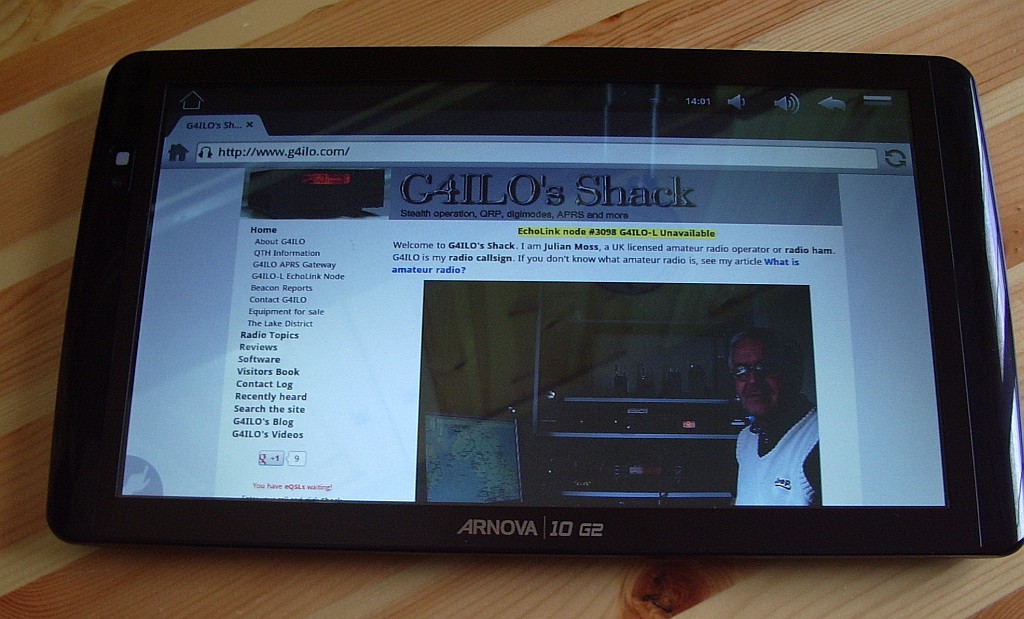 |
| Archos Arnova 10 G2 |
As a tablet virgin my impressions probably aren’t worth much but even I can tell that the Archos is not Apple build quality. The plastic case is more reminiscent of something that came out of a Christmas cracker. £11 on eBay got me a leatherette case/stand for the tablet so I don’t see the case anyway. But as many reviewers said, it’s a lot of tablet for the money. I haven’t got around to trying any e-book readers yet but I’ve used it for email and web surfing and I love it already. Battery life is great, the tablet is silent as there is no fan inside and no Intel Pentium giving you a hot lap so it’s a much better laptop device than a laptop.
One problem was that there was no Gmail app as I use on my smartphone. The Arnova doesn’t come with the standard Android Market so the choice of apps is rather limited. I found some instructions for installing Android Market on the Arnova but as usual whenever I attempt something technical with computers I got error messages that aren’t mentioned in the description. After trying a few things at random and on the point of giving up I noticed that Gmail had been installed and I had the full Market, except that it has been renamed Google Play. That probably confused me into thinking it was something to do with games, which I have no interest in.
The one thing I haven’t managed to do yet is find an app for my blogging activities. On the PC I use Blogger Dashboard in a browser (Firefox, of course) but on Android Dashboard is no good for keeping up with the blogs I follow because the list of posts is in an iframe and the Android browser doesn’t support scrolling in an iframe. Nor does the Dolphin browser, which I was led to believe would be the solution. I’ll probably have to use gReader, as I do on the smartphone, but I’d hoped the tablet would let me use something a bit more sophisticated.
We watched a TV show on the Arnova using the BBC iPlayer and I was impressed by the quality. Until then I could never understand why anyone would want to watch TV on a computer but in fact the angular size of the Arnova screen in my lap is larger than that of the TV when I’m sitting in my armchair, so it’s actually better. As you may gather, I’m pleased with my new gadget!

Julian Moss, G4ILO, is a regular contributor to AmateurRadio.com and writes from Cumbria, England. Contact him at [email protected].
QRPp is now online.
This appeared on the QRP e-mail reflectors today:
I would like to announce that the complete collection of QRPp, the NorCal QRP Club Journal that I did from 1993 to 2004 is now on line. Chuck Adams has scanned in every page of every issue and has it on line at http://www.k7qo.net/NorCal_QRPp.html. This is a temporary site, as we want to make sure that all of the bugs are out of it before we place it on the NorCal page where it will have a permanent home in about 3 weeks. This material is for the education of QRPers, and it will always be free. No one will ever have to pay anything to access it. We ask that no one makes it available on CD for distribution in any way. Everyone is granted permission to make an archival copy, but no one is granted permission to post any part or portion online. We want there to be one site where it is available. Some of the schematics will be redrawn and Chuck is coordinating that effort. I have struggled for years on how to make the information available and decided that this is the way to do it. Every article was donated, no one was paid anything for writing any article. So, I wanted to make it available for free. Enjoy. Thank you to Chuck Adams for doing the work to make the pdf’s, to Dean Davis for his future work in
putting it on the NorCal web page, and especially to all of the contributors over the years. 72, Doug, KI6DS
Thank you Doug and Chuck for making this available to all of us online.
72 de Larry W2LJ
QRP – When you care to send the very least!

Larry Makoski, W2LJ, is a regular contributor to AmateurRadio.com and writes from New Jersey, USA. Contact him at [email protected].
Alternate link to Handiham Podcast

http://handiham.net/audio/handiham031412.mp3
We apologize for any inconvenience.
Patrick Tice, WA0TDA
Courage Center Handiham System Manager
[email protected]

Pat Tice, WA0TDA, is the manager of HANDI-HAM and a regular contributor to AmateurRadio.com. Contact him at [email protected].
Handiham World for 14 March 2012
Welcome to Handiham World.
Last week I was thinking about mentioning something about “bad apples” – amateur radio operators who exhibit poor operating practices while on the air. There was plenty of other stuff to cover in the newsletter and podcast already, so I decided to let it go until this week. Anyway, as you know, the Amateur Radio Service is largely self-policed. That means that we observe what is going on on the bands and help other operators learn good operating practices, largely leading by example. In fact, the last thing you want to be is “the band police”, which is someone who sticks their nose into every situation and scolds other operators for real or imagined infractions on the bands. No, it is better to lead by example and always use your call sign, be helpful rather than judgmental as much as possible, and convey your concerns off the air. Frequently the telephone is a better choice, as would be a note in the mail. You don’t want to embarrass someone who has made a mistake by pointing it out on the air. If the violation was willful, it is likely that confronting someone on the air about it will simply result in an on the air argument that will certainly be heard by others and show amateur radio in general in a bad light.
Thankfully there are volunteers who listen on the bands for situations that call for some kind of resolution. These are “Official Observers”, or “OO’s”. The Official Observer program is run by ARRL. It is administered by the Section Manager, and the volunteers report to him or her. An Official Observer is recommended for appointment by the ARRL Section Manager and completes a short training course by reading relevant information provided by ARRL. For a complete list of the requirements, visit the ARRL website and put “Official Observer” in the search box. You’ll find a complete description and everything you need to know about becoming eligible for this important volunteer appointment.
But anyone can hear a violation or instance of bad operating on the air and take some notes. You can always send your Section Manager an e-mail expressing your concern and asking that Official Observers listen for further violations. Some of the most annoying and difficult situations are those where the bad operating practices go on day after day, week after week, and month after month. These are not something for an individual to tackle; it takes a team to gather information and make a case against the perpetrator. You will definitely want to pass the information on through the right channels. In some cases, the bad operating may be originating outside the borders of your country. Again, going through the right channels to gain experienced assistance is key to solving such problems. That is why I like the Official Observer program. It is backed by 85 years of collective experience at ARRL in dealing with virtually every kind of technical problem and bad operating practice.
Part of knowing when to report a violation is simply something that comes to you by gaining experience through years of operating and listening on the bands. You learn to get a sense of when something is a willful violation (done on purpose with a bad intent) or simply an innocent mistake that is unlikely to be repeated once the person finds out what they did wrong. Frankly, all of us are human and will make mistakes. It is not necessary to jump on someone because they made one of these all too common errors. Who among us has not gotten Echolink stuck in transmit mode? Yes, it is an embarrassing mistake but it is not the end of the world. On the other hand, talking for a half-hour in a roundtable conversation without using your call sign even once is not only against the law but also rude and inconsiderate of other operators. As I said, figuring out what to report and what to simply set aside for the moment is one of those things one picks up by experience. Listening is really important in amateur radio. We all learn a lot more by listening than by talking no matter what the situation – and amateur radio is no different!
The ultimate goal is to make the amateur radio bands a better, safer, and more civil place for all users and to always “put our best foot forward” for any listeners out there who might be thinking about getting their amateur radio licenses.
For Handiham World, I’m…
Patrick Tice, [email protected]
Handiham Manager

Understanding HF propagation
Along the lines of my previous comments about bad operating practices, I recently received an email about an interference problem on 160 meters. The interference situation arises when a group of stations in the eastern United States run high power and operate close to another frequency several kilohertz away that is in use by a group of operators here in Minnesota. As you know, these groups of stations may not even hear each other during early evening hours when daytime conditions hold sway and absorption keeps long-distance sky wave propagation from taking place. As the night falls and the ionospheric absorption decreases, the band starts to open up to longer distance skip, and soon the two groups of stations begin hearing each other.
Both groups may be tempted to dig in their heels and say, “We were here first”, but the fact of the matter is that the propagation conditions simply changed and that is what causes the interference. Understanding that it is not the other guy’s fault is important in making a decision about what to do next.
Remember what the FCC says about how we should only use the level of power necessary to carry on communications? Well, Sec. 97.313 Transmitter power standards, (a) says, “An amateur station must use the minimum transmitter power necessary to carry out the desired communications.”
When propagation conditions change, there are three good choices to mitigate the interference problem:
- All stations in both groups should lower their transmitting power levels, even though the temptation is to crank up the linear amplifier. Lower power levels decrease the likelihood of interference.
- Consider using a different frequency. This is often the best solution. Remember, no frequency has any single user’s name on it – I don’t care if your group has been on “their” frequency for 10 years. Get out of the mindset that one can claim a frequency by squatter’s rights.
- Change the scheduled time of your on the air gathering to avoid the propagation conditions you find undesirable.
Notice that these are all non-confrontational solutions that do not involve blaming “the other guy”. Understanding HF propagation can be very helpful in solving interference problems and enjoying ham radio even more!
Troubleshooting 101

If you are like most amateur radio operators, you probably have several portable, battery-operated devices that take consumer-grade replaceable cells such as AA’s or 9 V square batteries often used in smoke detectors. In this scenario, you decide to use your dip oscillator to check on the approximate resonant point of an antenna that you are building. When you press the power button, nothing happens. Since the dip oscillator is a battery-operated portable device, the first thing you are probably going to think of doing is checking the battery or batteries. For some incomprehensible reason, many of these amateur radio test accessories require you to use a screwdriver and take the case apart to get at the batteries. This makes it inconvenient to take the batteries out if the device if it is not going to be used for a long period of time.
Okay, so you go ahead and get the screwdriver and take the case off the dip oscillator. What do you see? Of course the battery is dead; it has obviously died a rather messy death because there is a white residue around the contacts. The battery has leaked and corrosion may have set in, possibly damaging the dip meter. The first thing to do is dispose of the old battery safely. Usually alkaline batteries or the old carbon-zinc batteries can simply be thrown in the trash while batteries with other chemistries such as rechargeables might have to be taken to a recycling center. If you are unsure of the residue leaked by the battery, it is prudent to wear gloves. Anything leaked from a lead-acid battery should be considered dangerous and corrosive. Usually such batteries are not found in small accessories.
With the battery gone, you can now attend to the mess left behind inside your meter. Flaky or powdery residue can sometimes be removed effectively with a brush such as an old paintbrush that is dedicated to such projects on your workbench. Do your best to avoid inhaling anything and if necessary use a mask to protect your lungs. A damp Q-tip can also be effective without creating dust. I have used a Q-tip dipped in rubbing alcohol because the alcohol will evaporate from the circuit board and contacts quickly. You don’t need to use much! A pencil eraser like the kind on a number two lead pencil can do a pretty good job of polishing up a battery contact on the meter’s battery holder. Try to make sure that the battery holder contacts are shiny and clean before putting in a new battery. I always try to avoid using abrasives on these battery contacts because they will remove any plating and open the road to further corrosion. If the battery contacts have been destroyed, it will be necessary to find a new battery holder, and this may mean making some slight modifications to accommodate it. Every case will be different, so this is a chance to be creative and figure out your own solution. Just be careful that nothing will short out when the meter is in use or when you put the case back on!
I have always wondered why manufacturers of these devices make it so doggone hard to get at the batteries in the first place. Something like a dip oscillator will only be used occasionally by most amateur radio operators, so it would be great to be able to put in and remove the battery easily and quickly so that the device could be stored for months or years without the battery in place.

Pat Tice, WA0TDA, is the manager of HANDI-HAM and a regular contributor to AmateurRadio.com. Contact him at [email protected].
Patience
Sometimes I think Pavlov would have done better using Hams rather than dogs. There seems to be a lot of salivating going on in Elecraft land.
As we get so ever closer to the KX3 shipping date, the KX3 reflector is going wild. You get a palpable sense that some of the guys are literally jumping out of their skin, waiting for their radios to ship.
For me, it was harder to wait for the ordering process to begin. In addition to not really knowing when it was going to happen, I was conflicted for a while wondering whether or not I would have the funds needed when things actually started rolling. Fortunately, that turned out not to be a problem when the Order Page finally opened up.
When the original forecast for shipment was stated to be mid-February, my mind immediately told me “March or April …… maybe”. I remember reading the stories that accompanied shipping the K3 when it first came out. I figured that while that experience might have helped with initially shipping the KX3, it would not entirely eliminate unforeseen shipping delays TO Elecraft of materials needed to manufacture the rigs.
So here we are at March 14th, Pi Day, and the official line on the Elecraft Website is that shipping will commence somewhere between March 16th and the 26th. I’m thinking that if I am very lucky, I will see mine somewhere right around Easter time.
I’m just hoping that I get it in plenty of time to build it and have it for QRP To The Field., which is usually the last Saturday in April.
72 de Larry W2LJ
QRP – When you care to send the very least!

Larry Makoski, W2LJ, is a regular contributor to AmateurRadio.com and writes from New Jersey, USA. Contact him at [email protected].
 Ham Radio Deluxe |
 W5SWL Electronics |
 Ham Radio Prep |
 KB3IFH QSL Cards  Hip Ham Shirts  HamRadioAuctions HamRadioAuctions Reliance Antennas Reliance Antennas Enigma Shop Enigma Shop |  morseDX  Ni4L Antennas  R&L Electronics R&L Electronics antennas.us antennas.us QRV QRV |
- Matt W1MST, Managing Editor
