 |
 Ham Nation 42
 5 April 2012 | by
http://dts.podtrac.com/redirect.mp4/twit.cachefly.net/video/hn/hn0042/hn0042_h264b_864x480_500.mp4
http://dts.podtrac.com/redirect.mp4/twit.cachefly.net/video/hn/hn0042/hn0042_h264b_640x368_256.mp4
http://www.podtrac.com/pts/redirect.mp3/twit.cachefly.net/hn0042.mp3
Hosts: Bob Heil (K9EID), Gordon West (WB6NOA), and George Thomas (W5JDX)
A 330A tube-powered audio amplifier, a visit to M2 Antenna Systems’ open house, a unique antenna rotor system, and more.
Guests: Gerry Moersdorf (KC8ZUL), Rebecca Rich (KB0VVT), Amanda Alden (K1DDN), and Cheryl Lasek (K9BIK)
Download or subscribe to this show at http://twit.tv/hn.
We invite you to read, add to, and amend our show notes at wiki.twit.tv.
Thanks to Joe Walsh who wrote and plays the Ham Nation theme.
Thanks to Cachefly for the bandwidth for this show.
Dr. Bob Heil, K9EID, is the founder of Heil Sound and host of TWiT.tv's Ham Nation which streams live each Tuesday at 6:00pm PT (9:00pm ET) at http://live.twit.tv. Contact him at [email protected].
KX3 SN 025
That would be Greg K2UM’s KX3 and he was nice enough to post a video about it:
Saliva glands are working overtime!
72 de Larry W2LJ
QRP – When you care to send the very least!
PS: Wow! No spam comments today. 1st time in about a month that has happened.

Larry Makoski, W2LJ, is a regular contributor to AmateurRadio.com and writes from New Jersey, USA. Contact him at [email protected].
Prolific problems
A package from China arrived in the post this morning – a USB programming cable for the Baofeng UV-3R+. I got it from eBay seller happyhamshop where it was sold as a “USB programming cable for Wouxun handheld radio” but Baofeng claims that the UV-3R+ is compatible with Wouxun accessories. I was going to make my own cable but I didn’t have a 2.5mm stereo jack plug in my parts box so I decided to take the easy option and get a ready made cable for not much more than the cost of the plug from a components vendor.
The cable was detected and appeared as COM1 – the same com port number as my other USB to serial adapters that use the Prolific chipset. I haven’t tried it on the Wouxun – I can’t think of a reason to program channels on 4m – but it works with the Baofeng using both the manufacturer’s software and CHIRP, the platform and rig-independent memory management program.
It took me several attempts to transfer the memories from the old UV-3R to the new one. Writing a file taken from the old radio to the new one using either program caused the frequency display to read DDDD.25. Fortunately I knew enough about this issue to have used the software to make a backup of the factory configuration, which was easily restored.
The solution, if you’re interested, was to use CHIRP to export the memories from a file saved from the old radio to a rig-independent .chirp file, then load the factory configuration from the radio and import the file you just exported.
Problems with programming cables seem to be making up half the traffic in forums and groups dedicated to handheld radios. The problems are all associated with cables that use (or claim to use) Prolific USB adapters. These days, programming cables come with USB adapters built-in, so the need for separate USB to RS-232 converters – which could use a less troublesome FTDI or Silicon Labs chipset – is eliminated. But so, unfortunately, is the option to solve the problem by using a different type of adapter.
A couple of days ago I became aware of something that is certainly not going to make this issue any less common. Apparently a Chinese chip manufacturer has produced an unlicensed clone of the Prolific PL2303 USB to serial chip which is now being used in many of the USB cables that come from China. Prolific is understandably not very happy about this. It has released a new driver that detects the clone chip and fails with an error code 10, causing much frustration for the innocent end user. The solution, apparently, is to turn off automatic updating and install an older driver (the cable vendor will hopefully have a link to a driver that works with the cable they sold you.) The problem seems to be worst for users of 64-bit Windows 7 for which there are fewer old drivers in circulation. I deliberately stay as far from the bleeding edge as possible, and have automatic updates disabled on my shack PC. So far I have had no problems with the 32-bit Windows XP Prolific driver I’ve been using for the last couple of years.

Julian Moss, G4ILO, is a regular contributor to AmateurRadio.com and writes from Cumbria, England. Contact him at [email protected].
KD1JV Tribander
Doug Hendricks KI6DS has announced that Hendricks QRP Kits will have a new offering at Dayton this year – The Weber Tribander.
“Hendricks QRP Kits will be introducing a new CW Transceiver at Dayton this year. Steve will be in our booth, which will be at a new location: Booth Numbers 459 and 460 which is right next to the TAPR booth, and right across the aisle from the ARRL. You will want to stop by and say hello to Steve and take a look at the new kit.”
“Specifications:
? Any three ham bands, 80, 40, 30, 20, 17 or 15 meters, choose at time of order.
? 5 watts output on all bands with 13.8V supply
? Built in Iambic keyer with 5 to 40 wpm code speed, selectable Iambic A or B modes and two 63 character
message memories.
? Receiver sensitivity, 0.2 uV MSD
? DDS VFO for rock steady stability with 50 Hz and 200 Hz tuning rates
? Easy to read four digit LED display with leading zero suppression.
? Rotary knob tuning
? RIT (receive incremental tuning)
? Four IF crystals for excellent selectivity and opposite side band rejection
? 600 Hz audio filter
? Audio derived AGC
? Small size, 6″ wide, 1.5″ tall and 4″ deep.
? Light weight, 12 ounces.
? Modest supply current requirements, 90 ma on receive (no signal) and 600 to 800 ma on transmit at 5W out
(current depends on band, higher bands draw more current)
Does that sound like a great radio? We think it does, and when you see the price, you will agree. The Weber Tribander will be introduced at Dayton, and the radio will include a Ken Locasale, WA4MNT, designed case of brushed aluminum that is pre-punched, drilled, includes a bail and ready to paint. And because it has a brushed aluminum finish, you can even leave it unpainted if you wish. The kit will include every thing you need to build it, and the SMT parts have been pre-installed, so you don’t have to worry about it. This is a through hole kit for the builder, and if you have previous building experience, know how to solder and identify parts, will be a straight forward build.
Where else can you buy a 3 band CW Transceiver with RIT, Digital Display, Encoder Tuning, Case with bail, and everything needed to build it for $200? That is about $67 per band!! And, you get to pick the bands you want. In fact, you can buy 2 of them and have the equivalent of a 6 band radio for $400!! We will have kits at Dayton, and this year we will be taking credit cards, including Visa, Master Charge, Discover and American Express.
I am in the process of kitting right now, and will be getting the boards in 3 weeks. All of the parts are in, and the prototypes have passed all the tests. Steve built the final one Saturday, and everything works fine. Steve is coming to Dayton this year for the introduction of the rig, and we will be posting the manual in a couple of weeks at www.qrpkits.com so that you can take a look at his latest design. Don’t forget that our booth has moved from the North Hall to the Ball Arena, which is where the ARRL booth is. We will be in Ball Arena 459 and 460. Stop by, say hello to Steve, Ken, Karen, Dean, Darrel and me. 72, Doug KI6DS”
As always – standard disclaimer that W2LJ has no financial interest in this – just trying to get the news out.
72 de Larry W2LJ
QRP – When you care to send the very least!

Larry Makoski, W2LJ, is a regular contributor to AmateurRadio.com and writes from New Jersey, USA. Contact him at [email protected].
ARRL is doing a study
This came down from the leadership of Northern New Jersey ARES; but it should be of interest to anyone who is involved with Emergency Communications:
FYI…the info below comes from the ARRL’s EmComm and Regulatory offices and needs your thoughtful and timely input…the ARRL states:
“The FCC has released a Public Notice soliciting input for the Congressional directed study of Amateur Radio Emergency Communications and Impediments to the amateur’s ability to provide those communications. This is the ARRL-proposed study which we have been seeking for the last 3 years….”
The links below should help you with filing your comments and reports….thank you all in advance for you help in this and all EmComm related matters
Additional information is also on the ARRL Website:
http://www.arrl.org/news/fcc-seeks-public-comments-on-emergency-communications-by-amateur-radio-and-impediments-to-amateur-ra
and
http://www.arrl.org/ccr-study-information
If you have participated in an EmComm event or deployment since January 1, 2000, we ask you to provide specific information on the activation by completing this form by clicking here.
http://www.arrl.org/emergency-communications-response-actions
If you are affected the deed restrictions, HOAs, or CC&Rs, please complete this form by clicking here.
http://www.arrl.org/ccr-regulations
TIME IS OF THE ESSENCE! Congress directed that the FCC provide the report back within 180-days and that clock is already counting. The FCC is only accepting comments for a 45-day period, which will end May 17,2012. In order for the ARRL to collate your information in a common report, we ask that you send in your information no later than WEDNESDAY APRIL 25.
~~~~~~~~~~~~~~~~~~~~~~~~~~~~~~~~~~~~~~~~~~~~~~~~~~~~
I know a lot of you out there are involved in Public Service activities and communications, so please, if you have something to contribute, please do so!
72 de Larry W2LJ
QRP – When you care to send the very least!

Larry Makoski, W2LJ, is a regular contributor to AmateurRadio.com and writes from New Jersey, USA. Contact him at [email protected].
OAx/K8GU
Loyal readers know that from time to time, I am fortunate to travel to interesting and exotic locales for work—they usually come in pairs, so Greenland and Peru are it for a while. Although the motivation is usually field work, occasionally a conference pops up. The International Symposium on Equatorial Aeronomy occurs every three to four years and can be counted on for an exotic locale. Sarah had such a good time when we attended the 12th ISEA in Crete in 2008 that she insisted on attending the 13th in Peru with me this year. Of course, Evan complicated that a bit, and so we evaluated the pros and cons of leaving him with grandparents or bringing grandparents along, eventually finding a willing pair of grandparents to come along. If you’re interested in a general travelogue (and following posts) and some photographs, you might check out my father’s blogs. This short post is mostly focused on radio aspects of the adventure.
In retrospect, it may not have been such a good idea to bring ham gear to this meeting. Between being the most seasoned traveler in my family and the only one with a functional command of the Spanish language, plus Evan, plus hours of meetings and collaborations each day, there was little time/energy to actually operate. Getting to Peru was uneventful—we took an American Airlines codeshare flight on LAN Airlines via Miama to Lima and got there early in the morning. Unlike their neighbors to the south, Peruvian Customs is by far the most curious I’ve encountered while carrying radio gear—just a minor headache but Sarah was a bit concerned when they took me away for additional questioning. I carry modest gear—a Yaesu FT-840, Astron SS-30 (this should be replaced with something smaller, but it’s what I have), WKUSB, Palm Mini-Paddle, the K8GU portable antenna system, and various cables to connect it all up. After clearing Customs, we boarded a bus to Paracas, where the meeting would be held…
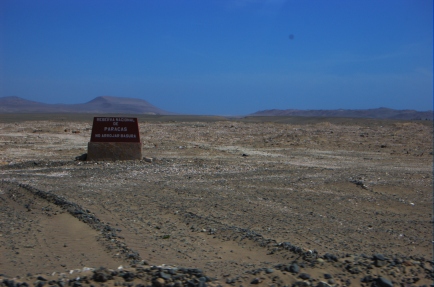
Paracas, which is about four hours’ drive south of Lima, was the site of a major earthquake several years prior and is still in recovery. The hotel that hosted the conference and a few nearby hotels had all been rebuilt from the ground up since the earthquake. The city is on a small bay that is protected from the Pacific. It’s very beautiful—desert sands that go right down to the bay. After a few days at the meeting, I managed to get the antenna set up.
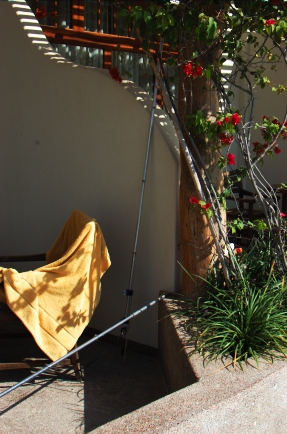
One of the things that surprised me was an excellent JA opening on 20 meters just after sunrise before I went to breakfast and then the meeting. I am pretty sure it was a direct-path opening because the signals did not sound like long path and the long path crosses the southern auroral oval, whereas the direct path does not. (Auroral absorption, by the way, is one reason that the long path can be more effective than the short path.) Any time I called CQ as OA5/K8GU, I was greeted with a roaring pileup. Not bad for an antenna propped up on my veranda. Verticals on the beach rule, and this one wasn’t even really on the beach.
At the request of a friend, I made a special effort to operate on 12-meter CW in the afternoon. The portable antenna would not tune up on 12 meters with the wire radials I had laid out. In a moment of desperation, I assembled some extra pieces of my portable antenna to produce a tuned radial that I clip-leaded to the ground lug as depicted in the photo above. It worked right away and I was quite popular there as well.
A comment about computers—my standard work-issued computer is a MacBook Pro, which although perfect for my work, is essentially useless for amateur radio. I know this will generate a torrent of discussion, but if you are accustomed to real contest/DXpedition logging software available for DOS and Windows, you know that the stuff for the Mac doesn’t cut the mustard. I have logged DX operations on paper (CE/K8GU), or in the case of the OX/K8GU operation, brought along a second computer. However, in a long-delayed flash of insight, I bought and installed VMware Fusion on the Mac in February. It runs Windows XP and TR4W with the WKUSB just brilliantly and with no special configuration. Aside from having to press Fn+F1 to CQ, this was an epic win. KB9UWU tells me that there’s an option in VMware to eliminate this nuisance as well.
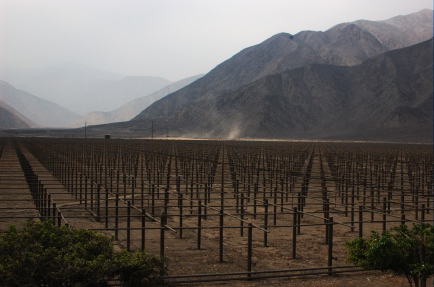
After the meeting in Paracas, we returned to Lima, where we celebrated the 50th anniversary of the Jicamarca Radio Observatory. The cornerstone of the Jicamarca facility is a 49.92-MHz radar that feeds an 18,720-element phased array, pictured above. Jicamarca is one of the most powerful radio transmitters in the world, capable of 4.5 MW output, and is used for a variety of atmospheric, ionospheric, and space science experiments. Like Arecibo, it was originally designed to perform incoherent scatter measurements of the ionospheric electron density profile.
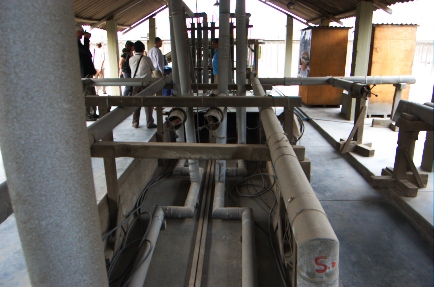
Lots of fire in that wire! Have you ever seen a coaxial cable that’s rated for over a megawatt at 50 MHz? This is the feedpoint of the phased array. There are a few tuned stubs in there, too.
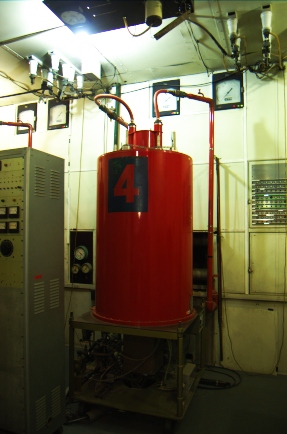
Here’s one of the four 1.5-MW transmitter cavities. A maximum of three are used together. When configured for three transmitters, the driver stage puts out 7 kW! Needless to say, everything is custom made on site. The transmitting tetrodes (8973s, if I recall correctly) are refurbished by the manufacturer as needed.
After Jicamarca, we went to Cusco, which is south and east of Paracas, and much more lush than the deserts around Lima and Paracas.

We spent a lot of time being tourists in Cusco and vicinity and I had some difficulty with my computer so I only made a handful of OA7/K8GU QSOs from Cusco on 17 meters. It is quite remarkable how much better the bands were from the coast. As someone who has operated from W3, W8, W9 and W0, I can attest to that difference as well. I missed my morning JA run…
A final thought—we drove through a lot of towns and communities in OA4, OA5, and OA7, on this trip. Nearly every town, no matter how small, had at least one building with an HF fan dipole on the roof. HF is alive and well in a mountainous country like Peru!
QSL information: If you worked OA5/K8GU or OA7/K8GU, the best way to get a confirmation is through ARRL’s Logbook of the World. I have been responding to direct cards (to my FCC address) with a one-day turn-around lately.
Ethan Miller, K8GU, is a regular contributor to AmateurRadio.com and writes from Maryland, USA. Contact him at [email protected].
WØ-SOTA.ORG
Hello friends,
Many who read my blog posts and have listened to episode 50 of the Practical Amateur Radio Podcast know my involvement with SOTA or Summits On The Air. While I’ve been concentrating on getting my new basement ham shack, podcast studio, home office and just general man-cave finished…I’ve also been helping in a small way spin up a new website for the WØ SOTA organization.
Our official press release which we’ve posted to many of the SOTA reflectors and websites is below. If you live in the WØ region or plan to visit someday, please bookmark the WØ-SOTA.org website.
On behalf of Steve, Matt and Bob. If we can help introduce you to the exciting and addictive world of Summits on the Air, please contact us.
Until next time…
73 de KD0BIK
NEWS FROM WØ-SOTA ASSOCIATION
The WØ-SOTA Association has Named 3-Regional Managers Plus Launched a NEW Website (http://w0-sota.org)
We are pleased to announce the WØ-SOTA Association has 3-New Regional Managers to help promote and encourage WØ-SOTA activities:
- Matt Schnizer/KØMOS Northern CO Region
Activator/Chaser for W0-Association
- Jerry Taylor/KDØBIK Central CO Region
Activator/Chaser and promoter via PARP/podcasts
and host for w0-sota.org website
- Bob Cutter/KIØG Western CO Region
Chaser and active SOTA promoter in Western CO
- Steve Galchutt/wGØAT Southern CO Region plus ND/SD
WØ-SOTA Association Mgr
Our BIG News is the WØ-SOTA Association has launched a new website (http://w0-sota.org). This web portal is primarily targeted at new and/or potential SOTA participants in the WØ area who are seeking Summits on the Air information. It also provides distilled content from other sources for already active SOTA regulars with documents, tools, links plus the latest regional news.
The site’s content is divided up into a welcome Homepage, About SOTA, Get Involved, How to …, SOTA-Tools/Resources, W0-SOTA, Contact and What’s Happening. Plus a dynamic feed of regional SOTA news and SOTAwatch realtime Spots plus links to multimedia photos and videos.
We hope you find w0-sota.org helpful in planning, chasing/activating and reporting your SOTA adventures!
Cheers, Steve & WØ-SOTA Team
PS: Special Thanks to our web grammarian, Chuck/N6UHB, who saved us from looking illiterate on w0-sota.org!
Jerry Taylor, KD0BIK, is a regular contributor to AmateurRadio.com and writes from Colorado, USA. He is the host of the Practical Amateur Radio Podcast. Contact him at [email protected].
 Ham Radio Deluxe |
 W5SWL Electronics |
 Ham Radio Prep |
 KB3IFH QSL Cards  Hip Ham Shirts  HamRadioAuctions HamRadioAuctions Reliance Antennas Reliance Antennas Enigma Shop Enigma Shop |  morseDX  Ni4L Antennas  R&L Electronics R&L Electronics antennas.us antennas.us QRV QRV |
- Matt W1MST, Managing Editor
